
In the fast-paced world of technology, efficiency is the currency of choice. Whether you are scrolling through a GitHub repository, debugging a complex issue on Stack Overflow, or coordinating a sprint on Slack, you have likely encountered a specific type of linguistic shorthand. Among the most prevalent of these is the acronym AFAIK.
While it may seem like a simple string of letters to the uninitiated, AFAIK represents a significant facet of digital culture and technical netiquette. In this article, we will explore the origins of the term, its vital role in the tech industry’s communication paradigms, and how digital shorthand continues to shape the way software developers and IT professionals interact in an increasingly asynchronous world.
1. Decoding the Acronym: Origins and Meaning
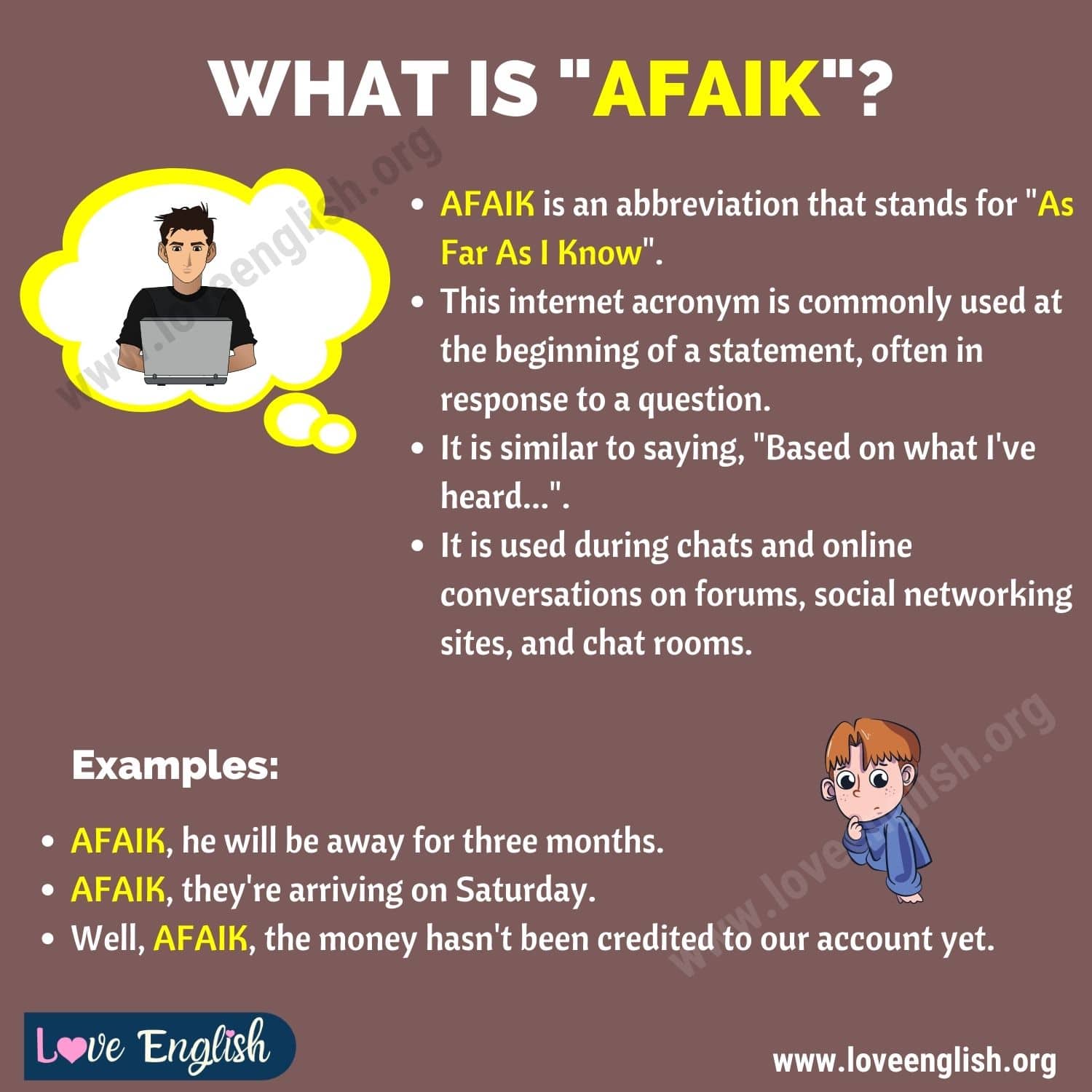
To understand AFAIK, one must first look at the literal translation and the historical context of the early internet. At its simplest level, AFAIK stands for “As Far As I Know.”
The Literal Definition and Function
In any technical discussion, precision is paramount. However, absolute certainty is often elusive in software development, where systems are complex and documentation can become outdated. AFAIK serves as a “hedge.” It allows the speaker to provide information based on their current understanding while simultaneously acknowledging that there may be unknown variables or updates they aren’t aware of. It is a linguistic tool for conveying information with a built-in disclaimer of non-omniscience.
Historical Context: IRC, Usenet, and the Early Web
The roots of AFAIK are deeply embedded in the “old-school” tech culture of the 1980s and 90s. Before the advent of high-speed broadband and sophisticated GUIs, technical communication happened over text-heavy platforms like Usenet, Bulletin Board Systems (BBS), and Internet Relay Chat (IRC).
In these environments, bandwidth was limited, and typing speed was a badge of honor. Users developed a massive library of acronyms to save keystrokes. AFAIK emerged alongside terms like IMHO (In My Humble Opinion) and RTFM (Read The F***ing Manual). These weren’t just shortcuts; they were the building blocks of a new digital dialect that prioritized speed without sacrificing the nuance of the message.
2. Why AFAIK Matters in Software Development and IT
In the modern tech ecosystem, AFAIK is more than just a relic of the IRC days. It has become an essential component of the professional “technical humility” that keeps development teams functioning smoothly.
Hedging and Accuracy in Documentation and Code Reviews
When a senior developer reviews a pull request, they might comment, “AFAIK, this library version doesn’t support the concurrent operations you’re trying to implement.”
This usage is critical. By using AFAIK, the developer is providing a lead for the junior developer to investigate, rather than making a definitive claim that could be proven wrong by a recent update. In the tech world, being “technically correct” is the highest goal, and AFAIK provides a safety net. It encourages collaborative verification rather than top-down dictation. It signals that the information is reliable based on the speaker’s experience but invites the recipient to verify it against the latest documentation.
The Role of Shorthand in Asynchronous Communication
The shift toward remote work and distributed engineering teams has made asynchronous communication (via tools like Jira, Notion, and Slack) the standard. In an “async” environment, long-winded explanations can lead to information fatigue.
Acronyms like AFAIK allow for “high-density” communication. A developer can answer a query in a few seconds while on the move, providing the necessary context without writing a formal paragraph. This velocity is vital for maintaining the flow of a DevOps pipeline or responding to a critical incident in real-time.
3. The Nuances of Tech Netiquette
While AFAIK is widely accepted, its effectiveness depends on the user’s understanding of digital netiquette. In tech, how you say something is often as important as what you are saying.
Distinguishing AFAIK from Similar Terms (IIRC, IMO, and TL;DR)
To communicate effectively in a professional tech environment, one must distinguish between various pieces of shorthand:
- IIRC (If I Recall Correctly): Used when referencing a past event or a specific meeting. It relates to memory rather than current knowledge of a system.
- IMO/IMHO (In My [Humble] Opinion): Used when discussing design choices or architectural preferences where there is no “right” answer, only subjective experience.
- AFAIK: Specifically refers to the state of information or data.

Using the correct acronym demonstrates a level of digital literacy that is highly valued in IT circles. It shows that you understand the difference between a subjective preference and a technical fact.
When to Use (and When to Avoid) Acronyms in Professional Settings
Despite its utility, AFAIK isn’t always appropriate. In high-stakes environments—such as a formal Root Cause Analysis (RCA) report for a major system outage or a legal compliance document—shorthand should be avoided.
In these contexts, ambiguity is the enemy. Professionalism in tech involves knowing when to be brief (Slack) and when to be exhaustive (API documentation). Over-reliance on AFAIK in a client-facing project proposal might make the team seem uncertain or unprofessional. The key is to match the vocabulary to the platform and the audience.
4. The Impact of Digital Shorthand on Modern Collaboration Tools
The technology we use to communicate actually encourages the use of acronyms like AFAIK. As our tools evolve, so does the way we compress language.
Slack, Microsoft Teams, and the Velocity of Information
Modern enterprise chat tools have integrated “shorthand” into their very DNA. Features like “Reactions” (using a thumbs-up emoji instead of typing “I agree”) are the spiritual successors to AFAIK. However, text-based shorthand remains necessary because it carries more specific semantic weight than an emoji can.
In a fast-moving Slack channel, AFAIK acts as a signal flare. It tells the team: “Here is the status as of this moment.” This helps prevent “bottlenecks,” where a team waits for a definitive answer that might not be available yet. It keeps the project moving forward by providing “good enough” information for the current phase of development.
AI-Driven Text Prediction and the Future of Shorthand
We are currently entering an era where Large Language Models (LLMs) and AI coding assistants (like GitHub Copilot) are writing our text for us. Interestingly, these AI tools are being trained on vast repositories of human-written code and comments, which means they are learning to use AFAIK correctly.
As predictive text becomes more sophisticated, we might see a decrease in manual typing of acronyms, but the concept of the acronym remains. Even if an AI expands “afaik” into “As far as I am aware,” the underlying intent—the “hedging” of technical information—remains a fundamental requirement of human-machine and human-human interaction.
5. Best Practices for Integrating Tech Slang in Global Teams
The tech industry is global, spanning continents and languages. This adds a layer of complexity to the use of English-based shorthand like AFAIK.
Bridging the Gap for Non-Native English Speakers
For teams with members who speak English as a second language (ESL), acronyms can sometimes be a barrier rather than a bridge. A developer in Tokyo or Berlin might be perfectly fluent in Python or C++, but they might not be familiar with the nuances of American-centric internet slang.
In global tech organizations, it is a best practice to use shorthand judiciously. While AFAIK is nearly universal in the dev world, lead developers should ensure that the team’s internal communication is inclusive. If a team member seems confused by shorthand, it is better to pivot to full sentences to ensure technical alignment.
Documenting Internal Lexicons
Forward-thinking tech companies often include a “Glossary of Terms” or a “Culture Handbook” in their onboarding documentation. This isn’t just for industry terms like “Kubernetes” or “Microservices,” but also for communication norms.
Including common acronyms like AFAIK, LGTM (Looks Good To Me), and WIP (Work In Progress) in an onboarding wiki helps new hires—especially those new to the industry—acclimate quickly. It reduces the “imposter syndrome” that often comes with not knowing the local dialect of a highly technical field.

Conclusion
AFAIK is more than just a four-letter shortcut; it is a testament to the evolution of technical communication. It represents a balance between the need for speed and the necessity of accuracy. By using AFAIK, tech professionals signal their expertise while acknowledging the ever-changing nature of the digital landscape.
As we continue to develop new ways to collaborate—through AI, virtual reality workspaces, and more—the spirit of AFAIK will remain. It is a reminder that in the world of technology, our knowledge is always evolving, and the way we share that knowledge must be as efficient and adaptable as the code we write. Whether you are an experienced CTO or a student writing your first “Hello World,” mastering this digital lexicon is a vital step in becoming a truly effective member of the global tech community.
aViewFromTheCave is a participant in the Amazon Services LLC Associates Program, an affiliate advertising program designed to provide a means for sites to earn advertising fees by advertising and linking to Amazon.com. Amazon, the Amazon logo, AmazonSupply, and the AmazonSupply logo are trademarks of Amazon.com, Inc. or its affiliates. As an Amazon Associate we earn affiliate commissions from qualifying purchases.