
In the landscape of business finance, the purchase order (PO) stands as one of the most critical documents for maintaining fiscal discipline and operational transparency. For entrepreneurs, finance managers, and procurement specialists, understanding what a purchase order looks like is more than just a matter of visual recognition—it is about understanding the architecture of a legally binding financial commitment. A well-structured purchase order serves as a safeguard for cash flow, an essential tool for internal audits, and a roadmap for accounts payable departments.
While a purchase order might appear to be a simple list of items, it is actually a sophisticated financial instrument. It outlines the specific expectations of a buyer, protecting the business from unauthorized spending and providing the seller with a guarantee of payment upon fulfillment. In this guide, we will dissect the anatomy of a purchase order, explore its role in corporate financial health, and examine how standardized documentation streamlines the path from procurement to payment.

The Anatomy of a Purchase Order: Essential Fields and Layout
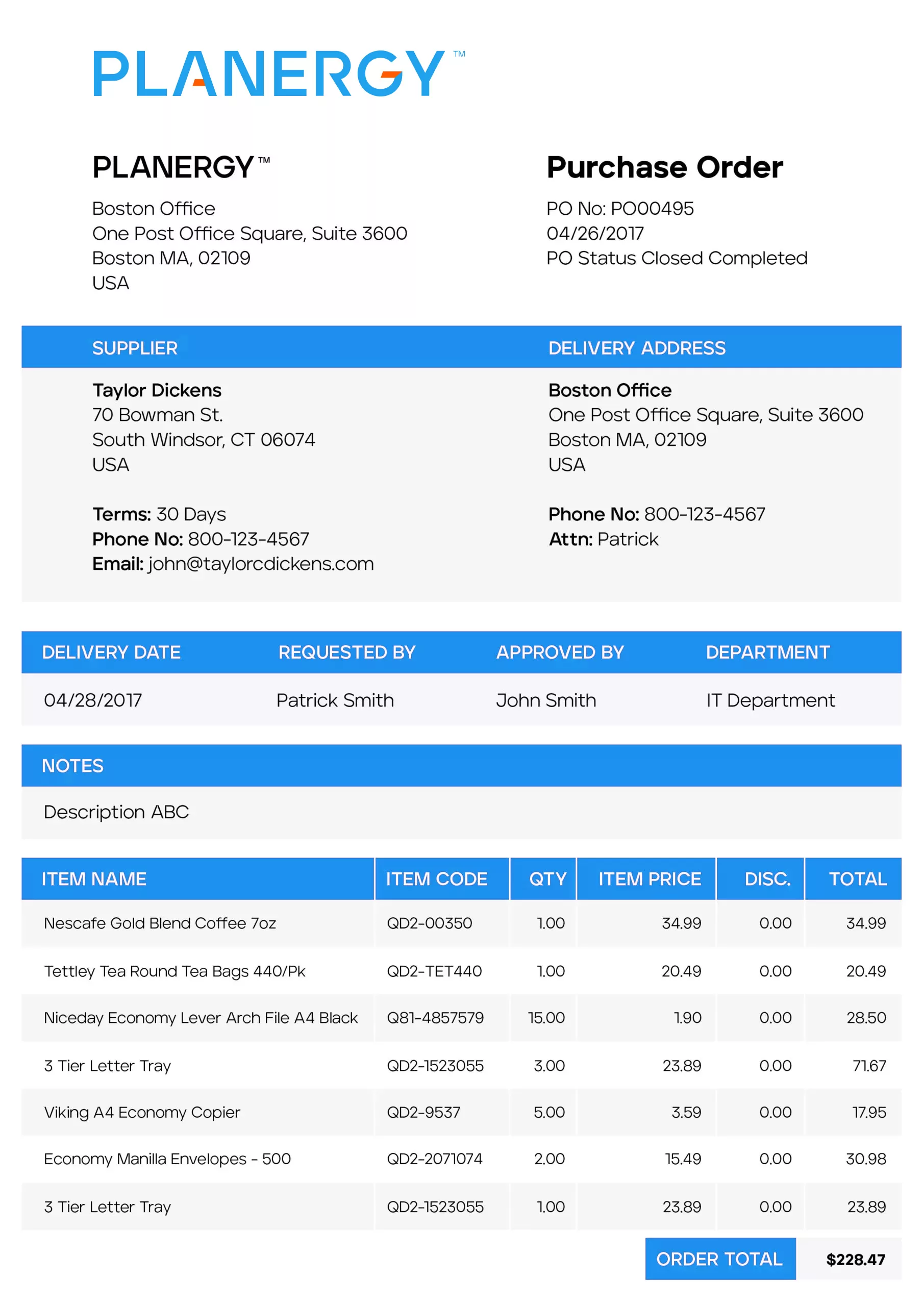
To understand what a purchase order looks like, one must view it as a data-driven document designed for clarity. Regardless of whether it is generated by a modern accounting suite or a manual template, the layout remains largely standardized across industries to ensure that both the buyer’s and the seller’s financial systems can process the information accurately.
Header Information and Vendor Details
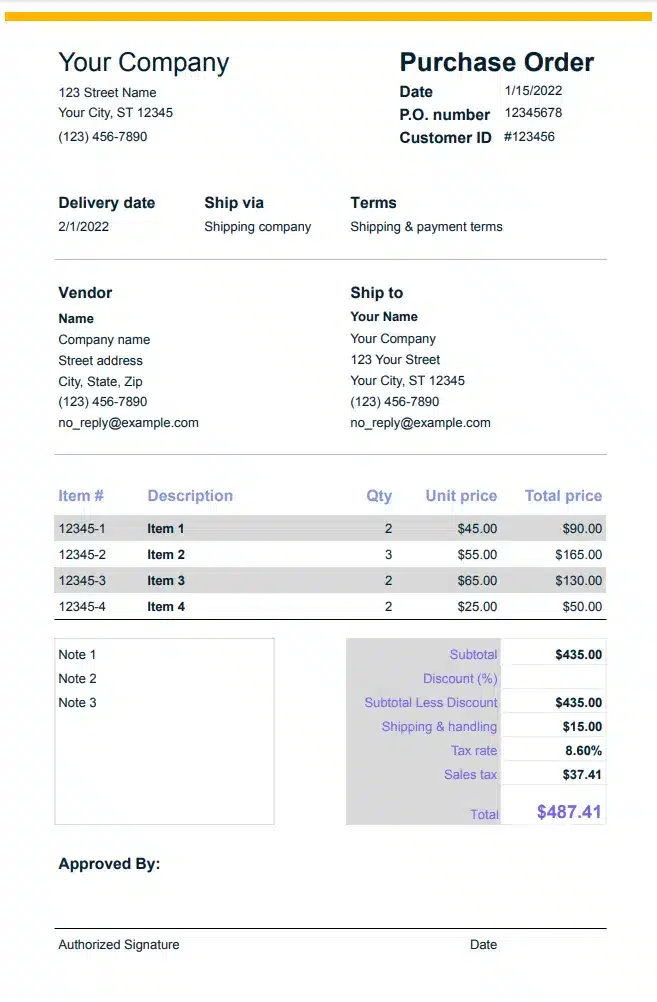
The top section of a purchase order acts as the identification layer. It must clearly state “Purchase Order” at the top to distinguish it from quotes or invoices. The most prominent feature here is the PO Number. This unique alphanumeric code is the “DNA” of the transaction, used to track the order through its entire lifecycle, from issuance to final reconciliation.
Below the header, you will find two distinct address blocks: the “Bill To” and “Ship To” sections. In business finance, these are rarely identical. The “Ship To” address identifies the warehouse or office receiving the physical goods, while the “Bill To” address is directed to the finance department responsible for processing the payment. Adjacent to these is the Vendor Information, which includes the seller’s legal business name, address, and contact details. This ensures that the financial obligation is tied to the correct legal entity.
Line Items, Quantities, and Pricing
The “body” of the purchase order is typically a grid-style table. This is where the financial specifics are laid out in granular detail. Each row, or “line item,” represents a specific product or service being procured. Professional purchase orders include several columns:
- SKU or Part Number: To ensure there is no ambiguity about the product.
- Description: A clear, brief explanation of the item.
- Quantity: The exact number of units being ordered.
- Unit Price: The negotiated cost per item.
- Line Total: The unit price multiplied by the quantity.
At the bottom of this grid, the document summarizes the financial commitment. It displays the Subtotal, any applicable Sales Tax or VAT, and finally, the Grand Total. This total represents the amount that the finance department has authorized for “encumbrance,” meaning those funds are now earmarked and cannot be spent elsewhere.
Terms, Conditions, and Authorization
The footer of the purchase order contains the “fine print” that governs the financial contract. This includes the Payment Terms (e.g., Net 30, Net 60), which dictate when the cash must actually leave the company’s bank account. It also includes the expected delivery date and shipping method (FOB points), which are vital for inventory valuation and insurance purposes.
Crucially, a valid purchase order must feature an Authorized Signature. In a professional financial environment, this signature—whether digital or physical—proves that the purchase has passed through the necessary internal approval channels.
The Role of Purchase Orders in Business Finance and Cash Flow
Beyond its physical appearance, a purchase order is a cornerstone of “Spend Management.” It is the first line of defense in protecting a company’s bottom line. By formalizing what a purchase looks like before it happens, a company can prevent “maverick spending”—unauthorized purchases made by employees that can lead to budget overruns.
Budgetary Control and Spend Tracking
When a purchase order is issued, it provides the finance team with a “forward-looking” view of liabilities. Unlike an invoice, which tells you what you owe for something already received, a purchase order tells you what you will owe in the future. This allows for more accurate cash flow forecasting.
For instance, if a CFO looks at the total value of all “Open POs,” they can anticipate the cash outflows for the next 30 to 60 days. This visibility is essential for managing working capital. Without the formal structure of a PO, a business is essentially flying blind, reacting to invoices as they arrive rather than proactively managing their financial commitments.
Streamlining Accounts Payable
A purchase order is a key component of the “Three-Way Match,” a gold standard in financial auditing. To ensure a payment is legitimate, the accounts payable (AP) department compares three documents:
- The Purchase Order: What was ordered and at what price?
- The Receiving Report: What was actually delivered to the warehouse?
- The Vendor Invoice: What is the vendor asking to be paid?
If the PO “looks” right and matches the other two documents, the payment is authorized. This process prevents fraud, overcharging, and duplicate payments. By standardizing the look and content of the PO, businesses can automate this matching process, drastically reducing the administrative cost of processing payments.
Digital Evolution: The Modern Interface of Procurement
While the fundamental data fields of a purchase order have remained consistent for decades, the medium has shifted. The “look” of a purchase order today is often a digital interface within an Enterprise Resource Planning (ERP) system rather than a carbon-copy paper form.
Cloud-Based Financial Systems
In modern business finance, a purchase order often looks like a series of validated data fields within a software dashboard. When an employee creates a “Purchase Requisition,” the software automatically checks the remaining budget for that department. If the funds are available, the requisition is converted into a PO.
The digital PO is often delivered to the vendor as a secure PDF or via an Electronic Data Interchange (EDI). This digital format allows for real-time updates. For example, if a vendor can only fulfill half of an order, the digital PO can reflect a “Partial Receipt” status, providing the finance department with instant updates on inventory value and outstanding liabilities.
The Audit Trail and Compliance
For many businesses, the “look” of a purchase order is defined by its ability to satisfy an auditor. An auditor looks for a “paper trail” that links a cash outflow to a business necessity. A digital purchase order system keeps a timestamped log of who created the order, who approved it, and when the terms were modified. This level of transparency is vital for tax compliance and for companies seeking to maintain high standards of corporate governance.
Best Practices for Implementing Purchase Orders in Business Finance
Implementing a purchase order system is one of the most effective ways to professionalize a business’s financial operations. However, for the system to work, the PO must be used consistently and correctly.
Standardizing Your Financial Documentation
To maintain professional integrity, every purchase order issued by a company should have a consistent visual identity. This means using the same font, layout, and branding. While this may seem like a “Brand” concern, in a “Money” context, it is about credibility. A vendor is more likely to offer favorable credit terms to a company that issues professional, standardized financial documents. It signals that the company has mature internal controls and is likely to be a reliable payer.
Avoiding Common Procurement Errors
What a purchase order shouldn’t look like is just as important as what it should. Common mistakes include:
- Vague Descriptions: Writing “Supplies” instead of “10x Reams of A4 80gsm Paper” leads to disputes and financial waste.
- Missing Prices: Issuing a PO without a set price gives the vendor “blank check” power, which is a significant financial risk.
- Post-Dated POs: Creating a PO after the invoice has already arrived (often called “Retroactive POs”) defeats the purpose of spend control and is a red flag for auditors.
Conclusion: The PO as a Financial Foundation
In conclusion, what a purchase order looks like is a reflection of a company’s financial health and organizational discipline. It is a document that bridges the gap between a business need and a financial transaction. By including clear vendor data, detailed line items, and firm payment terms, the purchase order provides the clarity required to manage cash flow and maintain a clean audit trail.
For any business looking to scale, moving away from informal “handshake” agreements and toward a standardized purchase order system is a non-negotiable step. It transforms procurement from a chaotic administrative task into a strategic financial function, ensuring that every dollar spent is tracked, authorized, and accounted for. Whether it is a simple one-page document or a complex entry in a cloud-based ERP, the purchase order remains the most vital tool in the kit of modern business finance.
aViewFromTheCave is a participant in the Amazon Services LLC Associates Program, an affiliate advertising program designed to provide a means for sites to earn advertising fees by advertising and linking to Amazon.com. Amazon, the Amazon logo, AmazonSupply, and the AmazonSupply logo are trademarks of Amazon.com, Inc. or its affiliates. As an Amazon Associate we earn affiliate commissions from qualifying purchases.