
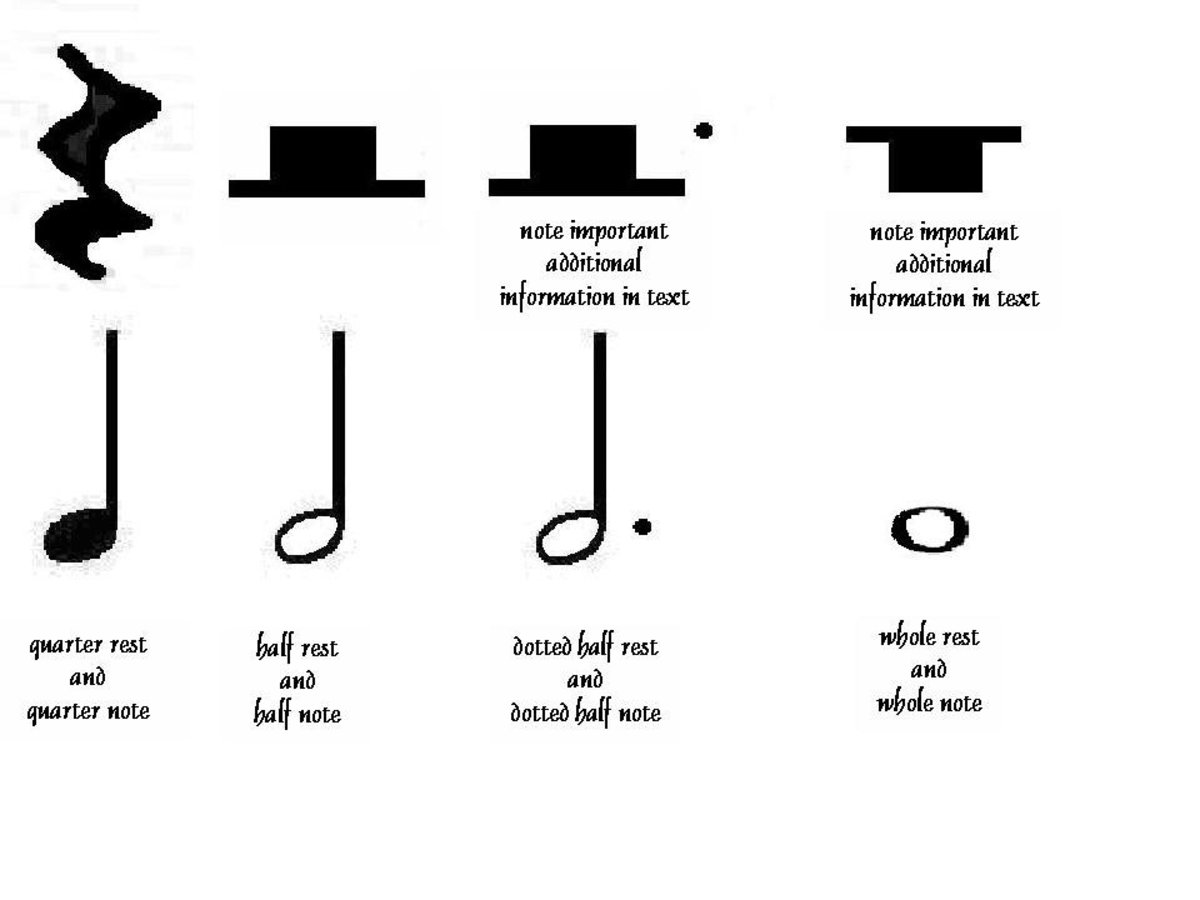
In the traditional sense, a half note—or minim—is a fundamental unit of musical notation represented by a hollow oval note head and a straight stem. However, as we transition deeper into the digital era, the question “what does a half note look like” transcends ink and parchment. In the realm of music technology, software engineering, and digital design, the half note has been reimagined as a data point, a vector graphic, and a structural element in complex algorithms.
Understanding the visual and technical representation of musical symbols is no longer just for composers; it is a critical intersection for software developers, UI/UX designers, and AI researchers. This exploration delves into how technology interprets, renders, and utilizes the half note across modern platforms.

The Digital Anatomy: Encoding Musical Symbols in Software
When a musician looks at a half note, they see a temporal instruction. When a software program “looks” at a half note, it sees a series of coordinates and boolean values. The digital anatomy of the half note is the foundation upon which all modern notation software is built.
Vector Graphics and High-Definition Rendering
In modern music notation software like Dorico or Sibelius, a half note is not a static image file (like a JPEG). Instead, it is rendered using Scalable Vector Graphics (SVG) or specialized music fonts like Bravura. These fonts are governed by the Standard Music Font Layout (SMuFL), an industry standard that ensures musical symbols look consistent across different tech platforms.
A half note’s “look” in this context is defined by mathematical curves. The hollow note head is a precise ellipse, and the stem is a line of a specific thickness (usually measured in “spaces” relative to the staff). Because these are vector-based, they can be scaled to any size—from a tiny mobile screen to a massive conductor’s display—without losing clarity. This high-definition rendering is essential for professional digital publishing.
The MIDI Equivalent: Duration and Velocity Data
Beyond the visual representation on a screen, the tech-centric view of a half note involves its MIDI (Musical Instrument Digital Interface) profile. In a Digital Audio Workstation (DAW) like Ableton Live or Logic Pro, a half note doesn’t look like an oval with a stem; it looks like a horizontal bar in a “Piano Roll” editor.
In this environment, the “look” of a half note is defined by its length on a grid. If the project is set to a 4/4 time signature, the half note occupies exactly two beats. Its visual identity is stripped of its classical aesthetic and replaced by a color-coded rectangle. The tech behind this involves “Note On” and “Note Off” messages sent to a synthesizer, where the duration between these two messages defines the note’s identity as a “half.”
Top Software Tools for Visualizing and Creating Music Theory
The evolution of music technology has led to a variety of tools that help both beginners and professionals visualize what a half note—and its surrounding theory—looks like in practice. These tools range from heavy-duty desktop applications to agile, web-based platforms.
Professional Suites: Sibelius, Finale, and Dorico
For decades, the “Big Three” of music notation have defined the aesthetic standards of digital sheet music. These programs use sophisticated layout engines to handle “collision avoidance”—the tech that prevents a half note’s stem from overlapping with lyrics or other symbols.
Dorico, the newest of the major players, uses a highly intelligent engine that treats music as a continuous flow rather than a series of fixed pages. In Dorico, a half note’s look is dynamic; if you change the meter, the software may instantly re-render that half note as two tied quarter notes to maintain rhythmic clarity. This level of automated visual intelligence represents the pinnacle of current notation technology.
Open-Source and Web-Based Alternatives
MuseScore and Noteflight have revolutionized the accessibility of music theory. MuseScore, an open-source powerhouse, allows developers to look under the hood at how musical symbols are coded. Its transition to a more professional UI in recent years has made it a favorite for those who want professional-looking half notes without the high licensing fees of proprietary software.
Web-based tools like Noteflight and Flat.io utilize JavaScript libraries (such as VexFlow) to render musical notation directly in the browser. These tools are critical for the “EdTech” sector, allowing students to see what a half note looks like and hear its playback instantly, bridging the gap between visual symbol and auditory result through Web Audio API.

AI and Optical Music Recognition (OMR): How Computers “See” the Half Note
One of the most exciting frontiers in music tech is Optical Music Recognition (OMR). This is the process of using Artificial Intelligence to scan physical sheet music and convert it into editable digital formats (like MusicXML).
The Complexity of Pattern Recognition in Sheet Music
For a computer, identifying a half note is significantly more difficult than identifying text. A half note must be distinguished from a quarter note based solely on the “whiteness” of the center of the note head. If the scan is low-quality or the ink is faded, the AI must use context to “guess” the note’s identity.
Machine learning models are trained on thousands of scores to recognize the specific geometry of a half note. These models look for the hollow oval and the vertical line. If the AI sees a hollow head but no stem, it identifies it as a whole note. If it sees a filled head, it identifies a quarter note. This pattern recognition is the same technology used in autonomous vehicles and facial recognition, applied to the niche but complex world of musicology.
From Paper to DAW: Automating the Transcription Process
Modern apps like PlayScore 2 or ScanScore allow users to snap a photo of a page of music and immediately hear it performed by a MIDI synthesizer. The tech pipeline here is fascinating:
- Image Pre-processing: Removing noise and leveling the staff lines.
- Object Detection: Locating every half note and eighth note on the page.
- Semantic Analysis: Understanding that a half note on the third line of a treble clef staff is a “B.”
- Data Conversion: Exporting that visual information into a digital format that a computer can play back.
User Experience (UX) Design in Music Applications
As music production moves more toward mobile and touch-screen interfaces, the “look” of musical symbols must adapt to the constraints of modern hardware. UX design plays a massive role in how we interact with a half note on a screen.
Skeuomorphism vs. Flat Design in Music Symbols
Early music software often used “skeuomorphism”—designing digital symbols to look exactly like their physical counterparts, complete with ink-bleed effects and parchment backgrounds. However, modern tech trends favor “Flat Design.”
In many mobile apps used for quick composing, the half note has been simplified. It retains its essential “hollow head and stem” look, but the lines are crisper, and the symbols are often larger to accommodate “fat-finger” interactions on tablets. The UX challenge is maintaining the integrity of 500 years of musical tradition while ensuring the symbols are legible on a 6-inch smartphone screen.
Accessibility and High-Contrast Notation for Modern Interfaces
Tech-driven notation is also making music more accessible. For visually impaired musicians, software can now render “Big Note” versions where the half note is scaled up significantly, or even translated into Braille Music code.
Furthermore, “Dark Mode” in DAWs and notation apps has changed the literal look of the half note. Instead of a black symbol on white paper, it becomes a glowing white or neon-green symbol on a dark grey background. This is not just an aesthetic choice; it reduces eye strain for producers working long hours in studio environments, demonstrating how tech prioritizes the user’s physical well-being.
The Future: Augmented Reality and the Virtual Half Note
As we look toward the future of technology, the representation of music is moving into 3D space. With the rise of Augmented Reality (AR) and Virtual Reality (VR), what a half note “looks like” is poised for another transformation.
In AR applications designed for learning piano, a half note might appear as a floating, translucent 3D object that “drops” onto the correct key of a physical piano at the precise moment it needs to be played. In this tech ecosystem, the half note is no longer a 2D symbol on a page but a temporal-spatial guide in a three-dimensional environment.
The transition from ink to pixels, and now to voxels, shows that the half note is more than just a musical instruction—it is a piece of data that continues to evolve alongside our most advanced technological innovations. Whether it is rendered as a vector on a high-res display or identified by a neural network in an OMR scan, the half note remains a cornerstone of how we bridge the gap between human creativity and digital precision.
aViewFromTheCave is a participant in the Amazon Services LLC Associates Program, an affiliate advertising program designed to provide a means for sites to earn advertising fees by advertising and linking to Amazon.com. Amazon, the Amazon logo, AmazonSupply, and the AmazonSupply logo are trademarks of Amazon.com, Inc. or its affiliates. As an Amazon Associate we earn affiliate commissions from qualifying purchases.