
While the colon (:) might be a familiar punctuation mark in everyday language, its meaning in the realm of mathematics is far more specific and can significantly impact calculations, understanding, and even the way we communicate technical information. For professionals navigating the dynamic worlds of tech, brand strategy, and finance, a clear grasp of mathematical notation is not just academic; it’s a crucial tool for effective problem-solving, clear communication, and smart decision-making. This article will demystify the colon’s mathematical roles, exploring its use in ratios, proportions, and other contexts relevant to these diverse fields.
The Colon: More Than Just a Punctuation Mark
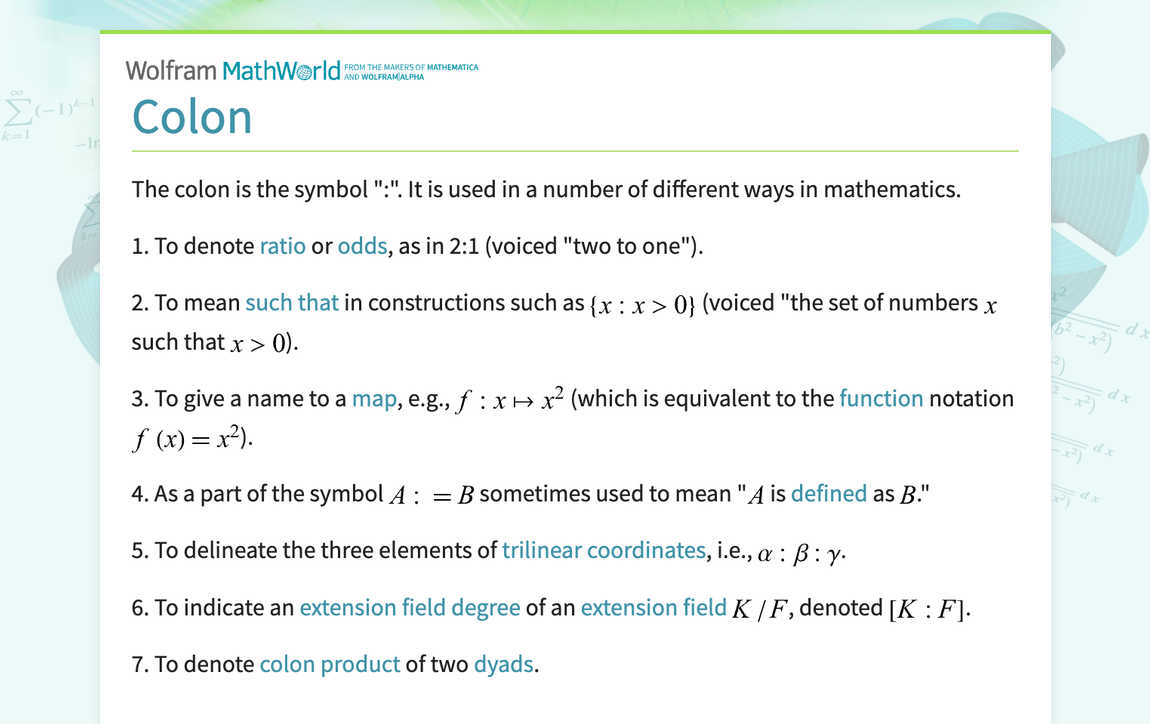
In English, a colon often introduces a list, an explanation, or a quotation. In mathematics, however, its function is primarily to denote a ratio. A ratio is a comparison of two or more quantities. Think of it as expressing how much of one thing there is compared to another. The colon acts as the separator, indicating this comparative relationship.
For instance, if you have a recipe that calls for 2 cups of flour and 1 cup of sugar, the ratio of flour to sugar is written as 2:1. This means for every 2 parts of flour, there is 1 part of sugar. This simple notation is fundamental to understanding many mathematical concepts and has far-reaching applications.
From Recipes to Ratios: Understanding the Foundation
The concept of ratios is deeply ingrained in everyday life, even if we don’t always explicitly use the colon notation.
- Cooking and Baking: As the flour-to-sugar example illustrates, recipes are built on precise ratios. A deviation can significantly alter the outcome of your culinary creation.
- Scaling and Proportions: When you’re scaling a design for a website, adjusting the dimensions of a graphic for different devices, or planning a marketing campaign budget, you’re often working with proportions. The ratio between elements remains constant, even as the overall size or quantity changes.
- Financial Planning: In personal finance and investing, ratios are essential for understanding financial health. Debt-to-income ratios, price-to-earnings ratios for stocks, and asset allocation percentages are all expressed using the principles of ratios.
The colon’s primary role as a ratio separator is the most prevalent and foundational meaning in mathematics. However, its application extends beyond this basic definition, touching upon more complex mathematical ideas.
Beyond Simple Comparison: Proportions and Beyond
While the colon directly signifies a ratio, it also plays a critical role in defining and working with proportions. A proportion is essentially a statement that two ratios are equal. For example, if the ratio of apples to oranges is 2:1, and you observe another fruit basket with 4 apples and 2 oranges, you can express this as:
2:1 = 4:2
Here, the equal sign signifies that the two ratios are equivalent. This concept of proportion is vital in many areas:
The Power of Proportions in Tech and Design
In the tech world, proportions are everywhere, impacting everything from user interface (UI) design to software architecture.
- Responsive Design: Ensuring a website or app looks good and functions well on a multitude of screen sizes (desktops, tablets, smartphones) relies heavily on maintaining consistent proportions. Elements are scaled proportionally to fit different displays, using the principles of ratios and proportions to ensure a seamless user experience.
- Graphics and Image Scaling: When resizing images or graphics, developers and designers maintain aspect ratios to prevent distortion. A 16:9 aspect ratio, for instance, indicates the proportional relationship between the width and height of a screen or image. Using the colon here is a direct visual cue to this mathematical relationship.
- Algorithmic Design: In areas like artificial intelligence (AI) and machine learning, algorithms often process data based on proportional relationships. Feature scaling, for example, ensures that different features in a dataset are on a similar scale, often by adjusting them proportionally to avoid one feature dominating the analysis due to its magnitude.
- Network Bandwidth and Data Transfer: Understanding the ratio of data being sent versus received, or the proportion of bandwidth utilized, is crucial for network management and optimization.
Proportions in Branding and Marketing

The principles of proportion are equally fundamental in building and communicating a brand.
- Logo Design: The visual harmony of a logo often depends on the proportional relationships between its elements. Designers meticulously consider the width and height of text, the spacing between letters, and the size of graphical elements to create a balanced and aesthetically pleasing mark. The aspect ratio of a logo is a direct application of proportional thinking.
- Marketing Collateral: Whether it’s a brochure, a billboard, or a social media ad, maintaining consistent visual proportions across all marketing materials reinforces brand identity. This ensures a cohesive and professional appearance, building trust and recognition.
- Brand Messaging: While less direct, even the messaging can relate to proportions. For example, a brand might highlight a “2:1 customer satisfaction to complaint ratio” in its marketing, using the colon to convey this specific metric clearly and concisely. This appeals to consumers who appreciate transparency and data-driven claims.
- Pricing Strategies: In business finance, pricing often involves understanding the proportion of cost to profit, or the ratio of perceived value to price. This informs how products are positioned in the market.
Proportions in Personal Finance and Investing
The financial world is saturated with ratios and proportions, making them indispensable for understanding financial well-being and making informed investment decisions.
- Financial Ratios: These are the backbone of financial analysis. Examples include:
- Current Ratio (Current Assets : Current Liabilities): Indicates a company’s ability to meet its short-term obligations.
- Debt-to-Equity Ratio (Total Debt : Total Shareholder Equity): Measures how much debt a company is using to finance its assets relative to the value of shareholders’ equity.
- Price-to-Earnings Ratio (Stock Price : Earnings Per Share): A valuation metric used to compare the price of a company’s stock to its earnings.
In all these cases, the colon clearly denotes the comparison between two key financial figures.
- Asset Allocation: Investors use ratios to determine how to divide their investments among different asset classes (stocks, bonds, real estate, etc.). A target asset allocation might be 60% stocks and 40% bonds, clearly expressed as 60:40. This proportion aims to balance risk and return based on individual financial goals and risk tolerance.
- Budgeting and Income Management: Personal budgets often involve proportions. For example, the “50/30/20 rule” suggests allocating 50% of income to needs, 30% to wants, and 20% to savings and debt repayment. This is a direct application of proportional thinking to personal finance.
Other Mathematical Uses of the Colon
While the ratio is its most common mathematical meaning, the colon can appear in other contexts, though less frequently encountered in general discourse:
Sets and Subsets
In set theory, a colon can sometimes be used to denote a subset. For example, if set A contains elements that are also in set B, you might see it written as A: B, implying that A is a subset of B. However, the more common notation for this is the “subset” symbol ($subseteq$).
Mathematical Expressions and Definitions
Occasionally, especially in older texts or specific academic contexts, a colon might be used to introduce a definition or to separate a variable or expression from its definition or meaning. For instance, one might encounter:
x: a variable representing the unknown quantity
However, in modern mathematical writing, this is often replaced by clearer phrasing or more standard notation.

The Clarity of the Colon: Bridging Disciplines
The colon, in its primary mathematical role of denoting a ratio, is a powerful symbol for comparison. Its understanding is not confined to mathematicians but is essential for professionals across various fields.
- In Tech: It underpins how we design interfaces, scale applications, and manage data efficiently.
- In Branding: It guides the creation of visually appealing and consistent brand identities and informs marketing strategies.
- In Money: It is the language of financial analysis, investment strategy, and sound personal finance management.
By understanding what a colon means in math, we gain a clearer lens through which to interpret data, make informed decisions, and communicate complex ideas with precision. Whether you’re debugging code, designing a logo, or analyzing your investment portfolio, the humble colon plays a vital, albeit sometimes understated, role. Mastering its mathematical meaning is an investment in clarity and effectiveness, empowering you to navigate the quantitative aspects of your professional life with greater confidence.
aViewFromTheCave is a participant in the Amazon Services LLC Associates Program, an affiliate advertising program designed to provide a means for sites to earn advertising fees by advertising and linking to Amazon.com. Amazon, the Amazon logo, AmazonSupply, and the AmazonSupply logo are trademarks of Amazon.com, Inc. or its affiliates. As an Amazon Associate we earn affiliate commissions from qualifying purchases.