
The term “85th percentile” frequently surfaces in discussions across various domains, from educational assessments and health statistics to performance metrics in technology and business. Understanding its meaning is crucial for interpreting data accurately, making informed decisions, and benchmarking progress. At its core, the 85th percentile signifies a point in a dataset below which a certain percentage of observations fall. However, its implications and applications extend far beyond this simple definition, particularly within the realm of business and finance, where it plays a pivotal role in strategic planning, risk assessment, and performance optimization.
Deconstructing the Percentile Concept
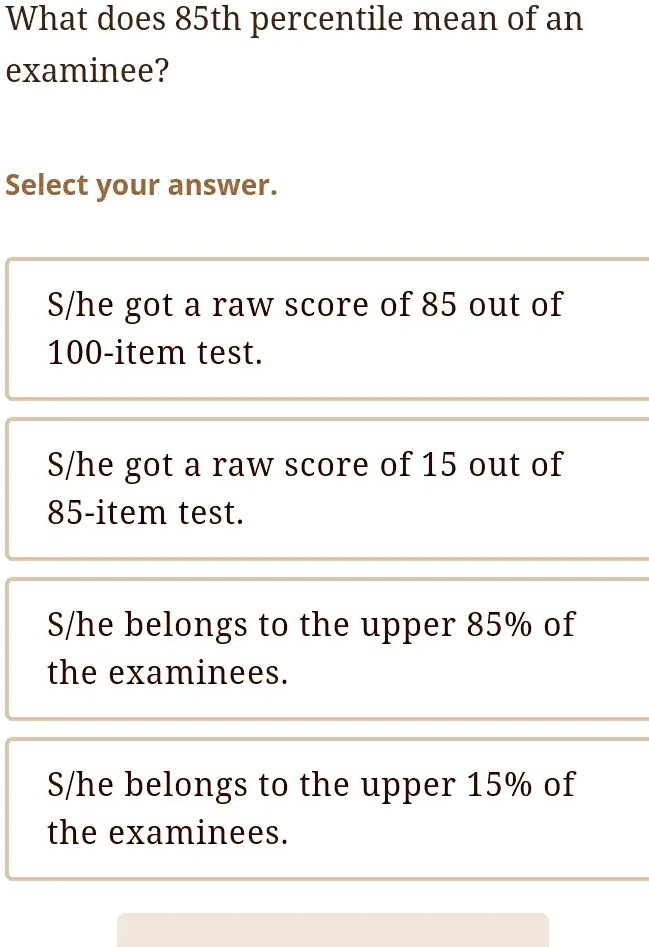
Before diving into the specifics of the 85th percentile, it’s essential to grasp the fundamental concept of percentiles. A percentile is a measure used in statistics indicating the value below which a given percentage of observations in a group of observations falls. For example, if a student scores in the 75th percentile on a standardized test, it means that their score is higher than 75% of all other test-takers. Conversely, it also means that 25% of test-takers scored higher than them. Percentiles are particularly useful for comparing individual data points to a larger distribution, offering a relative rather than absolute measure of performance or standing.
The Mathematical Foundation
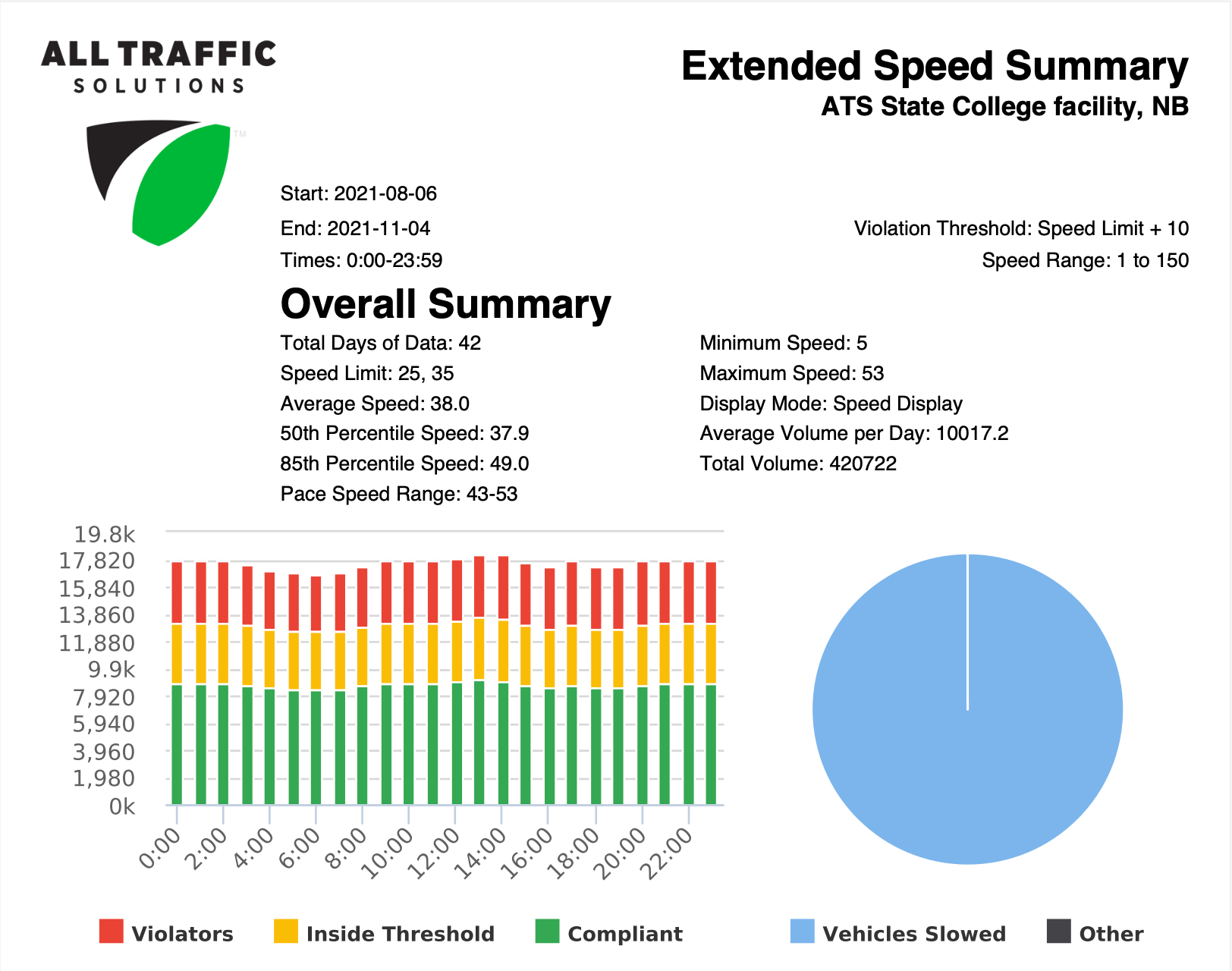
Mathematically, a percentile is calculated by ordering a dataset from smallest to largest. The percentile rank of a score is the percentage of scores in its frequency distribution that are equal to or lower than it. For instance, to find the 85th percentile, one would identify the value in the ordered dataset such that 85% of the data points are less than or equal to this value. This involves techniques like linear interpolation, especially when the exact position falls between two data points. While the calculation can seem complex, the concept is intuitive: it’s about dividing the data into 100 equal parts and identifying where a specific point lies within that division.
Distinguishing Percentiles from Percentages
It is crucial to differentiate percentiles from percentages. A percentage represents a part of a whole, expressed as a fraction of 100. For example, a 50% increase means the value has doubled. A percentile, however, indicates a position within a distribution. A score in the 90th percentile does not mean you scored 90% on a test; it means you scored better than 90% of the people who took the test. This distinction is vital when interpreting performance metrics, as conflating the two can lead to significant misinterpretations of one’s standing relative to a group.
The Strategic Significance of the 85th Percentile in Business Finance
The 85th percentile holds particular importance in business finance for several key reasons. It often serves as a benchmark for operational efficiency, cost management, and service level agreements. By focusing on the 85th percentile, businesses aim to strike a balance between providing excellent service or achieving high performance and managing resources effectively.
Optimizing Operational Efficiency and Cost Management
In the realm of operational efficiency, the 85th percentile is frequently used to set targets for processes like order fulfillment, production lead times, or customer service response times. For instance, a company might aim for its order fulfillment to be completed within the 85th percentile of its historical data. This means that 85% of all orders are processed and shipped within a certain timeframe. By setting this target, the company acknowledges that occasional delays might occur (the remaining 15% of orders), but it strives for a high level of consistent performance. This approach is more realistic and cost-effective than aiming for the 100th percentile, which might require excessive resources and staff to handle every single extreme case, potentially leading to overstaffing or unnecessary capital investment.
Similarly, in cost management, understanding the 85th percentile of expenses for a particular category can inform budgeting decisions. If the 85th percentile of a supplier’s invoices is $1,000, it suggests that most invoices are at or below this amount. This information can be used to negotiate better terms with suppliers or to set internal spending limits, ensuring that the majority of transactions remain within an acceptable range while allowing for some variability. This data-driven approach helps in creating more accurate financial forecasts and preventing budget overruns.
Benchmarking Service Level Agreements (SLAs)
Service Level Agreements (SLAs) are critical in business-to-business relationships, defining the expected level of service between a provider and a client. The 85th percentile is a common choice for setting performance targets within SLAs, especially for metrics related to response times or uptime. For example, an IT service provider might guarantee that 85% of critical support tickets will be responded to within 15 minutes. This ensures that the client can rely on prompt support for the vast majority of issues, while also giving the service provider some operational flexibility to handle exceptions or unforeseen circumstances that might extend response times for a small percentage of tickets.

This approach provides a robust framework for accountability. If the service provider consistently fails to meet the 85th percentile target, it indicates a systemic issue that needs to be addressed. Conversely, consistently exceeding the target might indicate that the SLA is too conservative and could potentially be renegotiated to reflect more efficient operations. The 85th percentile in SLAs offers a fair and measurable standard that benefits both parties by ensuring service quality without imposing unattainable perfection.
Applications of the 85th Percentile in Financial Performance and Risk Management
Beyond operational targets, the 85th percentile is a powerful tool for analyzing financial performance and managing risk. It allows businesses to gain a more nuanced understanding of their financial landscape and to make more strategic decisions to protect and grow their assets.
Evaluating Investment Performance and Risk
In investment management, the 85th percentile can be used to evaluate the performance of investment portfolios or individual assets. For instance, a fund manager might compare their fund’s annual return to the 85th percentile of all similar funds. If the fund is in the 85th percentile, it signifies strong performance relative to its peers, outperforming 85% of comparable investments. This metric is valuable for investors looking to identify top-performing assets and for managers seeking to demonstrate the success of their strategies.
Furthermore, the 85th percentile is crucial in risk management, particularly when assessing potential losses. Value at Risk (VaR) calculations often utilize percentiles. For example, a 95% VaR of $1 million means there is a 95% probability that the maximum loss over a specific period will not exceed $1 million. This implies that there is a 5% chance of experiencing losses greater than $1 million. In this context, understanding the 85th percentile of potential losses can help businesses establish adequate capital reserves or implement hedging strategies to mitigate the impact of less frequent but more severe negative events. It provides a clear understanding of the “tail risk” – the possibility of extreme outcomes – and informs decisions about how much risk is acceptable.
Setting Financial Targets and Forecasting
For financial targets and forecasting, the 85th percentile offers a more realistic and data-driven approach than simply aiming for averages. When forecasting revenue, for example, a business might consider the 85th percentile of sales figures from previous periods or from similar businesses. This helps to set ambitious yet achievable sales targets, acknowledging that actual sales will fluctuate. It avoids setting targets based solely on the average, which might be skewed by outliers, or the absolute best performance, which may be unsustainable.
In budgeting, understanding the 85th percentile of discretionary spending can guide resource allocation. By identifying the point below which 85% of spending occurs, a company can set a baseline budget that covers the majority of its needs while leaving some flexibility for unforeseen expenditures. This approach ensures that financial planning is grounded in historical data and provides a more robust framework for making strategic financial decisions, such as capital expenditure, debt management, and profit distribution.
The 85th Percentile in Context: Beyond the Numbers
While the mathematical definition and financial applications of the 85th percentile are significant, its true value lies in how it informs strategic decision-making. It represents a critical threshold that enables businesses to optimize performance, manage risk, and achieve sustainable growth by moving beyond simplistic averages and embracing a more sophisticated understanding of data distribution.
Balancing Performance and Practicality
The beauty of the 85th percentile lies in its ability to strike a practical balance between striving for excellence and acknowledging the realities of operational constraints and inherent variability. Aiming for the 100th percentile, while seemingly ideal, often proves to be cost-prohibitive and resource-intensive, leading to diminishing returns. Conversely, settling for lower percentiles might mean accepting subpar performance or an unacceptable level of risk. The 85th percentile offers a sweet spot, representing a high level of achievement that is generally attainable without excessive sacrifice. It is a pragmatic standard that fosters continuous improvement by pushing boundaries without demanding the impossible.
Driving Continuous Improvement and Strategic Advantage
By regularly measuring and analyzing performance against the 85th percentile benchmark, businesses can identify areas where they excel and where improvement is needed. This data-driven approach facilitates a culture of continuous improvement. When a process or metric falls below the 85th percentile target, it signals an opportunity for investigation and optimization. Understanding why certain data points fall into the upper 15% can also be instructive, revealing best practices that can be disseminated across the organization. This strategic use of the 85th percentile not only enhances operational efficiency and financial health but also builds a significant competitive advantage by fostering agility, responsiveness, and a deep understanding of performance drivers. It transforms raw data into actionable insights that fuel informed decision-making and ultimately lead to more successful business outcomes.
aViewFromTheCave is a participant in the Amazon Services LLC Associates Program, an affiliate advertising program designed to provide a means for sites to earn advertising fees by advertising and linking to Amazon.com. Amazon, the Amazon logo, AmazonSupply, and the AmazonSupply logo are trademarks of Amazon.com, Inc. or its affiliates. As an Amazon Associate we earn affiliate commissions from qualifying purchases.