
For many aspiring homeowners, the journey to securing a mortgage is a complex maze of terminology, figures, and choices. Among the various terms that often cause confusion, “points” stand out as a particularly significant, yet frequently misunderstood, element of a home loan. Far from an arbitrary fee, mortgage points represent a strategic financial instrument that can profoundly impact the long-term cost and structure of your home financing. Understanding what points are, how they function, and when they make financial sense is crucial for any borrower aiming to make an informed and advantageous decision.
In essence, mortgage points are upfront fees paid to the lender at closing, calculated as a percentage of the total loan amount. While they might seem like an additional burden, their purpose is often to either reduce your interest rate over the life of the loan or cover the administrative costs associated with processing your mortgage. Deciphering their true value requires looking beyond the immediate expense and considering their implications for your monthly payments, overall interest paid, and financial strategy. This comprehensive guide aims to demystify mortgage points, providing the knowledge necessary to navigate this aspect of home financing with confidence and clarity.
Demystifying Mortgage Points: A Foundational Understanding
The term “points” in the context of a home loan can be perplexing because it doesn’t immediately convey its financial weight. However, grasping its core definition and understanding its two main types is the first step toward making an educated decision.
Defining “Points” in Mortgage Terms
At its most fundamental level, one mortgage “point” is equivalent to one percent (1%) of the total loan amount. So, if you’re taking out a $300,000 mortgage, one point would cost you $3,000. This calculation remains consistent regardless of the interest rate or the specific type of point. It’s a direct percentage of the principal balance being borrowed.
Lenders offer points as a customizable option, allowing borrowers some flexibility in how they structure their loan. The decision to pay points is not mandatory; rather, it’s a strategic choice made by the borrower in consultation with their lender, based on their financial goals and the expected duration of their stay in the home.
The Two Primary Types of Mortgage Points
While the calculation for points is universal (1% of the loan amount), their purpose can differ significantly. There are generally two main categories of mortgage points, each serving a distinct function:
-
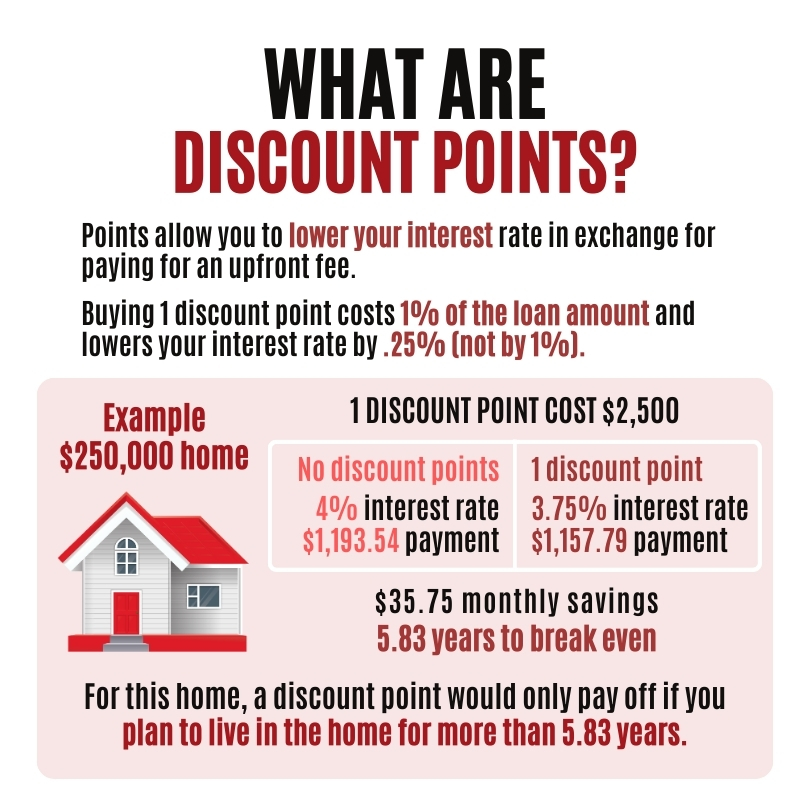
Discount Points (or “Buy-Down Points”): These are perhaps the most commonly discussed type of points. Borrowers pay discount points at closing with the explicit goal of “buying down” or reducing their interest rate. By paying more upfront, you secure a lower interest rate for the entire life of the loan. This means your monthly mortgage payments will be lower, and you’ll pay less interest over the full term of the mortgage. The exact reduction in interest rate for each point paid varies by lender and market conditions, but it’s typically a fraction of a percentage point (e.g., 0.125% to 0.25% reduction per point).
-
Origination Points: Unlike discount points, origination points are not about lowering your interest rate. Instead, they are a fee charged by the lender to cover the administrative costs associated with processing and underwriting your loan. These can include expenses for loan application processing, credit checks, title searches, document preparation, and other services necessary to finalize the mortgage. Origination points are essentially a way for the lender to cover their operating costs and earn a profit. They are often bundled into the overall closing costs and are not always negotiable, though some lenders may offer alternatives.
Distinguishing between these two types is vital because they serve fundamentally different purposes, impacting your upfront costs and long-term financial commitment in distinct ways.
How Discount Points Work: The Trade-off Between Upfront Cost and Long-Term Savings
Discount points represent a classic financial trade-off: pay more now to save more later. This strategy can be highly beneficial for the right borrower, but it requires careful calculation and consideration of one’s future plans.
Calculating the Cost of Discount Points
As established, each point costs 1% of your loan amount. Let’s consider an example:
- Loan Amount: $400,000
- One Point Cost: $4,000 ($400,000 x 0.01)
- Two Points Cost: $8,000 ($400,000 x 0.02)
When a lender quotes you an interest rate, they might also present options for paying discount points to achieve a lower rate. For instance, they might offer a 6.5% interest rate with zero points, or a 6.25% interest rate with 1 point, or a 6.0% interest rate with 2 points. Each of these options comes with a different upfront cost and a different long-term monthly payment.
The Mechanics of Rate Reduction
The amount by which discount points reduce your interest rate is not standardized. It varies based on several factors, including the lender, the prevailing market interest rates, the type of loan (e.g., fixed-rate vs. adjustable-rate), and the loan term. A common reduction might be around 0.125% to 0.25% per point. So, paying 1 point could potentially lower your interest rate from 6.5% to 6.25%, resulting in a noticeable reduction in your monthly mortgage payment.
The lender essentially uses the upfront payment from discount points to offset some of the risk or to allow them to offer a lower yield over the life of the loan. This benefit is passed on to the borrower in the form of a reduced interest rate.
Understanding the “Break-Even Point”
The critical calculation when considering discount points is the “break-even point.” This is the moment in time when the savings from your lower monthly payments (due to the reduced interest rate) equal the initial cost of the points you paid.
To calculate your break-even point:
- Calculate the monthly payment difference: Determine the difference in your monthly payment with and without paying the points.
- Divide the cost of points by the monthly savings:
- Example: If paying 1 point costs $4,000 and reduces your monthly payment by $50, then:
$4,000 (Cost of Points) / $50 (Monthly Savings) = 80 months. - 80 months / 12 months/year = approximately 6.67 years.
- Example: If paying 1 point costs $4,000 and reduces your monthly payment by $50, then:
In this scenario, you would need to stay in the home for at least 6.67 years for the discount points to pay for themselves. If you sell or refinance before this break-even point, you would have spent more upfront than you saved, making the investment in points financially disadvantageous. This calculation is paramount for deciding whether paying points aligns with your long-term housing plans.
Origination Points vs. Discount Points: Clarifying Lender Fees
While both origination points and discount points are paid at closing and are calculated similarly, their fundamental purpose and impact on your loan differ significantly. Understanding this distinction is key to dissecting your closing costs.
The Purpose of Origination Points
Origination points are, in essence, a fee for the lender’s services in arranging and processing your loan. They cover a wide array of administrative tasks and expenses incurred by the lender, which can include:
- Processing your application
- Underwriting the loan (assessing your risk)
- Coordinating with third parties (e.g., appraisers, title companies)
- Preparing loan documents
- Ensuring compliance with regulations
Unlike discount points, origination points do not directly reduce your interest rate. They are a cost of doing business with that specific lender. Think of them as a service charge for facilitating the complex process of borrowing a large sum of money.
Are Origination Points Negotiable?
The negotiability of origination points can vary. Some lenders present their origination fees as non-negotiable, a standard charge for their services. Others might be open to negotiation, especially in a competitive market or if you have a strong financial profile. It’s always worth asking your lender if the origination fees can be reduced or waived, or if they can be rolled into the loan amount (though this would mean paying interest on them).
Sometimes, a lender might offer a “no origination fee” loan. While this sounds appealing, it’s crucial to understand that lenders rarely work for free. A “no origination fee” loan often comes with a slightly higher interest rate to compensate the lender for the waived upfront fee. Therefore, comparing the Annual Percentage Rate (APR) and total closing costs between different loan offers is more important than just looking at individual line items.
The Impact on Your Total Loan Cost
Both origination points and discount points contribute to your total closing costs. Closing costs are the collection of fees paid at the end of a real estate transaction. While discount points are an optional choice made by the borrower to reduce interest, origination points are typically a mandatory fee from the lender.
When comparing loan offers, don’t just look at the interest rate. Always request a Loan Estimate, which details all closing costs, including both types of points, and presents the APR. The APR provides a more comprehensive measure of the true annual cost of borrowing because it factors in not only the interest rate but also most of the upfront fees, including points. A lower APR generally indicates a less expensive loan overall, making it a better metric for comparison.
Strategic Considerations: When Do Points Make Financial Sense?
Deciding whether to pay points is not a one-size-fits-all proposition. It depends heavily on your individual financial situation, your intentions for the property, and your broader financial goals. Strategic borrowers weigh several factors before committing to this upfront expense.
The Role of Loan Term and Your Intentions
The most critical factor in determining if discount points are worthwhile is how long you plan to keep the mortgage. As discussed with the break-even point, if you sell the home, refinance, or pay off the mortgage before you’ve recouped the cost of the points through interest savings, then paying points was not financially beneficial.
- Long-term homeowners (5+ years): If you intend to stay in your home for many years (e.g., 7-10+ years), paying discount points can be a very wise investment. The longer you keep the loan, the more you benefit from the lower interest rate, maximizing your overall savings.
- Short-term homeowners (under 5 years): If you anticipate moving, selling, or refinancing within a few years, paying discount points is likely not advisable. The upfront cost will probably outweigh the limited interest savings you’ll accrue. In such cases, taking a slightly higher interest rate with no points (or fewer points) keeps more cash in your pocket at closing.
Assessing Your Financial Situation and Cash Flow
Paying points means you need more cash available at closing. This upfront liquidity is a significant consideration.
- Ample Cash Reserves: If you have sufficient liquid assets, beyond your down payment and other closing costs, paying points can be an efficient use of that capital to reduce your long-term housing expenses. It can be seen as an investment with a guaranteed return (in the form of interest savings).
- Limited Cash Reserves: If your cash reserves are tight, or if you prefer to retain your cash for emergencies, home improvements, or other investments, then opting for a “no-points” loan (even with a slightly higher interest rate) might be a more prudent choice. Forcing yourself to pay points by depleting emergency savings could put you in a vulnerable financial position.
Comparing APR vs. Interest Rate
As mentioned earlier, the Annual Percentage Rate (APR) is a more holistic measure of the cost of borrowing than the nominal interest rate alone. The APR includes the interest rate plus most of the upfront costs, such as origination fees and discount points, spread out over the loan term.
- When comparing loan offers, always ask for the APR. A loan with a lower interest rate but high points might have a higher APR than a loan with a slightly higher interest rate but no points.
- Focus on the APR to get a clearer picture of the overall cost and to make an apples-to-apples comparison between different mortgage products.
Tax Implications of Paying Points
In some cases, the points you pay on a home loan may be tax-deductible.
- Discount Points: Generally, discount points paid on a mortgage for your primary residence are tax-deductible in the year they are paid, provided certain conditions are met (e.g., they must be for the acquisition or improvement of your main home, the loan is secured by your main home, and paying points is an established business practice in your area).
- Origination Points: These might also be deductible as “loan origination fees.”
- Refinancing: If you pay points when refinancing, the deductibility rules can be more complex, often requiring you to deduct them over the life of the loan rather than in a single year.
It’s crucial to consult with a qualified tax professional to understand the specific tax implications for your situation, as tax laws can be complex and change. The potential tax deduction can further enhance the financial benefit of paying points.
Navigating the Decision: Questions to Ask Your Lender
The best way to make an informed decision about mortgage points is to engage in a detailed conversation with your lender. Preparedness with the right questions will ensure full transparency and help you select the most suitable option for your financial future.
Understanding the Rate Without Points
Before diving into the options with points, establish a baseline. Ask your lender:
- “What is the lowest interest rate you can offer me with absolutely no discount points?”
- “What are the origination fees and other mandatory closing costs associated with that zero-point rate?”
This baseline will serve as your control group, against which you can evaluate the cost-effectiveness of paying points. Without this, you cannot accurately assess the savings or costs of alternative offers.
Itemized Breakdown of All Closing Costs
Request a comprehensive, itemized breakdown of all closing costs, not just the points. The Loan Estimate document is designed for this purpose and must be provided by law. Review it meticulously.
- “Please provide a detailed Loan Estimate showing all closing costs, clearly separating discount points from origination fees and other third-party costs.”
- “Can you explain each fee listed on the Loan Estimate?”
- “Are any of these fees negotiable, specifically the origination points?”
A clear understanding of every line item will prevent surprises and allow you to compare total costs across different lenders more accurately.
The Impact on Your Monthly Payment
Beyond the interest rate, the direct impact on your monthly budget is what most borrowers focus on.
- “How much would my monthly principal and interest payment be with zero points versus with one point or two points?”
- “What is the exact interest rate associated with each of those point options?”
Have the lender provide these figures in writing, perhaps through multiple Loan Estimate scenarios, so you can easily compare the monthly savings against the upfront cost of the points. This will be crucial for calculating your personal break-even point and determining if the monthly savings justify the initial outlay.
By asking these pointed questions, you empower yourself with the information needed to negotiate effectively and to choose a mortgage that aligns perfectly with your financial capacity and long-term goals.

Conclusion
Mortgage points, while initially appearing as an added expense, are a sophisticated tool in the landscape of home financing. Understanding whether to pay discount points to secure a lower interest rate, or acknowledging origination points as a cost of lender services, is paramount for any borrower. The decision hinges on a careful evaluation of your financial liquidity, your projected tenure in the home, and an astute comparison of the annual percentage rate (APR) across various loan offers.
For those planning to remain in their homes for an extended period, investing in discount points can lead to substantial long-term savings and lower monthly payments. Conversely, short-term homeowners or those with limited upfront cash may find that a “no-points” loan, despite a slightly higher interest rate, is the more financially prudent choice. Always leverage the Loan Estimate, engage in transparent conversations with your lender, and consult with tax professionals to ensure you’re making a decision that supports your overall financial well-being. By demystifying points, you gain the clarity and confidence to tailor your home loan to your unique circumstances, paving the way for a more affordable and sustainable homeownership journey.
aViewFromTheCave is a participant in the Amazon Services LLC Associates Program, an affiliate advertising program designed to provide a means for sites to earn advertising fees by advertising and linking to Amazon.com. Amazon, the Amazon logo, AmazonSupply, and the AmazonSupply logo are trademarks of Amazon.com, Inc. or its affiliates. As an Amazon Associate we earn affiliate commissions from qualifying purchases.