
In the landscape of personal finance, few assets are as highly regarded yet frequently misunderstood as American Express Membership Rewards (MR) points. Often referred to as a “flexible currency,” Amex points represent more than just a digital balance in a credit card account; they are a high-yield financial tool that, when leveraged correctly, can provide significantly more value than standard cash-back rewards. For the savvy consumer, the question isn’t just about what these points can buy, but how they can be strategically deployed to maximize return on spend.
The value of an Amex point is not fixed. Depending on how you choose to redeem them, a single point can be worth anywhere from 0.5 cents to over 5.0 cents. Understanding this delta is the difference between a mediocre rewards strategy and a masterclass in financial optimization.
The Mechanics of Membership Rewards: More Than Just Cash Back
At its core, the American Express Membership Rewards program is designed to incentivize loyalty through a tiered ecosystem of earning and redemption. Unlike co-branded cards—such as those tied specifically to Delta Air Lines or Hilton Hotels—Membership Rewards points are “transferable.” This means they act as a central hub from which value can be distributed to various partners or used within the Amex ecosystem itself.
Understanding Flexible Currency
The primary advantage of Amex points is their flexibility. In the world of personal finance, fixed-value rewards (like 1.5% cash back) offer simplicity but a low ceiling for growth. Membership Rewards are a “flexible currency” because they allow the cardholder to wait until the moment of redemption to decide what the points are worth. If a specific airline is offering a high-value redemption for a business-class seat, you can move your points there instantly. If you need to book a boutique hotel through the Amex portal, that option remains open. This optionality protects the consumer against the devaluation of any single airline or hotel loyalty program.
The Ecosystem of Amex Cards
To understand what these points get you, one must first understand how they are aggregated. The Amex ecosystem is built on “The Trifecta”—a combination of cards designed to capture maximum points across different spending categories. The American Express® Gold Card, for instance, excels at earning 4x points on dining and at U.S. supermarkets, while The Platinum Card® earns 5x on flights. By pooling these points into a single Membership Rewards account, users can accumulate a massive “war chest” of points that can be deployed for high-value redemptions.
The Gold Standard: Transferring Points to Travel Partners
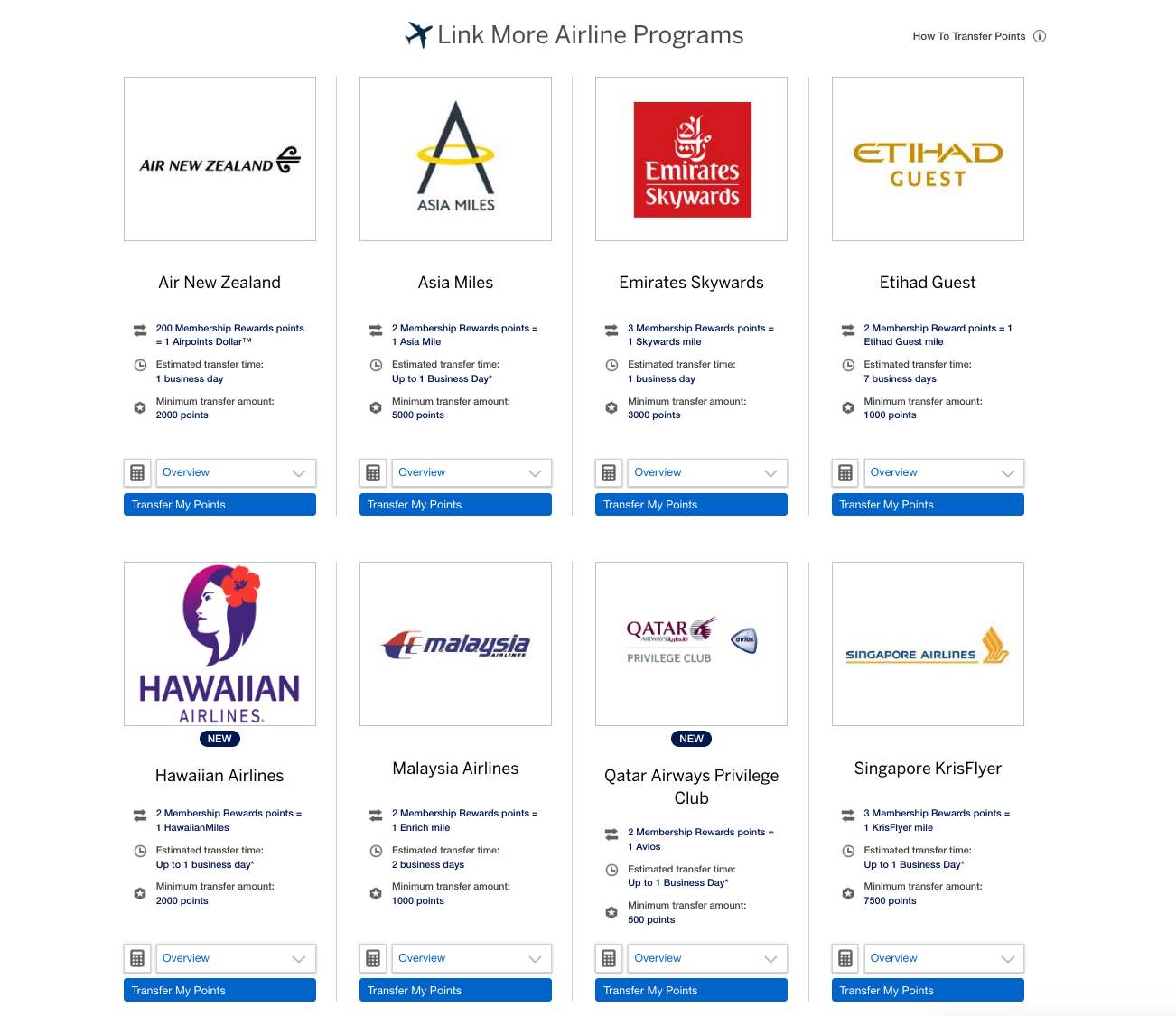
The absolute highest value you can extract from Amex points is found in their network of airline and hotel transfer partners. Currently, American Express partners with approximately 20 different airlines and three major hotel chains. In most cases, these points transfer at a 1:1 ratio, meaning 1,000 Amex points become 1,000 airline miles.
International Airline Partners and Global Alliances
The true power of Amex points lies in international travel. Because Amex partners with airlines across all three major global alliances—Star Alliance, SkyTeam, and Oneworld—you essentially have access to nearly every commercial flight in the world.
For example, transferring points to ANA (All Nippon Airways) can unlock round-trip business class tickets to Japan for a fraction of the retail cost. Similarly, transferring to Air France-KLM’s Flying Blue program can provide access to “Promo Rewards,” where flights to Europe can be booked for as little as 15,000 to 20,000 points. When a ticket that costs $3,000 can be purchased for 60,000 points, the value of each point jumps to 5 cents—a 500% increase over the standard 1-cent valuation.
Hotel Loyalty Programs
While airline transfers generally offer the best “cents per point” (CPP) value, hotel transfers provide a different kind of utility. Amex points can be transferred to Marriott Bonvoy, Hilton Honors, and Choice Privileges. While the transfer ratios for Hilton are often 1:2, the lower value of hotel points generally makes this a less efficient use of Amex MR points compared to airlines. However, for “top-off” situations—where you are a few thousand points short of a free night at a luxury resort—this bridge is invaluable.
The Power of Strategic Booking (Sweet Spots)
Maximizing what Amex points get you requires identifying “sweet spots” within partner award charts. A classic example is using British Airways Avios (an Amex partner) to book short-haul domestic flights on American Airlines. Because British Airways uses a distance-based award chart, a flight that might cost $400 in cash could cost only 7,500 to 11,000 points. This type of arbitrage is the cornerstone of advanced personal finance management using credit card rewards.
Lifestyle and Retail Redemptions: Convenience vs. Value
While travel transfers offer the highest ceiling, American Express provides several other ways to use points. These options offer more “liquidity” but generally come at a lower valuation. For many business owners or busy professionals, the convenience of these methods outweighs the desire to hunt for travel sweet spots.
Booking Through the Amex Travel Portal
The most straightforward way to use points is the “Pay with Points” feature on the American Express Travel portal. Generally, this gives you a value of 1 cent per point for flights. While this is lower than the potential value of transferring to partners, it offers one major advantage: simplicity. You do not have to worry about “award availability” or blackout dates. If a seat is for sale on the Amex portal, you can buy it with points. Furthermore, for those with the Business Platinum Card®, there is a 35% points rebate on select flights, effectively boosting the value of points to 1.54 cents each.
Shopping with Points (Amazon and Retailers)
Amex has integrated its rewards system into major retail platforms, most notably Amazon. At checkout, you can choose to use your points balance to pay for your cart. However, this is widely considered a poor financial move. Typically, points used at Amazon or other retailers are valued at approximately 0.7 cents per point. If you have 100,000 points, using them on Amazon gets you $700 in goods; transferring them to an airline could easily get you $2,000 to $5,000 in travel value.
Gift Cards and Statement Credits
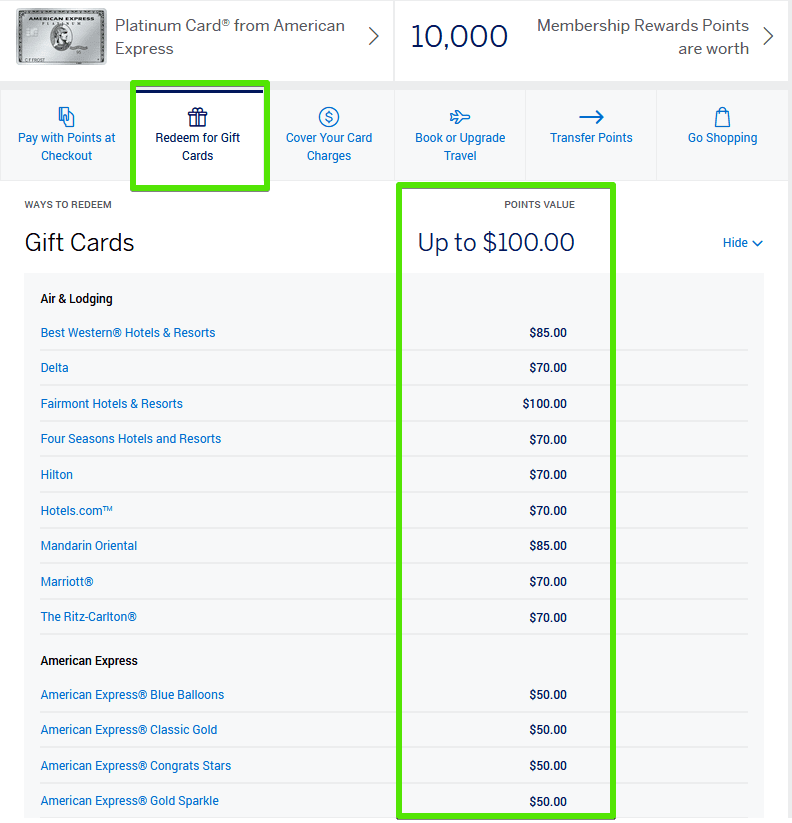
You can also redeem points for gift cards from hundreds of brands or apply them as a “Statement Credit” to cover your bill. Statement credits usually offer the lowest value, often around 0.6 cents per point. While this provides the most direct “cash-like” utility, it is the least efficient use of the asset. In the context of a wealth-building strategy, using points for statement credits is akin to selling a high-performing stock to pay for a depreciating consumer good.
Maximizing Your Return: How to Calculate Point Value
To truly understand what Amex points get you, you must treat them as a currency with a fluctuating exchange rate. Financial discipline requires calculating the “Cents Per Point” (CPP) for every redemption.
The Math of CPP
The formula is simple: (Cash Price of Item – Fees) / Number of Points = Value per Point.
If you are looking at a flight that costs $800, and you could book it for 50,000 points plus $50 in taxes, the math is ($800 – $50) / 50,000 = 0.015. In this case, you are getting 1.5 cents per point. In the world of Amex Membership Rewards, 1.0 to 1.2 CPP is considered the “baseline,” 1.5 to 2.0 is “good,” and anything above 3.0 is “exceptional.”
Avoiding Low-Value Pitfalls
The primary pitfall in the Amex ecosystem is the “convenience trap.” American Express intentionally makes it very easy to redeem points for low-value options like Amazon purchases or statement credits. These are “revenue-positive” for the bank but “value-negative” for the consumer. A disciplined approach to personal finance involves resisting the urge to spend points as soon as they are earned and instead saving them for high-value redemptions that would otherwise require significant cash outlays.
Advanced Strategies for Amex Point Accumulation and Usage
For those who view their credit card strategy as a secondary stream of “income” or a way to offset luxury lifestyle costs, certain advanced tactics can amplify the power of Amex points.
Leveraging Transfer Bonuses
Periodically, American Express offers transfer bonuses to specific partners. For example, they may offer a 30% bonus when transferring points to Virgin Atlantic or Hilton. This means 1,000 Amex points become 1,300 miles/points in the partner program. Waiting for these windows to move your points can instantly increase your purchasing power by nearly a third without any additional spending.
The “Amex Trifecta” and Yield Optimization
To maximize what points get you, you must first maximize how many you get. The “Amex Trifecta” involves using The Platinum Card for 5x on travel, the Amex Gold for 4x on food, and the Blue Business® Plus Credit Card for 2x on all other business purchases (up to a limit). By ensuring that every dollar spent earns at least 2 points, you effectively double your “yield.”
When this high-velocity earning is paired with high-value international travel transfers, the results are transformative. A household or business spending $50,000 a year across these categories could easily earn 150,000 to 200,000 points. At a 2-cent valuation, that is $4,000 in tax-free travel value—a 8% return on total spend.
Conclusion: The Strategic Value of Membership Rewards
What do Amex points get you? Ultimately, they get you access to a world of travel and luxury that would otherwise be cost-prohibitive. They serve as a financial buffer, a travel fund, and a tool for lifestyle inflation without the corresponding drain on your cash reserves. Whether you are using them to fly in a first-class suite across the Atlantic or simply to offset the cost of a family vacation through the travel portal, the value of the points is entirely dependent on the financial literacy of the cardholder. By treating Membership Rewards as a strategic asset rather than a simple rebate, you unlock the full potential of the American Express ecosystem.
aViewFromTheCave is a participant in the Amazon Services LLC Associates Program, an affiliate advertising program designed to provide a means for sites to earn advertising fees by advertising and linking to Amazon.com. Amazon, the Amazon logo, AmazonSupply, and the AmazonSupply logo are trademarks of Amazon.com, Inc. or its affiliates. As an Amazon Associate we earn affiliate commissions from qualifying purchases.