
In the landscape of personal finance, travel often represents one of the most significant discretionary expenses an individual or family will encounter. While many view airfare as a fixed cost or a matter of luck, savvy financial planners recognize that airfare is a volatile commodity subject to the laws of supply, demand, and sophisticated algorithmic pricing. Understanding the specific days that are cheapest to fly is not merely a travel tip; it is a vital component of a comprehensive wealth-management strategy. By optimizing travel schedules, consumers can redirect thousands of dollars annually toward investments, savings, or debt reduction.

The Economics of Airfare: Why Price Fluctuations Matter for Your Wallet
To understand why certain days are cheaper than others, one must first understand the financial mechanics of the aviation industry. Airlines utilize “Yield Management,” a variable pricing strategy based on anticipating and influencing consumer behavior to maximize revenue. For the consumer, this means that the price of a seat is rarely tied to the actual cost of the flight, but rather to the maximum amount the market is willing to pay at a specific moment.
Supply and Demand in the Aviation Industry
The airline industry operates on razor-thin margins. To ensure profitability, airlines must fill as many seats as possible at the highest possible price point. Demand is cyclical, peaking during periods when leisure and business travelers are most active. Historically, business travelers—who are less price-sensitive because their companies are footing the bill—tend to fly out on Monday mornings and return on Thursday or Friday afternoons. Leisure travelers typically look for weekend getaways, departing Friday and returning Sunday. By identifying the gaps between these high-demand periods, budget-conscious travelers can find the “valleys” in pricing where supply exceeds demand.
Dynamic Pricing Algorithms and Financial Planning
Airlines employ highly sophisticated software that adjusts prices in real-time based on booking velocity, historical data, and even the browsing habits of users. From a personal finance perspective, navigating these algorithms requires a disciplined approach. Viewing airfare as a market—much like the stock market—allows a traveler to identify “buy” signals. When you understand that prices are lower on specific days due to lower demand, you can treat your travel booking as a strategic financial acquisition rather than an impulsive purchase.
Identifying the Most Cost-Effective Days to Travel
While there is no universal “magic” day to book, historical data from financial analysts and travel aggregators consistently point toward mid-week departures as the most effective way to minimize expenditure. For those looking to optimize their personal balance sheets, adjusting a trip by just 24 to 48 hours can result in savings of 20% to 40% per ticket.
Mid-Week Savings: Tuesday and Wednesday
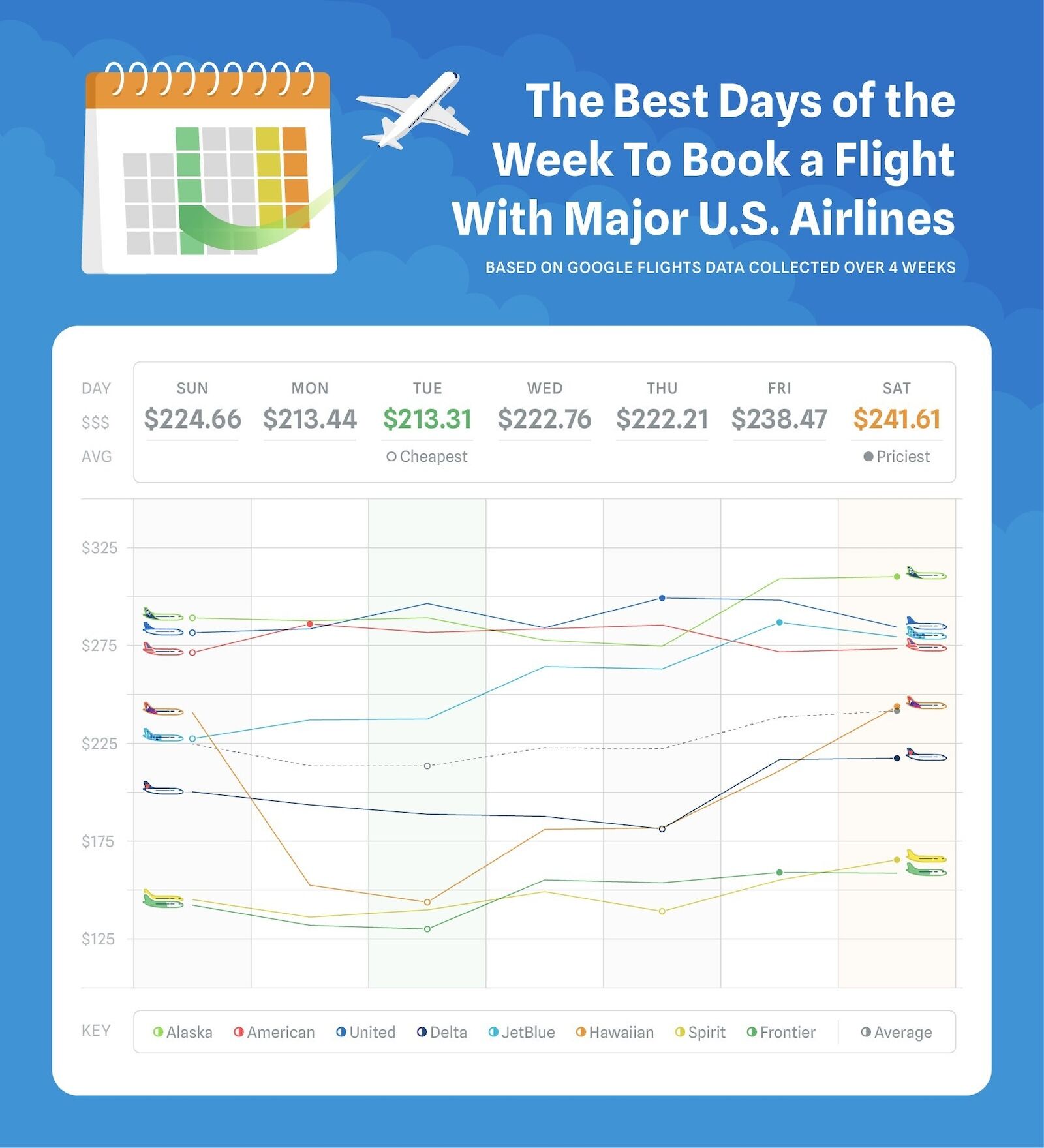
Data consistently shows that Tuesday and Wednesday are the cheapest days of the week to fly. Because these days fall between the peak business travel cycles and the weekend leisure rush, airlines often struggle to fill seats. To incentivize bookings, they lower the price floor. For a family of four, choosing a Wednesday departure over a Friday departure could easily result in a $400 to $800 saving—capital that could be better utilized in a 529 college savings plan or a high-yield savings account.
Avoiding the Weekend Premium
Friday and Sunday are statistically the most expensive days to fly. Sunday, in particular, carries a heavy premium as it is the primary return day for both weekend vacationers and business travelers preparing for the work week. From a financial management standpoint, flying on a Sunday is often an inefficient use of capital. If your professional schedule allows for it, returning on a Monday or even a Saturday can significantly lower the total cost of the trip. Saturday is an interesting anomaly; while it is a weekend day, it is often cheaper than Friday or Sunday because it is less popular for short-term business trips or full-week vacations.
Holiday Financial Management
The “day of the week” rule becomes even more critical during high-inflation periods like the holidays. For example, flying on Thanksgiving Day itself is almost always significantly cheaper than flying the Wednesday prior. In terms of financial strategy, the goal is to be a “contrarian” traveler. By traveling when others are already at their destination, you capitalize on the reduced demand and lower your overall travel liability.
Beyond the Calendar: Financial Tools for Finding Cheap Flights

Identifying the cheapest days is only half the battle. To maximize your financial return, you must use the right tools to monitor the market and leverage your existing assets.
Leveraging Price Tracking and Comparison Tools
In the modern digital economy, data is a form of currency. Tools like Google Flights, Skyscanner, and Hopper allow you to view “price grids” and “price graphs.” These tools are essentially financial analytics platforms for travelers. By setting alerts for specific routes, you can wait for a “market dip” before committing your funds. This level of patience and analysis is similar to waiting for a stock to hit a specific price target before executing a trade. It ensures that you are never paying the “all-time high” for a seat.
Utilizing Travel Rewards and Credit Card Points
For many high-net-worth individuals and disciplined budgeters, the cheapest day to fly is “free.” Utilizing credit card rewards and frequent flyer miles is an essential part of business finance and personal wealth strategy. By strategically using cards that offer 3x or 5x points on travel or dining, you are essentially creating a self-funding travel budget. When you combine these points with mid-week travel (when “award seat” availability is higher), you maximize the “cents-per-point” value, which is the primary metric for measuring the ROI of a rewards program.
Strategic Booking Windows: When to Commit Your Capital
Timing the day of your flight is important, but timing the date of purchase is equally vital for protecting your cash flow.
The Goldilocks Window: Booking in Advance
For domestic flights, the “Goldilocks Window”—the period where prices are most stable and lowest—is typically between 1 and 3 months before departure. For international travel, this window extends to 2 to 8 months. Booking too early can be a mistake, as airlines haven’t yet released their promotional fares. Booking too late, especially within 21 days of departure, triggers the “late-booking” algorithms designed to extract maximum profit from desperate or last-minute business travelers.
Last-Minute Risks vs. Opportunities
While some suggest that “last-minute deals” are a great way to save money, from a financial planning perspective, this is a high-risk strategy. The volatility of last-minute pricing can lead to significantly higher expenses that disrupt your monthly budget. A disciplined financial approach favors the predictability of the 1–3 month window over the gamble of a last-minute price drop.
Long-Term Financial Impact of Smart Travel Habits
The difference between an expensive flight and a cheap one may seem small in isolation, but when viewed through the lens of long-term wealth accumulation, the impact is profound.
Reinvesting Travel Savings into Personal Wealth
Consider the opportunity cost of an overpriced plane ticket. If a traveler saves $300 by choosing a Wednesday flight over a Sunday flight and invests that $300 into an index fund with an average 7% annual return, that single decision grows to over $1,100 in 20 years. If this habit is repeated twice a year, the traveler is looking at an additional $40,000 to $50,000 in retirement savings over a career. This is the essence of “Money” management: finding small, repeatable efficiencies that compound over time.
Developing a Disciplined Spending Mindset
Choosing the cheapest days to fly is a microcosm of a larger financial philosophy. It represents a move away from “convenience-based spending” toward “value-based spending.” This mindset, once adopted for travel, often bleeds into other areas of personal finance, such as insurance shopping, utility management, and investment fee reduction.
In conclusion, the question of what days are cheapest to fly is more than a logistical inquiry; it is a financial one. By targeting mid-week departures (Tuesdays and Wednesdays), utilizing analytical tools to monitor price fluctuations, and leveraging rewards programs, you can significantly lower your travel overhead. In the world of personal finance, every dollar saved on a recurring expense is a dollar that can be put to work in the markets, ultimately accelerating your path to financial independence.
aViewFromTheCave is a participant in the Amazon Services LLC Associates Program, an affiliate advertising program designed to provide a means for sites to earn advertising fees by advertising and linking to Amazon.com. Amazon, the Amazon logo, AmazonSupply, and the AmazonSupply logo are trademarks of Amazon.com, Inc. or its affiliates. As an Amazon Associate we earn affiliate commissions from qualifying purchases.