
Nvidia, a titan in the technology industry renowned for its groundbreaking advancements in graphics processing units (GPUs) and artificial intelligence (AI), proudly hails from the United States of America. Founded in Santa Clara, California, in 1993, Nvidia’s origins are deeply rooted in the heart of Silicon Valley, a crucible of innovation that has shaped the modern technological landscape. This geographical genesis is more than a mere footnote; it’s a foundational element that has influenced its corporate culture, strategic vision, and unparalleled contributions to computing.
The Genesis in Silicon Valley: A Hub of Innovation
The narrative of Nvidia begins in the quintessential American tech ecosystem of Silicon Valley. It was here, amidst a vibrant culture of entrepreneurship, venture capital, and cutting-edge research institutions, that Jensen Huang, Chris Malachowsky, and Curtis Priem conceived Nvidia. Their initial vision was audacious: to create an architecture for graphics processing that would not only enhance gaming experiences but also lay the groundwork for future computational breakthroughs.

Founding Vision and Early Days
In 1993, the three co-founders identified a nascent but rapidly growing market for 3D graphics. While many companies were vying for dominance in the emerging PC gaming sector, Nvidia set itself apart by focusing on programmability and flexibility in its GPU design. This foresight was crucial, allowing their technology to adapt and scale as computing demands evolved. Their first significant product, the NV1, launched in 1995, demonstrated early promise, but it was the RIVA 128 in 1997 that truly put Nvidia on the map, offering compelling 3D performance at an accessible price point, capturing the attention of both gamers and hardware manufacturers.
Silicon Valley’s Influence on Nvidia’s DNA
Silicon Valley provided more than just a mailing address for Nvidia; it offered a fertile ground for talent acquisition, access to critical early-stage funding, and a collaborative environment where ideas could flourish. The proximity to Stanford University, UC Berkeley, and other research powerhouses fostered a culture of relentless innovation and intellectual curiosity. This environment encouraged Nvidia to constantly push the boundaries of what was technologically possible, fostering a “think big” mentality that permeated its engineering and product development teams. The rapid pace of technological change inherent to Silicon Valley also instilled a need for agility and adaptability, traits that have allowed Nvidia to pivot and expand its focus beyond its initial gaming niche.
Revolutionizing Graphics Processing: The GPU’s Evolution
Nvidia’s most profound and enduring contribution to technology is arguably the modern Graphics Processing Unit (GPU). Initially designed to render complex 3D graphics for video games, the GPU’s architecture proved to be far more versatile than its creators might have initially imagined.
The Rise of the GeForce Line and Programmable Shading
The year 1999 marked a pivotal moment with the release of the GeForce 256, which Nvidia boldly marketed as the world’s first “GPU.” This chip integrated transform, lighting, triangle setup, and rendering engines into a single processor, significantly offloading these tasks from the CPU and enabling richer, more realistic graphics. This move not only solidified Nvidia’s position in the gaming market but also set a new standard for graphical computation. Subsequent generations of GeForce GPUs, particularly those incorporating programmable shading, unlocked unprecedented levels of visual fidelity and allowed developers immense creative freedom. The ability to program shaders directly on the GPU was a game-changer, transforming the visual possibilities of interactive entertainment and professional visualization alike.
Beyond Gaming: Professional Visualization and Accelerated Computing
While gaming remained a core market, Nvidia quickly recognized the GPU’s potential beyond entertainment. The parallel processing capabilities that made GPUs so adept at rendering pixels also made them incredibly efficient at handling other data-intensive tasks. This led to the development of professional workstation graphics cards under the Quadro brand, targeting industries like film production, architectural design, scientific visualization, and product engineering. These GPUs powered everything from intricate CAD models to complex scientific simulations, demonstrating the device’s inherent versatility as an accelerator for computational tasks well beyond rendering. This expansion laid the groundwork for the GPU’s eventual ascendance as a general-purpose parallel processor.

Pioneering the Age of AI and Parallel Computing
The true transformative power of Nvidia’s GPU architecture became undeniably clear with the advent of artificial intelligence, particularly deep learning. The inherently parallel structure of GPUs, designed to process millions of pixels simultaneously, proved to be perfectly suited for the matrix multiplications and parallel computations central to neural network training.
CUDA and the Democratization of AI
Recognizing the burgeoning potential, Nvidia made a strategic move in 2006 by introducing CUDA (Compute Unified Device Architecture). CUDA was not just another hardware release; it was a parallel computing platform and programming model that allowed developers to use Nvidia GPUs for general-purpose computing. This innovation effectively turned the GPU from a specialized graphics chip into a powerful, general-purpose parallel processor. CUDA democratized access to supercomputing-level performance, enabling researchers and developers to accelerate complex computations in fields like scientific research, data analytics, and, most critically, machine learning and deep learning. Without CUDA, the explosion of AI research and applications we see today would have been significantly delayed, as it provided the accessible computational horsepower needed to train massive neural networks.
Fueling Data Centers, Autonomous Vehicles, and Robotics
Nvidia’s GPUs, powered by CUDA, quickly became the backbone of modern AI infrastructure. Data centers around the world began adopting Nvidia’s Tesla (now A-series and H-series) GPUs for AI training and inference, leading to breakthroughs in areas such as natural language processing, computer vision, and recommendation systems. Hyperscale cloud providers built their AI offerings on Nvidia technology, making powerful AI accessible to businesses and researchers globally.
The company’s influence extended beyond the cloud, deep into edge computing and real-world applications. Nvidia’s Drive platform emerged as a leading solution for autonomous vehicles, providing the computational brains for self-driving cars, trucks, and robots. Its Jetson platform brought AI capabilities to embedded systems, empowering a new generation of smart devices and robotics. Nvidia’s commitment to building comprehensive ecosystems, encompassing hardware, software, and development tools, has been instrumental in its success across these diverse and demanding sectors. From scientific simulations to the metaverse, Nvidia’s technology forms the computational bedrock for many of the most advanced and future-facing technologies.
Global Impact and Future Trajectories
From its American roots, Nvidia has cultivated a truly global presence and impact, influencing technological development across continents. While its headquarters and core R&D remain firmly in the United States, its products, partnerships, and supply chains span the entire globe.
Supply Chains and International Collaboration
The manufacturing of Nvidia’s sophisticated chips involves a complex international supply chain, leveraging specialized foundries in countries like Taiwan (TSMC) and drawing upon expertise from around the world. Its software platforms and development kits are adopted by engineers and scientists in every major tech hub. This global interconnectedness highlights how a company originating from a specific country can foster worldwide technological advancement through collaboration and distributed expertise. Nvidia’s research initiatives often involve international academic partnerships, further cementing its role as a global technology enabler.
Shaping the Next Wave of Computing
Looking ahead, Nvidia continues to be at the forefront of several transformative technological waves. Its sustained investment in AI research and development positions it to drive further advancements in generative AI, large language models, and intelligent automation. The company is also a significant player in the burgeoning metaverse, providing the rendering and simulation capabilities necessary to build realistic virtual worlds. Furthermore, its focus on accelerated computing for scientific discovery, quantum computing simulations, and sustainable AI infrastructure points to a future where Nvidia’s technology will continue to unlock new frontiers of human potential and problem-solving.
A Symbol of American Innovation in Tech
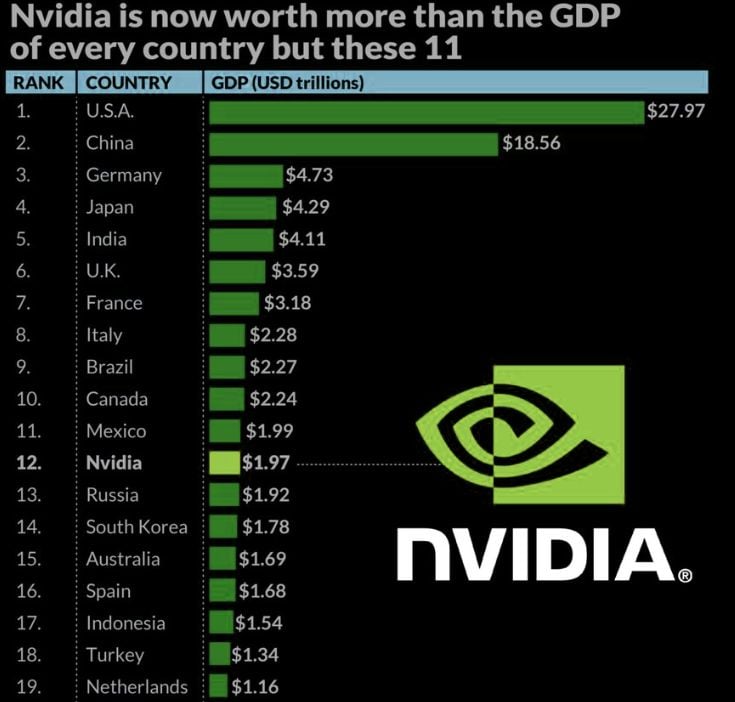
Nvidia stands as a quintessential example of American innovation in the technology sector. Its journey from a small startup in Silicon Valley to a multi-billion-dollar global leader reflects the entrepreneurial spirit, relentless pursuit of excellence, and capacity for disruption that characterize the U.S. tech industry. The company’s enduring commitment to research and development, its strategic vision to identify and capitalize on emerging technological shifts, and its ability to consistently deliver groundbreaking products have cemented its place as a pivotal force in shaping the digital future. While its influence is global, its identity remains deeply intertwined with its American origins, serving as a testament to the nation’s ongoing role in pioneering the technological revolution.
aViewFromTheCave is a participant in the Amazon Services LLC Associates Program, an affiliate advertising program designed to provide a means for sites to earn advertising fees by advertising and linking to Amazon.com. Amazon, the Amazon logo, AmazonSupply, and the AmazonSupply logo are trademarks of Amazon.com, Inc. or its affiliates. As an Amazon Associate we earn affiliate commissions from qualifying purchases.