
Compounding interest, often lauded as the “eighth wonder of the world” by none other than Albert Einstein, is a fundamental concept in finance that holds the key to significant wealth creation. Far from being a complex mathematical enigma, it is a deceptively simple yet extraordinarily powerful principle that allows your money to grow exponentially over time. At its core, compounding is the process of earning returns not only on your initial investment (the principal) but also on the accumulated interest from previous periods. This reinvestment of earnings creates a snowball effect, where your money generates more money, which then generates even more, accelerating your financial growth at an astonishing rate.
Understanding what compounding interest is, how it works, and how to harness its power is absolutely crucial for anyone looking to build a secure financial future, whether for retirement planning, saving for a down payment, or simply growing their personal wealth. It’s a concept that separates those who merely save from those who truly invest and see their capital multiply. This article will demystify compounding interest, explore its mechanics, illustrate its profound impact over time, and provide actionable strategies to leverage it effectively in your financial journey, while also highlighting its potential pitfalls in the context of debt.
The Mechanics of Compounding: How It Works Its Magic
To truly appreciate the power of compounding, one must first grasp its underlying mechanics and differentiate it from its simpler cousin. It’s the engine that drives long-term financial success, continuously adding fuel to its own fire.
Simple vs. Compound Interest: A Fundamental Distinction
The financial world operates on different types of interest, and understanding the distinction between simple and compound interest is paramount.
-
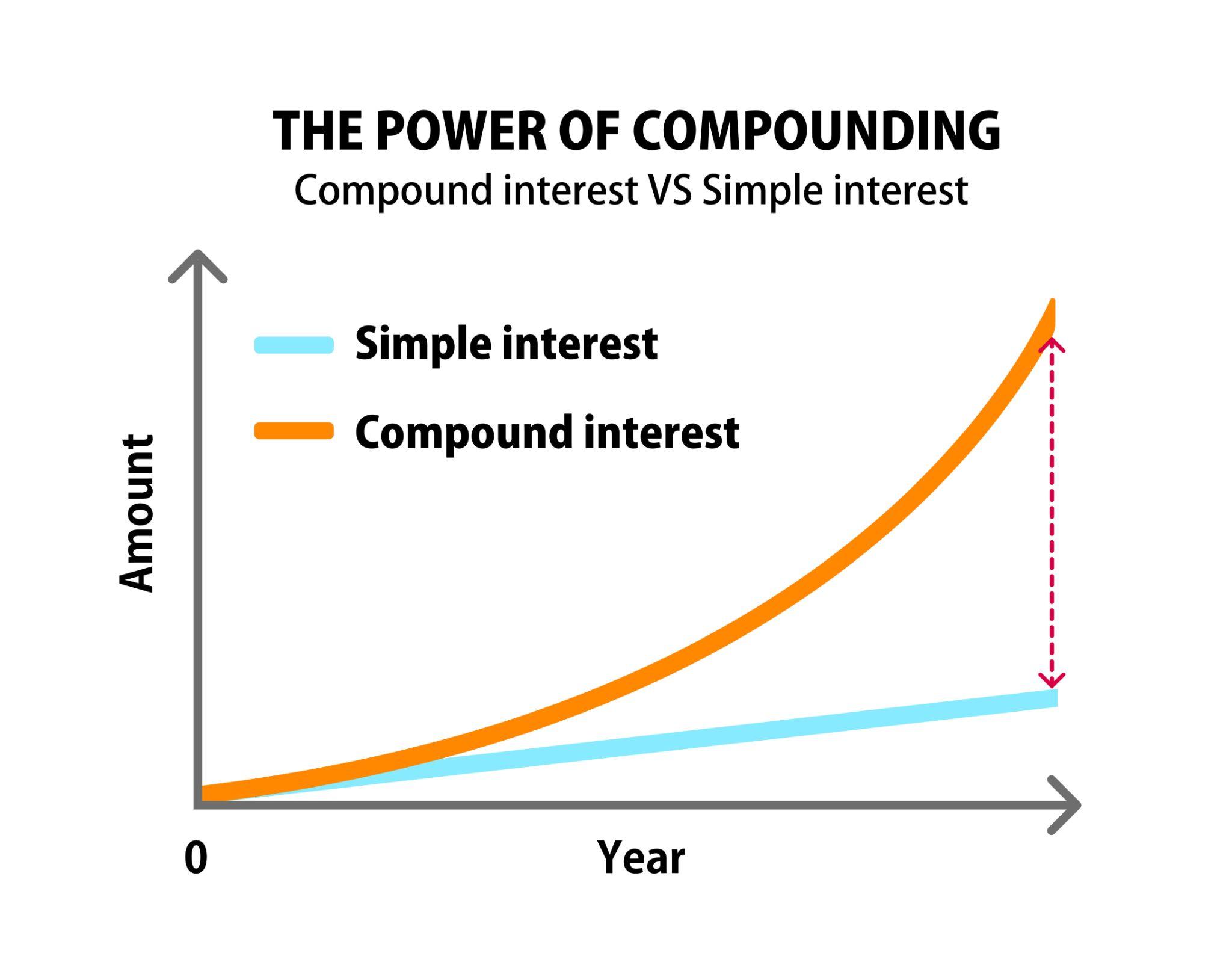
Simple Interest: This is the most straightforward form of interest. With simple interest, the earnings are calculated solely on the original principal amount. For example, if you invest $1,000 at a 5% simple interest rate for five years, you would earn $50 each year (5% of $1,000). Over five years, your total interest earned would be $250, bringing your total to $1,250. The principal never changes for the purpose of interest calculation. This form of interest is often seen in short-term loans or some bonds.
-
Compound Interest: This is where the magic happens. Compound interest is calculated on the initial principal and on the accumulated interest from previous periods. Using the same example: if you invest $1,000 at a 5% compound interest rate, in the first year, you earn $50, bringing your total to $1,050. In the second year, however, you earn 5% on the new total of $1,050, which is $52.50. Now your total is $1,102.50. This continues, with each subsequent year’s interest calculation based on a progressively larger sum. After five years, your investment would be approximately $1,276.28. While seemingly a small difference over five years, this gap widens dramatically over longer periods, illustrating the immense power of compounding.
The fundamental difference lies in the base upon which the interest is calculated. Simple interest’s base remains static, while compound interest’s base grows, leading to an accelerating rate of return.
Key Variables Influencing Compound Growth
Several factors dictate the pace and magnitude of compound growth. Understanding these variables allows you to optimize your investment strategies.
-
Principal Amount: This is your initial investment. Naturally, the larger your starting principal, the larger the initial interest earnings will be, providing a greater base for future compounding. A $10,000 investment at 7% will yield more absolute dollars in interest than a $1,000 investment at the same rate, even if the percentage growth is identical.
-
Interest Rate: The annual percentage rate (APR) at which your investment grows. A higher interest rate means your money grows faster. Even seemingly small differences in interest rates (e.g., 5% vs. 7%) can lead to significant differences in total returns over long periods due to compounding. Selecting investments with competitive, yet realistic, interest rates is crucial.
-
Time Horizon: This is arguably the most critical variable for compounding interest. The longer your money has to grow, the more cycles of compounding it undergoes, and the more pronounced the “snowball effect” becomes. This is why starting early is so frequently emphasized in financial planning. Even small investments made early can outperform much larger investments made later due to the sheer power of time.
-
Compounding Frequency: This refers to how often the interest is calculated and added back to the principal. Interest can compound annually, semi-annually, quarterly, monthly, weekly, or even daily. The more frequently interest compounds, the faster your money grows. For example, a 5% annual rate compounded monthly will yield slightly more than a 5% rate compounded annually because you start earning interest on your interest sooner. While the difference might be marginal in the short term, over decades, it can add up.
-
Additional Contributions: While not always considered a direct variable of compounding rate, regular additional contributions significantly amplify its effect. By periodically adding more money to your principal, you increase the base on which interest is calculated, giving the compounding mechanism more material to work with. This strategy, often employed in retirement accounts, dramatically boosts overall wealth accumulation.
The Exponential Power of Time: Albert Einstein’s “Eighth Wonder”
The true genius of compounding interest lies in its relationship with time. It’s not a linear progression; it’s an exponential one, a concept that makes even small, consistent efforts yield astonishing results over decades. This is why Einstein’s famous quote rings so true: compounding truly is a wonder.
The Power of Early Investment
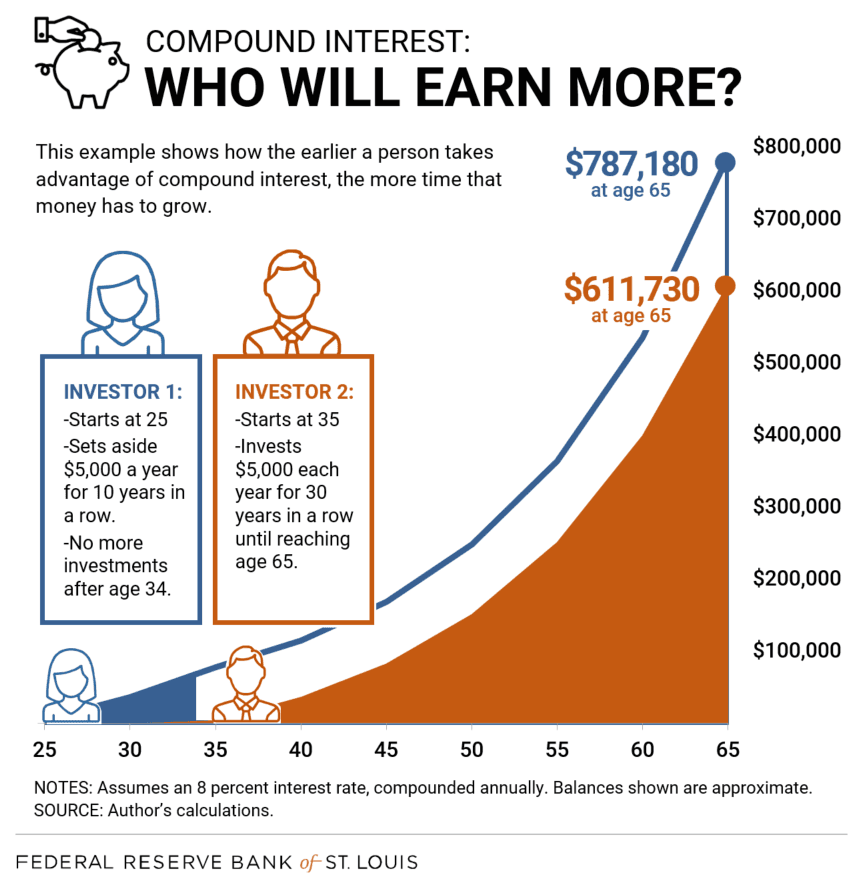
The most compelling argument for embracing compounding interest is the undeniable advantage of starting early. Consider two individuals: Sarah begins investing $200 per month at age 25, earning an average 7% annual return. She continues for 10 years, then stops, letting her money grow. By age 65, she will have contributed $24,000 and her investment could be worth well over $300,000. Now consider John, who starts investing $200 per month at age 35, also earning 7% annually, but continues for 30 years until age 65. He will have contributed $72,000, yet his total wealth might be only slightly more than Sarah’s, perhaps around $250,000 to $300,000.
This hypothetical scenario, often dubbed the “early bird gets the worm” in investing, vividly illustrates that the first few years of compounding are disproportionately more valuable than later years. The money invested early has the maximum amount of time to compound, allowing it to undergo numerous growth cycles and benefit from the “interest on interest” effect over a longer duration. Delaying investment means losing out on irreplaceable time, which is the most potent amplifier for compounding. The “opportunity cost” of not investing early is immense, as those lost years of compounding can never be recovered.
Visualizing Growth: The Hockey Stick Curve
The growth curve of compounded interest isn’t a straight line; it’s a “hockey stick” shape. In the initial years, the growth appears relatively modest. The amount of interest earned might seem small compared to the principal. However, as time progresses, and the base for calculation steadily increases with accumulated interest, the growth rate begins to accelerate dramatically. The curve slowly inclines at first, then sharply bends upwards, resembling the blade of a hockey stick.
This acceleration is where the exponential power manifests. After 10 or 15 years, the interest earned each year might start to equal or even surpass the amount of your original principal. In later stages, the vast majority of your account balance will consist of compounded earnings rather than your initial contributions. This visualization helps investors understand that patience and persistence are key. The early years might feel slow, but they are crucial for building the foundation for the explosive growth that comes later. Trusting the process and staying invested through the initial flatter part of the curve is essential for riding the upward surge.
Combating Inflation with Compounding
Beyond simply growing wealth, compounding interest plays a vital role in preserving purchasing power against the silent thief of inflation. Inflation erodes the value of money over time, meaning that a dollar today will buy less in the future. If your money is sitting idle or earning only simple interest at a rate lower than inflation, you are effectively losing money in real terms.
Compounding interest, particularly when invested in assets that historically outpace inflation (like stocks or real estate), helps your money not only keep pace but also grow beyond inflationary pressures. By consistently earning interest on interest, your wealth grows faster than the rate at which prices are rising, ensuring that your future self can maintain or improve their standard of living. It’s an essential tool in a long-term financial strategy to ensure that your savings retain and increase their real value.
Practical Applications: Leveraging Compounding for Wealth Creation
Understanding compounding theory is one thing; putting it into practice is another. Fortunately, numerous financial tools and strategies are designed to help you harness this potent force for your own wealth creation.
Investment Vehicles That Compound
Almost all long-term investment vehicles are designed to benefit from compounding, either directly through interest or indirectly through reinvested earnings.
- Savings Accounts & Certificates of Deposit (CDs): While often offering lower interest rates, these are straightforward examples of compounding. Interest is added to your principal, and future interest is calculated on the new, larger sum. CDs offer slightly higher rates for locking up your money for a set term.
- Mutual Funds and Exchange-Traded Funds (ETFs): These professionally managed portfolios of stocks, bonds, or other assets generate returns through capital appreciation and dividends. When dividends are reinvested, they buy more shares, and those new shares then generate their own returns, creating a powerful compounding effect.
- Stocks: Direct stock investments compound primarily through capital appreciation (the stock price increasing). However, many companies pay dividends, which, when reinvested, purchase more shares of the company, further compounding your equity.
- Retirement Accounts (401k, IRA): These tax-advantaged accounts are perhaps the most common and effective vehicles for compounding. Contributions are invested in a variety of assets (funds, stocks, bonds), and all growth within the account compounds tax-deferred or tax-free until retirement, allowing for maximum growth. Employer matching contributions in 401(k)s provide an immediate, guaranteed return that compounds over time.
- Bonds: Bonds pay periodic interest. If this interest is reinvested into more bonds or other assets, it creates a compounding effect.
Strategies for Maximizing Compound Returns
Simply having an account isn’t enough; strategic actions are required to maximize the benefits of compounding.
- Start Early, Invest Consistently: As discussed, time is your greatest asset. The earlier you begin, the more time your money has to compound. Consistent contributions, even small ones, significantly accelerate this process by continuously increasing the principal base.
- Prioritize Higher Interest Rates (Within Reason for Risk): Seek out investments that offer the best possible returns while aligning with your risk tolerance. Higher rates mean faster compounding, but generally come with increased risk. A diversified portfolio helps manage this.
- Reinvest Earnings (Dividends, Interest): Always opt to reinvest dividends and interest payments rather than taking them as cash. This automatically increases your principal, giving compounding more fuel to work with.
- Avoid Unnecessary Withdrawals: Every withdrawal from a compounding investment not only reduces your principal but also removes the future interest that principal would have earned. This breaks the compounding chain and can significantly diminish your long-term returns.
- Regularly Contribute Additional Capital: Make a habit of adding to your investments whenever possible. Even small, regular additions, especially in the early years, can have a dramatic impact on your total wealth over the long term. Automating these contributions is an effective strategy.
The Dark Side of Compounding: Debt
While compounding is an investor’s best friend, it can quickly become a consumer’s worst enemy when applied to debt. High-interest debt, such as credit card balances, personal loans, or even some mortgages, compounds against you. Interest is calculated not only on the original amount borrowed but also on the accumulated, unpaid interest. This means if you only make minimum payments, the interest you owe can quickly balloon, making it incredibly difficult to pay off the principal.
A small credit card balance left unpaid can grow into a significant financial burden over time, trapping individuals in a cycle of debt. Just as positive compounding builds wealth, negative compounding destroys it. Therefore, a critical financial strategy is to pay off high-interest debt as quickly as possible to stop this destructive compounding in its tracks. Prioritizing debt repayment before focusing on investments can sometimes be the most financially prudent decision.
Building Your Compounding Strategy: A Path to Financial Freedom
Embracing compounding interest is not merely about understanding a financial concept; it’s about adopting a mindset and executing a plan that leverages this powerful force to achieve your long-term financial goals. It’s an active process requiring forethought and discipline.
Setting Clear Financial Goals
The first step in any effective financial strategy is to define your objectives. What are you saving and investing for?
- Short-term goals (1-3 years): An emergency fund, a down payment on a car, a vacation. While compounding plays a role, these might prioritize liquidity and lower-risk investments.
- Medium-term goals (3-10 years): A down payment on a house, funding a child’s education, starting a business. Compounding becomes more significant here, allowing for growth while still considering a reasonable timeline.
- Long-term goals (10+ years): Retirement, significant wealth accumulation, leaving a legacy. This is where compounding shines brightest. The longer horizon allows for aggressive growth strategies and the full “hockey stick” effect.
By setting clear, measurable goals, you can tailor your investment choices, contribution amounts, and risk tolerance to best harness compounding interest for each objective. This clarity provides motivation and direction for your financial journey.
Creating a Budget and Saving Plan
You can’t invest what you don’t have. Therefore, a fundamental component of a compounding strategy is creating and adhering to a budget.
- Track Your Income and Expenses: Understand where your money is coming from and, more importantly, where it’s going. Identify areas where you can reduce discretionary spending.
- Automate Savings and Investments: The most effective way to ensure consistent contributions is to make them automatic. Set up recurring transfers from your checking account to your investment accounts (e.g., 401k, IRA, brokerage account) on payday. This “pay yourself first” approach ensures that investment happens before other expenses, capitalizing on the earliest possible compounding.
- Find Money to Invest: Look for ways to free up extra cash, such as negotiating bills, cutting unnecessary subscriptions, or taking on a side hustle. Every dollar saved and invested early becomes a powerful compounding asset.
A well-structured budget not only reveals investment capital but also helps prevent lifestyle creep, ensuring that as your income grows, a portion of that growth is directed towards your compounding investments rather than merely increasing spending.
Continuous Learning and Adaptation
The financial landscape is dynamic, and personal circumstances change. Your compounding strategy should evolve with them.
- Stay Informed: Continuously educate yourself about different investment options, market trends, and economic indicators. Understanding the assets you invest in is crucial for making informed decisions.
- Adjust Strategies as Life Changes: Major life events—marriage, children, career changes, home purchases—will impact your financial goals and risk tolerance. Regularly review your investment strategy and adjust it as needed. For instance, as you approach retirement, you might shift from more aggressive, high-growth investments to more conservative, income-generating ones.
- Seek Professional Advice When Needed: For complex financial situations or when you feel overwhelmed, consulting with a qualified financial advisor can be invaluable. They can help you craft a personalized compounding strategy, manage your portfolio, and navigate tax implications, ensuring you maximize your growth while minimizing risks.
Ultimately, building a compounding strategy is a lifelong endeavor. It requires discipline, patience, and a commitment to continuous financial health. By understanding its principles and applying them diligently, you can transform modest beginnings into substantial wealth, securing your financial independence and realizing your aspirations.
In conclusion, compounding interest is not merely a theoretical concept but a potent, practical force that underpins nearly all successful long-term financial strategies. By embracing its mechanics, respecting the power of time, making informed investment choices, and diligently managing both assets and liabilities, you can effectively harness the “eighth wonder of the world” to build a secure and prosperous financial future. The journey to financial freedom truly begins when you understand and act upon the incredible power of compounding.
aViewFromTheCave is a participant in the Amazon Services LLC Associates Program, an affiliate advertising program designed to provide a means for sites to earn advertising fees by advertising and linking to Amazon.com. Amazon, the Amazon logo, AmazonSupply, and the AmazonSupply logo are trademarks of Amazon.com, Inc. or its affiliates. As an Amazon Associate we earn affiliate commissions from qualifying purchases.