
The Dow Jones Industrial Average (DJIA), often referred to simply as “the Dow,” is one of the most watched stock market indices in the world. Established in 1896 by Charles Dow and Edward Jones, it serves as a high-level barometer for the health of the United States economy. Unlike the S&P 500, which tracks 500 of the largest American companies, or the Nasdaq Composite, which is heavily weighted toward technology, the Dow is a price-weighted index consisting of only 30 prominent, “blue-chip” companies. These companies are leaders in their respective industries and are chosen because they represent the broad pulse of the American industrial and financial landscape.
Understanding the Dow Jones Industrial Average (DJIA)
To understand which companies are in the Dow, one must first understand how the index is structured. The DJIA is unique among major indices because it is price-weighted. This means that companies with higher stock prices have a greater influence on the index’s daily movement than companies with lower stock prices, regardless of their total market capitalization.
The History and Evolution of the Index
When the Dow was first published on May 26, 1896, it contained only 12 companies, primarily in the heavy industry sector—sugar, oil, rubber, and railroads. As the American economy evolved from an agrarian and heavy industrial base to a service- and technology-oriented powerhouse, the components of the Dow changed to reflect this shift. Today, the “Industrial” in its name is largely vestigial; the index now includes retail giants, healthcare providers, and software innovators.
The Price-Weighted Methodology Explained
In a market-cap-weighted index like the S&P 500, a 1% move in a trillion-dollar company matters more than a 1% move in a billion-dollar company. In the Dow, however, a $10 move in a stock trading at $500 per share has the same impact on the index as a $10 move in a stock trading at $50 per share. This is why the selection committee is particularly careful about stock splits and price volatility among its components. To keep the index consistent, the “Dow Divisor” is used—a mathematical constant that adjusts whenever a component stock undergoes a split or a company is replaced.
The Current 30 Components of the Dow Jones
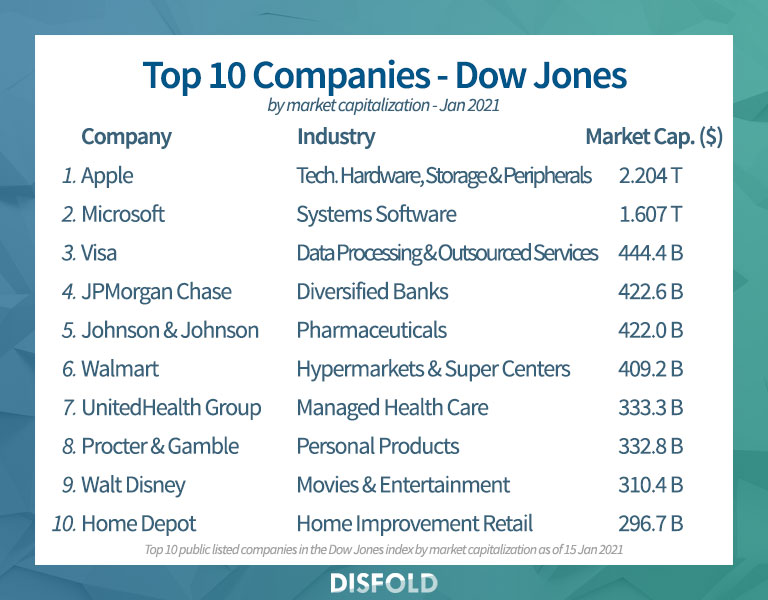
The list of companies in the Dow Jones is not static. It is reviewed periodically to ensure it remains a relevant snapshot of the U.S. economy. As of the most recent rebalancing, the following 30 companies represent the core of the index, categorized by their primary sectors.
Technology and Communication Services
In the modern era, technology has become the dominant force in the Dow. This sector includes some of the most valuable corporations on the planet.
-
Apple Inc. (AAPL): A global leader in consumer electronics and services.
-
Microsoft Corp. (MSFT): A cornerstone of enterprise software and cloud computing.
-
Salesforce Inc. (CRM): The leader in customer relationship management software.
-
Cisco Systems Inc. (CSCO): A major provider of networking hardware and cybersecurity.
-
International Business Machines Corp. (IBM): A pioneer in computing, now focused on hybrid cloud and AI.
-
Intel Corp. (INTC): A fundamental player in the semiconductor industry.
-
Verizon Communications Inc. (VZ): Representing the telecommunications infrastructure of the nation.
-
Amazon.com Inc. (AMZN): A recent addition replacing Walgreens, reflecting the shift toward e-commerce and cloud services.
Financials and Fintech
The financial sector is heavily represented in the Dow, as these institutions are the engines of capital and credit for the rest of the economy.
-
The Goldman Sachs Group Inc. (GS): An investment banking and asset management powerhouse.
-
JPMorgan Chase & Co. (JPM): The largest bank in the United States by assets.
-
American Express Co. (AXP): A leader in premium credit services and payments.
-
Visa Inc. (V): A global payments technology company that bridges the gap between finance and tech.
-
The Travelers Companies Inc. (TRV): A major provider of property and casualty insurance.
Healthcare and Pharmaceuticals
As the U.S. population ages, healthcare has become an increasingly vital part of the economic landscape.
-
UnitedHealth Group Inc. (UNH): A diversified healthcare and insurance giant, currently one of the highest-priced stocks in the index.
-
Johnson & Johnson (JNJ): A massive conglomerate operating in pharmaceuticals and medical devices.
-
Merck & Co. Inc. (MRK): One of the world’s leading research-intensive biopharmaceutical companies.
-
Amgen Inc. (AMGN): A biotechnology pioneer focused on innovative therapies.
Consumer Goods and Retail
These companies represent the spending power of the American consumer, from daily essentials to discretionary purchases.
-
The Coca-Cola Company (KO): An iconic beverage brand with a global footprint.
-
PepsiCo Inc. (PEP): (Note: While often associated with the Dow, Pepsi is a Nasdaq-100 staple; in the Dow, consumer staples are led by Procter & Gamble (PG) and Walmart (WMT)).
-
The Procter & Gamble Company (PG): The parent company of brands like Tide, Gillette, and Crest.
-
Walmart Inc. (WMT): The world’s largest retailer by revenue.
-
The Home Depot Inc. (HD): The premier destination for home improvement.
-
McDonald’s Corp. (MCD): The global leader in fast-food services.
-
Nike Inc. (NKE): The world’s leading athletic footwear and apparel brand.
-
The Walt Disney Company (DIS): A massive media and entertainment conglomerate.
Industrial, Energy, and Materials
While “Industrial” is no longer the sole focus, these companies remain the backbone of American infrastructure and manufacturing.
-
The Boeing Company (BA): A titan in aerospace and defense.
-
Caterpillar Inc. (CAT): The leading manufacturer of construction and mining equipment.
-
3M Company (MMM): A diversified manufacturer known for innovation across health care and consumer goods.
-
Honeywell International Inc. (HON): A conglomerate focused on aerospace, building technologies, and performance materials.
-
Chevron Corp. (CVX): Representing the integrated energy and oil sector.
-
Dow Inc. (DOW): A leader in materials science (not to be confused with the index itself).

How Companies Earn a Spot in the Dow
Unlike many other indices that have strict, formulaic rules based on market capitalization or liquidity, the Dow Jones Industrial Average is managed by the S&P Dow Jones Indices. The selection process is more subjective and is handled by a committee.
Selection Criteria: Beyond Market Cap
To be included in the Dow, a company must have an excellent reputation, demonstrate sustained growth, and be of interest to a large number of investors. The committee also looks for companies that are incorporated and headquartered in the United States. A crucial factor in selection is the stock price. Because the index is price-weighted, the committee avoids adding companies with excessively high stock prices that would distort the index, as well as companies with very low stock prices that would have almost no impact on the index’s value.
The Role of the S&P Index Committee
The committee monitors the index continuously. Changes are made on an as-needed basis rather than on a fixed schedule. Generally, a company is only removed if it undergoes a fundamental change, such as a merger, acquisition, or a significant decline in its market standing. For instance, General Electric (GE), an original member of the index, was famously removed in 2018 after its market influence waned, marking the end of an era.
Comparing the Dow to Other Major Indices
For investors and financial professionals, understanding the Dow requires comparing it to the S&P 500 and the Nasdaq. Each index provides a different perspective on the “Money” landscape.
Dow vs. S&P 500
The S&P 500 is often considered a more accurate representation of the total U.S. stock market because it includes 500 companies and uses market-cap weighting. While the Dow tracks the “best of the best,” the S&P 500 captures a wider swath of mid-cap and large-cap performance. However, because the Dow contains 30 of the most stable and profitable companies, it is often less volatile during market downturns than the broader S&P 500.
Dow vs. Nasdaq Composite
The Nasdaq is heavily skewed toward the technology and biotech sectors. If you want to know how “growth” stocks are doing, you look at the Nasdaq. If you want to know how the established “value” and “income” stocks are doing, you look at the Dow. Many companies, such as Apple and Microsoft, are members of all three indices, highlighting their massive influence on the global financial system.
Why the Dow Jones Still Matters for Your Portfolio
In an era of high-frequency trading and complex financial derivatives, some critics argue that a 30-stock, price-weighted index is an antiquated tool. However, the Dow remains a vital instrument for several reasons.
Indicators of Economic Health
Because the Dow contains the leaders of every major industry—from banking (JPMorgan) to retail (Walmart) to tech (Microsoft)—it acts as a concentrated dose of the American economy. When the “Dow is up,” it generally means that the pillars of American commerce are performing well, which typically correlates with high consumer confidence and strong corporate earnings.

Strategies for Investing in the Dow
Individual investors often use the Dow as a foundation for their portfolios. One popular strategy is the “Dogs of the Dow,” where investors buy the ten highest-yielding dividend stocks in the index at the beginning of the year. This strategy bets on the idea that these blue-chip giants are temporarily undervalued and will see a price correction while paying out steady dividends.
For those who want broad exposure without picking individual stocks, the SPDR Dow Jones Industrial Average ETF (DIA)—often called “Diamonds”—is one of the most liquid and popular exchange-traded funds in the world. It allows investors to own a piece of all 30 companies with a single transaction, providing a balance of growth, value, and dividend income.
The Dow Jones Industrial Average remains the ultimate “who’s who” of corporate America. By understanding the companies that comprise it and the logic behind its structure, investors can gain a clearer picture of market trends and the financial forces driving the global economy. Whether you are a seasoned investor or just starting your journey in personal finance, keeping an eye on these 30 giants is essential for navigating the complexities of the modern market.
aViewFromTheCave is a participant in the Amazon Services LLC Associates Program, an affiliate advertising program designed to provide a means for sites to earn advertising fees by advertising and linking to Amazon.com. Amazon, the Amazon logo, AmazonSupply, and the AmazonSupply logo are trademarks of Amazon.com, Inc. or its affiliates. As an Amazon Associate we earn affiliate commissions from qualifying purchases.