
In the realm of digital architecture, user interface (UI) design, and computational geometry, the parallelogram is far more than a simple four-sided figure found in a middle-school textbook. It represents a fundamental building block for visual dynamics, vector mathematics, and the algorithmic rendering of three-dimensional spaces on two-dimensional screens. While the rectangle dominates our screens and windows, the parallelogram—defined by its unique symmetry and directional lean—serves as the engine for motion, depth, and structural integrity in modern technology.
Understanding the properties of a parallelogram within a tech-centric framework allows developers, designers, and engineers to manipulate digital space with precision. Whether it is calculating the trajectory of a projectile in a physics engine or defining the “skew” of a brand’s aesthetic in a CSS framework, the geometric properties of this quadrilateral are essential.
Geometric Foundations in the Digital Workspace
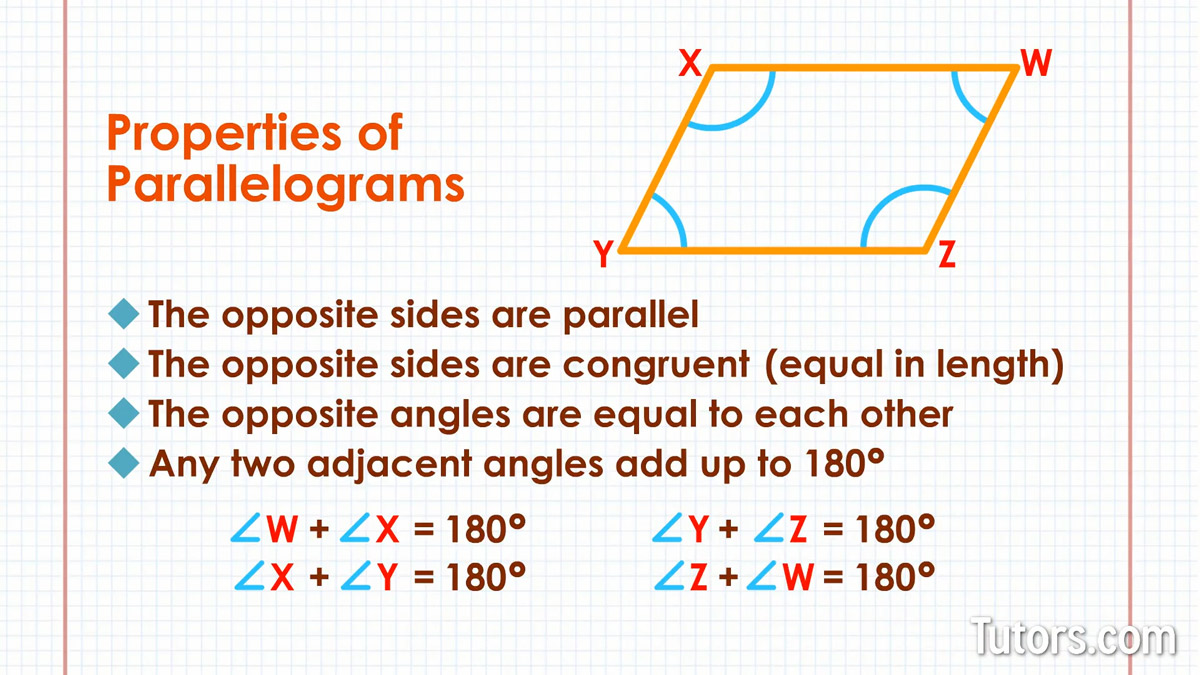
At its core, a parallelogram is a quadrilateral with two pairs of parallel sides. However, in the context of technology and software design, these properties are translated into constraints and variables that govern how objects behave in a virtual environment.
Defining the Parallelogram in a Vector Environment
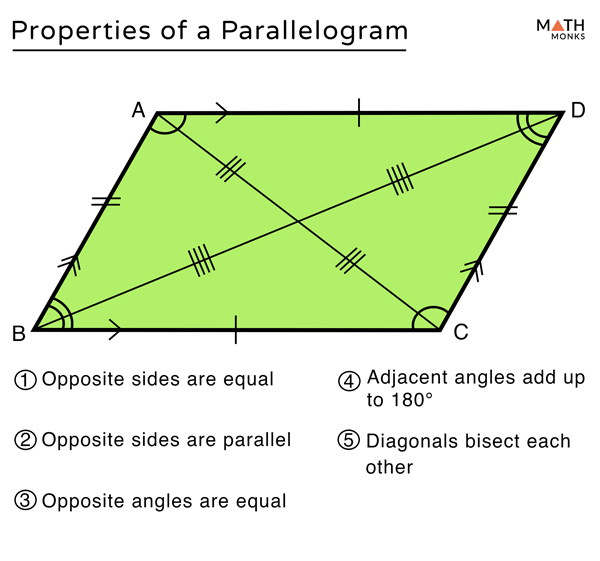
In vector-based software like Figma, Adobe Illustrator, or Inkscape, a parallelogram is defined by its vertices and the vectors that connect them. The primary property—that opposite sides are parallel and equal in length—ensures that the shape maintains its structural integrity during linear transformations. For a developer working with SVG (Scalable Vector Graphics), these properties mean that if you know the coordinates of three vertices, the fourth is mathematically predetermined. This predictability is vital for automated layout engines that need to generate complex shapes without manual input for every coordinate.
Symmetry and Balance: Why UI Designers Use Non-Rectangular Grids
While the “Bento Box” or rectangular grid is the standard for web layouts, the parallelogram introduces a sense of kinetic energy. The property that opposite angles are equal (and consecutive angles are supplementary) allows designers to create “slanted” layouts that still feel balanced to the human eye. By utilizing parallelograms in UI headers or button designs, tech companies can convey speed and progression—think of the slanted “italic” feel of a progress bar or the skewed background cards in a high-performance gaming dashboard. The geometric consistency of the parallelogram ensures that even when the design “leans,” it does not feel broken.
Mathematical Properties and Algorithmic Implementation
Beyond the visual, the mathematical properties of parallelograms are baked into the code that runs our favorite applications. From CSS transitions to the backend logic of CAD (Computer-Aided Design) software, these rules are applied millions of times per second.
Coordinate Geometry and Vertex Calculation
In computational geometry, a key property of the parallelogram is that its diagonals bisect each other. This midpoint property is a shortcut used in many algorithms. For example, if a software program needs to find the center of gravity or the rotation point of a skewed object, it doesn’t need complex calculus; it simply calculates the intersection of the diagonals. For developers writing code in Python or C++, leveraging these geometric shortcuts reduces the computational load, allowing for smoother performance in data visualization and real-time rendering.
Transformations: Skewing and Shearing in CSS and SVG
One of the most common applications of parallelogram properties in web development is the “shear transformation.” In CSS3, the transform: skew() property effectively turns a rectangle into a parallelogram.
- Preservation of Area: A fundamental property of a parallelogram is that its area remains the same as a rectangle with the same base and height, regardless of the slant.
- Parallelism Preservation: During a shear transformation, lines that were parallel before the transformation remain parallel afterward.
This allows developers to create complex, skewed layouts that maintain the readability of the text within them, as the internal logic of the grid remains consistent even as the visual representation is distorted.
Applications in 3D Modeling and Computer Graphics
When we move from 2D screens to 3D environments, the properties of the parallelogram become even more critical. They form the basis of “quads”—the four-sided polygons that make up the meshes of 3D models in software like Blender, Maya, and Unreal Engine.
Texture Mapping and Planar Projections
In 3D rendering, “UV mapping” is the process of projecting a 2D image onto a 3D surface. Because many 3D surfaces are composed of quads (often parallelograms), the software must calculate how to stretch a square texture to fit a skewed surface. The property of proportional side lengths in a parallelogram allows the engine to calculate “interpolation.” It determines how pixels should be distributed across the surface so that the “skin” of a character or the “paint” on a virtual car looks realistic rather than pixelated or stretched.
The Role of Parallelograms in Mesh Generation
While triangles are the smallest unit of 3D rendering (polygons), parallelograms (as quads) are preferred by modelers for “clean topology.” The property of having parallel opposite edges allows for “edge loops,” which are paths of edges that wrap around a model. This is essential for animation. When a 3D character bends an elbow, the parallelogram-based mesh deforms more predictably and smoothly than a triangle-based mesh, preventing “pinching” and visual artifacts in high-end video games and cinematic VFX.
Parallelograms in Game Development and Physics Engines
If you have ever played a 2D platformer or a top-down tactical game, you have interacted with the properties of a parallelogram through the game’s physics and collision logic.
Hitboxes and Collision Detection
In game development, a “hitbox” defines the space an object occupies. While simple games use circles or rectangles, more sophisticated engines use “Oriented Bounding Boxes” (OBBs), which are often parallelograms. The property that any line segment passing through the center of a parallelogram and terminating at the sides is bisected by the center allows physics engines to calculate “Narrow Phase” collision detection. This means the game can determine exactly where a sword hit a shield, even if the shield is held at an angle, by calculating the intersection points within the parallelogram’s coordinate space.
Vector Addition: The Parallelogram Law of Forces
One of the most famous applications of this shape in tech is the “Parallelogram Law of Vector Addition.” In physics engines (like Havok or Unity’s PhysX), when two forces act on an object—such as wind blowing a sail while the boat’s engine pushes it forward—the resulting movement is calculated by forming a parallelogram from the two force vectors. The diagonal of that parallelogram represents the resulting velocity and direction. Without this geometric property, developers would struggle to simulate realistic movement in flight simulators, racing games, or robotics software.
The Future of Computational Geometry in AI and VR
As we look toward the future of technology, the properties of the parallelogram are being applied to even more abstract fields, such as artificial intelligence and virtual reality (VR).
Neural Networks and Spatial Data Analysis
In machine learning, specifically in the field of “manifold learning,” researchers often project high-dimensional data into lower-dimensional spaces. This process frequently involves “affine transformations,” where the properties of parallelograms are used to map relationships between data points. By maintaining the parallel nature of certain data clusters, AI can more accurately identify patterns in image recognition and natural language processing. The parallelogram serves as a mathematical anchor for preserving the “distance” between concepts in a vector space.

Immersive Interfaces and Non-Euclidean Perspectives
In Virtual and Augmented Reality (VR/AR), the user’s perspective is constantly shifting. As a user moves through a digital room, rectangular walls appear as parallelograms due to perspective distortion. VR hardware (like the Meta Quest or Apple Vision Pro) must perform real-time “reprojection” based on the geometric properties of these skewed shapes. By understanding how a rectangle transforms into a parallelogram from a specific viewing angle, the software can correct for lens distortion and prevent motion sickness, ensuring that the digital world feels as stable and “parallel” as the physical one.
In conclusion, the parallelogram is far more than a geometric curiosity. Its properties—parallelism, equal opposite angles, bisecting diagonals, and area consistency—form the mathematical scaffolding for the modern tech stack. From the way a button is rendered on your smartphone to the way a force is calculated in a physics simulation, the properties of the parallelogram are integral to the precision and beauty of our digital world. As technology continues to evolve into more complex spatial environments, our reliance on these fundamental geometric truths will only deepen.
aViewFromTheCave is a participant in the Amazon Services LLC Associates Program, an affiliate advertising program designed to provide a means for sites to earn advertising fees by advertising and linking to Amazon.com. Amazon, the Amazon logo, AmazonSupply, and the AmazonSupply logo are trademarks of Amazon.com, Inc. or its affiliates. As an Amazon Associate we earn affiliate commissions from qualifying purchases.