
Understanding the various forms of unemployment is more than just an academic exercise; it’s a critical component of personal financial planning, business strategy, and broader economic health. For individuals, knowing why you might be out of work can inform your savings goals, career development, and investment decisions. For businesses, recognizing the types of unemployment helps in workforce planning, risk management, and understanding market demand. From a macro perspective, these categories guide monetary and fiscal policies, influencing interest rates, inflation, and government spending – all factors that profoundly impact personal and business finance.

Understanding the Economic Landscape of Joblessness
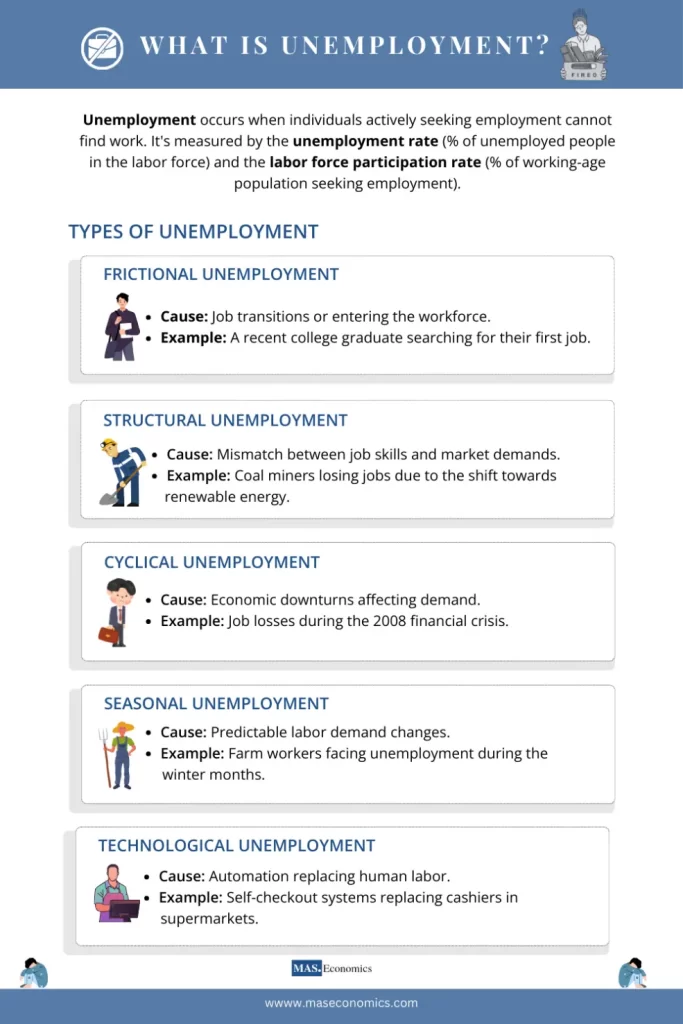
Unemployment, defined as the state of being jobless while actively seeking work, is a core economic indicator that can signal the health of a nation’s economy. High unemployment rates often correlate with reduced consumer spending, lower corporate profits, and increased reliance on social safety nets. Conversely, low unemployment can signify a booming economy, rising wages, and increased investment. Economists typically break down unemployment into four distinct categories, each with its unique causes, characteristics, and, crucially, its specific financial implications. These types help us differentiate between temporary market adjustments and deeper structural issues, allowing for more targeted financial preparation and policy responses.
Frictional Unemployment: The Natural Turnover
Frictional unemployment represents the natural, short-term period of joblessness that occurs when individuals are transitioning between jobs, entering the workforce for the first time, or re-entering after a period of absence. It is often considered a healthy and inevitable part of a dynamic labor market.
Defining Frictional Unemployment
This type of unemployment is largely voluntary or temporary. Examples include a recent college graduate searching for their first professional role, an individual leaving one job to seek better opportunities, or someone relocating for personal reasons and needing to find new employment. The “friction” refers to the time it takes to match job seekers with suitable vacancies, involving processes like resume submissions, interviews, and background checks. This form of unemployment is usually brief, reflecting the natural ebb and flow of the labor market rather than a lack of available jobs or skills.
Financial Implications for Individuals and Businesses
For individuals, navigating frictional unemployment often requires a robust emergency fund. Having three to six months of living expenses saved can bridge the income gap between jobs, preventing reliance on high-interest debt or depletion of investment accounts. It also allows individuals the luxury of being selective, ensuring their next role aligns better with their career goals and financial aspirations, potentially leading to higher long-term earnings. From a personal finance perspective, a well-managed job search during frictional unemployment can be an investment in human capital, yielding better returns down the line.
For businesses, frictional unemployment translates into ongoing recruitment costs and a fluctuating talent pool. Companies must budget for advertising job openings, conducting interviews, and onboarding new employees. While it presents a cost, it also indicates a fluid labor market where businesses can find new talent with specialized skills. Strategic human resource planning, including competitive compensation and benefits, becomes crucial to attract and retain the best candidates, mitigating the financial impact of employee turnover and ensuring business continuity.
Structural Unemployment: A Mismatch of Skills
Structural unemployment arises when there’s a fundamental mismatch between the skills workers possess and the skills employers require, or when jobs are geographically available in different locations than the available workforce. Unlike frictional unemployment, it tends to be long-term and often requires significant adjustments from individuals and industries.
Identifying Structural Gaps
This type of joblessness is frequently driven by profound economic shifts. Technological advancements, such as automation replacing manufacturing jobs or AI transforming administrative roles, can render existing skills obsolete. Industry declines, like the reduction in coal mining or traditional media, also lead to structural unemployment. Globalization, which can shift production to countries with lower labor costs, is another significant factor. Furthermore, geographical immobility, where workers are unable or unwilling to relocate to areas with job openings, contributes to this problem.
Long-Term Financial Challenges
The financial consequences of structural unemployment can be severe and protracted for individuals. Those affected often face extended periods of unemployment, leading to a significant loss of income and potential depletion of savings, including retirement funds. Without new skills, their earning potential can be permanently reduced. This often necessitates investment in retraining, reskilling, or higher education, which can be costly and time-consuming, possibly requiring loans or government assistance programs. Personal budgeting becomes incredibly tight, and debt accumulation is a common challenge, impacting credit scores and future financial opportunities.
For businesses, structural unemployment presents a paradox: a lack of suitable talent despite high overall unemployment. Companies in growing sectors may struggle to find workers with the necessary specialized skills, leading to slower expansion, increased training costs for new hires, or even offshoring work. This can impact innovation, productivity, and ultimately, profitability. From a business finance perspective, it highlights the need for continuous investment in employee training and development, as well as proactive engagement with educational institutions to cultivate future talent pipelines. Government policies often respond with retraining programs, educational subsidies, and relocation incentives to address these deep-seated imbalances, all of which have significant budgetary implications.
Cyclical Unemployment: The Business Cycle’s Shadow
Cyclical unemployment is directly tied to the overall health of the economy, rising during economic downturns (recessions or depressions) and falling during periods of economic growth (expansions). It is the most visible and often most feared type of unemployment.
Unpacking Economic Downturns
When an economy contracts, consumer spending typically falls, leading to reduced demand for goods and services. In response, businesses experience lower revenues and profits, prompting them to cut costs. Layoffs become common as companies shed workers to align their capacity with reduced demand. Industries particularly sensitive to economic fluctuations, such as manufacturing, construction, and retail, are often hit hardest. Cyclical unemployment is a systemic issue, reflecting a broad-based slowdown across multiple sectors, rather than isolated industry shifts or individual job transitions.
Navigating Financial Hardship During Recessions
For individuals, cyclical unemployment can be devastating. Layoffs are often sudden and widespread, impacting many simultaneously, which can make finding a new job extremely difficult due to the sheer volume of available workers and fewer openings. Emergency funds are crucial during these times, providing a financial buffer. Without adequate savings, individuals may be forced to draw down retirement accounts, accrue high-interest credit card debt, or default on loans, severely damaging their long-term financial stability and creditworthiness. Government unemployment benefits provide a partial income replacement, but rarely cover all expenses, necessitating careful budgeting and spending reductions.
Businesses face significant financial strain during periods of cyclical unemployment. Reduced sales lead to cash flow problems, making it difficult to cover operational costs, debt payments, and payroll. This can result in further layoffs, bankruptcies, and reduced investment in future growth. Financial tools like lines of credit and careful cash flow management become vital. Governments typically respond with fiscal stimulus (e.g., infrastructure spending, tax cuts) and monetary policy adjustments (e.g., lower interest rates by central banks) to stimulate demand and encourage borrowing and investment, aiming to shorten the recession and mitigate unemployment. These interventions, while necessary, have profound impacts on national debt, inflation, and the cost of capital.
Seasonal Unemployment: Predictable Rhythms
Seasonal unemployment occurs when people are out of work because of regular, predictable fluctuations in demand for labor at different times of the year. This type of unemployment is less about economic crises and more about the inherent nature of specific industries.
Explaining Predictable Job Fluctuations
Certain sectors naturally experience peak and off-peak periods. Agriculture, for instance, requires more workers during planting and harvesting seasons than in winter. Tourism and hospitality industries see increased demand during holidays and warmer months. Retail often hires extra staff for the busy holiday shopping season and then reduces headcount afterwards. Construction activity typically slows down in colder weather. These fluctuations are anticipated and largely predictable, forming a regular pattern of job creation and loss throughout the year.
Financial Planning for Seasonal Work
Individuals in seasonal industries require meticulous financial planning to manage income variability. Saving a significant portion of earnings during peak seasons is crucial to cover living expenses during the lean months. Budgeting tools and strategies, such as creating a yearly budget rather than monthly, are essential. Some individuals actively seek supplementary income or “gig economy” work during their off-season to smooth out their earnings. Diversifying skills or gaining certifications that allow for work in multiple seasonal industries can also be a valuable strategy to maintain consistent income. Relying solely on unemployment benefits during the off-season can be financially precarious given their limited scope.
For businesses operating in seasonal sectors, workforce planning is key to optimizing profitability. This includes temporary hiring, utilizing part-time staff, and cross-training employees to perform different roles during various seasons. Strategic financial management involves forecasting seasonal revenues and expenses, managing inventory carefully, and potentially diversifying business activities to generate revenue during off-peak times. For example, a summer resort might offer conference facilities in the winter. From a financial perspective, managing cash flow is paramount, often requiring lines of credit or careful management of working capital to bridge the gaps between peak seasons.

The Broader Financial Impact and Policy Responses
The interplay of these four types of unemployment significantly influences a nation’s overall financial health. High unemployment across any category leads to reduced tax revenues for governments, increased spending on social welfare programs like unemployment insurance, and a potential rise in national debt. For financial markets, sustained high unemployment can signal economic weakness, affecting investor confidence, stock valuations, and interest rate outlooks.
Policymakers, guided by economic data on unemployment types, employ various tools to mitigate their impact. Monetary policy, managed by central banks, might involve adjusting interest rates to stimulate borrowing and investment (to combat cyclical unemployment) or cool down an overheating economy. Fiscal policy, enacted by governments, can include infrastructure projects, tax incentives, and direct spending programs aimed at creating jobs or providing retraining opportunities (addressing structural and cyclical unemployment). Unemployment insurance schemes provide a safety net for those experiencing frictional, cyclical, and seasonal job losses, allowing them to maintain some purchasing power and financial stability.
For individuals and businesses alike, a deep understanding of these unemployment types fosters better financial resilience. Building robust emergency funds, continuously investing in skill development, diversifying income streams, and carefully managing debt are all strategies that help navigate the inevitable fluctuations of the labor market. Recognizing the causes behind joblessness allows for more informed financial decisions, whether it’s saving more diligently, pursuing further education, or adjusting business models to withstand economic cycles.
aViewFromTheCave is a participant in the Amazon Services LLC Associates Program, an affiliate advertising program designed to provide a means for sites to earn advertising fees by advertising and linking to Amazon.com. Amazon, the Amazon logo, AmazonSupply, and the AmazonSupply logo are trademarks of Amazon.com, Inc. or its affiliates. As an Amazon Associate we earn affiliate commissions from qualifying purchases.