
Tesla Inc. has undeniably revolutionized the automotive industry, not just by popularizing electric vehicles (EVs), but by approaching car manufacturing from a technology-first perspective. Far more than mere transportation, Tesla’s vehicles are sophisticated, software-defined machines that integrate advanced battery technology, artificial intelligence, and a comprehensive digital ecosystem. Understanding the various Tesla models isn’t just about listing different cars; it’s about appreciating the diverse applications of a singular, groundbreaking technological philosophy. This article delves into the distinct characteristics and technological advancements embedded within each of Tesla’s principal vehicle offerings, exploring how they collectively push the boundaries of automotive engineering and user experience.

The Core Pillars of Tesla’s Vehicle Architecture
At the heart of every Tesla model lies a foundational suite of technologies that differentiate them from traditional internal combustion engine (ICE) vehicles and even many competing EVs. These core pillars define the driving experience, performance, and long-term value proposition of Tesla’s fleet.
Proprietary Battery Technology and Powertrains
Tesla’s ascendancy is inextricably linked to its mastery of battery technology and electric powertrains. Unlike many manufacturers who source off-the-shelf components, Tesla has invested heavily in designing and manufacturing its own battery cells (such as the 2170 and the newer 4680 cells), battery packs, and electric motors. This vertical integration allows for optimized energy density, thermal management, and power delivery. The result is vehicles with industry-leading range, blistering acceleration, and efficient charging capabilities. Their permanent magnet synchronous reluctance motors, for instance, are engineered for high efficiency across a wide range of speeds, providing instant torque that redefines performance expectations for consumer vehicles. The continuous refinement of battery chemistry and structural battery pack designs further promise increased range, reduced costs, and enhanced vehicle safety.
Software-Defined Vehicles and Over-the-Air Updates
Perhaps the most radical departure from traditional automotive manufacturing is Tesla’s software-first approach. A Tesla vehicle is essentially a computer on wheels, with almost every aspect of its functionality – from powertrain management and infotainment to driver-assistance systems and climate control – governed by intricate software. This architecture enables unprecedented flexibility and continuous improvement through over-the-air (OTA) updates. Owners routinely receive updates that introduce new features, enhance existing functionalities, improve performance, extend range, or even fix issues, all without a visit to a service center. This paradigm shift means a Tesla vehicle can literally get better over time, fundamentally altering the ownership experience and setting a benchmark for the connected car era.
Advanced Driver-Assistance Systems (ADAS): Autopilot and Full Self-Driving (FSD)
A hallmark of Tesla’s technological ambition is its suite of advanced driver-assistance systems. Standard on all models, Autopilot offers sophisticated safety and convenience features, including adaptive cruise control, lane keeping, and automatic lane changes. The optional Full Self-Driving (FSD) Capability builds upon this with features like Navigate on Autopilot (automatic driving from highway on-ramp to off-ramp, including interchanges and overtakes), Auto Lane Change, Autopark, Summon, and Traffic Light and Stop Sign Control. Crucially, FSD is an evolving technology, powered by a sophisticated neural network trained on billions of miles of real-world driving data collected from its fleet. The hardware suite, consisting primarily of multiple high-resolution cameras, ultrasonic sensors, and a powerful onboard computer, is designed to provide a 360-degree view around the car, enabling its AI to perceive the environment and make driving decisions with increasing autonomy.
A Comprehensive Overview of Tesla’s Passenger Vehicle Lineup
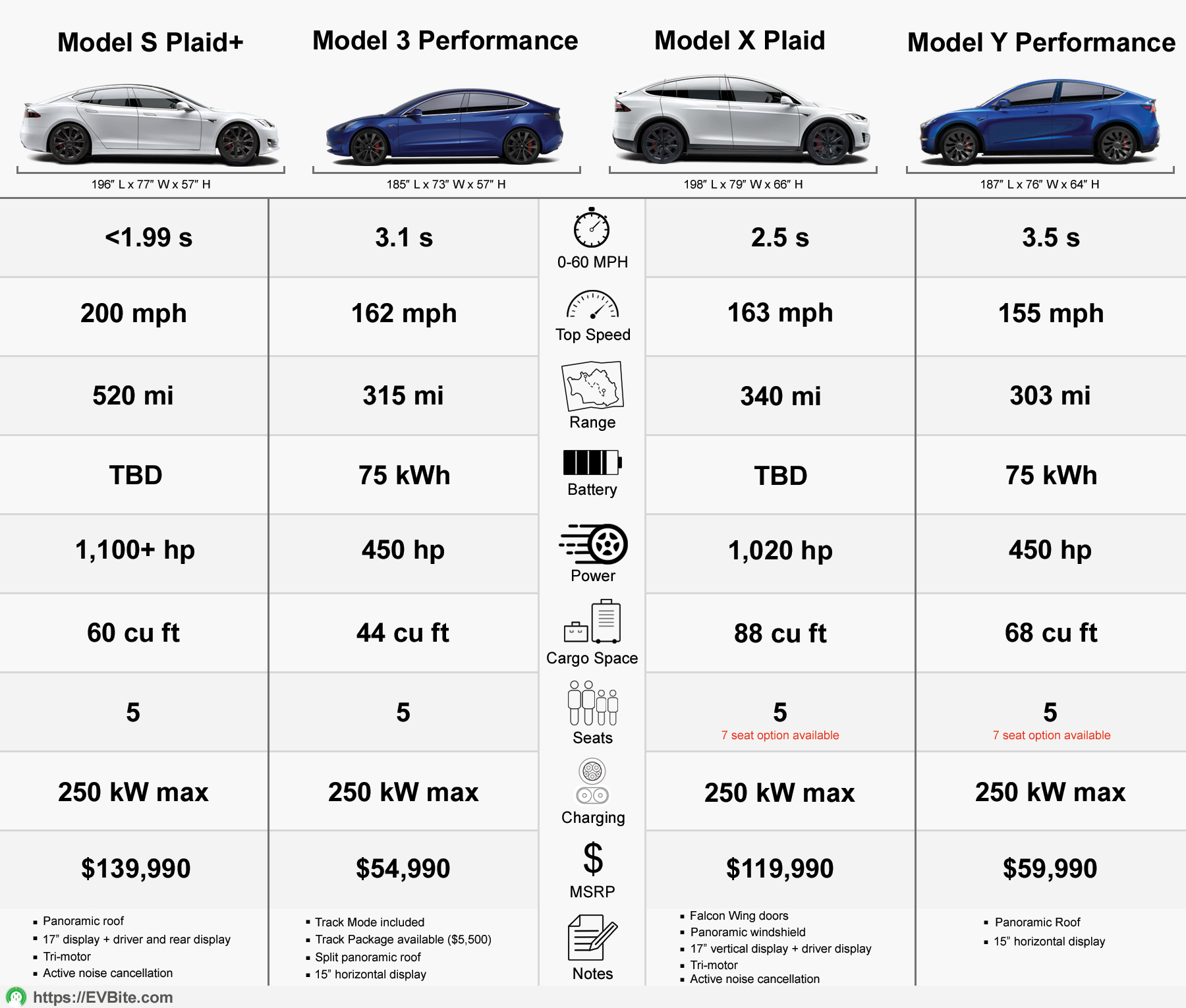
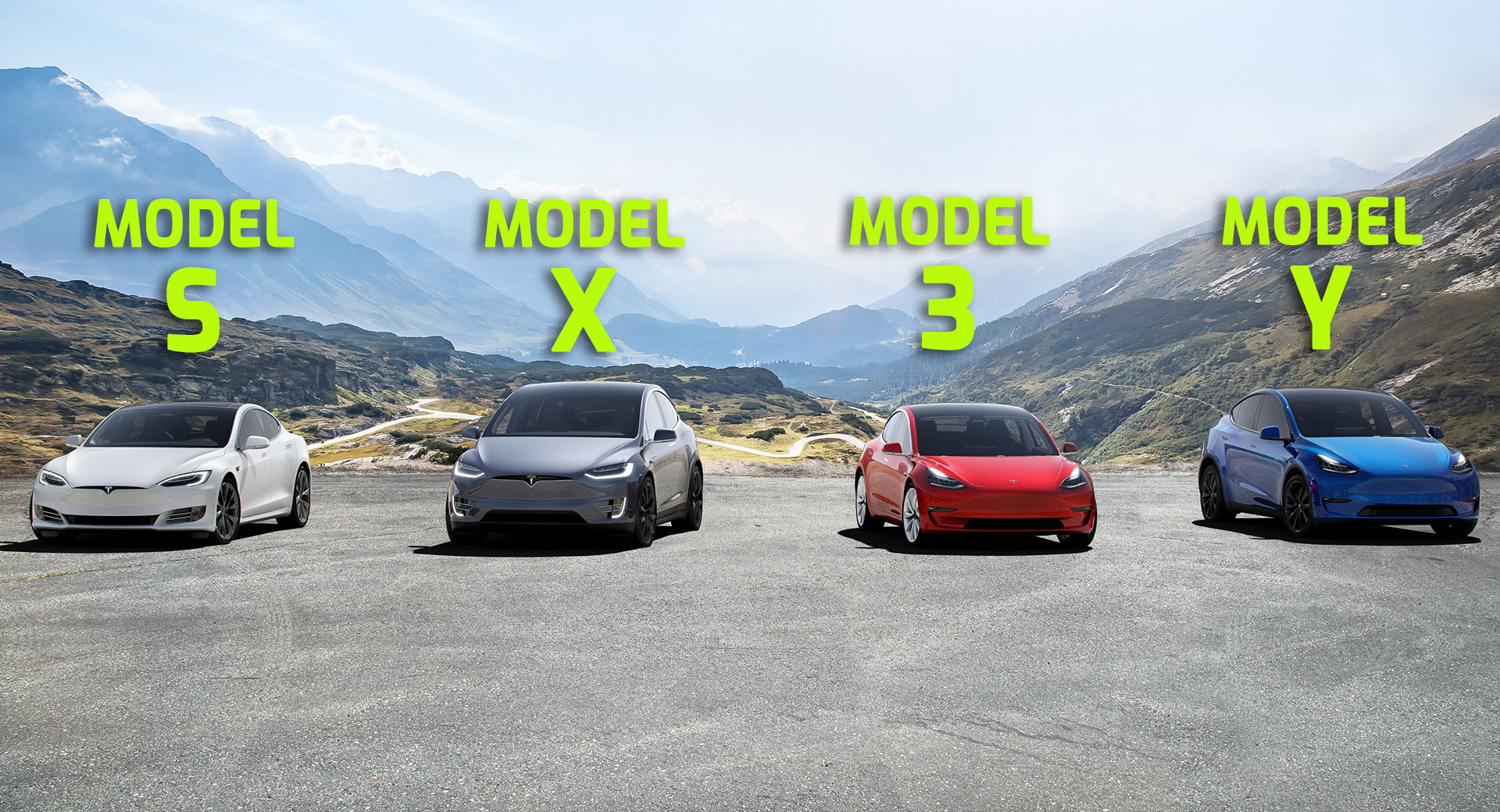
Tesla’s current passenger vehicle lineup consists of four distinct models, each designed to cater to different segments of the market while upholding the brand’s core technological principles.
Tesla Model S: The Flagship of Electric Luxury Performance
Introduced in 2012, the Model S established Tesla’s reputation for long-range, high-performance electric vehicles. As a full-size luxury sedan, it combines executive comfort with supercar-rivalling acceleration. Its sleek, aerodynamic design minimizes drag, contributing to its impressive range. The latest iterations, particularly the Plaid variant, boast astonishing acceleration figures (0-60 mph in under 2 seconds) thanks to a tri-motor all-wheel-drive (AWD) powertrain, showcasing the extreme potential of electric propulsion. Inside, the Model S features a minimalist cabin dominated by a large, horizontal touchscreen display that serves as the command center for infotainment, navigation, and vehicle controls, complemented by a secondary screen for the driver and a third for rear passengers in newer models. Its advanced air suspension system adapts to road conditions, ensuring a smooth and responsive ride.
Tesla Model 3: Engineering for Mass-Market Electric Mobility
Launched in 2017, the Model 3 was envisioned as Tesla’s more affordable, mass-market offering, playing a pivotal role in accelerating the world’s transition to sustainable energy. It retains much of Tesla’s core technology, albeit in a more compact and streamlined package. The Model 3’s design prioritizes manufacturing efficiency, making extensive use of automation in its production process. Despite its smaller size, it delivers excellent range and impressive performance, with various rear-wheel-drive (RWD) and AWD configurations. Its interior is even more minimalistic than the Model S, featuring a single, centrally mounted touchscreen that consolidates all vehicle information and controls. The Model 3 is a testament to Tesla’s ability to scale its technology and make high-performance EVs accessible to a broader audience.
Tesla Model X: Redefining the Electric SUV Segment
The Model X, an all-electric mid-size luxury SUV, stands out with its unique Falcon Wing Doors that articulate upwards, allowing for easier access to the second and third rows. Introduced in 2015, it combines SUV utility with groundbreaking technology and performance. Like the Model S, it features dual or tri-motor AWD configurations, offering substantial power and exhilarating acceleration for a vehicle of its size. Beyond the distinctive doors, the Model X incorporates a HEPA air filtration system, providing unparalleled cabin air quality, and offers flexible seating configurations for up to seven passengers. Its expansive panoramic windshield extends over the front passengers, offering an unobstructed view and a sense of openness. The Model X exemplifies Tesla’s willingness to push design and engineering boundaries in pursuit of both utility and innovation.
Tesla Model Y: The Versatile Electric Crossover for the Modern Era
The Model Y, a compact crossover SUV, entered the market in 2020 and quickly became one of Tesla’s most popular models due to its blend of practicality, performance, and relatively accessible price point. Sharing many components with the Model 3, including its platform, powertrain, and interior design, the Model Y offers increased cargo space, a higher driving position, and an optional third row of seats, making it a highly versatile family vehicle. Its manufacturing process has also been at the forefront of innovation, utilizing technologies like gigacasting to simplify the body structure, reduce production costs, and improve manufacturing efficiency. The Model Y embodies Tesla’s strategy of leveraging existing technology platforms to rapidly expand its product portfolio and address diverse market demands.
Beyond Passenger Cars: Expanding the Technological Horizon
Tesla’s vision extends beyond conventional passenger cars, encompassing revolutionary designs and broader energy solutions that intertwine with its automotive offerings.
The Revolutionary Tesla Cybertruck: A New Paradigm for Utility
Unveiled with a polarizing, futuristic design in 2019 and entering limited production in late 2023, the Cybertruck is unlike any other vehicle on the road. Its stainless-steel exoskeleton, shatter-resistant armor glass, and robust construction are engineering marvels intended for extreme durability and utility. From a technological standpoint, it pushes boundaries with its steer-by-wire system, adaptive air suspension, and impressive towing capacity combined with sports car-like acceleration in its top trims. It also integrates innovative features like bi-directional charging, allowing it to power external devices or even a home, and a versatile ‘vault’ bed with a powered tonneau cover. The Cybertruck represents Tesla’s bold foray into the truck market, aiming to disrupt traditional utility vehicles with radical design and advanced EV technology.
The Next-Generation Tesla Roadster: Hypercar Redefined
The second-generation Roadster, initially revealed in 2017, is Tesla’s re-entry into the high-performance sports car segment. Positioned as an electric hypercar, it promises unprecedented performance figures, including a 0-60 mph time of 1.9 seconds, a top speed exceeding 250 mph, and a projected range of over 620 miles on a single charge. These incredible metrics are achieved through advancements in battery technology, powerful electric motors, and sophisticated aerodynamics. The Roadster aims to showcase the ultimate potential of electric propulsion, pushing the boundaries of what’s possible in automotive performance and challenging the dominance of traditional hypercars.
Integration with the Tesla Ecosystem: Supercharging and Energy Solutions
Integral to the functionality and appeal of all Tesla models is the expansive Supercharger network. This proprietary global fast-charging infrastructure alleviates range anxiety, allowing owners to embark on long-distance journeys with confidence. The seamless integration of Superchargers with in-car navigation automatically plans routes with charging stops, ensuring convenience. Beyond charging, Tesla vehicles are part of a larger energy ecosystem that includes Powerwall home battery storage and solar panels, reflecting the company’s holistic approach to sustainable energy. Future advancements, such as enhanced vehicle-to-grid (V2G) capabilities, could further integrate Tesla vehicles into smart home and energy grids, transforming them from mere transportation devices into dynamic energy assets.
Tesla’s Continuous Innovation and Future Trajectory
Tesla’s current model lineup is a dynamic snapshot of its ongoing technological evolution, driven by relentless innovation in several key areas.
Artificial Intelligence and Robotics in Vehicle Development
AI is not just central to Tesla’s FSD ambitions but also pervades its manufacturing processes and future product developments. From the Dojo supercomputer training its neural networks for autonomous driving to advanced robotics in its Gigafactories, AI is an enabler across the board. The Optimus humanoid robot project, while still nascent, hints at Tesla’s long-term vision to apply its AI and robotics expertise beyond vehicles, potentially revolutionizing manufacturing and various other sectors. This deep integration of AI influences how vehicles are designed, built, and how they interact with their environment.
Battery Day and Beyond: The Quest for Energy Density and Cost Reduction
Tesla’s “Battery Day” events have provided insights into its aggressive roadmap for battery innovation. The development of 4680 battery cells, for example, promises increased energy density, improved power output, and a more efficient manufacturing process through dry electrode technology. These advancements are critical for achieving longer ranges, faster charging, and significantly reducing the cost per kilowatt-hour, which is vital for making EVs more affordable and sustainable. The pursuit of more sustainable battery materials and recycling processes also underscores Tesla’s commitment to environmental responsibility.
The Software-First Approach: Shaping the Driving Experience
The true genius of Tesla’s model strategy lies in its commitment to a software-first approach. By designing vehicles as platforms that can be continuously updated and improved through software, Tesla ensures that its models remain cutting-edge long after they leave the factory floor. This iterative development cycle, informed by vast amounts of real-world driving data, allows for rapid iteration of features, enhanced safety protocols, and a perpetually evolving user experience. It’s this software dynamism that future-proofs Tesla’s diverse range of models and keeps them at the forefront of automotive technology.
In conclusion, Tesla’s different models—from the luxurious Model S to the utilitarian Cybertruck—are more than just distinct vehicle types; they are tangible manifestations of a singular, overarching technological vision. Each model embodies Tesla’s pioneering spirit in electric powertrains, advanced software integration, and autonomous driving capabilities. As Tesla continues to refine its battery technology, AI systems, and manufacturing processes, its evolving lineup promises to further cement its role as a transformative force in the automotive and energy sectors, pushing the boundaries of what is possible in personal transportation.
aViewFromTheCave is a participant in the Amazon Services LLC Associates Program, an affiliate advertising program designed to provide a means for sites to earn advertising fees by advertising and linking to Amazon.com. Amazon, the Amazon logo, AmazonSupply, and the AmazonSupply logo are trademarks of Amazon.com, Inc. or its affiliates. As an Amazon Associate we earn affiliate commissions from qualifying purchases.