
The realm of video games has transcended its niche origins to become a global cultural and economic powerhouse. What started as pixelated novelties has evolved into a multi-billion dollar industry, captivating billions and shaping digital entertainment. Within this vast landscape, certain titles stand out, not just for their critical acclaim or cultural impact, but for their sheer commercial dominance – their ability to reach an unprecedented number of players worldwide. Delving into “what are the best selling video games of all time” is more than just a list; it’s an exploration of technological innovation, astute brand strategy, and the immense financial implications that underpin these digital blockbusters.
Defining Gaming’s Grandest Achievements: More Than Just Numbers
Before we dive into the titans of the industry, it’s crucial to establish what “best-selling” truly means in the context of video games. Unlike movies or music, which often have clearer metrics for sales (tickets sold, album units), video games present a more complex picture.
The Elusive “Units Sold”: A Complex Metric
The primary metric for best-selling games is usually “units sold,” encompassing physical copies shipped to retailers and digital downloads. However, this seemingly straightforward number is fraught with complexities. Data often comes from various sources – publishers, market research firms, and sometimes estimations – and these figures can fluctuate. Some publishers include bundled sales (games sold alongside consoles), while others might count free-to-play conversions that later monetize. Furthermore, the longevity of a game plays a massive role; titles released decades ago have had more time to accumulate sales than recent blockbusters. The absence of a single, universally verified database means many figures are estimates, albeit well-researched ones. Nevertheless, certain games have consistently appeared at the top, irrespective of minor statistical variations, solidifying their status.
Beyond Sales: Revenue, Longevity, and Cultural Impact
While units sold provide a snapshot of market penetration, they don’t tell the whole story. Revenue, for instance, offers a different perspective. A game with fewer units sold but significant post-launch monetization (DLC, microtransactions, season passes) might generate more profit than a game with higher initial unit sales. This is particularly true in the modern gaming era, where games as a service (GaaS) models are prevalent.
Longevity is another critical factor. Many best-selling games have remained relevant for years, even decades, through continuous updates, community engagement, and new platform releases. This sustained interest transforms a game from a mere product into a cultural touchstone. Their impact extends beyond the screen, influencing other media, fashion, and even language, cementing their place not just in sales charts, but in the collective consciousness. Understanding these nuances helps us appreciate the true magnitude of a game’s success.
The Pantheon of Digital Titans: Unpacking the Best Sellers
When we sift through the sales data, certain names emerge consistently at the pinnacle, representing a diverse array of genres, platforms, and eras. These are the games that have transcended generations and geographical boundaries.
The Ubiquitous Worlds: Minecraft and Grand Theft Auto V
At the very top, two games frequently contend for the crown: Minecraft and Grand Theft Auto V.
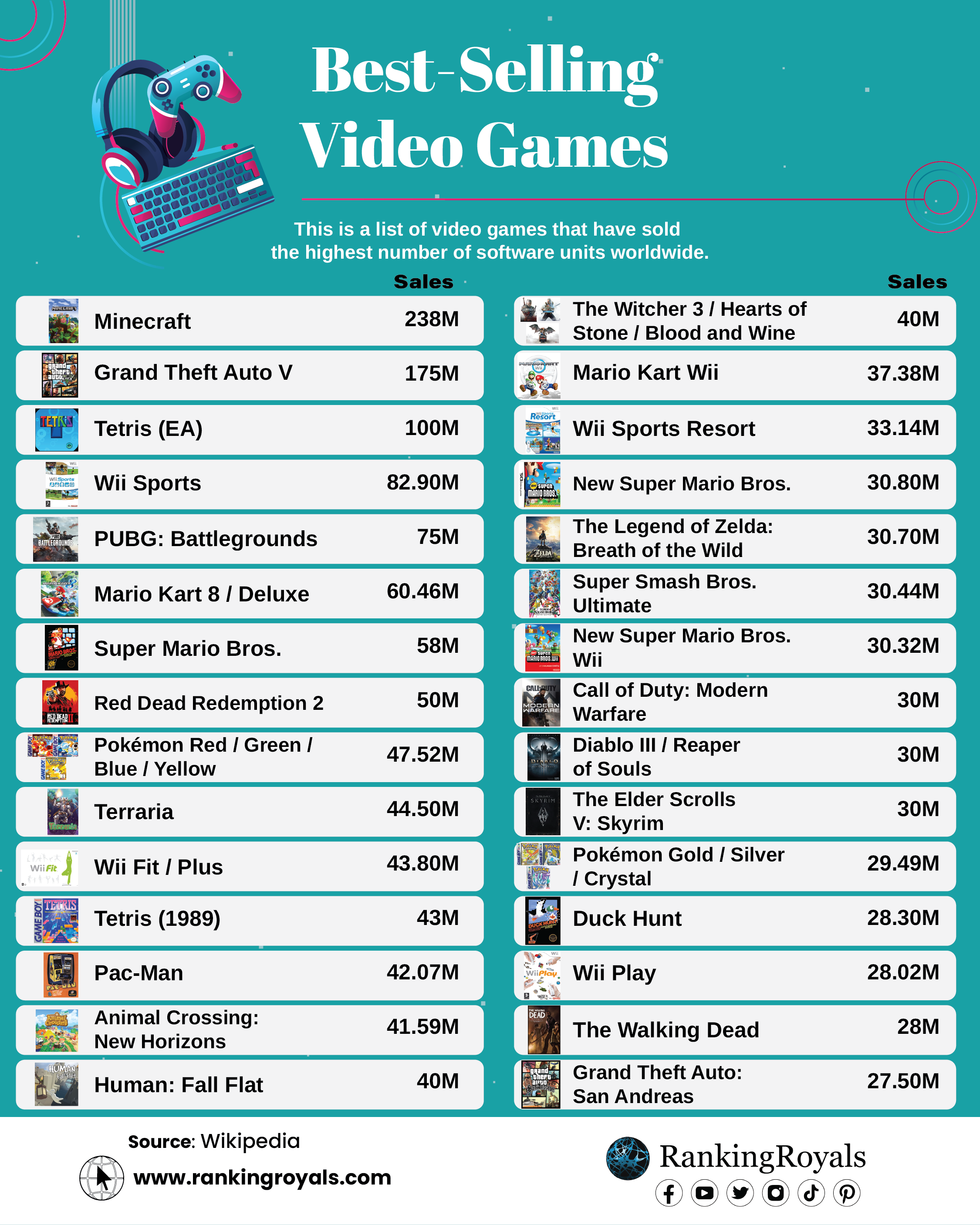
Minecraft, developed by Mojang and acquired by Microsoft, is often cited as the best-selling video game of all time, with over 300 million units sold across virtually every platform imaginable as of late 2023. Its success lies in its deceptively simple premise: a sandbox world where players can build, explore, and survive. Its blocky aesthetic, infinite possibilities, and robust multiplayer features fostered a massive global community. From an AI tools perspective, procedural generation plays a significant role in creating its endless worlds, a concept that continues to evolve with more sophisticated AI algorithms in game design. The game’s brand is not just about its sales; it’s about a platform for creativity, education, and community, spawning countless YouTube channels, merchandise lines, and even educational versions.
Grand Theft Auto V (GTA V), from Rockstar Games, holds the distinction of being one of the most profitable entertainment products ever created, with over 195 million units sold and revenue exceeding $8 billion. Launched in 2013, its longevity is unprecedented, thanks largely to its incredibly popular online component, Grand Theft Auto Online. This game pushed technological boundaries at its release with its vast open world, intricate details, and compelling narrative. Its success is a testament to the power of a strong brand strategy, consistent content updates for its online mode, and a loyal fanbase eager to engage with its irreverent humor and action-packed gameplay.
Nintendo’s Enduring Legacy: Mario, Pokémon, and Wii Sports
Nintendo, a pioneer in the video game industry, has consistently produced best-selling titles that leverage its beloved intellectual properties and innovative hardware.
The Super Mario franchise, while not a single game, collectively represents hundreds of millions of sales. Iconic titles like Super Mario Bros. (over 40 million on NES), Mario Kart 8 Deluxe (over 60 million on Switch and Wii U combined), and Super Mario Odyssey (over 27 million on Switch) showcase the enduring appeal of its flagship character. Mario’s success is a masterclass in corporate identity and brand consistency, evolving with technology while retaining its core accessible gameplay.
Pokémon, another Nintendo/Game Freak phenomenon, is a juggernaut in its own right. From the original Pokémon Red/Blue/Green (over 31 million) to modern hits like Pokémon Sword/Shield (over 26 million) and Pokémon Scarlet/Violet (over 24 million), the franchise has sold hundreds of millions of units across its main series games. Its success is fueled by a brilliant marketing strategy that leverages collecting, trading, and battling, creating a strong sense of community and perpetual engagement across games, anime, and merchandise.
Perhaps one of the most surprising entries is Wii Sports. Bundled with the Nintendo Wii console, it sold over 82.9 million copies, making it the best-selling single-platform game. Its brilliance lay in its simplicity and accessibility, demonstrating the potential of motion controls to engage a broader, non-traditional gaming audience. It was a perfect marriage of hardware and software, a testament to Nintendo’s ability to innovate and expand the gaming market.
The Global Phenomenon: Tetris and Other Cross-Platform Giants
Before the internet truly connected the world, one game achieved truly global ubiquity: Tetris. Originally developed in the Soviet Union, Tetris has sold an estimated 100 million copies across mobile platforms alone, with hundreds of millions more across its myriad versions on consoles, PCs, and handhelds (including its iconic bundling with the original Game Boy). Its simple, addictive puzzle gameplay transcended language and cultural barriers, proving that elegantly designed mechanics can be universally appealing. Its digital security implications were minimal given its era, but its productivity impact on those playing it was certainly noticeable!
Other notable cross-platform hits include PlayerUnknown’s Battlegrounds (PUBG), which pioneered the battle royale genre and sold over 75 million units on PC and consoles, with its mobile version having billions of downloads (though primarily free-to-play). The game’s focus on competitive multiplayer showcased the power of digital security measures to maintain fair play in a high-stakes environment.
Call of Duty and the Power of Annual Iteration
The Call of Duty franchise is another colossus, consistently ranking among the best-selling titles year after year. While individual titles vary, games like Modern Warfare (2019), Black Ops and Modern Warfare 3 each sold over 30 million units, contributing to the franchise’s cumulative sales of over 400 million units. Activision’s strategy of annual releases, coupled with a highly polished multiplayer experience and compelling single-player campaigns, has cultivated a massive, loyal fanbase. This success highlights the effectiveness of a well-executed brand strategy that leverages familiarity, incremental innovation, and aggressive marketing campaigns to maintain relevance in a competitive market.
The Technological Blueprint: How Innovation Fuels Dominance
The success of best-selling video games is inextricably linked to advancements in technology. From the chips that power consoles to the software tools used for development, tech drives the evolution of the gaming experience.
Hardware Evolution and Accessibility: From Consoles to Mobile
The journey from rudimentary arcade machines to powerful home consoles and ubiquitous mobile devices is a story of relentless technological progress. Early best-sellers like Space Invaders and Pac-Man were limited by simple processors and memory. The advent of home consoles like the NES, Sega Genesis, PlayStation, and Xbox brought increasingly sophisticated graphics, sound, and processing power, enabling richer, more complex games. The Nintendo Wii, as discussed, innovated with motion controls, expanding the definition of a “gamer.”

The most significant leap in accessibility, however, came with the proliferation of smartphones. Mobile gaming, empowered by compact yet powerful processors, touchscreens, and always-on internet, transformed gaming from a dedicated hobby into a ubiquitous pastime. Games like Tetris and PUBG Mobile have found unprecedented reach on these platforms, demonstrating how making gaming available anytime, anywhere can skyrocket sales and user engagement. This aligns perfectly with Technology Trends in Apps and Gadgets, showcasing how powerful hardware in users’ pockets can drive massive markets.
Software Design and Engine Breakthroughs
Underneath the captivating visuals and engaging gameplay of best-selling titles lies sophisticated software engineering. Game engines like Unreal Engine and Unity have democratized game development, providing robust tools for creating complex worlds and mechanics. These engines continually evolve, integrating advanced rendering techniques, physics simulations, and AI tools for character behavior and environmental generation. The technical prowess behind games like Grand Theft Auto V allowed for its sprawling open world and dynamic systems, setting new benchmarks for realism and player freedom. The constant iteration and improvement in game development software directly contribute to the quality and appeal of blockbusters.
Connectivity and Community: The Rise of Online Multiplayer
The internet fundamentally reshaped the gaming landscape, enabling online multiplayer experiences that fostered massive global communities. Titles like Grand Theft Auto Online, Call of Duty, and Minecraft thrive on their multiplayer components, offering endless replayability and social interaction. This connectivity relies on robust network infrastructure, sophisticated server management, and effective digital security measures to prevent cheating and protect player data. The ability for players to connect, compete, and collaborate globally has not only boosted sales but has also created entirely new phenomena like esports and streaming, which further amplify a game’s reach and profitability. The focus here on network stability and cybersecurity is a direct nod to Digital Security as a key website topic.
Crafting Legends: The Brand and Marketing Magic
Beyond technology, the journey to becoming a best-selling video game involves an intricate dance of brand strategy, corporate identity, and brilliant marketing.
Intellectual Property and Franchise Building
The most successful games often leverage powerful intellectual property (IP). Nintendo’s Mario and Pokémon are prime examples; their characters are instantly recognizable globally, imbued with decades of history and positive associations. Building a strong IP involves consistent artistic direction, compelling lore, and a clear vision for how the brand evolves across different media. These IPs aren’t just games; they are universes that can expand into movies, TV shows, merchandise, and theme parks, creating multiple revenue streams and reinforcing the core brand. This continuous expansion and reinforcement of the IP contributes significantly to the longevity and sales of associated games. It’s a masterclass in Personal Branding applied on a corporate scale.
Cultivating Brand Loyalty and Community Engagement
A best-selling game is rarely just a product; it’s an experience around which a loyal community forms. Publishers and developers cultivate this loyalty through transparency, regular updates, community events, and responsive customer service. Games like Minecraft thrive on user-generated content and strong community support. Grand Theft Auto Online keeps players engaged with continuous free updates, challenges, and new content. This active engagement transforms passive consumers into passionate advocates, creating powerful word-of-mouth marketing and ensuring sustained interest, leading to repeat purchases (e.g., season passes) and attracting new players. This proactive engagement is a core element of effective Brand Strategy and Reputation management.
Strategic Marketing and Global Reach
Reaching hundreds of millions of players requires a sophisticated and multi-faceted marketing approach. This includes traditional advertising campaigns (TV, print, billboards), digital marketing (social media, influencer campaigns, targeted ads), and strategic partnerships. Launch events, trailers, and demos are meticulously crafted to generate hype and anticipation. Localizing games for different languages and cultures, and adapting marketing messages accordingly, is crucial for global reach. The sheer financial investment in marketing for AAA titles often rivals or even exceeds their development budgets, underscoring its importance in achieving blockbuster sales. Case Studies of game launches often highlight ingenious and effective marketing campaigns.
The Economic Engine: Money, Investment, and the Business of Blockbusters
The video game industry is a financial behemoth, and best-selling titles are at the heart of its immense economic impact. This isn’t just about initial sales; it’s about diverse revenue streams, massive investments, and a burgeoning ecosystem of related financial opportunities.
Revenue Streams Beyond Initial Sales: DLC, Microtransactions, and Subscriptions
In the modern gaming era, the initial purchase price of a game is often just the beginning of its revenue potential. Downloadable Content (DLC) expands the game with new levels, characters, or stories, offering additional revenue from existing players. Microtransactions, small in-game purchases for cosmetic items, currency, or convenience, have become a dominant revenue driver, particularly in free-to-play mobile games and many AAA online titles. Games like Grand Theft Auto Online have generated billions through these ongoing purchases.
Furthermore, subscription models (e.g., Xbox Game Pass, PlayStation Plus) offer access to a library of games for a recurring fee, providing a steady revenue stream and broadening player bases. This diversification of Online Income strategies has transformed the financial landscape of gaming, making games “services” rather than mere “products,” and drastically increasing their long-term profitability. Understanding these models is critical for anyone interested in Business Finance within the entertainment sector.
The Investment Landscape: From Indies to AAA Studios
The development of best-selling games requires massive financial investment. AAA titles can cost hundreds of millions of dollars to develop and market, necessitating significant capital from publishers and investors. This makes the gaming industry a vibrant, albeit high-risk, area for Investing. Companies like Activision Blizzard (now part of Microsoft), Nintendo, and Sony PlayStation are publicly traded giants whose stock performance is heavily influenced by the success of their blockbuster releases. Beyond the giants, there’s also a thriving side hustle economy for game development, with smaller independent studios seeking funding through crowdfunding or venture capital, hoping to create the next breakout hit. Financial Tools for project management and budgeting are essential in navigating these complex productions.
The Gaming Ecosystem: Side Hustles, Esports, and the Creator Economy
The financial impact of best-selling games extends far beyond the developers and publishers. A vast ecosystem of related Online Income and Side Hustles has emerged. Professional gamers compete in esports tournaments for multi-million dollar prize pools, while streamers and content creators on platforms like Twitch and YouTube monetize their gameplay, tips, and commentary, turning their passion into significant income. Companies that create gaming accessories (headsets, controllers), merchandise, and even educational content benefit from the popularity of these titles. This entire “creator economy” is a direct offshoot of the games that capture the public’s imagination and engagement, demonstrating how a successful digital product can generate wealth across numerous ancillary industries. This vibrant ecosystem showcases the full power of Personal Finance and entrepreneurial spirit in the digital age.
The Ever-Evolving Frontier: What’s Next for Gaming’s Best Sellers?
The landscape of best-selling video games is continuously shifting, driven by technological breakthroughs and evolving player expectations. Predicting future blockbusters means looking at emerging Tech Trends and innovative Business Models.
Emerging Technologies and New Business Models
Virtual Reality (VR) and Augmented Reality (AR) are still in their nascent stages for mainstream gaming but hold immense potential to create entirely new experiences. As hardware becomes more affordable and sophisticated, these technologies could spawn future best-sellers that offer unparalleled immersion. Cloud gaming services, which stream games directly to devices without the need for powerful local hardware, could further expand accessibility and change how games are distributed and consumed. The integration of AI Tools will also deepen, creating more dynamic NPCs, procedurally generated content, and personalized gameplay experiences.
Furthermore, the rise of blockchain technology and NFTs (Non-Fungible Tokens) within gaming, while controversial, presents new potential Financial Tools and business models, allowing for true digital ownership and player-driven economies. While mainstream adoption is still distant, these technologies could redefine how players interact with game assets and potentially create new forms of value within virtual worlds.

The Enduring Power of Innovation and Storytelling
Despite all the technological advancements and shifting business models, the core ingredients for a best-selling game remain constant: innovation, compelling gameplay, and captivating storytelling. Whether it’s the boundless creativity of Minecraft, the intricate narrative of Grand Theft Auto V, or the accessible fun of Wii Sports, the games that achieve legendary sales figures are those that resonate deeply with players. They offer escape, challenge, community, and joy.
The pursuit of the next best-selling video game will continue to push the boundaries of technology, strategy, and creativity, solidifying the industry’s place as a vanguard of digital entertainment and a powerful economic force. As Technology Trends continue to accelerate, the list of all-time best-sellers will undoubtedly see new contenders, but the principles of innovative design, powerful branding, and smart monetization will remain timeless catalysts for success.
aViewFromTheCave is a participant in the Amazon Services LLC Associates Program, an affiliate advertising program designed to provide a means for sites to earn advertising fees by advertising and linking to Amazon.com. Amazon, the Amazon logo, AmazonSupply, and the AmazonSupply logo are trademarks of Amazon.com, Inc. or its affiliates. As an Amazon Associate we earn affiliate commissions from qualifying purchases.