
In the intricate world of business finance, understanding the various categories of costs is paramount to achieving profitability, making informed decisions, and maintaining a competitive edge. Among these, “prime costs” stand out as a fundamental concept, representing the direct expenses associated with producing a good or service. Far from being just an accounting term, prime costs offer crucial insights into a company’s operational efficiency and its ability to generate revenue. This article will delve deep into what prime costs are, how they are calculated, their strategic importance, and how they relate to other critical cost concepts, providing a comprehensive guide for business owners, finance professionals, and anyone seeking to demystify the core economics of production.

Understanding the Core Components of Prime Costs
At its heart, a prime cost is the sum of a product’s direct material costs and direct labor costs. These are the expenses that can be directly and explicitly traced to the creation of a specific product or the delivery of a particular service. Unlike indirect costs, which are necessary for overall operations but not directly attributable to a single unit, prime costs are the most immediate and tangible outlays for production.
Direct Materials
Direct materials are the raw goods and components that become an integral part of the finished product. These are not merely consumed during the production process, but actually form the physical substance of what is being sold. Their cost can be clearly identified and measured for each unit produced.
- Definition and Examples: Think of the wood used to build a wooden chair, the fabric and buttons for a shirt, the flour and sugar for a cake, or the microchips and circuit boards for a smartphone. These are all direct materials because without them, the final product simply wouldn’t exist in its intended form. Their quantity and cost can be directly assigned to each unit.
- Importance in Costing: The cost of direct materials often constitutes a significant portion of a product’s total cost. Accurate tracking of direct material costs is essential for inventory valuation, cost of goods sold (COGS) calculation, and ultimately, determining gross profit margins. Fluctuations in raw material prices can have a direct and immediate impact on a company’s profitability, necessitating careful supply chain management and procurement strategies.
Direct Labor
Direct labor refers to the wages paid to employees who are directly involved in the manufacturing process or the delivery of the service. These are the hands-on workers whose efforts transform raw materials into finished goods or directly perform the service for the customer. Their time and effort can be directly traced to the production of a specific item or service.
- Definition and Examples: This includes the assembly line workers who put together electronics, the bakers who mix and bake bread, the tailors who cut and sew garments, or the technicians directly performing repairs. In a service context, direct labor could be the consultant’s time billed directly to a client project, or the hairstylist’s time spent on a client’s hair. What makes it “direct” is the ability to specifically allocate their work hours and associated wages to a particular output.
- Calculating Direct Labor Cost: Direct labor cost is typically calculated by multiplying the number of direct labor hours worked by the hourly wage rate (including associated benefits and payroll taxes that are directly tied to that labor). Efficient management of direct labor, through productivity improvements and effective scheduling, can significantly reduce per-unit costs and enhance overall profitability.
Calculating Prime Costs: A Practical Approach
The calculation of prime costs is straightforward, making it a powerful and accessible metric for businesses of all sizes. It serves as a foundational step in more complex cost accounting analyses.
The Prime Cost Formula
The formula for prime costs is elegantly simple:
Prime Costs = Direct Materials + Direct Labor
This formula aggregates the two most immediate and traceable costs of production, providing a clear picture of the minimum expense incurred to create a single unit or deliver a specific service.
Identifying Direct vs. Indirect Costs
A critical aspect of accurately calculating prime costs is the ability to distinguish between direct and indirect costs. Misclassifying costs can lead to skewed profitability analyses and poor decision-making.
- Direct Costs: As discussed, these are costs directly attributable to a specific product or service. They increase or decrease proportionally with the volume of production. Examples include raw materials, wages of assembly line workers, or components used in a finished good.
- Indirect Costs (Overhead): These are costs necessary for the overall operation of the business but cannot be directly traced to a specific product or service. They are often fixed or semi-variable regardless of the production volume in the short term. Examples include factory rent, utility bills for the plant, salaries of supervisory staff, depreciation of machinery, or marketing expenses. These indirect costs, often referred to as manufacturing overhead, are crucial for business operations but are not included in prime costs. They are, however, integral to calculating total manufacturing costs and setting final product prices.
The Strategic Importance of Prime Costs in Business
Understanding and effectively managing prime costs is not just an accounting exercise; it’s a strategic imperative that influences pricing, profitability, cost control, and overall business strategy.
Pricing Decisions and Profitability
Prime costs form the absolute floor for a product’s selling price. If a product is sold below its prime cost, the business is losing money on every unit produced, even before considering overhead expenses.
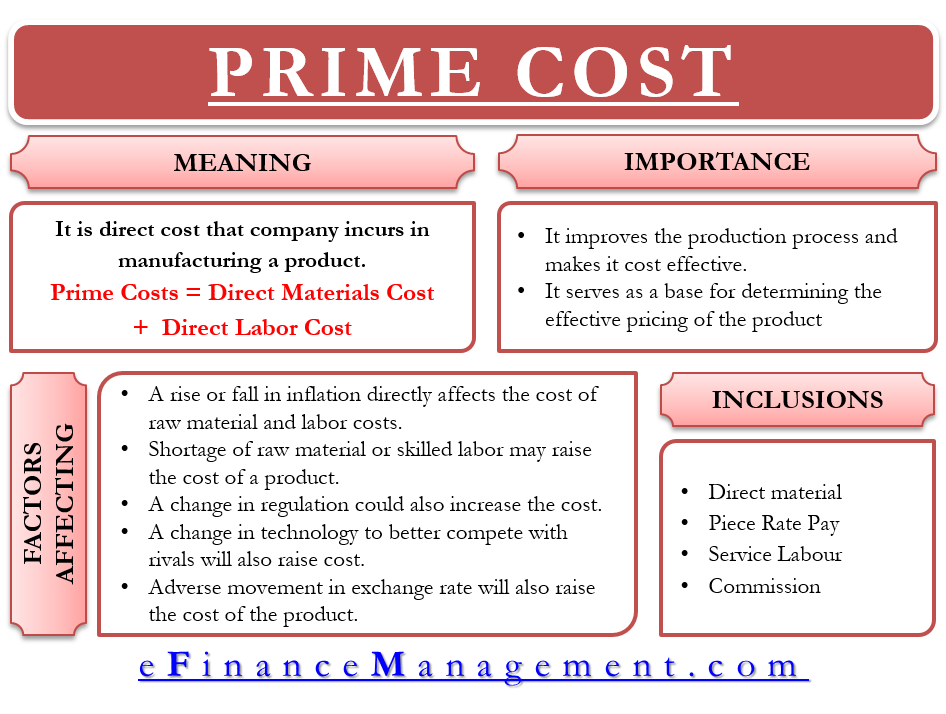
- Setting Competitive Prices: By knowing the precise prime cost per unit, businesses can set competitive selling prices that cover at least the direct costs and contribute to covering overhead and generating a profit margin. It helps in determining the minimum acceptable price for bulk orders or during promotional periods.
- Analyzing Product Profitability: Businesses often produce multiple products. By calculating the prime cost for each product, management can assess which products are most profitable at the direct cost level. This insight can guide decisions on product mix, resource allocation, and identifying underperforming products that might need re-evaluation or discontinuation.
Cost Control and Efficiency
Monitoring prime costs is a direct way to gauge and improve operational efficiency. Significant deviations in prime costs can signal inefficiencies in production.
- Identifying Waste: An increase in direct material costs without a corresponding increase in output might indicate material waste, spoilage, or inefficient procurement. Similarly, a rise in direct labor costs per unit could point to unproductive labor, excessive overtime, or inefficient production processes.
- Process Improvement: By analyzing prime cost trends, companies can identify areas for process improvement, such as optimizing material usage, negotiating better supplier contracts, implementing lean manufacturing techniques, or investing in automation to reduce labor intensity. Effective prime cost management directly contributes to a leaner, more efficient operation.
Performance Evaluation
Prime costs are a key metric for evaluating the performance of production departments, supply chain management, and even individual product lines.
- Benchmarking: Companies can benchmark their prime costs against industry standards or historical data to assess their efficiency relative to competitors or previous periods. This helps in identifying areas where they are performing well and areas that require attention.
- Budgeting and Forecasting: Accurate prime cost data is indispensable for effective budgeting and financial forecasting. It allows businesses to project future production costs based on anticipated sales volumes, helping in cash flow management and strategic planning.
Prime Costs vs. Conversion Costs and Total Manufacturing Costs
While prime costs focus on the direct inputs of production, other cost categories provide different perspectives on the manufacturing process. Understanding these distinctions is crucial for comprehensive cost accounting.
Differentiating Prime Costs from Conversion Costs
Another important cost concept is “conversion costs.” While prime costs focus on what goes into a product, conversion costs focus on what it takes to transform direct materials into a finished product.
- Conversion Costs = Direct Labor + Manufacturing Overhead
- The Overlap: Notice that direct labor is common to both prime costs and conversion costs. This is because direct labor is both a direct input (part of prime costs) and a cost incurred to convert materials (part of conversion costs).
- Different Perspectives: Prime costs emphasize the direct cost of inputs, useful for quick profitability checks and minimum pricing. Conversion costs emphasize the cost of transforming materials, crucial for evaluating production efficiency and the cost of the manufacturing process itself, often used in process costing environments.
Integrating Prime Costs into Total Manufacturing Costs
Prime costs are a subset of a broader category known as “total manufacturing costs,” also referred to as “total production costs” or “product costs.”
- Total Manufacturing Costs = Direct Materials + Direct Labor + Manufacturing Overhead
- The Bigger Picture: Total manufacturing costs represent all the expenses incurred in the factory to produce goods. It includes the direct costs (prime costs) and all the indirect costs necessary to run the factory (manufacturing overhead).
- Significance: Understanding total manufacturing costs is vital for inventory valuation (especially for work-in-process and finished goods inventories on the balance sheet), calculating the cost of goods sold (COGS) on the income statement, and ultimately, determining overall gross profit. Prime costs provide an initial, direct glimpse, while total manufacturing costs offer a complete picture of production expenses.
Real-World Examples and Application
The concept of prime costs is universally applicable across various industries, albeit with nuances in what constitutes direct materials and direct labor.
Manufacturing Industry
In manufacturing, the application of prime costs is most straightforward and commonly understood.
- Example: Furniture Manufacturer
- Direct Materials: Lumber, fabric, foam, screws, nails, glue, specific finishing stains.
- Direct Labor: Wages for carpenters cutting and assembling, upholsterers, and painters/finishers working directly on the furniture pieces.
- Not included (Overhead): Factory rent, electricity for the factory, salaries of production supervisors, depreciation of machinery, marketing expenses, administrative salaries.
By calculating prime costs, the furniture maker knows the minimum cost to produce each chair or table, aiding in pricing strategies and material sourcing.
Service Industry Considerations
While prime costs are traditionally associated with manufacturing, the concept can be adapted to service-based businesses, though defining “direct materials” might require a broader interpretation.
- Example: IT Consulting Firm
- Direct Materials: Specific software licenses purchased for a particular client project, specialized hardware components required for the client’s solution. (This requires careful tracking to be truly “direct”).
- Direct Labor: Wages of the consultants, programmers, or technicians who are directly billing their hours to a specific client project.
- Not included (Overhead): Office rent, administrative staff salaries, general software subscriptions, marketing, utilities.
For service firms, direct labor is often the predominant component of prime costs, highlighting the importance of efficient utilization of human capital and accurate time tracking for project profitability.

Conclusion
Prime costs are more than just a line item on a cost sheet; they are a fundamental metric that empowers businesses to understand their core production expenses, make strategic pricing decisions, enhance operational efficiency, and evaluate performance. By focusing on the direct materials and direct labor that form the essence of a product or service, companies gain clarity on their profitability at the most granular level. While distinct from other cost categories like conversion costs and total manufacturing costs, prime costs serve as an indispensable building block for a comprehensive understanding of a business’s financial health and its journey toward sustainable growth. Continuous monitoring and analysis of prime costs are vital for any enterprise aiming to thrive in a competitive marketplace.
aViewFromTheCave is a participant in the Amazon Services LLC Associates Program, an affiliate advertising program designed to provide a means for sites to earn advertising fees by advertising and linking to Amazon.com. Amazon, the Amazon logo, AmazonSupply, and the AmazonSupply logo are trademarks of Amazon.com, Inc. or its affiliates. As an Amazon Associate we earn affiliate commissions from qualifying purchases.