
In the world of finance, numbers are more than just digits on a screen; they are the indicators of health, growth, and stability. Whether you are tracking the performance of your stock portfolio, analyzing your business’s quarterly revenue, or simply trying to understand the impact of inflation on your grocery bill, the ability to calculate percentage increase and decrease is a fundamental skill. It is the bridge between raw data and actionable insights. Understanding how values shift relative to their starting point allows investors and professionals to move beyond “gut feelings” and toward data-driven decision-making.

The Mathematics of Money: Mastering the Core Formulas
At its heart, calculating a percentage change is a simple three-step process. However, in the context of money, the implications of these calculations are profound. To understand where you are going, you must first understand where you started.
The Formula for Percentage Increase
A percentage increase represents how much a value has grown compared to its original amount. This is most commonly used to track capital gains, interest accrual, or price hikes.
The universal formula is:
((New Value – Original Value) / Original Value) × 100
For example, if you purchased a share of a technology company for $150 and it is now trading at $180, your calculation would look like this:
- Subtract the original price from the new price: $180 – $150 = $30.
- Divide the difference by the original price: $30 / $150 = 0.2.
- Multiply by 100 to get the percentage: 0.2 × 100 = 20%.
You have experienced a 20% increase in your investment.
The Formula for Percentage Decrease
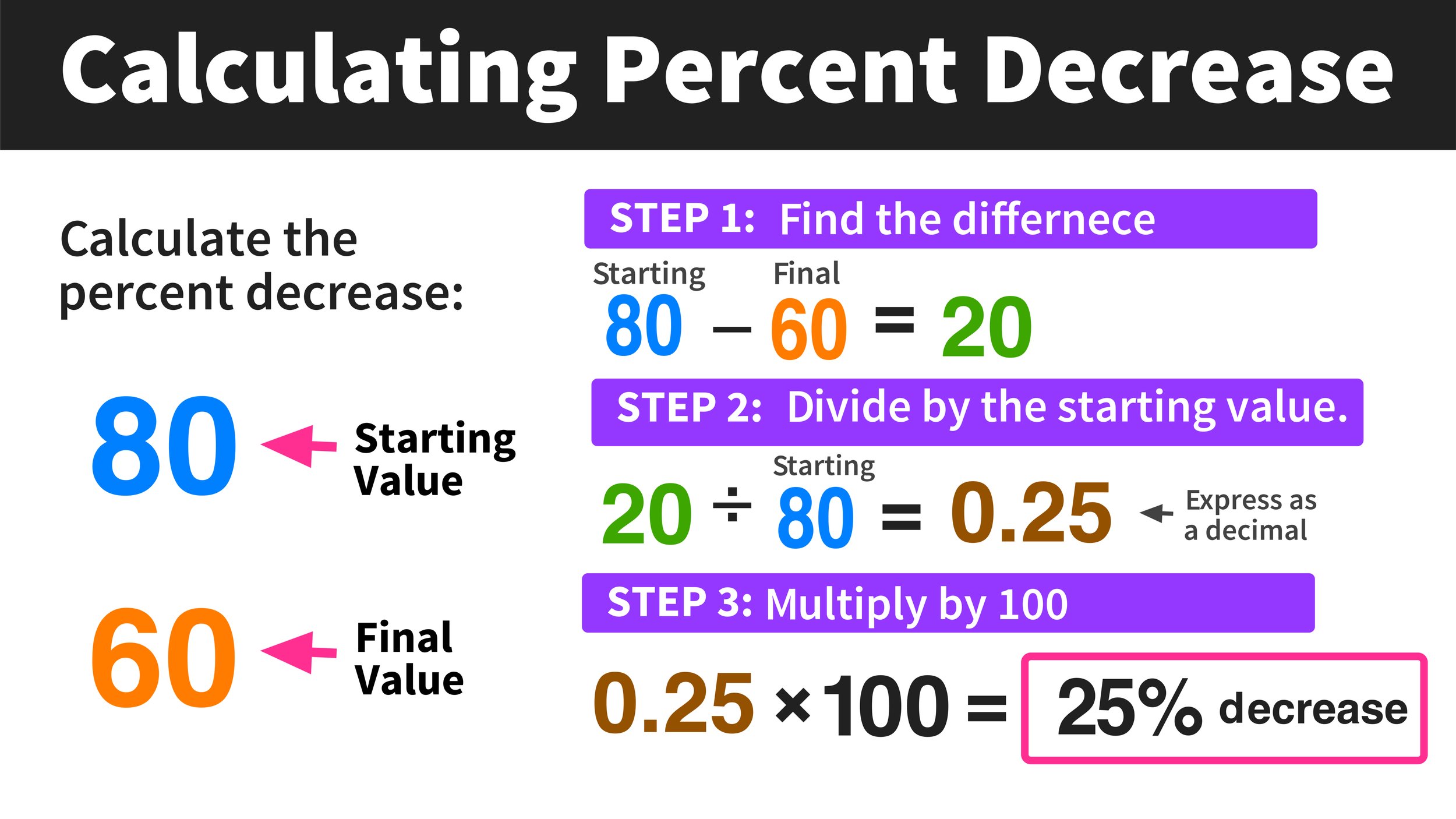
Conversely, a percentage decrease measures the loss of value. This is critical for assessing market drawdowns, depreciation of assets, or the effectiveness of cost-cutting measures.
The formula remains identical, but the result will be a negative number, indicating a drop:
((New Value – Original Value) / Original Value) × 100
Imagine you bought a vehicle for a small business for $40,000, and one year later its resale value is $32,000.
- Subtract the original value from the new value: $32,000 – $40,000 = -$8,000.
- Divide by the original value: -$8,000 / $40,000 = -0.2.
- Multiply by 100: -20%.
The asset has depreciated by 20%. In financial reporting, this is often expressed as an absolute value labeled as a “decrease” to maintain clarity.
Measuring Investment Performance and Portfolio Volatility
In the realm of personal finance and investing, percentage change is the primary metric for success. Absolute dollar amounts can be misleading; a $1,000 gain is impressive on a $5,000 investment (20%), but negligible on a $1,000,000 investment (0.1%).
Calculating Return on Investment (ROI)
ROI is the most common application of the percentage increase formula in the financial sector. It allows investors to compare the efficiency of different investments regardless of the size of the initial capital. By calculating the percentage increase of various assets—stocks, bonds, real estate, or cryptocurrencies—an investor can determine which part of their portfolio is pulling its weight.
Furthermore, understanding percentage change is vital for “rebalancing.” If one asset class grows by 30% while another stays flat, your portfolio’s risk profile changes. Calculating these shifts allows you to sell high and buy low, maintaining your desired asset allocation.
The Asymmetry of Loss: Why Decreases Matter More
One of the most critical lessons in financial literacy is understanding the “asymmetry of percentage change.” A 50% decrease in an investment requires a 100% increase just to break even.
If you have $100 and lose 50%, you have $50. To get back to $100, you need to gain $50. However, $50 is 100% of your current $50 balance. By mastering the calculation of percentage decreases, investors can better appreciate the importance of risk management and stop-loss orders. Monitoring the percentage drawdown of a portfolio helps in identifying when a strategy is no longer viable before the “math of recovery” becomes too steep to overcome.
Applying Percentages to Personal Budgeting and Purchasing Power
Beyond the stock market, percentage calculations are essential for managing a household budget and understanding the broader economic environment.
Tracking Inflation and Real Value
Inflation is essentially a percentage increase in the general price level of goods and services. If the annual inflation rate is 5%, it means your purchasing power has decreased by that same margin. To maintain your standard of living, your income must see a percentage increase that at least matches the inflation rate.
When evaluating a salary raise, it is important to calculate the percentage increase and compare it to the Consumer Price Index (CPI). If you receive a 3% raise but inflation is at 6%, you have actually experienced a 3% decrease in “real” income. Being able to run these numbers empowers employees during salary negotiations and helps families adjust their savings goals.
Analyzing Savings and Debt Reduction
For those focused on debt consolidation or high-interest savings, percentages are the guiding light. When you compare a credit card with an 18% APR to a personal loan with a 10% interest rate, you are looking at the percentage cost of capital.
When paying down debt, tracking the percentage decrease in your total balance can be a powerful psychological motivator. Similarly, calculating the percentage of your gross income that goes toward savings (the “savings rate”) is a better indicator of long-term financial health than the raw dollar amount saved. A person earning $50,000 who saves 20% is often in a better long-term position than a person earning $200,000 who only saves 2%.
Business Finance: Growth Metrics and Operational Efficiency
For entrepreneurs and business owners, percentage change is the pulse of the company. It transforms a cluttered balance sheet into a narrative of growth or a warning of inefficiency.
Revenue and Profit Margin Trends
To gauge the health of a business, stakeholders look at “Year-over-Year” (YoY) and “Quarter-over-Quarter” (QoQ) growth. If a company earned $1.2 million in revenue this year compared to $1 million last year, they have achieved a 20% revenue increase.
However, revenue is only half the story. One must also calculate the percentage change in profit margins. If revenue increased by 20% but operating expenses increased by 30%, the business is actually becoming less efficient. By calculating the percentage change of individual line items—such as Cost of Goods Sold (COGS), marketing spend, and payroll—management can pinpoint exactly where capital is being eroded.
Cost-Benefit Analysis and Scalability
When a business considers a new project, they use percentage calculations to forecast potential yields. This is often referred to as the “Internal Rate of Return” (IRR). If a company spends $50,000 on a new software system that reduces labor costs by $10,000 annually, they are looking at a 20% annual return on that expenditure.
Furthermore, calculating the percentage decrease in “Customer Acquisition Cost” (CAC) over time is a key metric for scalability. If a business can grow its user base while the percentage cost to acquire each user drops, the business model is considered highly scalable. These percentages are what venture capitalists and lenders look for when deciding whether to provide funding.

Conclusion: The Power of Financial Literacy
Mastering the calculation of percentage increase and decrease is not merely an academic exercise; it is an essential tool for financial survival and prosperity. In the context of money, these formulas provide a standardized way to measure progress, evaluate risk, and compare opportunities.
From the micro-level of choosing a discounted product at the store to the macro-level of analyzing global market trends, percentages provide clarity in a world of complex data. By consistently applying these formulas to your investments, budgets, and business ventures, you transition from a passive observer of your finances to an active, informed manager of your wealth. Remember, in finance, it is not just about how much the numbers change—it is about the percentage of that change that truly defines your success.
aViewFromTheCave is a participant in the Amazon Services LLC Associates Program, an affiliate advertising program designed to provide a means for sites to earn advertising fees by advertising and linking to Amazon.com. Amazon, the Amazon logo, AmazonSupply, and the AmazonSupply logo are trademarks of Amazon.com, Inc. or its affiliates. As an Amazon Associate we earn affiliate commissions from qualifying purchases.