
In the landscape of personal finance, understanding how to accurately calculate discounts is more than just a party trick; it’s a fundamental skill that empowers consumers to make informed purchasing decisions, manage budgets effectively, and ultimately, build wealth. The ubiquitous “20 percent off” sale sign is a common sight, yet many shoppers either rely on the register’s calculation or make quick, potentially inaccurate, mental estimates. Mastering this calculation, however, transforms a simple transaction into a strategic financial move. This article delves into the various methods for working out 20 percent off, embedding this practical skill within a broader framework of sound financial management.

The Strategic Importance of Discount Calculation in Personal Finance
At its core, personal finance is about managing your money efficiently – earning, saving, spending, and investing. Discounts play a significant role in the spending aspect, offering opportunities to acquire desired goods or services at a reduced cost. While the immediate benefit is clear, the long-term impact of consistently leveraging discounts effectively can be substantial. Understanding how to precisely calculate a 20% markdown allows you to:
Optimize Your Budget
Every dollar saved through a discount is a dollar that can be allocated elsewhere – perhaps to savings, debt repayment, or investments. When you know exactly how much you’re saving, you can better track your expenditure against your budget, ensuring you stay within limits without compromising on needs or reasonable wants. This precision prevents scenarios where an assumed discount leads to overspending because the actual saving was less than anticipated.
Avoid Overspending and Impulse Buys
Sales and discounts are powerful marketing tools designed to encourage purchases. A “20% off” sticker can create a sense of urgency or perceived value, sometimes leading to impulse buys of items that aren’t truly needed. By taking a moment to calculate the actual final price and the real savings, you can evaluate if the purchase aligns with your financial goals and current needs, rather than being swayed solely by the percentage reduction. Is an item that’s 20% off still expensive for your budget? Does the 20% off truly make it a value purchase, or is it still overpriced even with the discount?
Enhance Financial Literacy
Developing the skill to quickly and accurately calculate percentages strengthens your overall financial literacy. This capability extends beyond shopping, applying to understanding interest rates, investment returns, tax calculations, and more. It builds a foundation of numerical fluency critical for navigating complex financial decisions throughout life. It fosters a proactive approach to your money, moving beyond passively accepting prices to actively evaluating them.
Mastering the 20% Discount Calculation: Methods and Examples
Calculating 20 percent off is straightforward, and several methods can be employed depending on personal preference or the situation. Each method arrives at the same accurate answer but uses a slightly different mathematical approach.
Method 1: The Subtraction Method (Calculate the Discount, Then Subtract)
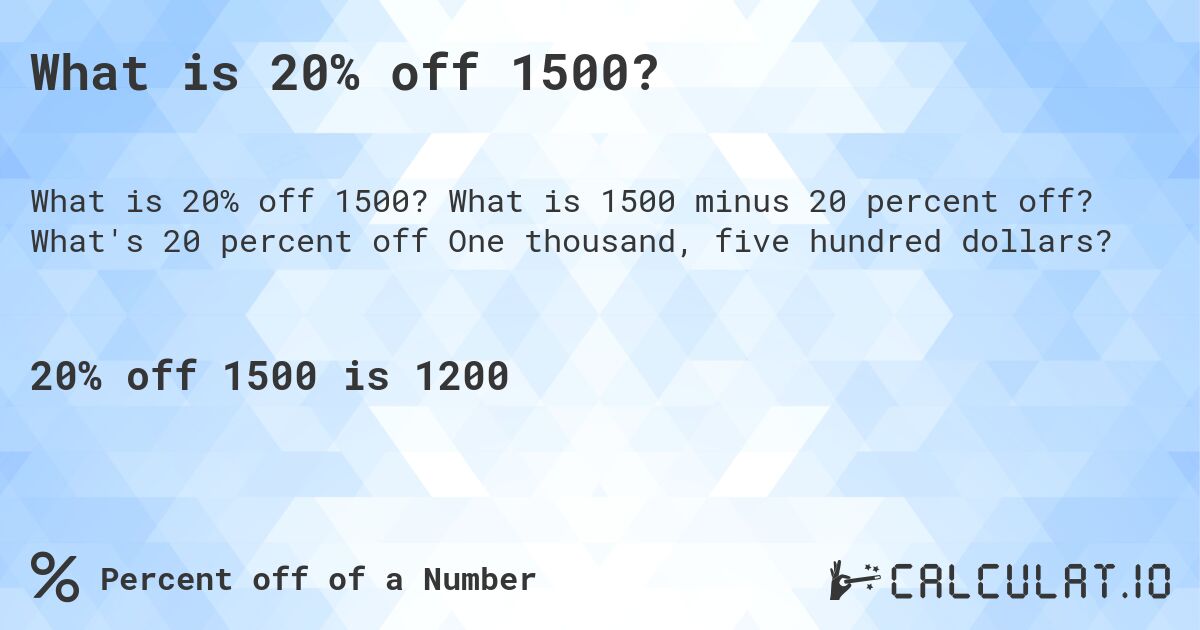
This is often the most intuitive method for many. You first calculate the value of 20% of the original price and then subtract that amount from the original price.
-
Calculate 20% of the original price: To find 20% of a number, multiply the number by 0.20 (or 20/100).
- Formula: Discount Amount = Original Price × 0.20
-
Subtract the discount amount from the original price: This gives you the final discounted price.
- Formula: Final Price = Original Price – Discount Amount
Example: A jacket costs $150.
-
Discount Amount = $150 × 0.20 = $30
-
Final Price = $150 – $30 = $120
The jacket costs $120 after the 20% discount.
Method 2: The Multiplier Method (Calculate the Remaining Percentage)
This method is often quicker as it involves only one multiplication step. If you’re getting 20% off, it means you’re paying 80% of the original price (100% – 20% = 80%).
-
Determine the percentage you will pay: If it’s 20% off, you pay 80% (100% – 20%).
-
Convert this percentage to a decimal: 80% becomes 0.80.
-
Multiply the original price by this decimal:
- Formula: Final Price = Original Price × 0.80
Example: A jacket costs $150.
-
Percentage to pay = 80%
-
Decimal multiplier = 0.80
-
Final Price = $150 × 0.80 = $120
Again, the jacket costs $120. This method is particularly efficient for mental calculations or when using a calculator.
Method 3: The “Divide by Five” Shortcut
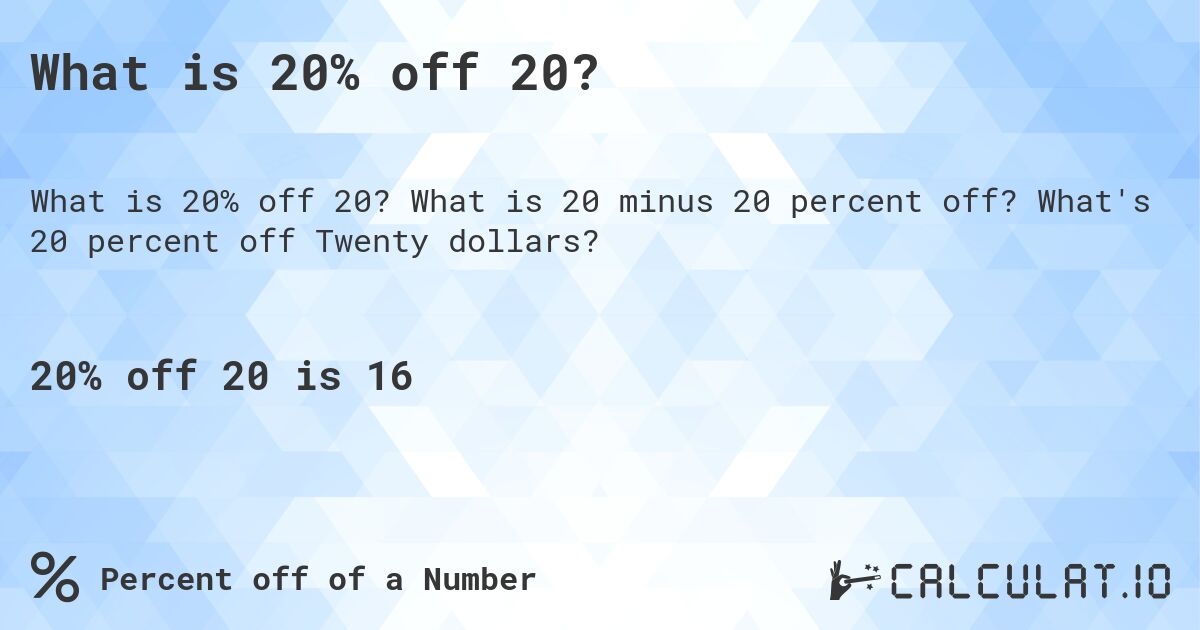
This is a handy mental math trick, especially for numbers easily divisible by 5 or 10. Twenty percent is equivalent to one-fifth (1/5).
-
Divide the original price by 5: This directly gives you the discount amount (since 1/5 is 20%).
- Formula: Discount Amount = Original Price / 5
-
Subtract this discount amount from the original price:
- Formula: Final Price = Original Price – Discount Amount
Example: A jacket costs $150.
-
Discount Amount = $150 / 5 = $30
-
Final Price = $150 – $30 = $120
This method simplifies the mental calculation significantly. If the original price is not easily divisible by 5, you can still use it, but methods 1 or 2 might feel more direct.
Beyond the Register: Strategic Discount Utilization for Financial Growth
Understanding the math is just the first step. The true financial savvy comes from integrating this knowledge into a broader strategy for financial growth. Discounts, when used wisely, can be powerful tools in your financial toolkit.
Differentiating Value from Perceived Savings
A “20% off” sign does not automatically equate to a good deal. The actual value of a purchase depends on the item’s utility, quality, and its original price relative to your budget. A 20% discount on an overpriced or unnecessary item still means you’re spending money you might not need to. Always ask: “Would I buy this item at its original price if I truly needed it?” If the answer is no, the discount alone might not justify the purchase. Consider the item’s total cost of ownership, including maintenance, potential upgrades, and longevity.
Integrating Discounts into Budgeting and Planning
Smart shoppers anticipate sales. For significant purchases or recurring expenses, planning around periods of 20% off (or greater) can yield substantial savings over time.
-
Big-ticket items: Furniture, appliances, or electronics often see seasonal or holiday sales. Waiting for these periods can translate to hundreds or thousands of dollars saved.
-
Everyday essentials: Groceries, personal care products, and household supplies can also be purchased strategically during sales. Stocking up on non-perishable items when they are 20% off can reduce your average monthly expenditure.
-
Subscription services: Many services offer a discount for annual payments versus monthly. While not strictly “20% off,” the principle of paying less for the same service applies. Calculate the per-month savings to see if the upfront cost makes sense for your cash flow.
These savings aren’t just for immediate gratification; they are funds that can be redirected. By consistently saving 20% on various purchases, you create a surplus in your budget. This surplus can then be channeled towards higher financial goals, such as building an emergency fund, increasing retirement contributions, or paying down high-interest debt.
Comparing Discounts with Other Financial Benefits
Many retailers offer loyalty programs, cashback, or reward points in addition to percentage-off discounts. When faced with multiple offers, understanding how to calculate the true value becomes even more critical.
-
Cashback vs. Percent Off: Is 5% cashback on a $100 purchase better than 20% off on a $20 item? Calculating the actual dollar amount helps you compare disparate offers. For a $100 item, 20% off is $20 savings. For a $20 item, 5% cashback is $1 savings. Always look at the absolute dollar impact.
-
Rewards Points: Understand the redemption value of points. If 1,000 points equal $10, and you earn 2 points per dollar, then a $100 purchase earns 200 points, or $2 in value. Compare this to a direct percentage discount.
The goal is to maximize your financial benefit. Sometimes stacking discounts (e.g., using a coupon for 20% off and earning cashback) is possible, further amplifying your savings.
Leveraging Consistent Savings for Long-Term Financial Health
The cumulative effect of consistently saving 20% here and there might seem negligible on a single purchase, but over weeks, months, and years, it forms a powerful foundation for robust financial health.
The Power of Redirected Savings
Imagine saving an average of $50 per month by consistently applying smart discount strategies. Over a year, that’s $600. If this $600 is then invested, even in a modest growth account, it begins to compound. Over several years, especially if this practice continues, the invested savings can grow significantly, far surpassing the initial amount saved on individual purchases. This demonstrates the profound difference between simply spending less and actively reallocating the savings towards wealth creation.
Building a Strong Financial Mindset
Regularly calculating and utilizing discounts fosters a disciplined approach to spending. It trains you to be a more deliberate and conscious consumer, less susceptible to marketing ploys and more focused on value. This mindset extends beyond shopping, influencing how you view other financial decisions, from negotiating salaries to choosing financial products. It cultivates a habit of critical evaluation, which is invaluable in all aspects of personal finance.
In conclusion, the ability to “work out 20 percent off” is far more than a simple arithmetic exercise. It is a vital component of financial literacy, empowering individuals to save money, make wiser purchasing decisions, and strategically allocate resources towards their long-term financial goals. By mastering the calculation methods and applying a disciplined, analytical approach to every transaction, consumers can transform everyday spending into an active strategy for wealth building and financial freedom.
aViewFromTheCave is a participant in the Amazon Services LLC Associates Program, an affiliate advertising program designed to provide a means for sites to earn advertising fees by advertising and linking to Amazon.com. Amazon, the Amazon logo, AmazonSupply, and the AmazonSupply logo are trademarks of Amazon.com, Inc. or its affiliates. As an Amazon Associate we earn affiliate commissions from qualifying purchases.