
In the vast landscape of mathematics and its myriad applications, the ability to manipulate equations and isolate specific variables is a fundamental skill. “Solving Y in terms of X” is a classic directive that underpins problem-solving in fields ranging from engineering and physics to economics and data science. At its core, it means rearranging an equation so that Y is alone on one side, and the other side contains X and any constants or other variables. While the principles are rooted in algebra, modern technology has revolutionized how we approach and execute these tasks, making complex manipulations accessible and efficient. This article delves into the core concepts, illustrates manual approaches, and crucially, explores how various technological tools can empower you to solve Y in terms of X with precision and speed.
Understanding the Fundamentals: What “Solving Y in Terms of X” Truly Means
Before we harness the power of technology, a firm grasp of the underlying mathematical concept is essential. Solving for a variable isn’t just a mechanical process; it’s a strategic one that requires understanding the relationships between quantities in an equation.
The Core Concept of Variable Isolation
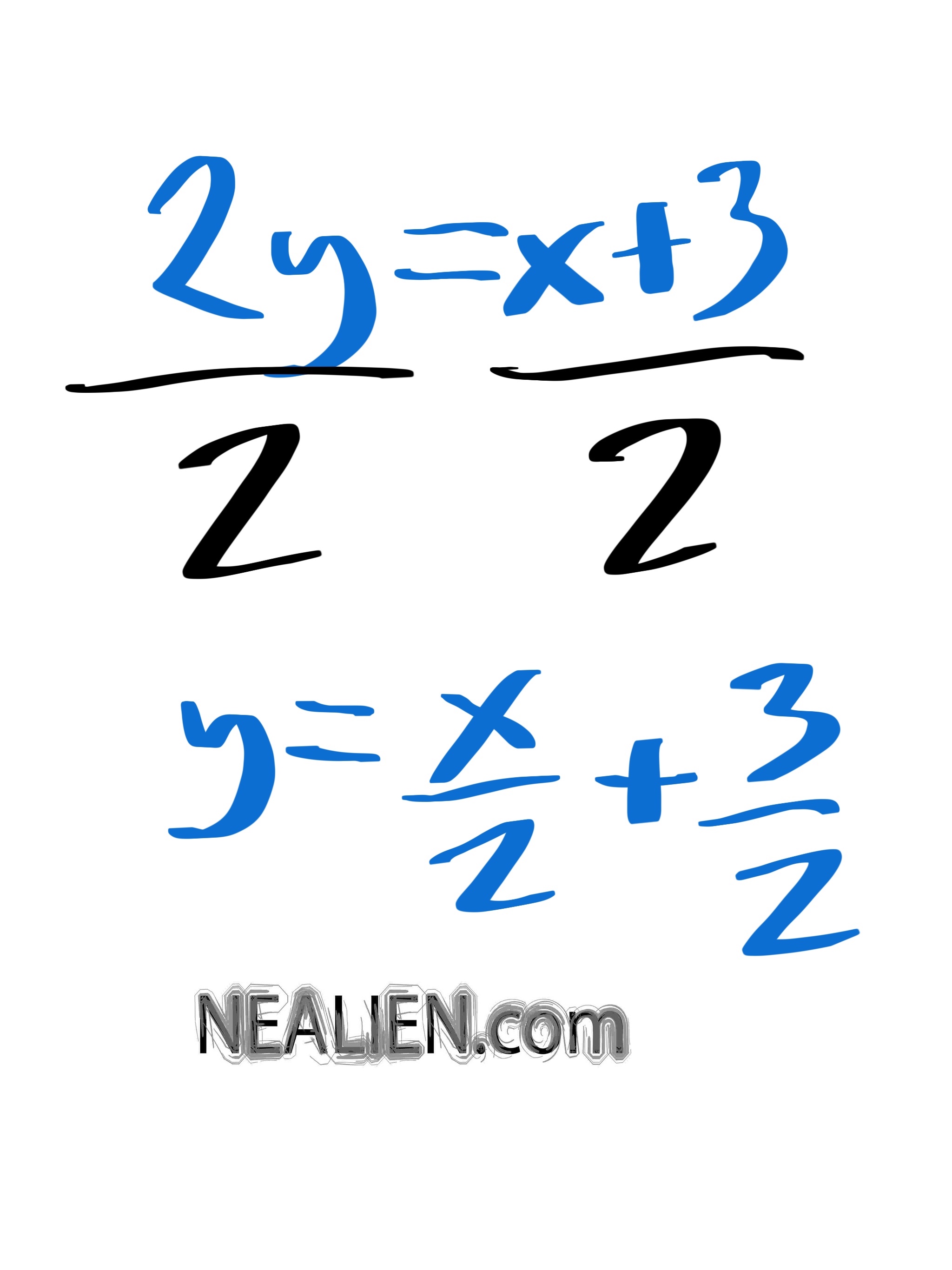
When asked to “solve Y in terms of X,” the objective is to transform a given equation into the form Y = f(X), where ‘f(X)’ represents an expression containing X and potentially numerical constants, but no other instances of Y. This process is often referred to as isolating the variable Y. The fundamental principle behind this isolation is the application of inverse operations. Every operation (addition, subtraction, multiplication, division, exponentiation, etc.) has an inverse that “undoes” it. To move a term from one side of the equation to the other, or to remove an operation applied to Y, we apply its inverse operation to both sides of the equation, maintaining equality.
For example, if you have Y + 5 = X, to isolate Y, you subtract 5 from both sides: Y + 5 - 5 = X - 5, which simplifies to Y = X - 5. Similarly, for 3Y = X, you would divide both sides by 3: 3Y / 3 = X / 3, resulting in Y = X / 3.
Why It Matters: Real-World Applications
The skill of solving for a variable is far from an academic exercise; it’s a practical necessity across numerous disciplines.
-
Physics and Engineering: Formulas like
F = ma(Newton’s second law) can be rearranged toa = F/mto solve for acceleration, orm = F/ato solve for mass, depending on what needs to be determined. Understanding how to derive one variable in terms of others is critical for design, analysis, and problem-solving. -
Economics and Business: Equations modeling supply and demand, cost functions, or profit margins often require solving for a specific variable (e.g., quantity demanded in terms of price, or profit in terms of sales volume) to make predictions or optimize outcomes.
-
Data Science and Statistics: When building predictive models or analyzing relationships between variables, isolating the dependent variable (Y) in terms of independent variables (X) is a standard practice in regression analysis and model interpretation.
-
Computer Science and Programming: Algorithms often involve mathematical expressions, and the ability to express a variable in terms of others is crucial for implementing calculations and logic efficiently.
Step-by-Step Manual Approach: The Foundation Before Tech
While technology offers powerful shortcuts, mastering the manual process builds a robust understanding that makes you a more insightful user of those tools. It helps in recognizing errors, interpreting results, and troubleshooting.
Basic Algebraic Manipulations
The journey begins with mastering elementary operations:
-
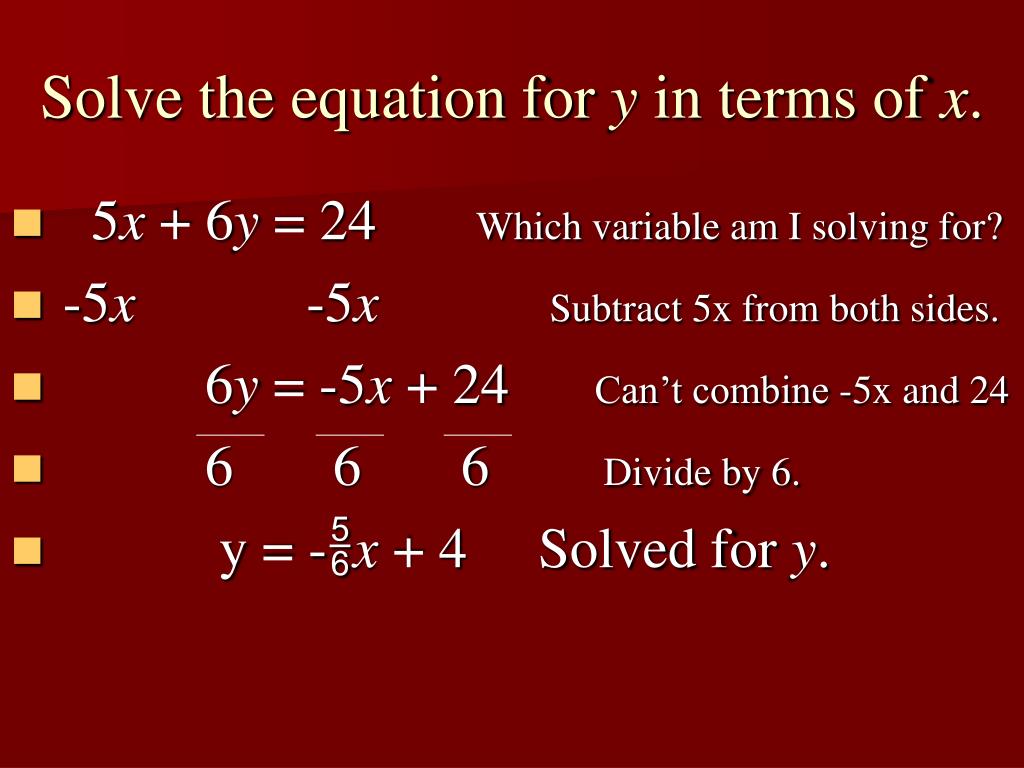
Addition/Subtraction: To move a term added to or subtracted from Y, perform the inverse operation on both sides.
- Example:
Y - 7 = 2X + 3->Y = 2X + 3 + 7->Y = 2X + 10
- Example:
-
Multiplication/Division: To eliminate a coefficient multiplying Y, divide both sides by that coefficient. If Y is divided by a number, multiply both sides by that number.
-
Example:
4Y = 8X - 12->Y = (8X - 12) / 4->Y = 2X - 3 -
Example:
Y / 5 = X + 2->Y = 5(X + 2)->Y = 5X + 10
-
-
Parentheses and Distribution: If Y is inside parentheses, or if a term needs to be distributed, perform these operations first to clear the way for isolation.
- Example:
2(Y + 3) = 4X->2Y + 6 = 4X->2Y = 4X - 6->Y = 2X - 3
- Example:
Handling More Complex Equations
Equations can quickly become more intricate, involving exponents, roots, and multiple instances of Y.
-
Combining Like Terms: Before isolating, simplify both sides of the equation by combining any like terms.
-
Working with Exponents and Roots: If Y is squared (
Y^2), you’ll need to take the square root of both sides (sqrt(Y^2) = sqrt(X)). Remember to consider both positive and negative roots. Conversely, if Y is under a square root (sqrt(Y)), you’ll square both sides ((sqrt(Y))^2 = X^2). -
Factoring out Y: If Y appears in multiple terms on one side of the equation (e.g.,
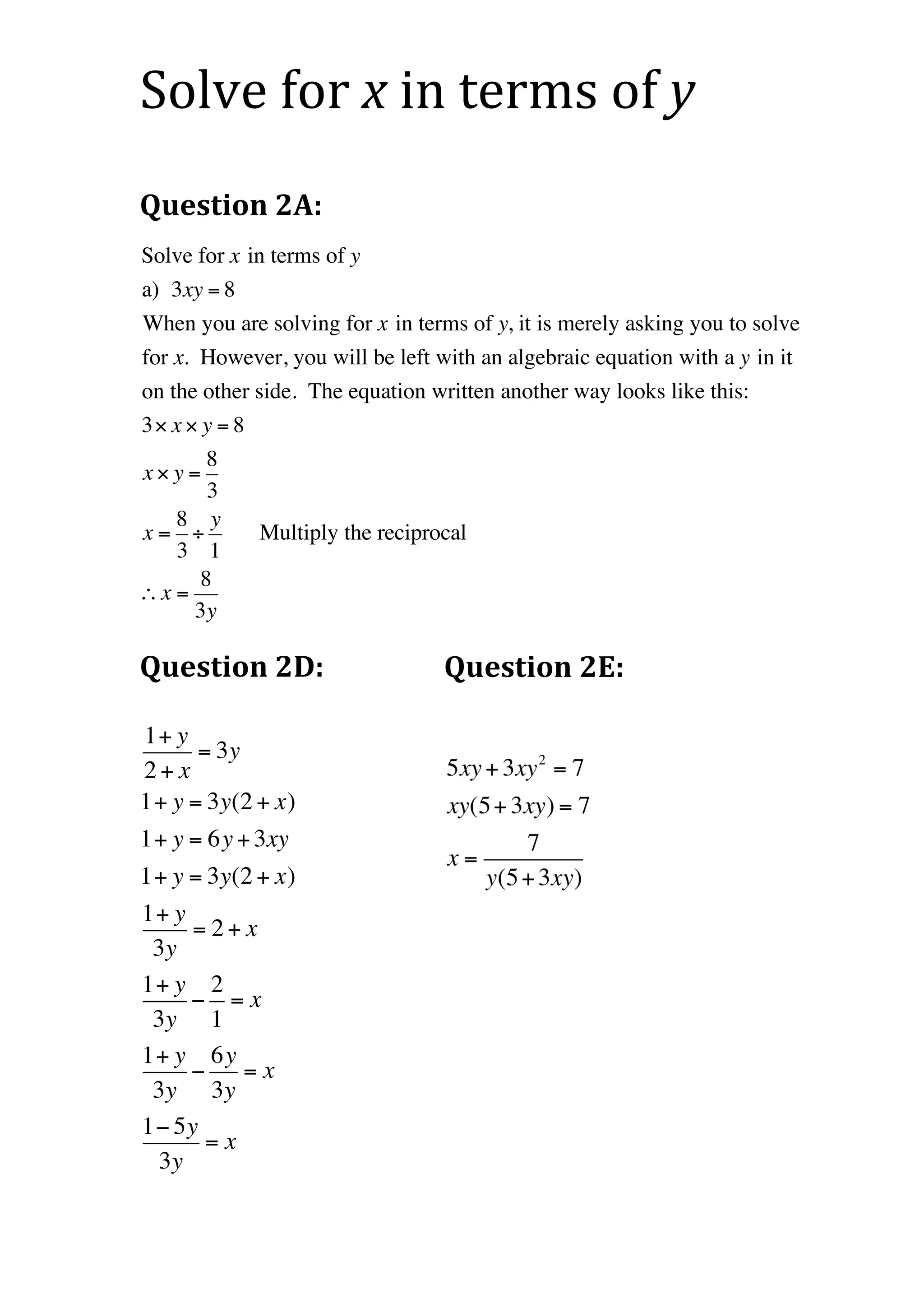
aY + bY = X), factor out Y:Y(a + b) = X. Then, divide by the expression in the parentheses:Y = X / (a + b). This is a critical step for more advanced problems.
Common Pitfalls and How to Avoid Them
Even experienced individuals can stumble. Awareness of common errors is key:
-
Sign Errors: Forgetting to change a sign when moving a term across the equality.
-
Distributive Property Mistakes: Failing to distribute a multiplier to all terms inside parentheses.
-
Dividing by Zero: Be cautious when dividing by an expression involving X; consider conditions where the denominator might be zero, as this would make the solution undefined.
-
Order of Operations (PEMDAS/BODMAS): Always adhere to the correct order of operations.
Leveraging Technology for Efficient Solutions
While a solid manual foundation is invaluable, technology empowers us to tackle more complex equations, verify manual solutions, and perform repetitive calculations with speed and accuracy.
Graphing Calculators: Your First Computational Aid
Modern graphing calculators (e.g., TI-84, Casio fx-CG50) are powerful tools that go beyond basic arithmetic.
-
Solve Functions: Many calculators have dedicated
solvefunctions that can rearrange equations for a specified variable. You typically input the equation and indicate which variable you want to solve for. -
Numerical Solvers: For equations that are difficult to solve symbolically, calculators can often find numerical approximations of solutions.
-
Graphing and Table Features: Visualizing an equation can sometimes provide insight, and tables can help in checking specific points.
- Example: To solve
3Y + 5 = 2X - 1for Y, you’d input this into the calculator’s equation solver, specifying Y as the variable to isolate.
- Example: To solve
Symbolic Math Software (e.g., Wolfram Alpha, MATLAB, Mathematica)
For university-level mathematics, engineering, and scientific research, symbolic math software packages are indispensable.
-
Wolfram Alpha: An incredibly accessible online computational knowledge engine. You can simply type a query like “solve 3y + 5 = 2x – 1 for y” in natural language, and it provides the exact symbolic solution, along with steps, graphs, and related information. It’s excellent for quick checks and understanding concepts.
-
MATLAB (Symbolic Math Toolbox): MATLAB, primarily known for numerical computation, offers a Symbolic Math Toolbox. Using functions like
symsto declare symbolic variables andsolve, you can perform complex algebraic manipulations.-
syms x y -
eq = 3*y + 5 == 2*x - 1; -
solve(eq, y)
-
-
Mathematica: Similar to MATLAB but with a stronger focus on symbolic computation, Mathematica provides extensive capabilities for algebraic manipulation, calculus, and visualization, handling equations of almost any complexity.
These tools are not just calculators; they are sophisticated engines that understand mathematical rules and can perform transformations that would be tedious or impossible by hand, especially for systems of equations or those involving advanced functions.
Programming Languages (Python, R) for Algorithmic Solutions
Programming languages offer another layer of technological assistance, particularly for integrating equation solving into larger applications or for custom algorithmic approaches.
-
Python (with SymPy Library): Python, with its
SymPylibrary, turns into a powerful symbolic math environment. You can define symbolic variables and equations and then usesympy.solveto isolate a desired variable.-
from sympy import symbols, solve -
x, y = symbols('x y') -
equation = 3*y + 5 - (2*x - 1) -
solution = solve(equation, y) -
This outputs
[-2*x/3 + 2], representingY = -2/3 X + 2.
-
-
R: While R is more focused on statistical computing, it also has packages (like
Ryacasorsymengine) that interface with symbolic computation engines, allowing for similar algebraic manipulations within an R script.
Using programming languages allows for automation, solving equations within larger data processing workflows, or creating interactive tools that depend on algebraic solutions.
Practical Examples: Bridging Theory and Tech Application
Let’s illustrate with some common types of equations, demonstrating both manual thinking and how technology provides a fast track.
Linear Equations
Equation: 5(Y - 2) + 3X = 15
Manual Steps:
-
Distribute the 5:
5Y - 10 + 3X = 15 -
Move terms not involving Y to the right side:
5Y = 15 + 10 - 3X -
Combine constants:
5Y = 25 - 3X -
Divide by 5:
Y = (25 - 3X) / 5 -
Simplify:
Y = 5 - (3/5)X
Tech (Wolfram Alpha): Type “solve 5(y – 2) + 3x = 15 for y”
Output: y = (3x)/5 + 5 (note Wolfram Alpha often presents x term first, which is equivalent).
Quadratic Equations
Equation: X^2 + Y^2 = R^2 (Equation of a circle, solve for Y)
Manual Steps:
-
Move
X^2to the right side:Y^2 = R^2 - X^2 -
Take the square root of both sides:
Y = ±sqrt(R^2 - X^2)(Remember the ± sign for two possible solutions).
Tech (Python with SymPy):
from sympy import symbols, solve, sqrt
x, y, r = symbols('x y r')
equation = x**2 + y**2 - r**2
solution = solve(equation, y)
Output: [sqrt(-x**2 + r**2), -sqrt(-x**2 + r**2)]
Equations with Multiple Variables or Functions
Equation: A = P(1 + rY) (Compound interest formula, solve for Y)
Manual Steps:
-
Divide by P:
A/P = 1 + rY -
Subtract 1:
A/P - 1 = rY -
Divide by r:
(A/P - 1) / r = Y -
Rearrange:
Y = (A - P) / (Pr)
Tech (Wolfram Alpha): Type “solve A = P(1 + rY) for Y”
Output: y = (A - P) / (Pr)
Beyond Simple Solutions: Interpreting and Applying Results
Getting an answer from an equation solver is only half the battle. The true value lies in understanding what that solution means and how to apply it responsibly.
Validating Your Solution
Always check your answer, especially if you performed the steps manually. Substitute your derived expression for Y back into the original equation. If both sides are equal, your solution is correct. Technology can also aid this: most symbolic solvers will automatically simplify the equation after substitution to show if it evaluates to true.
Understanding Constraints and Domain
When you solve for Y, the resulting expression might have limitations. For instance, in Y = ±sqrt(R^2 - X^2), for Y to be a real number, R^2 - X^2 must be greater than or equal to zero. This implies X^2 <= R^2, or -R <= X <= R. Such constraints define the domain for X for which Y has a real solution. Technology will often provide these domain restrictions or highlight potential issues (e.g., complex numbers).
The Human Element: When to Trust and When to Double-Check Tech
While technology is incredibly powerful, it’s a tool, not a replacement for understanding.
-
Garbage In, Garbage Out: If your input equation is incorrect, the technological solution will also be incorrect.
-
Misinterpretation: A solution like
y = (3x)/5 + 5is unambiguous, but more complex expressions might require careful interpretation, especially if the software simplifies in a non-intuitive way. -
Learning Aid: Use technology to learn by comparing your manual steps to the software’s step-by-step solutions (where available). This helps reinforce correct procedures.
-
Verification: For critical applications, always cross-reference solutions from different tools or manually re-verify.
Conclusion
The ability to “solve Y in terms of X” is a foundational skill in mathematics with profound implications across virtually every technical and scientific discipline. It’s a critical component of analytical thinking and problem-solving. While the algebraic principles remain constant, technological advancements have provided an array of sophisticated tools—from graphing calculators to symbolic math software and programming libraries—that streamline the process, handle complexity, and enhance accuracy. Mastering the manual techniques provides an essential intellectual framework, while embracing technology empowers you to operate more efficiently and tackle challenges that would otherwise be insurmountable. The optimal approach integrates both: a solid conceptual understanding reinforced and augmented by the intelligent application of digital tools.
aViewFromTheCave is a participant in the Amazon Services LLC Associates Program, an affiliate advertising program designed to provide a means for sites to earn advertising fees by advertising and linking to Amazon.com. Amazon, the Amazon logo, AmazonSupply, and the AmazonSupply logo are trademarks of Amazon.com, Inc. or its affiliates. As an Amazon Associate we earn affiliate commissions from qualifying purchases.