
Navigating the complexities of the Internal Revenue Service (IRS) can be a daunting task for even the most financially savvy individuals. While the primary focus of tax season is often on filing accurate returns, the logistics of actually transmitting funds to the federal government is a critical component of financial management. Whether you are settling an annual balance, making quarterly estimated payments, or addressing a past-due notice, understanding the most efficient, secure, and cost-effective ways to send money to the IRS is essential for maintaining your financial health.
The landscape of government payments has evolved significantly over the last decade. Moving away from a reliance on paper checks and snail mail, the IRS now offers a suite of digital tools designed to streamline the process. Choosing the right method depends on your specific financial situation, your need for immediate confirmation, and whether you are acting as an individual or a business entity.
Understanding Your Payment Obligations and Timing
Before selecting a payment method, it is crucial to identify exactly why and when you are sending money. Tax liabilities generally fall into two categories: reconciliation payments made during the annual filing season and periodic payments made throughout the year.
Annual Tax Due and Extensions
For most individual taxpayers, the deadline to pay any remaining balance for the prior tax year is April 15. A common misconception is that filing an extension to submit your tax return also grants an extension to pay the taxes owed. In reality, an extension only provides more time to file paperwork; the money itself is still due by the original April deadline. Failure to pay by this date typically results in the accrual of interest and late-payment penalties, which can significantly increase your total liability over time.
Estimated Quarterly Tax Payments
Self-employed individuals, freelancers, and business owners often do not have taxes withheld from their income automatically. For these taxpayers, the IRS requires quarterly estimated tax payments. These are generally due on April 15, June 15, September 15, and January 15 of the following year. Managing these payments requires a proactive approach to cash flow, ensuring that funds are set aside throughout the year to avoid a massive, unexpected bill in April.
Balance Due Notices
If you receive a notice from the IRS (such as a CP2000 or a Notice of Intent to Levy), the payment process becomes even more time-sensitive. In these instances, using a method that provides instant confirmation and “same-day” processing is often the best strategy to halt further collection actions.
Digital Payment Methods: Efficiency and Security
In the modern era, digital payments are the preferred method for both the IRS and taxpayers. They offer higher security, faster processing times, and immediate receipts of transaction.
IRS Direct Pay
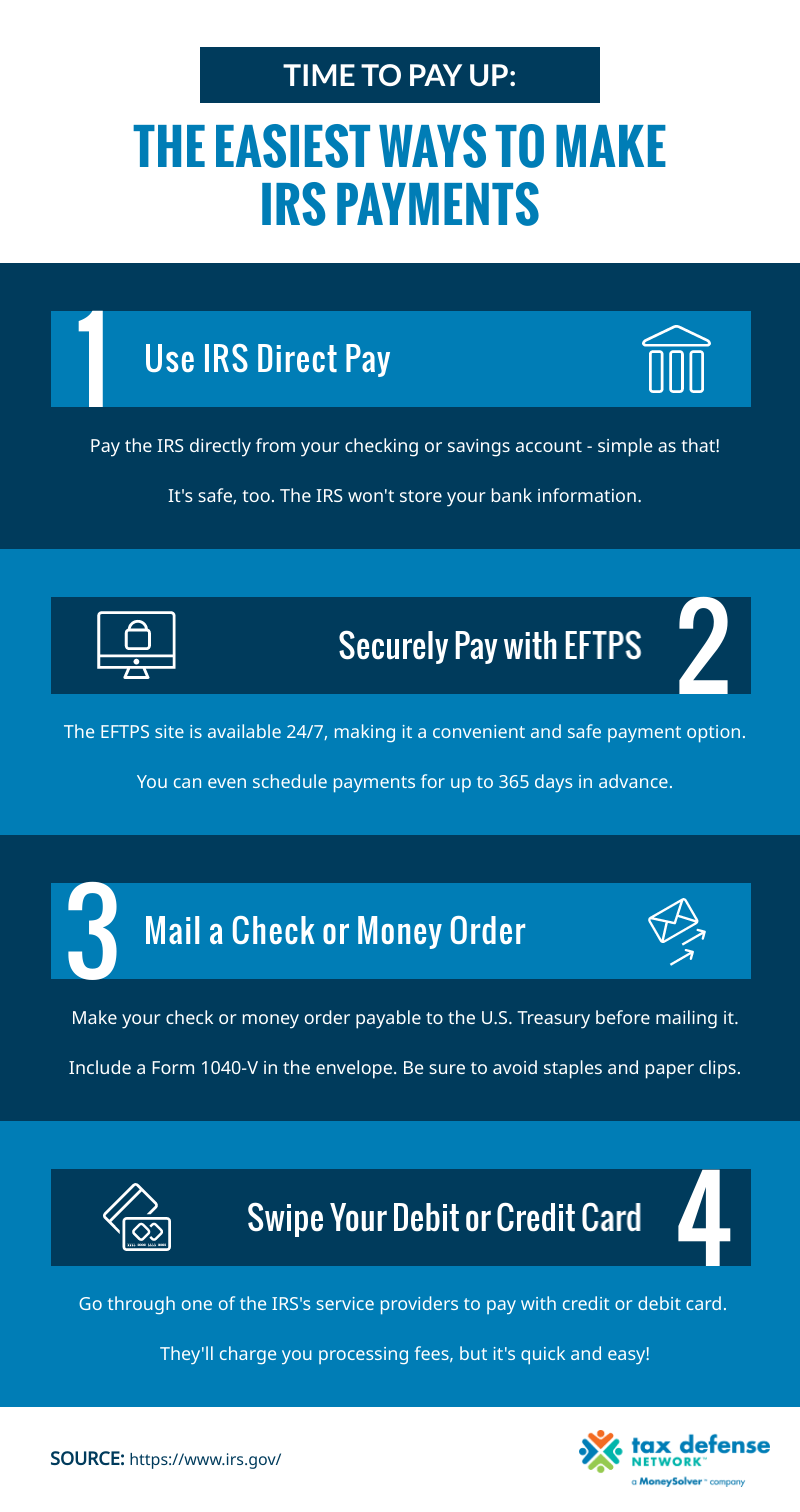
For individual taxpayers, IRS Direct Pay is arguably the most efficient tool available. This service allows you to pay your income tax directly from a checking or savings account without any additional fees.
-
Pros: It is free, requires no prior registration, and provides an immediate confirmation number.
-
How it Works: You simply select the “Make a Payment” option on the IRS website, choose the reason for payment (e.g., 1040, Estimated Tax, Extension), and verify your identity using information from a prior year’s tax return.
-
Best For: Individuals paying their annual balance or quarterly estimated taxes who want to avoid processing fees.
Electronic Federal Tax Payment System (EFTPS)
While Direct Pay is designed for individuals, the EFTPS is the robust alternative intended for businesses and high-frequency individual taxpayers. Unlike Direct Pay, EFTPS requires a formal enrollment process, which includes receiving a PIN via physical mail for security purposes.
-
Pros: It allows for scheduling payments up to 365 days in advance, making it an excellent tool for tax planning. It also maintains a comprehensive history of all payments made over the last 16 months.
-
Best For: Small business owners, corporations, and individuals with complex tax needs who want to automate their quarterly payments.
Credit and Debit Card Options
The IRS utilizes third-party payment processors to handle credit and debit card transactions. While this method offers convenience and the potential to earn credit card rewards or points, it comes with a catch: convenience fees.
-
Fees: These fees are set by the processors, not the IRS, and typically range from a flat fee for debit cards to roughly 1.8% to 2% of the total amount for credit cards.
-
Strategic Use: Paying by credit card can be a viable short-term solution if you are facing a liquidity crisis and need to avoid IRS late-payment penalties, which are often higher than the interest rates on a credit card. However, this should be a last resort.
Digital Wallets and Mobile Apps
Reflecting broader trends in fintech, the IRS now accepts payments via PayPal and Venmo through its authorized processors. Additionally, the IRS2Go mobile app provides a streamlined interface for making payments via mobile devices. This is particularly useful for younger taxpayers or those who manage their entire financial lives through a smartphone.

Traditional Methods: When Physical Documentation Matters
Despite the push toward digital, many taxpayers still prefer traditional methods. Whether due to technological barriers or a personal preference for a physical paper trail, the IRS continues to support several non-digital payment avenues.
Paying by Check or Money Order
If you choose to mail a check or money order, precision is vital. The IRS processes millions of pieces of mail, and a small error can lead to your payment being misapplied or lost.
-
Checklist for Mailing: Always make the check payable to the “United States Treasury.” Never leave the recipient line blank or address it to the “IRS.” On the memo line, you must include your Social Security Number (or Employer Identification Number), the tax year the payment applies to, and the specific form number (e.g., “2023 Form 1040”).
-
Form 1040-V: This is a payment voucher that should accompany your check. It ensures the IRS scanner can quickly attribute the funds to your account.
-
Mailing Security: It is highly recommended to send tax payments via Certified Mail with a Return Receipt Requested. This provides legal proof that the payment was mailed by the deadline, protecting you from late-payment penalties if the mail is delayed.
In-Person Payments
In rare circumstances, taxpayers may choose to pay in person at an IRS Taxpayer Assistance Center (TAC). This usually requires an appointment. Additionally, the IRS has partnered with specific retail chains to accept cash payments. This “Pay with Cash at a Retail Partner” option is designed for the “unbanked” population, though it requires an online pre-verification process and involves a small convenience fee.
Strategic Financial Management of Tax Liabilities
Sending money to the IRS is not just a logistical hurdle; it is a significant financial event. If you find yourself unable to pay the full amount owed, the IRS offers several strategic options to manage the debt without triggering aggressive collection tactics.
Installment Agreements
If you owe $50,000 or less (including tax, penalties, and interest), you can often apply for an Online Payment Agreement. This allows you to pay off your balance over a period of up to 72 months. While interest and some penalties still accrue during the life of the plan, an installment agreement prevents the IRS from issuing levies or liens against your property, provided you remain compliant with the terms.
Offer in Compromise (OIC)
An OIC is a formal agreement that allows you to settle your tax debt for less than the full amount you owe. This is a rigorous process that requires a full disclosure of assets, income, and expenses. The IRS only grants an OIC if they determine that the tax liability cannot be collected in full or if doing so would create an unfair economic hardship.
Temporary Delay in Collection
If you can demonstrate that you are currently unable to pay any of your tax debt due to financial hardship, the IRS may report your account as “Currently Not Collectible.” This does not erase the debt, and interest continues to accrue, but it stops the IRS from active collection efforts for a period of time.
Security Protocols and Common Pitfalls to Avoid
As with any transaction involving large sums of money, security is paramount. Tax-related identity theft and payment scams are prevalent, making it essential to follow verified protocols.
Identifying Scams
The IRS will never initiate contact with taxpayers via email, text message, or social media to request personal or financial information. Furthermore, the IRS never demands immediate payment over the phone using specific methods like gift cards, wire transfers, or cryptocurrency. All legitimate payment portals are accessible directly through the official IRS.gov website.
Verification and Record Keeping
Regardless of the method you choose, maintaining a robust record-keeping system is non-negotiable.
-
Print Confirmations: Always save a digital or physical copy of the confirmation number provided at the end of an online transaction.
-
Monitor Your Bank Account: Ensure the funds are actually withdrawn. Sometimes a typo in a routing number can cause a payment to fail, which the IRS may treat as a non-payment.
-
Check Your IRS Account: You can create an “IRS Online Account” on the official website to view your total balance owed, your payment history, and key information from your most recent tax return. This is the single most effective way to ensure your payments are being correctly applied to your liability.

Correcting Payment Errors
If you accidentally pay the wrong tax year or apply a payment to the wrong spouse’s Social Security Number in a joint filing, don’t panic. The IRS has procedures to move “misapplied payments.” However, resolving these issues often requires calling the IRS customer service line, which can involve long wait times. Proactive accuracy is always the better strategy.
By selecting the right payment tool—be it the speed of Direct Pay, the scheduling power of EFTPS, or the tradition of a mailed check—you can ensure that your financial obligations are met with professional precision. Managing your relationship with the IRS through these modern channels not only protects your credit and assets but also provides the peace of mind that comes with total financial compliance.
aViewFromTheCave is a participant in the Amazon Services LLC Associates Program, an affiliate advertising program designed to provide a means for sites to earn advertising fees by advertising and linking to Amazon.com. Amazon, the Amazon logo, AmazonSupply, and the AmazonSupply logo are trademarks of Amazon.com, Inc. or its affiliates. As an Amazon Associate we earn affiliate commissions from qualifying purchases.