
For millions of graduates across the globe, the culmination of years of academic pursuit is often met with a significant financial reality: student loan debt. Far from being a mere line item on a balance sheet, student debt can cast a long shadow over financial futures, impacting everything from housing decisions and career paths to family planning and retirement savings. The sheer volume and complexity of student loans can feel overwhelming, making the prospect of repayment seem like an insurmountable challenge.
However, the journey to becoming student-debt-free is not just a pipe dream; it’s an achievable goal with the right strategies, discipline, and understanding. This comprehensive guide aims to demystify the process, offering actionable insights and proven methods to navigate the complexities of student loan repayment. We’ll explore various approaches, from understanding your existing debt structure to leveraging government programs and employing aggressive repayment techniques, all designed to empower you to take control of your financial future and accelerate your path to freedom from student loans.

I. Understanding Your Student Debt Landscape
Before you can effectively tackle your student loans, it’s imperative to have a clear and comprehensive understanding of what you owe. This foundational step is often overlooked but is critical for developing an informed and efficient repayment strategy. Knowing the specifics of your loans allows you to identify which ones to prioritize, which strategies will be most effective, and what resources are available to you.
A. Federal vs. Private Loans: Knowing the Distinction
The first and most crucial distinction to make is between federal and private student loans. This difference is not just semantic; it dictates the types of repayment plans, deferment options, and borrower protections available to you.
- Federal Student Loans: These are loans originated by the U.S. government (e.g., Stafford, Perkins, PLUS loans). They typically come with a host of borrower benefits, including fixed interest rates, income-driven repayment (IDR) plans, deferment and forbearance options, and potential for loan forgiveness in certain circumstances. These protections are invaluable, especially during times of financial hardship.
- Private Student Loans: These are loans offered by banks, credit unions, and other private lenders. They generally have fewer borrower protections and more stringent terms. Interest rates can be variable and often higher than federal loans, and options for flexible repayment or hardship relief are typically limited and at the discretion of the lender. Understanding which category your loans fall into is the first step in unlocking appropriate repayment strategies.
B. Interest Rates, Loan Balances, and Servicers
Once you’ve categorized your loans, delve into the specifics of each one. Compile a detailed list that includes:
- Loan Balance: The principal amount you owe on each individual loan.
- Interest Rate: The percentage charged annually on the outstanding balance. Note whether it’s fixed or variable. High-interest loans should generally be prioritized in aggressive repayment strategies.
- Loan Servicer: This is the company that handles your loan payments, provides customer service, and manages your account. For federal loans, common servicers include Nelnet, Aidvantage, MOHELA, and Edfinancial. For private loans, it will be the bank or lender you originally borrowed from. Knowing your servicer is vital for making payments, inquiring about options, or updating your information. You can typically find your federal loan details on StudentAid.gov.
C. Current Repayment Status and Terms
Finally, understand your current repayment status. Are your loans in deferment, forbearance, or active repayment? What is your current payment schedule and minimum monthly payment for each loan? Are there any grace periods still in effect? Familiarize yourself with the original loan terms, including the repayment period (e.g., 10-year standard plan). A thorough inventory of these details will serve as your blueprint for building an effective repayment plan.
II. Strategic Repayment Approaches for Faster Debt Elimination
With a clear picture of your debt, you can now explore the various strategies designed to accelerate your repayment journey. These approaches range from behavioral tactics to financial restructuring, each offering unique benefits depending on your financial situation and psychological preferences.
A. The Avalanche Method: Prioritizing High-Interest Debt
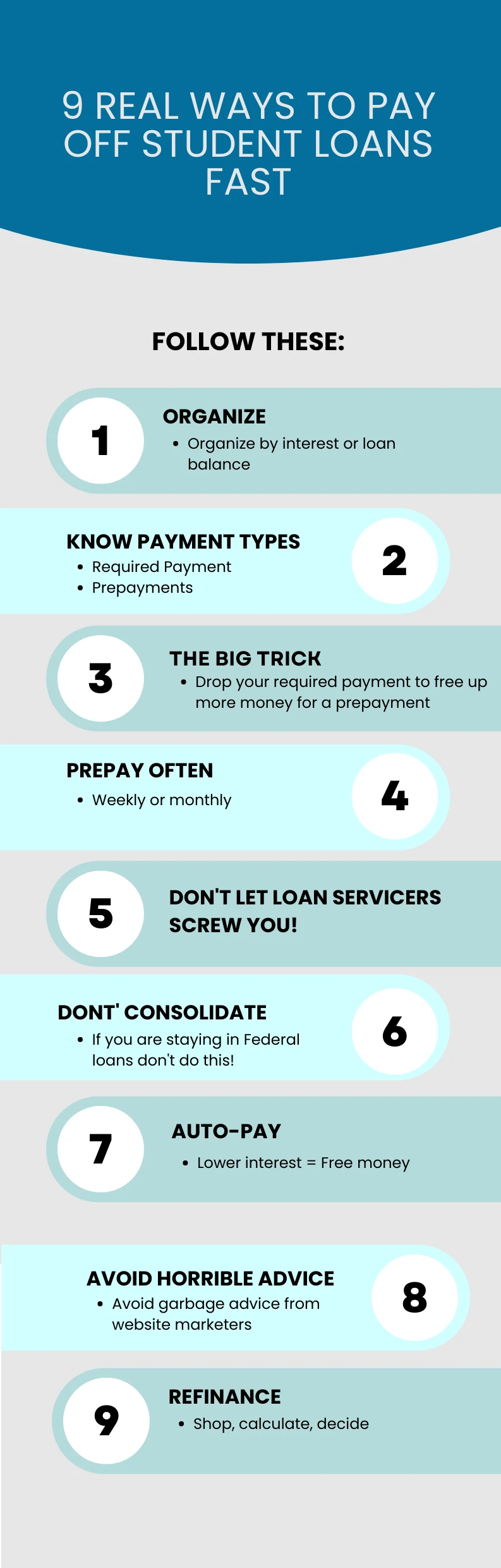
The student loan avalanche method is a financially optimized strategy that focuses on saving money on interest over the life of your loans. This method dictates that you make minimum payments on all your loans, but any extra money you have should be directed towards the loan with the highest interest rate. Once that loan is paid off, you take the money you were paying on it (minimum payment + extra payment) and apply it to the loan with the next highest interest rate.
- How it Works: Mathematically, this method saves you the most money because it eliminates the most expensive debt first. It requires discipline and may not offer the quick “wins” of the snowball method, but the long-term financial benefits are significant.
- Who It’s For: Individuals who are highly disciplined and focused on minimizing total interest paid.
B. The Snowball Method: Building Momentum
In contrast, the student loan snowball method prioritizes psychological motivation. With this approach, you make minimum payments on all loans except for the one with the smallest outstanding balance. You direct all extra payments towards this smallest loan. Once it’s paid off, you take the entire payment amount (the previous minimum payment plus the extra payment) and apply it to the next smallest loan.
- How it Works: While it may not save you as much in interest as the avalanche method, the snowball method provides psychological wins by quickly eliminating smaller debts. These successes build momentum and keep you motivated to continue the repayment process.
- Who It’s For: Individuals who need psychological boosts and motivation to stay on track with their debt repayment goals.
C. Making Extra Payments & Lump Sum Contributions
Beyond these structured methods, simply making extra payments whenever possible can significantly reduce your principal and the total interest you pay. Even small additional contributions add up over time.
- Round Up Payments: If your minimum is $180, pay $200.
- Bi-Weekly Payments: Instead of one monthly payment, pay half every two weeks. This results in 13 full payments per year instead of 12.
- Windfalls: Use bonuses, tax refunds, or unexpected income (e.g., gifts, inheritance) as lump sum payments directly to your principal. Always specify that extra payments should go towards the principal of a specific loan to avoid having it applied to future payments.
D. Boosting Income and Reducing Expenses
To free up more money for extra payments, focus on two key areas: increasing your income and decreasing your expenses.
- Side Hustles: Consider gig work, freelancing, or part-time jobs to generate additional income specifically dedicated to debt repayment.
- Budgeting: Create a detailed budget to identify where your money is going. Look for areas to cut back, such as dining out, subscriptions, or discretionary spending. Every dollar saved can be a dollar put towards your student loans.
- Automate Savings: Set up automatic transfers from your checking to a separate “debt payment” savings account, or directly to your loan servicer, to ensure consistency.
III. Leveraging Government Programs and Protections
Federal student loans come with a suite of benefits and repayment options designed to help borrowers manage their debt, especially during financial hardship. Understanding and utilizing these programs can be a game-changer for many.
A. Income-Driven Repayment (IDR) Plans
IDR plans adjust your monthly federal student loan payment based on your income and family size. These plans can make your payments more affordable by extending the repayment period and potentially offering loan forgiveness after a certain number of qualifying payments. The main IDR plans include:
-
REPAYE (Revised Pay As You Earn): Generally caps payments at 10% of your discretionary income.
-
PAYE (Pay As You Earn): Caps payments at 10% of discretionary income, but usually not more than the 10-year Standard Repayment Plan amount.
-
IBR (Income-Based Repayment): Caps payments at 10% or 15% of discretionary income, depending on when you took out your loans.
-
ICR (Income-Contingent Repayment): Caps payments at 20% of discretionary income or what you’d pay on a fixed 12-year plan, whichever is less.
-
Key Consideration: While IDR plans offer lower monthly payments and potential forgiveness, they often lead to paying more interest over time and can result in a “tax bomb” on the forgiven amount (unless the forgiven amount is from PSLF).
B. Public Service Loan Forgiveness (PSLF)
PSLF is a powerful program for individuals working full-time for qualifying government or non-profit organizations. After making 120 qualifying monthly payments under a qualifying repayment plan (usually an IDR plan) while working for a qualifying employer, the remaining balance on your Direct Loans can be forgiven tax-free.
- Eligibility: Strict rules apply to eligible employers, loan types, and payment plans. It’s crucial to ensure you meet all requirements from the outset.
- Certification: Regularly certify your employment to track your progress towards the 120 payments.
C. Other Forgiveness and Discharge Programs
Beyond PSLF, other federal loan forgiveness and discharge options exist:
-
Teacher Loan Forgiveness: For teachers who work for five consecutive years in low-income schools.
-
Total and Permanent Disability (TPD) Discharge: If you become totally and permanently disabled.
-
Borrower Defense to Repayment: If your school misled you or engaged in other misconduct.
-
Closed School Discharge: If your school closes while you’re enrolled or shortly after you withdraw.
-
Important Note: These programs have specific eligibility criteria. Research thoroughly or consult with a financial advisor specializing in student debt to determine if you qualify.
D. Deferment and Forbearance
These options allow you to temporarily pause or reduce your federal student loan payments.
-
Deferment: Interest may not accrue on subsidized loans during deferment. Reasons include enrollment in school, unemployment, or economic hardship.
-
Forbearance: Interest typically accrues on all loan types during forbearance. It’s a short-term solution for temporary financial difficulty.
-
Caution: While helpful in a crisis, using deferment or forbearance should be a last resort, as it extends your repayment period and often increases the total amount you pay in interest.
IV. Optimizing Debt Through Refinancing and Consolidation
Refinancing and consolidation are two distinct strategies that can alter the structure of your student loans, potentially leading to lower interest rates, simplified payments, and reduced monthly costs. However, they come with different implications, especially concerning federal loan protections.
A. Federal Loan Consolidation (Direct Consolidation Loan)
Federal loan consolidation combines multiple federal student loans into a single new federal loan with a single monthly payment.
- Benefits:
- Simplifies repayment: One loan, one servicer, one payment.
- Maintains federal benefits: You retain access to IDR plans, deferment, forbearance, and forgiveness programs like PSLF.
- Access to IDR plans: Can make previously ineligible federal loans (like FFEL loans) eligible for IDR plans and PSLF.
- Drawbacks:
- Interest rate: The new interest rate is a weighted average of your previous rates, rounded up to the nearest one-eighth of a percent. It generally won’t lower your interest rate.
- Extends repayment: Can stretch out your repayment period, potentially leading to more interest paid over the long run.
- When to Consider: Primarily for simplifying payments, regaining access to federal benefits, or qualifying for specific IDR plans or PSLF.
B. Private Student Loan Refinancing
Refinancing involves taking out a new private loan to pay off one or more existing student loans (federal or private). The goal is typically to secure a lower interest rate, which can significantly reduce your total cost of borrowing and your monthly payments.
- Benefits:
- Lower interest rates: If you have excellent credit, a stable income, and a strong debt-to-income ratio, you could qualify for a significantly lower interest rate.
- Simplified payments: Consolidate multiple loans into one with a single lender.
- Flexible terms: Choose a new loan term (e.g., 5, 10, 15, 20 years) to align with your financial goals.
- Drawbacks:
- Loss of federal benefits: Refinancing federal loans into a private loan means forfeiting all federal protections (IDR plans, deferment, forbearance, forgiveness programs). This is a critical consideration.
- Credit requirements: You need a strong credit score and income to qualify for the best rates.
- No forgiveness: Private loans do not offer forgiveness programs.
- When to Consider:
- If you have high-interest private loans.
- If you have federal loans but a stable, high income, excellent credit, and you are confident you won’t need federal protections or qualify for federal forgiveness (like PSLF). This decision requires careful evaluation.
V. Integrating Debt Repayment into Your Broader Financial Plan
Paying off student debt shouldn’t be an isolated goal. It needs to be integrated into your overall financial strategy, balancing it with other critical objectives like saving for retirement, building an emergency fund, and future investments.
A. Prioritizing an Emergency Fund
Before aggressively tackling student debt, ensure you have a robust emergency fund. This fund, typically 3-6 months’ worth of essential living expenses, acts as a financial safety net for unexpected events (job loss, medical emergency, car repair). Without it, any financial setback could force you to default on your loans or take on new, high-interest debt, undermining your progress.
B. Balancing Debt Repayment with Other Financial Goals
The “debt vs. save/invest” dilemma is common. While aggressively paying off high-interest debt is often a smart move, completely neglecting retirement savings or other investment opportunities can be detrimental in the long run.
- Retirement: At least contribute enough to your employer-sponsored 401(k) or similar plan to get the full company match. This is essentially free money and provides an immediate, guaranteed return on your investment.
- Future Goals: Consider short-term savings goals like a down payment for a house or a new car. A balanced approach might involve dedicating a portion of your extra income to debt and a portion to savings/investments.
C. Building and Maintaining Good Credit
Responsible student loan repayment positively impacts your credit score. Timely payments, a long credit history, and a good mix of credit types contribute to a healthy score, which is crucial for future financial endeavors like buying a home or car, or even securing certain jobs. Even while paying down debt, continue to manage your credit responsibly.
D. Staying Disciplined and Reviewing Progress
The journey to becoming debt-free is a marathon, not a sprint. Consistency and discipline are key.
- Set Clear Goals: Define specific, measurable, achievable, relevant, and time-bound (SMART) goals for your student debt repayment.
- Track Your Progress: Regularly review your loan statements and repayment progress. Seeing the principal balance shrink can be incredibly motivating.
- Adjust as Needed: Life circumstances change. Revisit your budget, strategies, and repayment plans periodically to ensure they still align with your current financial situation and goals. Don’t be afraid to pivot if a strategy isn’t working or if a new opportunity arises.
Conclusion
Paying off student debt is a significant financial undertaking, but it is entirely within your control. By diligently understanding the nuances of your loans, strategically applying proven repayment methods, leveraging available government programs, and integrating your efforts into a broader financial plan, you can transform what feels like an overwhelming burden into a manageable and conquerable challenge. The path to financial freedom from student loans demands informed decisions, consistent effort, and unwavering discipline. Embrace this journey with a clear strategy and a positive mindset, and you will ultimately achieve the peace of mind that comes with being student-debt-free, paving the way for a more secure and prosperous future.
aViewFromTheCave is a participant in the Amazon Services LLC Associates Program, an affiliate advertising program designed to provide a means for sites to earn advertising fees by advertising and linking to Amazon.com. Amazon, the Amazon logo, AmazonSupply, and the AmazonSupply logo are trademarks of Amazon.com, Inc. or its affiliates. As an Amazon Associate we earn affiliate commissions from qualifying purchases.