
Navigating the landscape of federal taxes can often feel like deciphering a complex code. For many, the annual tax season brings a mix of apprehension and the desire for clarity on how to accurately and efficiently fulfill their obligations. Beyond the initial process of preparing your tax return, understanding the various methods available for payment, managing your tax liabilities throughout the year, and knowing what to do if you face challenges are crucial components of sound financial stewardship. This comprehensive guide aims to demystify the process, providing you with insightful, actionable information on how to pay your federal taxes.
Understanding Your Tax Obligation
Before diving into payment methods, it’s essential to grasp the fundamental aspects of your tax obligation. This involves knowing who needs to pay, which forms are relevant, and the critical deadlines set by the Internal Revenue Service (IRS).
Who Needs to Pay Federal Taxes?
Virtually every U.S. citizen and resident alien with income above a certain threshold is required to pay federal income taxes. This includes individuals earning wages from an employer, self-employed individuals, those with investment income, rental income, and various other forms of taxable earnings. The specific threshold depends on your filing status (e.g., single, married filing jointly, head of household) and age. It’s not just income tax; federal taxes can also include self-employment taxes (Social Security and Medicare for self-employed individuals), capital gains taxes, and, in some cases, estate or gift taxes. Understanding your specific tax situation is the first step toward compliance.
Key Tax Forms and Documents
The journey to paying your federal taxes begins with accurate record-keeping and understanding the forms involved. Your primary tax return form is typically Form 1040, U.S. Individual Income Tax Return. Supporting documents are vital for accurately completing this form and calculating your tax liability. These commonly include:
- Form W-2 Wage and Tax Statement: Received from employers, showing wages earned and taxes withheld.
- Form 1099-NEC Nonemployee Compensation: For independent contractors or self-employed individuals.
- Form 1099-MISC Miscellaneous Information: For various types of income such as rents, royalties, or awards.
- Form 1099-INT Interest Income & 1099-DIV Dividends and Distributions: For investment income.
- Form 1098 Mortgage Interest Statement: If you own a home and pay mortgage interest.
- Records of deductions and credits: Such as charitable contributions, medical expenses, student loan interest, or educational expenses.
Meticulous organization of these documents throughout the year significantly streamlines the tax preparation process and helps prevent errors that could lead to penalties or delays.
Important Deadlines to Remember
The most widely known tax deadline is April 15th for filing individual income tax returns and paying any taxes due. However, several other crucial dates dot the tax calendar:
- January 31st: Employers typically issue W-2s, and payers issue 1099s by this date.
- April 15th: Deadline for filing federal income tax returns and paying any balance due. Also, the deadline for the first quarter’s estimated tax payments for the current year.
- June 15th: Second quarter estimated tax payment deadline.
- September 15th: Third quarter estimated tax payment deadline.
- October 15th: Extended filing deadline for those who filed Form 4868 for an extension. Note that an extension to file is not an extension to pay.
- January 15th (of next year): Fourth quarter estimated tax payment deadline.
Missing these deadlines can result in penalties and interest, underscoring the importance of proactive tax planning and calendar management.
Common Methods for Paying Federal Taxes
Once you’ve calculated your tax liability, the IRS offers several convenient and secure methods for payment. Choosing the right method often depends on your preference for electronic vs. paper, and whether you’re paying a balance due with your return or making estimated tax payments throughout the year.
Direct Pay (IRS.gov)
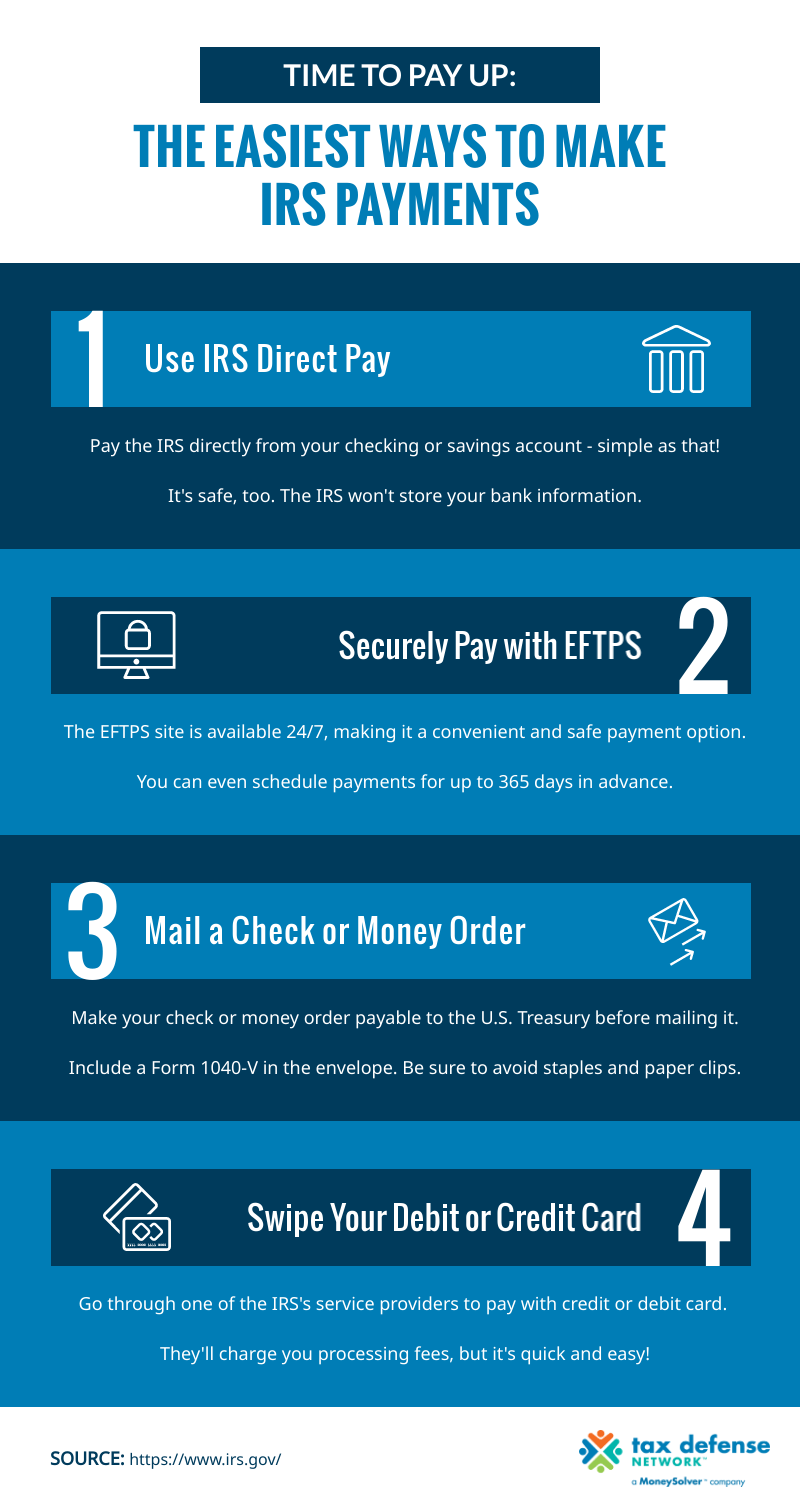
IRS Direct Pay is one of the most popular and straightforward electronic options. It allows you to pay your taxes directly from your checking or savings account for free. You can schedule payments up to 365 days in advance, receive email confirmations, and even modify or cancel payments up to two days before the scheduled date. This method is ideal for one-time payments associated with filing your annual return, making estimated tax payments, or paying certain types of tax bills.
Electronic Federal Tax Payment System (EFTPS)
EFTPS is a robust, free service offered by the U.S. Department of Treasury for both individual and business taxpayers. It allows you to make all federal tax payments electronically, including estimated taxes, payroll taxes, and other business taxes. Unlike Direct Pay, EFTPS requires enrollment and a few days for activation. Once set up, it provides a comprehensive platform for managing ongoing tax payments, scheduling them in advance, and reviewing payment history. This is particularly beneficial for self-employed individuals or small business owners who make quarterly estimated tax payments.
Debit/Credit Card or Digital Wallet
For those who prefer the convenience of using a debit or credit card, or digital wallet services like PayPal or Click to Pay, the IRS partners with third-party payment processors. While these methods offer instant confirmation and the potential to earn credit card rewards, they do come with a processing fee charged by the third party, which varies depending on the provider and payment amount. This can be a good option for taxpayers who need to make a last-minute payment or prefer the flexibility of paying with plastic.
Electronic Funds Withdrawal (EFW) – During e-filing
When you e-file your federal tax return through tax software or a tax professional, you’ll typically have the option to authorize an electronic funds withdrawal (EFW) directly from your bank account. This convenient method allows you to schedule a payment for the exact date your return is filed or any future date up to the tax deadline. It simplifies the process by integrating payment directly into the e-filing workflow, eliminating the need for separate steps to pay.
Payment by Check or Money Order
For taxpayers who prefer traditional methods or cannot use electronic options, payment by check or money order is still accepted. You should make the check or money order payable to the “U.S. Treasury,” write your name, address, daytime phone number, Social Security number (SSN), the tax year, and the related tax form (e.g., “2023 Form 1040”) on it. You then mail it with your tax return or a payment voucher (Form 1040-V) to the appropriate IRS address. While reliable, this method is slower, offers less immediate confirmation, and is more susceptible to postal delays.
Strategies for Managing Your Tax Payments
Effective tax payment goes beyond merely cutting a check or initiating an electronic transfer. It involves strategic planning to ensure you meet your obligations without undue stress or financial strain.
Estimated Taxes for Self-Employed and Other Income
If you are self-employed, own a business, or have significant income not subject to withholding (e.g., interest, dividends, rental income, alimony, or prizes), you are generally required to pay estimated taxes throughout the year. The IRS operates on a “pay-as-you-go” system, meaning you must pay income tax as you earn or receive income during the year. This is typically done through four quarterly payments using Form 1040-ES, Estimated Tax for Individuals. Failing to pay enough estimated tax throughout the year can result in penalties, even if you pay your full balance by April 15th. Calculating your estimated taxes accurately is crucial, often requiring a projection of your annual income and deductions.
Withholding Adjustments for W-2 Employees
For employees who receive W-2 forms, your federal income tax is typically withheld from each paycheck by your employer. If you find yourself consistently owing a significant amount at tax time or receiving a very large refund, you might consider adjusting your withholding. You can do this by submitting a new Form W-4, Employee’s Withholding Certificate, to your employer. Adjusting your withholding allows you to align the amount of tax taken out of each paycheck more closely with your actual tax liability, avoiding large balances due or excessively large refunds (which essentially means giving the government an interest-free loan).
Planning for Unexpected Tax Bills
Life is unpredictable, and so can be your income. A sudden bonus, a large capital gain from selling investments, or an unexpected inheritance can significantly impact your tax liability. It’s prudent to set aside funds throughout the year, especially if you anticipate such events. Building an emergency fund that can also serve as a buffer for unexpected tax bills provides financial peace of mind. Regular review of your income and potential tax implications can help you proactively adjust your payments or savings strategy.
What if You Can’t Pay on Time? (Payment Plans)
If you’re unable to pay your federal taxes by the deadline, don’t ignore the issue. The IRS offers several options for taxpayers facing financial hardship:
- Short-Term Payment Plan: You may be granted up to 180 days to pay your tax liability in full, although interest and penalties still apply.
- Offer in Compromise (OIC): This allows certain taxpayers to resolve their tax liability with the IRS for a lower amount than they originally owed. An OIC is typically granted when you can demonstrate a significant inability to pay the full amount due.
- Installment Agreement: You can make monthly payments for up to 72 months. While interest and penalties still accrue, they are often reduced. Setting up an installment agreement online is usually straightforward for those who owe less than a certain amount (e.g., $50,000 for individuals including tax, penalties, and interest).
Proactively communicating with the IRS and exploring these options can prevent more severe consequences like levies or liens.
Utilizing Financial Tools for Tax Preparation and Payment
The digital age has brought a plethora of financial tools that can simplify both tax preparation and payment, making the process more efficient and less error-prone.
Tax Software Solutions (e.g., TurboTax, H&R Block)
Modern tax software has revolutionized how millions prepare and file their taxes. Programs like TurboTax, H&R Block Tax Software, and TaxAct guide users step-by-step through the process, helping them identify eligible deductions and credits, accurately calculate their tax liability, and e-file their returns. Many of these platforms also offer integrated options for paying federal taxes electronically through methods like EFW or Direct Pay, further streamlining the entire tax experience. They can also assist with calculating estimated taxes for the current year.
Professional Tax Preparers (CPAs, Enrolled Agents)
For those with complex financial situations, significant life changes, or simply a desire for expert assistance, engaging a professional tax preparer is a valuable financial tool. Certified Public Accountants (CPAs) and Enrolled Agents (EAs) are licensed professionals who specialize in tax law. They can ensure accuracy, identify all applicable deductions and credits, and provide strategic tax planning advice. While there is a cost associated with their services, the peace of mind and potential tax savings can often outweigh the expense, especially for intricate returns.
Record-Keeping Tools and Strategies
Effective record-keeping is the backbone of accurate tax filing and payment. Digital tools, such as budgeting apps (e.g., Mint, YNAB), expense tracking software (e.g., QuickBooks Self-Employed, Expensify), and cloud storage services (e.g., Google Drive, Dropbox), can help organize financial documents throughout the year. By categorizing income and expenses as they occur, you can significantly reduce the scramble during tax season and ensure you have all the necessary information readily available for your return.
Avoiding Pitfalls and Ensuring Accuracy
The goal of paying your federal taxes isn’t just to make the payment but to do so accurately and on time, avoiding unnecessary complications.
Common Errors to Watch Out For
Even minor errors can lead to processing delays or correspondence from the IRS. Common mistakes include:
- Mathematical errors: Simple addition or subtraction mistakes can alter your tax liability.
- Incorrect Social Security Numbers: A misplaced digit can cause issues with matching your income to your return.
- Wrong bank account information: For direct deposit refunds or electronic payments.
- Forgetting to sign and date your return: Paper returns must be signed.
- Claiming incorrect deductions or credits: Ensure you meet all eligibility requirements.
- Missing or incomplete information: Such as forgetting to report all sources of income.
Careful review of your return before submission is paramount.
The Importance of Reviewing Your Return
Whether you use tax software or a professional, always take the time to review your completed return thoroughly. Check personal information, income reported, deductions claimed, and the final tax due or refund amount. Many software programs include error-checking features, but a human review can catch logical inconsistencies or overlooked details. If using a preparer, ask questions about anything you don’t understand.
Keeping Records for Future Reference
After filing and paying your taxes, store all relevant documents—your filed return, W-2s, 1099s, receipts for deductions, and proof of payment—in a secure place. The IRS generally has three years from the date you filed your return to audit it (or two years from the date you paid the tax, whichever is later). However, in cases of substantial underreporting of income, this period can extend to six years. Keeping organized records protects you in the event of an audit and serves as a valuable reference for future tax planning.
Conclusion
Paying your federal taxes is an unavoidable aspect of financial responsibility, but it doesn’t have to be an overwhelming ordeal. By understanding your obligations, utilizing the various payment methods available, strategically managing your tax liabilities throughout the year, and leveraging modern financial tools, you can approach tax season with confidence and clarity. Proactive planning, meticulous record-keeping, and a thorough review of your return are the cornerstones of accurate and timely tax payments. By embracing these principles, you not only fulfill your duties as a taxpayer but also take a significant step toward robust personal financial management.
aViewFromTheCave is a participant in the Amazon Services LLC Associates Program, an affiliate advertising program designed to provide a means for sites to earn advertising fees by advertising and linking to Amazon.com. Amazon, the Amazon logo, AmazonSupply, and the AmazonSupply logo are trademarks of Amazon.com, Inc. or its affiliates. As an Amazon Associate we earn affiliate commissions from qualifying purchases.