
Facing a tax bill you can’t pay immediately can be a source of significant stress and anxiety. The Internal Revenue Service (IRS), however, recognizes that financial difficulties can arise, and it offers several avenues for taxpayers to resolve their outstanding tax liabilities through various payment plans. Ignoring tax debt is never the solution; it only leads to more severe penalties, interest, and potential enforcement actions. Instead, understanding and utilizing the IRS’s structured payment options can provide a clear path to financial recovery and peace of mind. This comprehensive guide delves into the various payment plans available, the application process, and essential considerations to help you navigate your tax obligations effectively and professionally.

Understanding Your IRS Payment Options
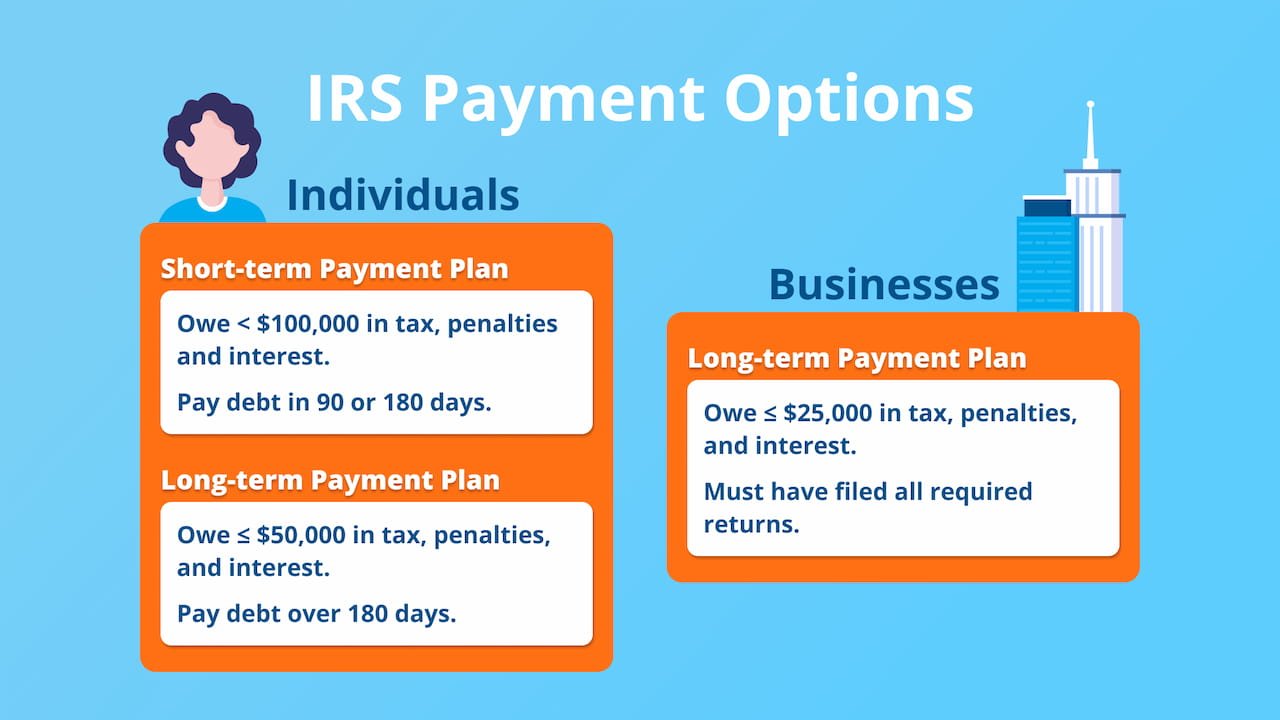
The IRS provides a range of options designed to assist taxpayers based on their specific financial circumstances. It’s crucial to understand each plan’s characteristics, eligibility requirements, and implications to choose the most suitable one for your situation.
Short-Term Payment Plan
For taxpayers who anticipate being able to pay their full tax liability within a relatively short period, typically up to 180 days, the IRS offers a short-term payment plan. This option is straightforward and does not require a formal installment agreement.
-
Description: This plan allows for a temporary extension to pay your tax bill in full. It’s ideal if you expect a lump sum payment (e.g., a bonus, inheritance, or sale of an asset) that will cover your debt within a few months.
-
Eligibility: Most taxpayers can qualify for a short-term payment plan simply by requesting it. You don’t need to fill out extensive forms or provide detailed financial statements, as long as the amount owed is manageable within the timeframe.
-
Implications: While this plan grants you extra time, it’s important to note that interest and penalties continue to accrue on your unpaid balance until it is paid in full. The “failure to pay” penalty rate is typically 0.5% of the unpaid taxes for each month or part of a month that taxes remain unpaid, up to 25% of your unpaid taxes. Interest rates fluctuate but are generally set quarterly by the IRS.
Offer in Compromise (OIC)
An Offer in Compromise (OIC) is a more complex and often more challenging option, but it can provide significant relief for taxpayers facing severe financial hardship. An OIC allows certain taxpayers to resolve their tax liability with the IRS for a lower amount than they originally owe.
-
Description: An OIC is an agreement between a taxpayer and the IRS that settles a tax liability for less than the full amount owed. The IRS considers your ability to pay, your income, your expenses, and the equity of your assets when evaluating an OIC.
-
Eligibility: The IRS will generally approve an OIC when there is “doubt as to collectibility,” meaning they believe you cannot pay the full amount of your tax liability. It can also be considered based on “doubt as to liability” (when there’s a legitimate question whether the assessed tax is correct) or “effective tax administration” (when requiring full payment would cause economic hardship or be unfair/inequitable). This option is for individuals who truly cannot afford to pay their taxes and have exhausted other payment avenues.
-
Process: Applying for an OIC is a detailed and rigorous process. It requires completing Form 656, Offer in Compromise, and Form 433-A (OIC), Collection Information Statement for Wage Earners and Self-Employed Individuals (or Form 433-B (OIC) for Businesses). You’ll need to provide extensive documentation of your income, expenses, and assets. The IRS will conduct a thorough financial investigation. Be prepared for a potentially lengthy review period, and understand that many OICs are rejected.
-
Implications: If an OIC is accepted, it can provide substantial relief by significantly reducing your tax debt. However, while your OIC is pending, the IRS may levy your bank accounts or wages, and a federal tax lien may remain in place until your OIC is paid in full. Additionally, you must remain compliant with all tax filings and payments for five years after the acceptance of an OIC.
Installment Agreement (IA)
The most common and generally most accessible payment plan is the Installment Agreement (IA). This plan allows taxpayers to make monthly payments for up to 72 months (six years).
-
Description: An IA is a formal agreement with the IRS to make a series of monthly payments over an extended period until your tax debt, including penalties and interest, is paid in full.
-
Eligibility: This option is available to individual taxpayers who owe a combined total of $50,000 or less in tax, penalties, and interest, and to businesses that owe $25,000 or less in tax, penalties, and interest. You must have filed all required tax returns.
-
Types:
-
Streamlined Installment Agreement: If you meet the debt threshold and other basic requirements, you can usually qualify for a streamlined IA without providing detailed financial statements. This is the simplest and most frequently used IA.
-
Non-Streamlined Installment Agreement: If you owe more than the streamlined thresholds or have specific complex circumstances, you might still qualify for an IA, but the IRS may require a more detailed financial analysis, similar to what’s required for an OIC.
-
-
Implications: While an IA provides a structured payment schedule, interest and penalties continue to accrue. However, the failure-to-pay penalty rate is typically reduced by half (from 0.5% to 0.25%) once an IA is established. Establishing an IA prevents the IRS from taking more aggressive collection actions, such as wage garnishments, bank levies, or seizing assets, as long as you adhere to the terms of the agreement.
Steps to Apply for an IRS Payment Plan
Once you understand the available options, the next step is to initiate the application process. This involves careful preparation and adherence to IRS procedures.
Determine Your Eligibility and Best Option
Before applying, take an honest look at your financial situation.
-
Review Your Financial Situation: Assess your income, expenses, assets, and liabilities. How much can you realistically afford to pay each month without compromising essential living expenses?
-
Gather Necessary Financial Documents: Collect all relevant financial records, including recent tax returns, pay stubs, bank statements, investment account statements, and a detailed list of your monthly expenses (mortgage/rent, utilities, food, transportation, medical, etc.).
-
Use IRS Tools: The IRS offers resources like the Offer in Compromise Pre-Qualifier Tool (available on IRS.gov) which can help you determine if an OIC might be a viable option based on your initial financial information.
How to Apply
The application method varies depending on the type of payment plan you’re seeking.
-
Online Payment Agreement (OPA) Application: For most streamlined Installment Agreements, individuals and businesses can apply online using the IRS’s Online Payment Agreement application tool. This is often the quickest and easiest way to establish an IA.
-
Form 9465, Installment Agreement Request: If you prefer to apply by mail or cannot use the online tool (e.g., if you owe more than the online system allows, or have not filed all required returns yet), you can complete and mail Form 9465. This form is typically filed with your tax return or mailed separately.
-
Form 656, Offer in Compromise: To apply for an OIC, you must complete Form 656 and the relevant Collection Information Statement (Form 433-A (OIC) or 433-B (OIC)), along with the required application fee and payment for certain OIC types.
-
Contacting the IRS Directly: You can also call the IRS directly or visit a Taxpayer Assistance Center (TAC) for guidance and to discuss your payment options. Be prepared to provide your Social Security number or Employer Identification Number and have your tax information readily available.
What to Expect After Applying
Once you’ve submitted your application, the process isn’t over.
-
Confirmation and Review Period: For online Installment Agreements, you often receive immediate confirmation. For mailed applications or OICs, there will be a waiting period during which the IRS reviews your submission. They may request additional information or clarification.
-
Continued Payment of Current Taxes: Even while your payment plan application is pending, it is crucial to continue filing all future tax returns on time and paying any new tax liabilities as they come due. Failure to do so can jeopardize your application or existing agreement.
Managing Your Payment Plan and Avoiding Pitfalls
Securing a payment plan is just the first step. Successfully navigating your tax debt requires diligent adherence to the agreement’s terms.

Adhering to the Agreement
Once your payment plan is approved, consistency is key.
-
Make Timely Payments: Ensure all agreed-upon monthly payments are made on time. Set up automatic payments to avoid missing deadlines.
-
File All Future Tax Returns On Time: Even if you can’t pay the new taxes owed, you must file your returns on time.
-
Pay All Future Tax Liabilities On Time: As part of the agreement, you are expected to meet all future tax obligations (estimated taxes, payroll taxes, etc.) without falling behind.
Consequences of Defaulting
Failing to meet the terms of your payment plan can lead to severe repercussions.
-
Termination of the Agreement: The IRS can terminate your payment plan, immediately demanding the full outstanding balance.
-
Reinstatement of Original Penalties and Interest: Upon default, the full, higher failure-to-pay penalty rate will typically be reinstated, along with interest.
-
Resumption of Aggressive Collection Actions: The IRS will resume or initiate aggressive collection actions, including issuing levies on bank accounts or wages, or filing federal tax liens against your property.
When Your Financial Situation Changes
Life circumstances can change, impacting your ability to meet payment plan obligations.
-
Proactively Contact the IRS: If you experience a change in income or expenses that makes your current payment plan unaffordable, do not wait until you miss a payment. Contact the IRS immediately to discuss modifying your agreement. They may be able to adjust your monthly payment or offer other solutions.
-
Don’t Wait Until You Miss a Payment: Being proactive shows good faith and gives you more options. The IRS is generally more willing to work with taxpayers who communicate their difficulties before defaulting.
The Role of Tax Professionals
For complex tax situations or when negotiating an OIC, seeking professional help can be invaluable.
-
When to Seek Help: If you owe a substantial amount, if your financial situation is complicated, if you’re considering an OIC, or if you feel overwhelmed by the process, a tax professional can provide expert guidance.
-
Benefits: Experienced CPAs, Enrolled Agents (EAs), or tax attorneys specialize in IRS procedures and tax law. They can help you understand your options, prepare accurate documentation, negotiate with the IRS on your behalf, and ensure you comply with all terms, providing peace of mind.
Important Considerations and Tips
Beyond the mechanics of applying, several critical factors should inform your approach to an IRS payment plan.
Understanding Penalties and Interest
It’s a common misconception that a payment plan eliminates penalties and interest.
-
Penalties Still Apply: While an Installment Agreement can reduce the failure-to-pay penalty, penalties for late filing or underpayment still apply.
-
Interest Compounds Daily: Interest on unpaid taxes and penalties continues to accrue daily until the balance is paid in full. The IRS interest rate is adjusted quarterly and is typically based on the federal short-term rate plus 3 percentage points. Understanding this ongoing cost is vital for planning your payments.
Statute of Limitations
The IRS generally has 10 years from the date of assessment to collect tax debt. This is known as the Collection Statute Expiration Date (CSED).
- Payment Plans Can ‘Toll’ the Statute: Entering into certain payment plans, such as an Installment Agreement or an Offer in Compromise, can “toll” or pause this 10-year collection period. This means the clock stops ticking on the IRS’s ability to collect while the agreement is in effect or pending, effectively extending the time the IRS has to collect your debt. This is an important detail to be aware of.
Proactivity is Key
The most crucial advice when dealing with tax debt is to act promptly.
-
Don’t Ignore IRS Notices: Opening and responding to all IRS correspondence is essential. Ignoring notices will not make the problem disappear; it will only lead to more severe consequences.
-
Address Issues Early: The earlier you address your tax debt, the more options you will have, and the less likely you are to incur additional penalties and interest or face enforcement actions. Proactive communication with the IRS demonstrates a willingness to resolve your debt.
Don’t Forget State Taxes
Remember that if you owe federal taxes, you might also owe state taxes. Each state tax authority operates independently from the IRS and has its own set of rules, payment plans, and collection procedures. You will need to address state tax liabilities separately.
Conclusion
Owing money to the IRS can be daunting, but it is a manageable challenge with the right approach. The IRS offers various payment plans—short-term payment plans, Offers in Compromise, and Installment Agreements—each designed to cater to different financial circumstances. By understanding these options, meticulously preparing your application, and diligently adhering to the terms of your agreement, you can effectively manage your tax debt. Remember to prioritize open communication with the IRS, proactively address any changes in your financial situation, and consider seeking assistance from a qualified tax professional when needed. Taking these steps not only resolves your tax obligations but also provides the peace of mind that comes from taking control of your financial future.
aViewFromTheCave is a participant in the Amazon Services LLC Associates Program, an affiliate advertising program designed to provide a means for sites to earn advertising fees by advertising and linking to Amazon.com. Amazon, the Amazon logo, AmazonSupply, and the AmazonSupply logo are trademarks of Amazon.com, Inc. or its affiliates. As an Amazon Associate we earn affiliate commissions from qualifying purchases.