
Percentages are more than just a mathematical concept; they are the bedrock of financial understanding, a universal language spoken across every facet of personal and business finance. From evaluating a discount at your favorite store to dissecting complex investment returns, the ability to accurately calculate and interpret percentages is not merely a useful skill—it is an indispensable tool for informed decision-making and genuine financial empowerment.
In a world brimming with financial data, where interest rates, profit margins, tax rates, and investment returns are constantly presented in percentage form, a solid grasp of this fundamental arithmetic is crucial. This article will demystify percentages, providing a comprehensive guide on how to calculate them and, more importantly, how to apply this knowledge to navigate the intricate landscape of personal and business finance with confidence and clarity. By the end, you’ll not only know “how to find the percentage of a number” but also understand its profound implications for your financial well-being.

The Core Mechanics: Understanding How to Calculate Percentages
Before diving into complex financial scenarios, it’s essential to solidify the foundational understanding of what a percentage is and the primary methods for calculating it. These core mechanics are the building blocks for all financial applications.
What is a Percentage? Defining the Basics
At its heart, a percentage represents a proportion or a fraction of a whole, expressed as a number out of 100. The term “percent” literally means “per hundred” or “for every hundred.” It’s denoted by the symbol “%”. For example, 50% means 50 out of 100, or one-half.
The power of percentages lies in their ability to standardize comparisons. Whether you’re comparing a small budget item to your monthly income or a nation’s deficit to its GDP, expressing these relationships as percentages allows for clearer, more intuitive understanding than raw numbers alone. It transforms disparate figures into a common, comparable scale.
Formula 1: Finding the Percentage of a Given Number
This is perhaps the most common application of percentages, frequently encountered when dealing with discounts, interest, or commissions. The goal is to determine a specific portion of a larger number.
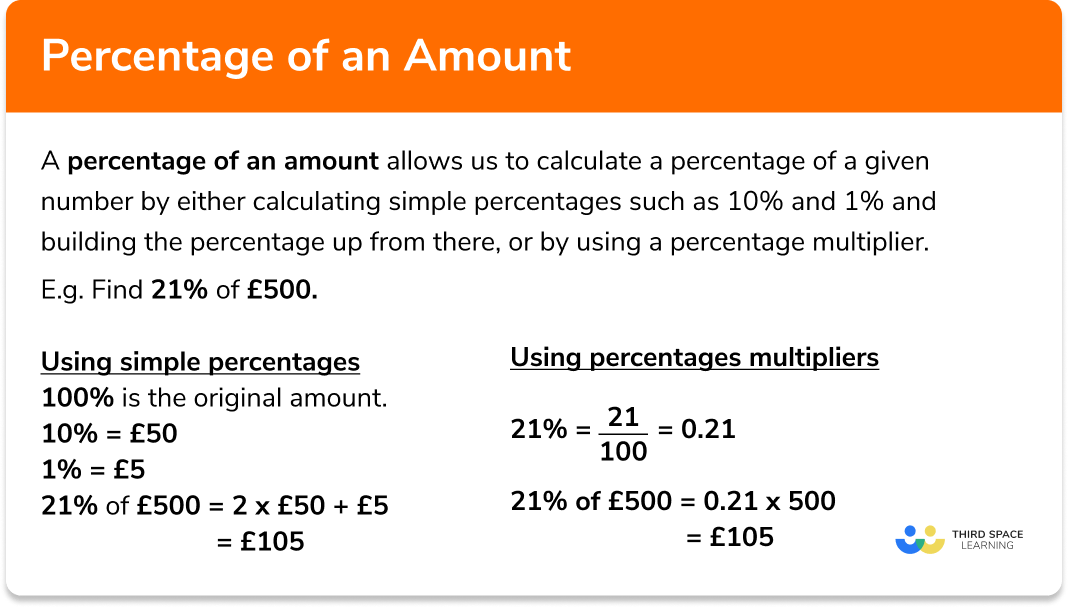
Formula: Percentage of Number = (Percentage / 100) * Whole Number
Alternatively, you can convert the percentage to a decimal by dividing it by 100, then multiply by the whole number:
Percentage of Number = Decimal Equivalent * Whole Number
Example 1: Calculating a Discount
Imagine you want to buy a jacket that costs $150, and it’s on sale for 20% off.
- Method 1 (Fraction): (20 / 100) * $150 = 0.20 * $150 = $30
The discount amount is $30. The sale price is $150 – $30 = $120. - Method 2 (Remaining Percentage): If it’s 20% off, you’re paying 80% of the original price.
(80 / 100) * $150 = 0.80 * $150 = $120
This directly gives you the final price.
Example 2: Calculating Simple Interest
You invest $1,000 in a savings account that offers a 3% annual interest rate.
- (3 / 100) * $1,000 = 0.03 * $1,000 = $30
You would earn $30 in interest over the year.
Formula 2: Expressing One Number as a Percentage of Another
This formula is crucial for understanding proportions, such as what percentage of your income goes to rent, or what percentage of your investment portfolio a single stock represents.
Formula: Percentage = (Part / Whole) * 100
Example 1: Analyzing Budget Allocation
Your monthly income is $4,000, and your rent is $1,200. What percentage of your income goes to rent?
- ($1,200 / $4,000) * 100 = 0.30 * 100 = 30%
30% of your income is allocated to rent.
Example 2: Calculating Investment Gains
You invested $5,000 in a stock, and it grew to $5,500. What percentage of your initial investment is the profit?
- First, find the profit: $5,500 – $5,000 = $500
- Then, calculate the percentage: ($500 / $5,000) * 100 = 0.10 * 100 = 10%
Your investment yielded a 10% profit.
Formula 3: Calculating Percentage Change (Increase or Decrease)
Understanding percentage change is vital for tracking growth (or decline) over time, be it in stock prices, inflation rates, or personal income. It tells you the relative shift between two values.
Formula: Percentage Change = ((New Value - Old Value) / Old Value) * 100
- A positive result indicates a percentage increase.
- A negative result indicates a percentage decrease.
Example 1: Stock Price Increase
A stock you own was priced at $80 last year and is now $96. What is the percentage increase?
- (($96 – $80) / $80) * 100 = ($16 / $80) * 100 = 0.20 * 100 = 20%
The stock price increased by 20%.
Example 2: Inflation Rate
If a basket of goods cost $100 last year and now costs $103, what is the inflation rate?
- (($103 – $100) / $100) * 100 = ($3 / $100) * 100 = 0.03 * 100 = 3%
The inflation rate is 3%.
Percentages in Personal Finance: Everyday Applications
Once the basic calculations are mastered, their immediate utility in managing personal finances becomes apparent. Percentages aren’t just for mathematicians; they’re for everyone aiming to manage their money better.
Budgeting and Expense Management
Effective budgeting relies heavily on percentages to allocate funds and understand spending patterns.
- The 50/30/20 Rule: A popular budgeting guideline suggests allocating 50% of your income to needs, 30% to wants, and 20% to savings and debt repayment. Understanding these percentages allows you to quickly assess if your spending aligns with your financial goals.
- Tracking Spending: By calculating what percentage of your income goes to various categories (e.g., groceries, entertainment, transportation), you can identify areas for potential savings. If 15% of your income goes to dining out, and your goal is 10%, you know where to adjust.
- Debt-to-Income Ratio (DTI): Lenders use DTI to assess your ability to manage monthly payments and repay debts. It’s calculated as your total monthly debt payments divided by your gross monthly income, expressed as a percentage. A lower DTI indicates less risk.
Understanding Discounts and Sales
The retail world thrives on percentages. Knowing how to quickly calculate discounts empowers you to make smarter purchasing decisions.
- Single Discounts: Easily calculate 15% off, 30% off, or even 70% off. Knowing the absolute dollar savings helps you decide if a deal is truly worth it.
- Cumulative Discounts: Some sales offer “additional 20% off the marked down price.” This requires sequential percentage calculations. For example, an item originally $100, discounted 30%, then an additional 20% off the new price:
- First discount: $100 * (1 – 0.30) = $70
- Second discount: $70 * (1 – 0.20) = $56
The final price is $56, not $100 * (1 – 0.50) = $50. Understanding this difference can save you money.
Interest Rates and Loans
Perhaps no area of personal finance is more dominated by percentages than interest rates.
- Annual Percentage Rate (APR): This is the yearly interest rate charged on loans (mortgages, credit cards, personal loans) or earned on investments. Understanding how APR translates into monthly payments or earnings is critical. A 19.99% APR on a credit card means you’re paying nearly 20 cents for every dollar you carry as a balance annually.
- Simple vs. Compound Interest: While simple interest uses Formula 1 (percentage of a number), compound interest involves calculating interest on both the initial principal and the accumulated interest from previous periods. Understanding this exponential growth (for investments) or accumulation (for debt) is key to long-term financial planning.
- Loan Affordability: Lenders assess your ability to pay based on percentages of your income. Knowing what percentage of your take-home pay a new car loan or mortgage payment will consume helps you avoid overextending yourself.
Savings and Investments
Percentages are the language of growth, return, and risk in the investment world.
- Savings Rate: The percentage of your income that you save is a direct indicator of your financial discipline and future wealth potential.
- Return on Investment (ROI): This is a key metric calculated as
(Current Value - Initial Investment) / Initial Investment * 100. A 15% ROI indicates a strong return. - Dividend Yield: For dividend-paying stocks, the yield is the annual dividend per share divided by the stock’s price per share, expressed as a percentage. It helps compare income-generating investments.
- Expense Ratios: Mutual funds and ETFs charge annual fees expressed as a percentage of your investment. A 0.50% expense ratio might seem small, but over decades, it can significantly erode your returns due to compounding.
Percentages in Business and Investing: Strategic Insights
Beyond personal finances, percentages provide the analytical framework for business performance, investment strategies, and economic understanding.
Profitability and Margins
Businesses live and die by their margins, all expressed as percentages.
- Gross Profit Margin:
(Gross Profit / Revenue) * 100. This indicates how much profit a company makes from its sales after accounting for the direct costs of goods sold. - Net Profit Margin:
(Net Profit / Revenue) * 100. This is the ultimate measure of a company’s profitability, showing what percentage of revenue is left after all expenses, including taxes, are paid. - Operating Margin:
(Operating Income / Revenue) * 100. This indicates a company’s efficiency in managing its core operations. Comparing these percentages across competitors or over time reveals a company’s financial health and operational effectiveness.
Investment Performance and Risk
Sophisticated investors and analysts rely heavily on percentages to gauge investment success and manage risk.
- Year-over-Year Growth: Calculating the percentage change in revenue, earnings, or assets from one year to the next is a standard way to assess a company’s growth trajectory.
- Portfolio Allocation: Investors decide what percentage of their portfolio to allocate to different asset classes (e.g., 60% stocks, 30% bonds, 10% cash) to manage risk and achieve diversification. This strategy directly uses percentages to build a balanced portfolio.
- Volatility: Measures like “standard deviation” or “beta” quantify an investment’s risk as a percentage of its expected return or market movements.
- Drawdowns: The maximum percentage decline from a peak to a trough in an investment’s value is a critical risk metric for fund managers and investors.
Taxation and Deductions
Tax systems are inherently percentage-based, making their understanding crucial for both individuals and businesses.
- Marginal Tax Rates: This is the percentage of tax applied to your last dollar of income, varying by income bracket. Understanding this helps in tax planning.
- Effective Tax Rate: The actual percentage of your total income paid in taxes after all deductions and credits.
(Total Tax Paid / Total Taxable Income) * 100. - Tax Deductions and Credits: These reduce your taxable income or directly reduce your tax liability, often expressed as a percentage of eligible expenses or specific amounts. Calculating their actual financial impact requires percentage understanding.
Economic Indicators
Macroeconomic health is communicated through a lexicon of percentages.
- Inflation Rates: The percentage increase in prices over a period, directly impacting purchasing power and investment strategies.
- Unemployment Rates: The percentage of the labor force that is unemployed, a key indicator of economic health.
- GDP Growth Rates: The percentage increase in a country’s gross domestic product, signifying economic expansion or contraction.
- Interest Rate Changes: Central banks use percentage point changes in policy rates to influence borrowing costs and economic activity. A “25 basis point increase” translates to a 0.25% change.
Leveraging Digital Tools for Percentage Calculations
While the underlying mathematical understanding is paramount, modern digital tools significantly simplify and expedite percentage calculations, reducing the chance of human error.
Spreadsheets (Excel, Google Sheets)
Spreadsheets are perhaps the most powerful and versatile tools for financial calculations involving percentages.
- Direct Formulas: You can easily implement all the percentage formulas discussed using cell references. For example, to find 20% of the number in cell A1, you’d type
=A1*0.20or=A1*20%. To express A1 as a percentage of B1, you’d use=(A1/B1)*100or simply=(A1/B1)and format the cell as a percentage. - Financial Functions: Spreadsheets offer built-in functions for complex financial calculations like loan payments (PMT), future value (FV), and present value (PV), all of which inherently deal with percentages (interest rates).
- Data Analysis: They allow for creating dynamic reports, charts, and conditional formatting that highlight key financial percentages, such as expenses exceeding a certain percentage of income.
Financial Calculators and Apps
Beyond general spreadsheets, specialized tools cater specifically to financial percentage calculations.
- Online Calculators: Websites abound with calculators for mortgages, loan amortization, compound interest, retirement savings, and investment returns. These often require percentage inputs and provide percentage-based outputs.
- Banking and Budgeting Apps: Many mobile banking and personal finance apps automatically categorize your spending and present it as percentages of your income or budget limits, offering real-time insights into your financial health.
- Dedicated Financial Calculators: Physical or software-based financial calculators (like the HP 12c or specialized apps) are designed for complex business and investment calculations, simplifying percentage-heavy operations.
The Importance of Understanding the Underlying Math
While these tools are invaluable, their utility is maximized when coupled with a firm understanding of the basic percentage calculations. Relying solely on a calculator without comprehending the inputs or outputs can lead to misinterpretations or erroneous conclusions.
Knowing the underlying math allows you to:
- Verify results: Quickly estimate whether a calculator’s output seems reasonable.
- Spot errors: Identify if you’ve entered incorrect data or used the wrong formula.
- Adapt to new situations: Apply the principles to unique financial problems not covered by standard tools.
- Gain confidence: Feel empowered by a true understanding of your financial data, rather than just passively observing automated reports.

Conclusion
Mastering percentages is not just about crunching numbers; it’s about unlocking a deeper understanding of the financial world around you. From the personal realm of budgeting and loan management to the strategic landscape of business profitability and investment growth, percentages are the common thread that connects and quantifies financial information.
By internalizing the core calculation methods and actively applying them to real-world financial scenarios, you transform a basic mathematical concept into a powerful tool for financial literacy and success. Whether you’re making a household budget, evaluating a stock, or understanding economic headlines, your ability to confidently interpret and calculate percentages will serve as a foundational pillar for making informed, insightful, and ultimately, more prosperous financial decisions. Embrace the power of percentages, and embark on a clearer, more empowered financial journey.
aViewFromTheCave is a participant in the Amazon Services LLC Associates Program, an affiliate advertising program designed to provide a means for sites to earn advertising fees by advertising and linking to Amazon.com. Amazon, the Amazon logo, AmazonSupply, and the AmazonSupply logo are trademarks of Amazon.com, Inc. or its affiliates. As an Amazon Associate we earn affiliate commissions from qualifying purchases.