
In the intricate world of personal finance, investing, and business management, numbers tell a story. But raw numbers alone often lack the context needed for meaningful insights. This is where percentages step in, transforming absolute figures into relatable proportions and growth indicators. Understanding “how to get the percentage of a whole number” isn’t merely a mathematical exercise; it’s a critical financial literacy skill that empowers individuals and businesses to make informed decisions, track progress, and strategically plan for the future.
From calculating discounts on a sale item to deciphering investment returns, from understanding loan interest to analyzing profit margins, percentages are the ubiquitous language of money. They allow us to compare unlike quantities, gauge relative changes, and set measurable financial goals. Without a solid grasp of percentage calculations, one might struggle to interpret financial statements, optimize a budget, or even spot a good deal. This guide will demystify the process, demonstrating not just the mechanics of calculation but, more importantly, the profound impact this fundamental skill has across the financial landscape. We’ll explore various methods, dive into practical applications in both personal and business finance, and highlight common nuances that can make all the difference in your financial acumen.

The Core Concept: Understanding Percentages in Financial Context
At its heart, a percentage is a way to express a number as a fraction of 100. The word “percent” literally means “per hundred” or “out of one hundred.” In finance, this simple concept becomes an incredibly powerful tool for standardizing comparisons and illustrating proportions that drive economic decisions.
What is a Percentage? Beyond the Mathematical Definition
While mathematically a percentage (denoted by the symbol %) is simply a ratio where the second term is 100, its financial interpretation is much richer. It provides a universal benchmark. For instance, a 5% raise, a 20% discount, a 15% interest rate, or a 30% profit margin are all immediately understandable regardless of the absolute amounts involved. They communicate relative value, growth, cost, or share.
Think of it this way: if you say your investment grew by $500, that sounds good. But if you say it grew by 10%, that gives context. Was it a $5,000 investment or a $50,000 investment? The percentage tells you the rate of growth, allowing you to compare its performance against other investments or market benchmarks. Similarly, knowing that taxes take 25% of your income provides a clear picture of the government’s share, regardless of your specific salary.
Why Percentages Matter in Your Financial Life
The relevance of percentages permeates almost every aspect of your financial existence.
-
Budgeting: What percentage of your income goes towards housing, food, or savings? This helps you adhere to rules like the 50/30/20 budget.
-
Investing: Annualized returns, compound interest, portfolio allocation – all are percentage-based metrics critical for assessing investment performance and risk.
-
Debt: Loan interest rates (APR), credit card interest, and the percentage of your minimum payment going towards principal versus interest are crucial for managing debt effectively.
-
Shopping: Sales discounts, value-added taxes (VAT), sales tax, and tips are all calculated as percentages of a base price.
-
Income & Expenses: Understanding salary increases, commission rates, and the percentage breakdown of your business expenses directly impacts profitability.
Mastering percentage calculations empowers you to confidently navigate these scenarios, avoiding miscalculations and making more strategic financial choices.
Deconstructing the Calculation: Step-by-Step for Financial Applications
Calculating a percentage fundamentally involves understanding the relationship between a part and a whole. There are two primary methods, each useful depending on the specific financial question you’re trying to answer.
Method 1: The Basic Formula – Part/Whole x 100
This method is used when you know a “part” of a number and the “whole” number, and you want to express the “part” as a percentage of the “whole.”
Formula:
Percentage = (Part / Whole) × 100
Let’s apply this to some common financial scenarios:
-
Example 1: Calculating a discount percentage on an item.
You bought a jacket that was originally $150 for $120. You want to know what percentage discount you received.
-
First, calculate the actual discount amount: $150 (Whole) – $120 (Paid) = $30 (Part/Discount Amount).
-
Now, apply the formula:
Percentage Discount = ($30 / $150) × 100
Percentage Discount = 0.2 × 100
Percentage Discount = 20%
You received a 20% discount on the jacket.
-
-
Example 2: Determining the percentage of your budget spent on a category.
Your monthly take-home income (Whole) is $4,000. You spent $1,200 (Part) on rent. What percentage of your income goes to rent?
-
Apply the formula directly:
Percentage on Rent = ($1,200 / $4,000) × 100
Percentage on Rent = 0.3 × 100
Percentage on Rent = 30%
30% of your monthly income is allocated to rent. This instantly helps you evaluate if you’re within your budgeting guidelines (e.g., the 30% rule for housing).
-
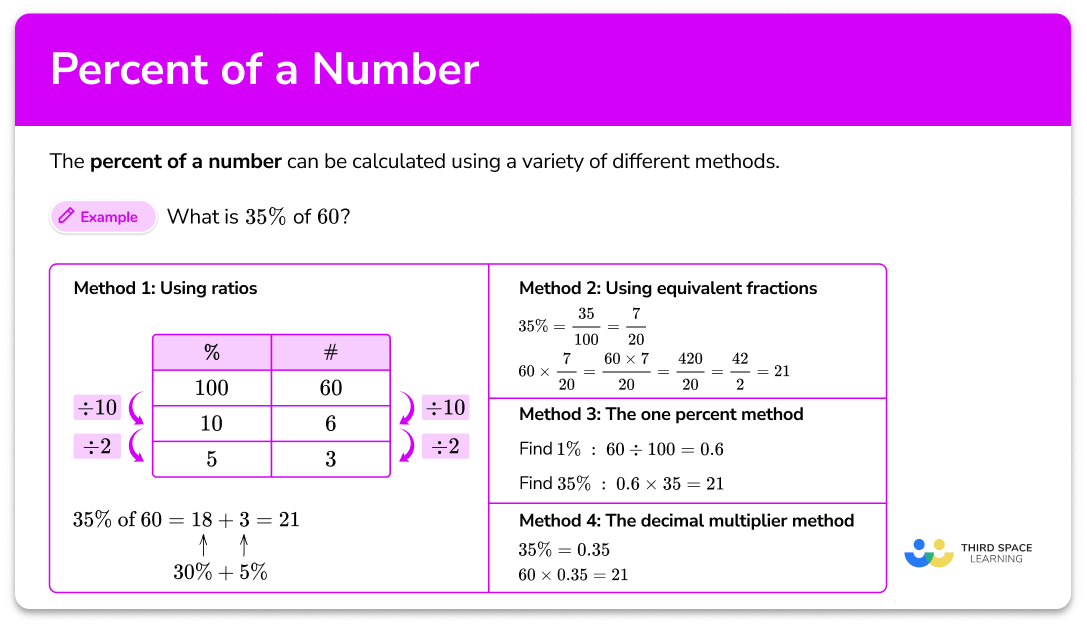
Method 2: The Decimal Approach – Converting Percentages to Decimals
This method is used when you already have a percentage and you want to find out what that percentage of a whole number is. This is particularly useful for calculating taxes, interest, or a percentage contribution.
Formula:
Value of Percentage = (Percentage / 100) × Whole Number
Alternatively, and more commonly:
Value of Percentage = (Percentage as a Decimal) × Whole Number
To convert a percentage to a decimal, simply divide the percentage by 100 (or move the decimal point two places to the left). For example, 25% becomes 0.25, 7% becomes 0.07.
-
Example 1: Calculating sales tax on a purchase.
You’re buying a new gadget for $500, and the sales tax rate is 8%. How much sales tax will you pay?
-
Convert the percentage to a decimal: 8% / 100 = 0.08.
-
Multiply the decimal by the whole number:
Sales Tax Amount = 0.08 × $500
Sales Tax Amount = $40
You will pay $40 in sales tax.
-
-
Example 2: Figuring out interest earned on savings.
You have $10,000 in a savings account that earns an annual interest rate of 1.5%. How much interest will you earn in one year?
-
Convert the percentage to a decimal: 1.5% / 100 = 0.015.
-
Multiply the decimal by the whole number:
Interest Earned = 0.015 × $10,000
Interest Earned = $150
You will earn $150 in interest in one year.
-
Practical Applications in Personal Finance and Investing
The ability to calculate percentages transforms abstract financial data into actionable insights for managing your personal wealth and investment portfolio.
Budgeting and Expense Tracking
A fundamental use of percentages in personal finance is budgeting. By calculating the percentage of your income allocated to various categories, you gain clarity on your spending habits and can make adjustments to align with your financial goals.
-
The 50/30/20 Rule: This popular budgeting guideline suggests allocating 50% of your income to needs, 30% to wants, and 20% to savings and debt repayment. If your monthly take-home income is $4,500:
-
Needs (50%): 0.50 × $4,500 = $2,250
-
Wants (30%): 0.30 × $4,500 = $1,350
-
Savings/Debt (20%): 0.20 × $4,500 = $900
By tracking your actual spending, you can use Method 1 (Part/Whole x 100) to see if you’re hitting these targets, e.g., if you spent $1,500 on wants, that’s ($1,500 / $4,500) x 100 = 33.3%, indicating you might be overspending on wants.
-

Understanding Investments and Returns
Percentages are the bedrock of investment analysis, allowing investors to assess performance and compare opportunities irrespective of the capital invested.
-
Percentage Gain/Loss: If you invested $1,000 in a stock and it grew to $1,200, your gain is $200. The percentage gain is ($200 / $1,000) × 100 = 20%. Conversely, if it dropped to $800, your loss is $200, representing a ($200 / $1,000) × 100 = 20% loss.
-
Annualized Returns: This standardizes investment performance over different time frames, allowing for apples-to-apples comparison of various investment vehicles.
-
Compound Interest: The magic of compound interest relies heavily on percentage calculations, as interest is earned not just on the principal but also on accumulated interest, demonstrating exponential growth over time. Understanding how to calculate the future value of an investment with a certain interest rate is a critical skill for long-term financial planning.
Debt Management and Loan Interest
Percentages play a crucial role in understanding the true cost of borrowing and managing debt.
-
Annual Percentage Rate (APR): This is the total cost of borrowing money, expressed as a yearly percentage. Understanding how to calculate the monthly interest payment based on the APR and your outstanding balance is vital for paying down debt strategically. For a credit card with a 20% APR and an average daily balance of $1,500, your monthly interest (approximate) would be (20% / 12) * $1,500 = 1.67% * $1,500 = $25.05.
-
Impact of Different Interest Rates: Small percentage differences in loan rates can translate to significant dollar amounts over the life of a mortgage or car loan. Being able to quickly estimate these differences helps in selecting the best loan terms.
Discounts, Sales Tax, and Tipping
Everyday transactions heavily involve percentages.
-
Discounts: A common application of Method 2. A 30% off sale on a $75 item means you save 0.30 × $75 = $22.50.
-
Sales Tax: As shown in a previous example, calculating sales tax is a direct application of finding a percentage of a whole number.
-
Tipping: If you want to leave a 15% tip on a $60 meal, you calculate 0.15 × $60 = $9.
Leveraging Percentages for Business and Entrepreneurship
For businesses, percentages are indispensable for measuring performance, setting prices, and making strategic operational decisions.
Profit Margins and Revenue Growth
These are critical indicators of a business’s financial health.
-
Gross Profit Margin: (Gross Profit / Revenue) × 100. If a company sells an item for $100 (Revenue) that cost $40 to produce (Cost of Goods Sold), the Gross Profit is $60. The Gross Profit Margin is ($60 / $100) × 100 = 60%. This tells a business how efficiently it produces goods or services.
-
Net Profit Margin: (Net Profit / Revenue) × 100. This measures how much profit a company makes for every dollar of revenue after all expenses, including taxes, are accounted for.
-
Revenue Growth: If a company’s revenue increased from $1,000,000 last year to $1,200,000 this year, the growth is $200,000. The percentage growth is ($200,000 / $1,000,000) × 100 = 20%. This is crucial for evaluating a company’s expansion.
Pricing Strategies and Markups
Businesses use percentages to set prices that ensure profitability.
-
Markup Percentage: If a product costs a business $50 and they want a 40% markup on cost, the markup amount is 0.40 × $50 = $20. The selling price would then be $50 + $20 = $70.
-
Desired Profit Percentage: Businesses often work backward, setting a selling price that achieves a target profit margin.
Analyzing Business Performance
Beyond profits, percentages offer insight into various operational aspects.
-
Market Share: A company’s sales as a percentage of the total sales in its industry.
-
Customer Retention Rates: The percentage of customers a business retains over a given period, vital for long-term growth.
-
Expense Ratios: Each expense category (e.g., marketing, salaries) as a percentage of total revenue or operating expenses, helping to identify areas for cost control.
Common Pitfalls and Advanced Considerations
While the core calculation is straightforward, nuances exist that are crucial for accurate financial interpretation.
The Importance of the ‘Whole’
Always be clear about what constitutes the “whole” number or the base value from which the percentage is being calculated. A 10% increase from $100 ($10) is vastly different from a 10% increase from $1,000,000 ($100,000). Misidentifying the base can lead to significant errors in financial analysis, making growth or decline seem more or less significant than it truly is. For example, a “300% return” on a penny stock that gained 3 cents is less impactful than a “10% return” on a $100,000 investment.
Percentage Points vs. Percentage Change
This is a common point of confusion, particularly in financial news and reports.
-
Percentage Change: Refers to the relative change between two numbers, calculated as ((New Value – Old Value) / Old Value) × 100. This is what we’ve primarily discussed.
-
Percentage Points: Refers to the arithmetic difference between two percentages. For example, if an interest rate increases from 5% to 7%, it has increased by 2 percentage points, not by 2% of the original rate. A 2% increase of 5% would only be 0.1 percentage points (0.02 * 5% = 0.1%). Understanding this distinction is vital when discussing shifts in interest rates, inflation rates, or market share.
Using Financial Tools and Calculators Effectively
While manual calculation is essential for understanding the underlying principles, for complex financial scenarios or large datasets, leveraging financial tools is practical and often necessary.
-
Spreadsheets (e.g., Excel, Google Sheets): Ideal for calculating percentages across many items, building budgets, tracking investments, and performing sensitivity analyses. Functions like
(B2/A2)*100orB2*0.05become second nature. -
Online Calculators: Numerous free online calculators exist for specific financial applications like loan amortization, compound interest, or retirement planning. Understand the inputs required and how the results are presented, often in percentage terms.
-
Financial Calculators: Dedicated handheld calculators designed for more complex financial functions.
Even with these tools, the core understanding of how percentages work ensures you can correctly input data, interpret results, and spot potential errors.
Conclusion
The ability to accurately “get the percentage of a whole number” is more than just a basic arithmetic skill; it is a cornerstone of financial literacy. From personal budgeting and making savvy shopping decisions to evaluating complex investment portfolios and driving business growth, percentages provide the crucial context that transforms raw data into meaningful insights. By mastering the simple formulas and understanding their diverse applications, you empower yourself to navigate the financial world with greater confidence, make informed choices, and ultimately achieve your monetary goals. Embrace the power of percentages, practice their application regularly, and unlock a deeper understanding of your financial landscape.
aViewFromTheCave is a participant in the Amazon Services LLC Associates Program, an affiliate advertising program designed to provide a means for sites to earn advertising fees by advertising and linking to Amazon.com. Amazon, the Amazon logo, AmazonSupply, and the AmazonSupply logo are trademarks of Amazon.com, Inc. or its affiliates. As an Amazon Associate we earn affiliate commissions from qualifying purchases.