
The ability to calculate a percentage of a number is not just a mathematical curiosity; it’s a fundamental financial literacy skill. From understanding interest rates on loans and savings accounts to deciphering investment returns, navigating discounts, or budgeting effectively, percentages are woven into the fabric of daily financial life. Mastering this calculation empowers individuals and businesses to make informed decisions, optimize spending, maximize savings, and evaluate opportunities with clarity.
The Core Concept: Understanding Percentages in Finance
At its heart, a percentage represents a fraction of a whole, expressed as a number out of 100. The word “percent” itself comes from the Latin “per centum,” meaning “by the hundred.” When we talk about a percentage of a number, we’re asking: “What portion of this total value does a certain part represent, if the total were broken into 100 equal pieces?”

What is a Percentage? A Financial Perspective
In finance, percentages are omnipresent. An interest rate of 5% on a savings account means that for every $100 you have saved, you’ll earn $5 in interest over a specified period. A 20% down payment on a house means you pay $20 for every $100 of the house’s total price upfront. A 15% discount on a product translates to saving $15 for every $100 of its original cost.
Understanding this foundational concept is crucial because it allows for standardization. Comparing an interest rate of 3% on a $1,000 loan to a 4% rate on a $10,000 loan is straightforward because the percentages provide a common benchmark, regardless of the principal amount.
Why Percentages Matter in Your Money Life
The relevance of percentages spans nearly every financial domain:
-
Interest Rates: Whether you’re paying interest on a mortgage, car loan, or credit card, or earning interest on investments or savings, percentages dictate the cost or return of borrowing and lending money.
-
Discounts and Sales Tax: Shoppers encounter percentages daily. A “25% off” sale directly impacts your purchasing power, while sales tax (e.g., 7%) adds a percentage to the sticker price.
-
Investment Returns: Evaluating the performance of your stock portfolio, mutual funds, or real estate investments relies heavily on understanding percentage gains or losses. Return on Investment (ROI) is almost always expressed as a percentage.
-
Budgeting and Savings Goals: Financial advisors often recommend saving a certain percentage of your income (e.g., 10-20%) or allocating percentages to different spending categories (e.g., 50/30/20 rule).
-
Business Finance: Businesses use percentages to calculate profit margins, assess growth rates, determine markups, and analyze market share.
-
Taxes: Income tax brackets, property tax rates, and capital gains taxes are all expressed as percentages, directly impacting your disposable income.
Without a firm grasp of percentage calculations, navigating these financial scenarios effectively becomes a significant challenge, potentially leading to missed opportunities or costly mistakes.
The Basic Formula: Calculating a Percentage of a Number
The core method for finding what percentage a part is of a whole, or finding a percentage of a number, is surprisingly simple and relies on fundamental arithmetic.
Step-by-Step Calculation
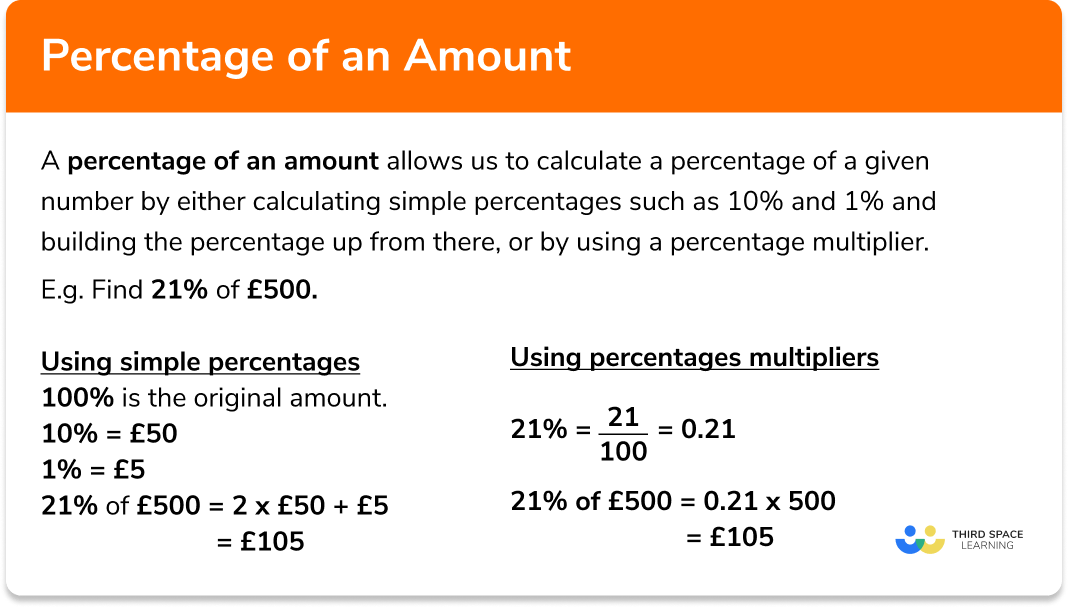
To find a percentage of a number, you’ll typically follow this two-step process:
-
Convert the percentage to a decimal: Divide the percentage by 100.
-
Example: 25% becomes 25 / 100 = 0.25
-
Example: 7% becomes 7 / 100 = 0.07
-
-
Multiply the decimal by the number: Take the decimal value and multiply it by the whole number you’re interested in.
Formula: Percentage (as decimal) x Whole Number = Part
Let’s illustrate with practical financial examples:
-
Scenario 1: Calculating a Discount
You want to buy a jacket that costs $80, and it’s on sale for 20% off.
-
Convert 20% to a decimal: 20 / 100 = 0.20
-
Multiply by the original price: 0.20 * $80 = $16
The discount amount is $16. So, the new price is $80 – $16 = $64.
-
-
Scenario 2: Calculating Sales Tax
You purchase an item for $50, and the sales tax rate is 6%.
-
Convert 6% to a decimal: 6 / 100 = 0.06
-
Multiply by the item price: 0.06 * $50 = $3
The sales tax is $3. Your total cost will be $50 + $3 = $53.
-
-
Scenario 3: Estimating a Tip
Your dinner bill is $75, and you want to leave a 15% tip.
-
Convert 15% to a decimal: 15 / 100 = 0.15
-
Multiply by the bill amount: 0.15 * $75 = $11.25
The tip amount is $11.25.
-
The Decimal Method: A Quicker Approach
The decimal method is inherently what the step-by-step process describes. However, many people find it faster to simply “move the decimal point two places to the left” to convert a percentage to a decimal.
-
25% -> 0.25
-
7% -> 0.07
-
120% -> 1.20 (useful for calculating total cost including a markup, like 100% of the original price plus a 20% tax)
This mental shortcut streamlines the first step, allowing for quicker calculations, especially when dealing with financial decisions on the fly.
Real-World Financial Applications
The power of knowing how to calculate a percentage of a number truly shines in its diverse applications across personal and business finance.
Personal Budgeting and Savings Goals
Many financial frameworks, like the popular 50/30/20 rule, rely on percentages. This rule suggests allocating 50% of your after-tax income to needs, 30% to wants, and 20% to savings and debt repayment.
-
If your monthly after-tax income is $4,000:
-
Needs (50%): 0.50 * $4,000 = $2,000
-
Wants (30%): 0.30 * $4,000 = $1,200
-
Savings/Debt (20%): 0.20 * $4,000 = $800
-
These calculations provide clear targets for managing your cash flow and achieving financial stability.
Understanding Interest Rates (Loans, Savings Accounts)
Interest is essentially the cost of borrowing money or the reward for saving it, expressed as a percentage of the principal amount.
-
Loan Interest: If you take out a $10,000 personal loan at an annual interest rate of 8%, the annual interest cost before compounding would be: 0.08 * $10,000 = $800. This helps you understand the true cost of credit.
-
Savings Account Interest: If you have $5,000 in a savings account earning a 0.5% annual interest rate, you would earn: 0.005 * $5,000 = $25 in interest over a year.
It’s vital to note that most loans and many savings accounts use compounding interest, where interest is calculated on the principal plus accumulated interest, making the actual calculation more complex over time but still rooted in finding percentages of evolving balances.
Analyzing Investment Returns (ROI, Gains/Losses)
When you invest, you aim for a return. This return is most commonly expressed as a percentage to easily compare different investment opportunities.
-
Scenario: You invest $5,000 in a stock, and it grows to $5,600.
-
Calculate the gain: $5,600 – $5,000 = $600
-
To find the percentage gain (ROI): (Gain / Original Investment) * 100
-
($600 / $5,000) * 100 = 0.12 * 100 = 12%
Your investment yielded a 12% return.
-
This allows you to quickly assess performance relative to your initial capital and compare it against benchmarks or other investments.
Discounts, Sales Tax, and Tips (Everyday Transactions)
These are arguably the most common daily applications of percentage calculations.
-
Discounted Price: A $120 pair of shoes is 30% off.
-
Discount amount: 0.30 * $120 = $36
-
New price: $120 – $36 = $84
-
-
Total with Sales Tax: An appliance costs $700, and sales tax is 8.5%.
-
Tax amount: 0.085 * $700 = $59.50
-
Total cost: $700 + $59.50 = $759.50
-
-
Restaurant Tip: A $48 meal requires an 18% tip.
- Tip amount: 0.18 * $48 = $8.64
Being able to perform these calculations quickly ensures you pay the correct amount, verify charges, and effectively manage your spending.
Business Finance: Profit Margins and Growth
For businesses, percentage calculations are critical for financial health and strategic planning.
-
Profit Margin: If a product costs $50 to make and sells for $75, the profit is $25.
- Profit margin: ($25 / $75) * 100 = 33.33%
This tells a business how much profit it makes for every dollar of revenue.
-
Revenue Growth: A company’s revenue was $1,000,000 last year and $1,200,000 this year.
-
Growth amount: $1,200,000 – $1,000,000 = $200,000
-
Percentage growth: ($200,000 / $1,000,000) * 100 = 20%
Growth percentages are key indicators of a company’s performance and scalability.
-
Common Pitfalls and Advanced Considerations
While the basic calculation is straightforward, financial contexts introduce nuances that require careful attention.
Percentage Points vs. Percentage Change
This is a common source of confusion, especially in financial news.
-
Percentage points refer to the absolute difference between two percentages. If an interest rate increases from 4% to 5%, that’s an increase of 1 percentage point.
-
Percentage change (or relative change) refers to the percentage increase or decrease relative to the original value. An increase from 4% to 5% is actually a (1/4) * 100 = 25% increase in the interest rate itself.
-
(New Value – Old Value) / Old Value * 100
-
(5 – 4) / 4 * 100 = 1 / 4 * 100 = 25%
-
Understanding this distinction is crucial when interpreting financial news about inflation, interest rate adjustments, or market shifts.
Cumulative Percentages (e.g., Compounding Interest)
When percentages are applied sequentially, especially over time, they don’t simply add up. Compounding interest is the prime example. If you earn 10% on an investment in year one, and another 10% in year two, you’re earning 10% on your original investment plus the first year’s earnings.
-
Initial $1,000
-
Year 1: $1,000 * 10% = $100. Balance = $1,100
-
Year 2: $1,100 * 10% = $110. Balance = $1,210
The total gain is $210, which is (210/1000)*100 = 21%, not 20% (10% + 10%). This “interest on interest” is a powerful concept in investing and debt.
The Importance of the ‘Whole’ (Base Number)
Always be clear about what constitutes the “whole” or the base number when calculating percentages. A 10% raise sounds great, but 10% of a $30,000 salary ($3,000) is very different from 10% of a $100,000 salary ($10,000). The perception and impact of a percentage are entirely dependent on the value of the base it’s applied to. Ensure you’re using the correct base to avoid misinterpretations in financial analysis.
Leveraging Tools for Financial Percentage Calculations
While mental math is valuable, for complex financial planning or large datasets, digital tools offer accuracy and efficiency.
Spreadsheets (Excel, Google Sheets)
Spreadsheets are indispensable for financial calculations. They allow you to set up formulas once and apply them across numerous data points, making budgeting, investment tracking, and business analysis much simpler.
-
To find 20% of a number in cell A1: In cell B1, type
=0.20*A1or=20%*A1. -
To calculate a percentage increase:
=(B1-A1)/A1(where A1 is the original, B1 is the new). -
To calculate a percentage of a total:
=A1/SUM(range)
These tools are crucial for managing personal finances, tracking business expenses, and performing intricate financial modeling.
Online Calculators and Financial Apps
Numerous online percentage calculators and financial apps simplify these tasks. Most banking apps, investment platforms, and budgeting tools automatically perform these calculations for you, showing interest earned, spending percentages, or investment returns. While convenient, understanding the underlying math helps you interpret the results and detect potential errors.

Mental Math Shortcuts for Quick Estimates
For everyday situations like tipping or quick discount estimations, mental math shortcuts can be invaluable:
-
10% rule: To find 10% of a number, just move the decimal one place to the left (e.g., 10% of $75 is $7.50).
-
Using 10% to find others:
-
To find 20%, double the 10% value ($7.50 * 2 = $15).
-
To find 5%, halve the 10% value ($7.50 / 2 = $3.75).
-
To find 15%, add the 10% and 5% values ($7.50 + $3.75 = $11.25).
-
-
Approximation: Round numbers to make calculations easier. If something is $49.99 and 20% off, approximate it as $50, then 20% of $50 is $10.
These quick estimations help you make swift financial decisions without needing a calculator every time.
In conclusion, understanding how to find what percentage of a number is more than an academic exercise; it’s a critical skill for navigating the financial world. From managing personal budgets and debt to making savvy investment decisions and running a profitable business, percentages provide the universal language for financial evaluation and comparison. Mastering this fundamental concept empowers individuals to take control of their financial destiny and make choices grounded in clear quantitative understanding.
aViewFromTheCave is a participant in the Amazon Services LLC Associates Program, an affiliate advertising program designed to provide a means for sites to earn advertising fees by advertising and linking to Amazon.com. Amazon, the Amazon logo, AmazonSupply, and the AmazonSupply logo are trademarks of Amazon.com, Inc. or its affiliates. As an Amazon Associate we earn affiliate commissions from qualifying purchases.