
In the complex world of finance, whether personal or corporate, numbers tell a story. But raw numbers alone often fail to capture the true magnitude or significance of change. An increase of $100 might be insignificant for a multi-million dollar corporation, but life-changing for an individual on a tight budget. This is where percentages come into play. Understanding how to calculate and interpret percentage increase or decrease is not just a mathematical exercise; it’s a fundamental financial skill that empowers individuals and businesses to make informed decisions, track progress, and evaluate performance with precision and clarity.
From assessing the growth of an investment portfolio to analyzing a company’s quarterly sales, or even simply tracking changes in your household budget, the ability to quantify change in relative terms is indispensable. It allows for apples-to-apples comparisons, reveals underlying trends, and provides a standardized metric for evaluating success, failure, and everything in between. This article will demystify the process, providing a comprehensive guide to finding the percentage of increase or decrease, and illustrating its profound importance across various financial contexts.
Understanding the Fundamentals: Why Percentages Matter in Finance
At its heart, a percentage represents a proportion out of one hundred. When we talk about percentage change, we’re discussing how much a quantity has changed relative to its original size. This relative perspective is crucial in finance because it provides context that absolute numbers often lack.
Beyond Simple Numbers: The Power of Relative Change
Imagine two scenarios: in the first, your investment gains $1,000. In the second, your investment also gains $1,000. Without additional information, these seem identical. However, if the first investment started at $10,000 and the second started at $100,000, the story changes dramatically.
-
For the $10,000 investment, a $1,000 gain represents a 10% increase.
-
For the $100,000 investment, a $1,000 gain represents only a 1% increase.
The absolute dollar amount is the same, but the relative change tells you much more about the performance. A 10% return is significantly better than a 1% return, highlighting efficiency and growth rate. This relative perspective allows for more meaningful comparisons across different scales and timeframes, making it a cornerstone of financial analysis.
Everyday Applications: From Personal Budgets to Investment Portfolios
The utility of percentage change permeates almost every facet of finance:
-
Personal Finance: Tracking how much your monthly utility bill has increased or decreased, calculating the growth rate of your savings account, or understanding the percentage of your income dedicated to specific expenses.
-
Investing: Evaluating the return on investment (ROI) for stocks, bonds, or mutual funds, comparing the performance of different assets, or calculating portfolio growth.
-
Business Finance: Analyzing sales growth, measuring profit margin changes, assessing cost reductions, or understanding market share fluctuations.
-
Economics: Interpreting inflation rates, GDP growth, or unemployment rate changes.
In each instance, percentage change offers a standardized, universal language for understanding and communicating financial shifts.
The Basic Formula: Calculating Percentage Change
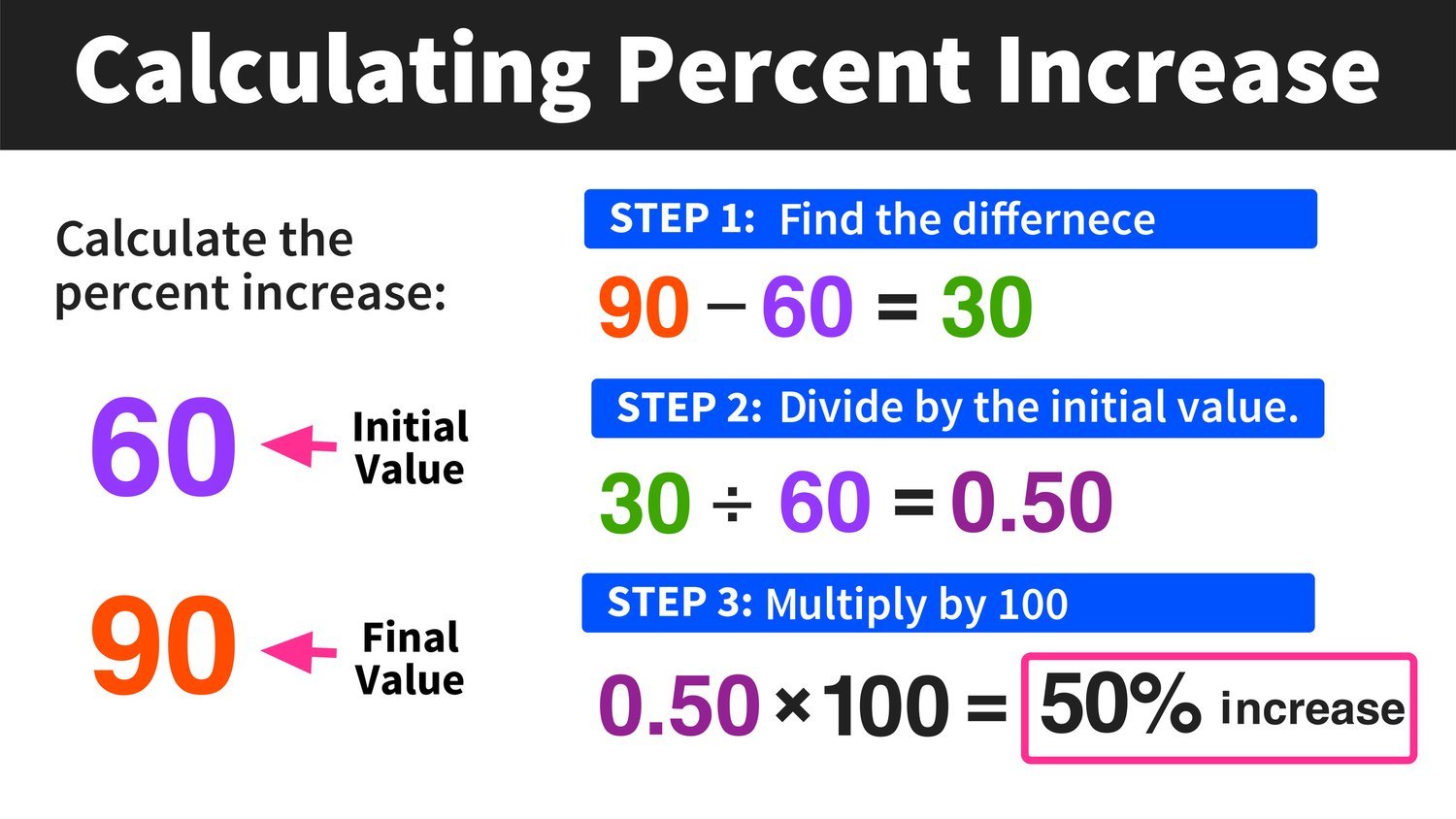
The process of calculating percentage increase or decrease follows a simple, yet powerful, formula. It involves identifying the difference between the new and original values, and then expressing this difference as a proportion of the original value.
The Core Equation: Absolute Change / Original Value * 100
The fundamental formula for calculating percentage change is:
$$ text{Percentage Change} = left( frac{text{New Value} – text{Original Value}}{text{Original Value}} right) times 100 $$
Let’s break down the components:
-
Original Value: This is the starting point, the baseline against which you are measuring the change. It’s crucial to identify this correctly.
-
New Value: This is the ending point, the value after the change has occurred.
-
Absolute Change (New Value – Original Value): This calculates the raw numerical difference between the two values. A positive result indicates an increase, while a negative result indicates a decrease.
Multiplying by 100 converts the decimal result into a percentage, making it easier to read and interpret.
Step-by-Step for Percentage Increase
When the new value is greater than the original value, you have a percentage increase.
Example: Investment Gain
You invested $5,000 (Original Value) in a stock, and it grew to $6,250 (New Value).
-
Calculate the Absolute Change:
$$ $6,250 – $5,000 = $1,250 $$
-
Divide by the Original Value:
$$ frac{$1,250}{$5,000} = 0.25 $$
-
Multiply by 100 to get the Percentage:
$$ 0.25 times 100 = 25% $$
Your investment saw a 25% increase.
Example: Revenue Growth
A business had $150,000 in sales last quarter (Original Value) and $180,000 this quarter (New Value).
-
Absolute Change:
$$ $180,000 – $150,000 = $30,000 $$
-
Divide by Original Value:
$$ frac{$30,000}{$150,000} = 0.20 $$
-
Multiply by 100:
$$ 0.20 times 100 = 20% $$
The business experienced a 20% increase in sales.
Step-by-Step for Percentage Decrease
When the new value is less than the original value, you have a percentage decrease.
Example: Expense Reduction
Your monthly utility bill was $120 (Original Value), and after implementing energy-saving measures, it dropped to $96 (New Value).
-
Calculate the Absolute Change:
$$ $96 – $120 = -$24 $$
-
Divide by the Original Value:
$$ frac{-$24}{$120} = -0.20 $$
-
Multiply by 100 to get the Percentage:
$$ -0.20 times 100 = -20% $$
(Often expressed as a 20% decrease, implying the negative sign.)
Your utility bill decreased by 20%.
Example: Stock Loss
You purchased a stock for $80 per share (Original Value), and its price fell to $60 per share (New Value).

-
Absolute Change:
$$ $60 – $80 = -$20 $$
-
Divide by Original Value:
$$ frac{-$20}{$80} = -0.25 $$
-
Multiply by 100:
$$ -0.25 times 100 = -25% $$
The stock price decreased by 25%.
Handling Negative Numbers and Zeroes
-
Negative Original Value: The standard formula assumes a positive original value. If the original value is negative, the interpretation of percentage change becomes complex and can be misleading. In such rare financial scenarios, it’s often better to focus on the absolute change or specific context.
-
Original Value of Zero: If the original value is zero, percentage change is undefined because you cannot divide by zero. In financial terms, if you start with nothing and gain something, you’ve achieved infinite growth. If you start with nothing and end with nothing, there’s no change. If you start with something and end with nothing, it’s a 100% decrease.
Advanced Applications and Common Financial Scenarios
Beyond basic calculations, percentage change forms the bedrock for more sophisticated financial metrics and analyses.
Investment Performance: ROI and CAGR
-
Return on Investment (ROI): A widely used metric to evaluate the efficiency of an investment. It’s essentially a percentage increase calculation:
$$ text{ROI} = left( frac{text{Net Profit}}{text{Cost of Investment}} right) times 100 $$
If an investment generates a profit of $2,000 from an initial $10,000, the ROI is $(2,000 / 10,000) times 100 = 20%$.
-
Compound Annual Growth Rate (CAGR): For investments over multiple periods, CAGR provides a smoothed annual growth rate, assuming profits are reinvested. It’s a more advanced application of percentage change that helps understand average annual performance over time, crucial for comparing investments with different durations. While the formula is more complex, its essence is normalizing growth into an annual percentage.
Business Metrics: Sales Growth, Profit Margins, and Cost Reductions
Businesses rely heavily on percentage changes to gauge performance and strategize.
-
Sales Growth: Comparing this quarter’s sales to last quarter’s, or this year’s to last year’s, helps identify trends and the effectiveness of sales strategies. A 15% increase in sales is a clear indicator of positive momentum.
-
Profit Margins: Gross profit margin (Gross Profit / Revenue), Operating profit margin (Operating Income / Revenue), and Net profit margin (Net Income / Revenue) are all expressed as percentages. Tracking their increase or decrease over time reveals a company’s efficiency in converting sales into profit. An increase in net profit margin from 5% to 7% is a significant improvement.
-
Cost Reductions: Reducing operational costs by a certain percentage can significantly impact profitability. Knowing that production costs decreased by 10% from the previous quarter helps management assess efficiency initiatives.
Personal Finance: Budgeting, Savings Growth, and Debt Reduction
For individuals, percentage change is a powerful tool for managing personal finances.
-
Budgeting: Understanding that your housing costs represent 30% of your take-home pay, or that your discretionary spending increased by 15% last month, offers critical insights for financial control.
-
Savings Growth: Tracking your savings account’s annual percentage yield (APY) or seeing your retirement account grow by 8% annually motivates continued saving and intelligent investment choices.
-
Debt Reduction: Calculating the percentage of your total debt you’ve paid off (e.g., 20% of your student loan principal) provides tangible progress markers, helping to sustain motivation on your debt-free journey.
Inflation and Real Returns: Understanding Purchasing Power
Inflation is the rate at which the general level of prices for goods and services is rising, and subsequently, purchasing power is falling. It is always expressed as a percentage. Understanding inflation helps investors calculate their “real return” – the actual increase in purchasing power after accounting for inflation. If your investment grew by 5% but inflation was 3%, your real return was only approximately 2%. This highlights how percentage change allows for a more nuanced understanding of economic realities.
Common Pitfalls and Best Practices
While the calculation is straightforward, misinterpreting or misapplying percentage change can lead to incorrect conclusions and poor financial decisions.
The Importance of the “Original Value”
The most common mistake is using the wrong “original value.” Always ensure the denominator in your calculation is the value before the change occurred. Forgetting this can drastically skew results. For example, if a stock drops from $100 to $50 (a 50% decrease), and then rises from $50 back to $100, it’s a 100% increase from the $50 base, not a 50% increase from the original $100. The baseline matters immensely.
Distinguishing Between Percentage Point Change and Percentage Change
This is a critical distinction, especially in discussions involving rates or proportions.
-
Percentage Change: As discussed, it’s the relative change from an original value.
-
Percentage Point Change: This refers to the absolute difference between two percentage values.
-
Example: If a company’s profit margin increased from 10% to 12%, this is a 2 percentage point increase (12% – 10% = 2%).
-
However, the percentage change in the profit margin itself is $((12% – 10%) / 10%) times 100 = (2% / 10%) times 100 = 20%$.
Misusing these terms can lead to significant misunderstanding, particularly in financial reporting and policy discussions.
-
Context is King: What Do the Numbers Really Mean?
A 100% increase sounds phenomenal, but if it’s an increase in your electricity bill from $10 to $20, it’s less impressive than a 100% increase in your retirement savings from $100,000 to $200,000. Always consider the absolute values involved and the context of the change. A small percentage change on a very large base can be more significant than a large percentage change on a very small base. Similarly, consider the time frame – a 5% monthly return is incredible, a 5% annual return might be modest.
Leveraging Financial Tools for Accuracy and Efficiency
While manual calculation is essential for understanding, in real-world financial management, leveraging tools is key.
-
Spreadsheets (Excel, Google Sheets): These are invaluable for calculating percentage changes across large datasets, automating calculations, and visualizing trends. Functions like
=((New Value - Original Value)/Original Value)simplify the process. -
Online Calculators: Numerous websites offer quick calculators for percentage increase/decrease.
-
Financial Software: Personal finance apps and investment platforms often display percentage changes automatically, helping you track portfolio performance or budget fluctuations with ease.
Mastering Percentage Change for Financial Empowerment
The ability to accurately calculate and critically interpret percentage increase or decrease is far more than a basic math skill; it’s a foundational element of financial literacy. It transforms raw data into actionable insights, allowing for a deeper understanding of financial dynamics.
From Passive Observer to Active Manager
By understanding percentage change, you move beyond simply observing numbers to actively managing them. You can identify when your expenses are increasing at an unsustainable rate, when an investment is truly outperforming, or when a business metric signals a need for strategic adjustment. This proactive approach is essential for achieving financial goals, whether personal or professional.
Making Informed Decisions with Confidence
Every major financial decision, from buying a house (assessing mortgage rate changes, property value growth) to launching a new product (forecasting sales growth, margin analysis), relies on an understanding of relative change. Mastering this skill gives you the confidence to dissect financial reports, evaluate investment opportunities, negotiate effectively, and plan for a more secure financial future.

Continuous Learning for Financial Growth
The financial landscape is ever-evolving. Developing a strong grasp of fundamental concepts like percentage change provides a robust framework for continuous learning and adaptation. As you encounter more complex financial instruments or economic indicators, your ability to break them down into their component parts and understand their relative movement will remain an invaluable asset, ensuring sustained financial growth and stability.
aViewFromTheCave is a participant in the Amazon Services LLC Associates Program, an affiliate advertising program designed to provide a means for sites to earn advertising fees by advertising and linking to Amazon.com. Amazon, the Amazon logo, AmazonSupply, and the AmazonSupply logo are trademarks of Amazon.com, Inc. or its affiliates. As an Amazon Associate we earn affiliate commissions from qualifying purchases.