
In the realm of finance, numbers are the language of progress. Whether you are tracking the growth of a startup’s quarterly revenue, evaluating the performance of a diversified investment portfolio, or calculating the impact of inflation on your household budget, one mathematical concept stands above the rest in terms of utility: the percentage increase. Understanding how to find percentage increase is not merely an academic exercise; it is a fundamental skill for anyone looking to navigate the complexities of the modern economic landscape.
At its core, percentage increase measures the relative change between an initial value and a subsequent value. In financial terms, this represents the velocity of growth. For investors and business leaders, this figure provides a standardized way to compare different assets or business units, regardless of their absolute size. This guide will delve into the mechanics of calculating percentage increase, its critical applications in investment and business strategy, and how it shapes personal financial health.
The Mathematical Foundation of Financial Growth
Before applying the concept to complex financial models, one must master the basic mechanics of the calculation. The percentage increase formula is the heartbeat of financial reporting and performance analysis.
The Universal Formula
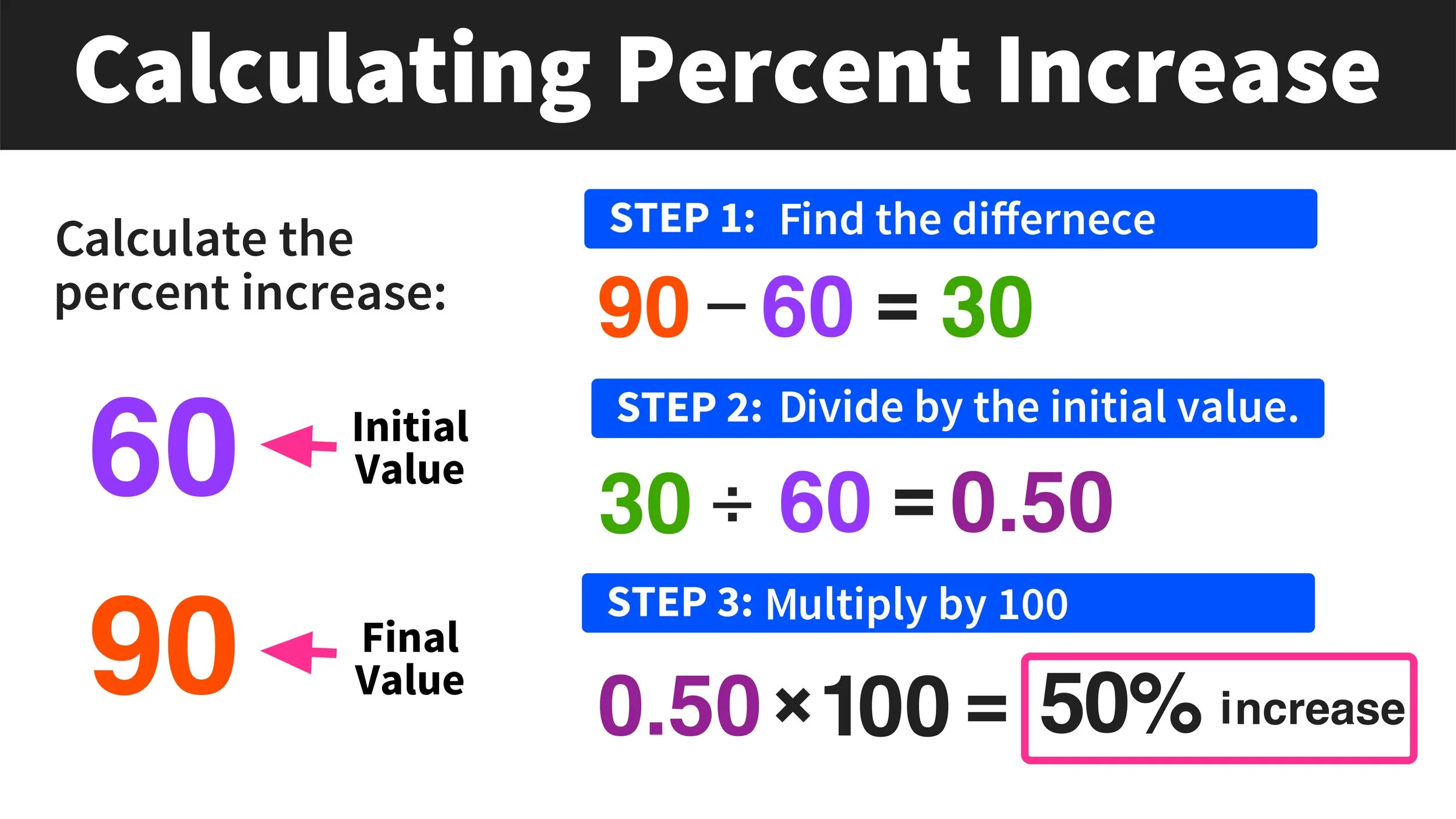
To find the percentage increase, you follow a straightforward three-step process:
- Subtract the original value (the starting point) from the new value (the ending point). This gives you the absolute increase.
- Divide that absolute increase by the original value.
- Multiply the resulting decimal by 100 to convert it into a percentage.
Mathematically, it is expressed as:
((New Value – Original Value) / Original Value) x 100 = Percentage Increase
Real-World Application: Stock Price Movement
Imagine you purchased a share of a blue-chip technology company at $150. After a strong earnings report, the stock price climbs to $187.50. To find your gain in percentage terms:
- $187.50 – $150 = $37.50 (Absolute Increase)
- $37.50 / $150 = 0.25
- 0.25 x 100 = 25%
In this scenario, your investment has grown by 25%. This standardized figure allows you to compare this stock’s performance against a savings account yielding 4% or a real estate investment yielding 12%, providing a clear picture of where your capital is most productive.
Avoiding Common Calculation Pitfalls
One of the most frequent errors in financial analysis is “denominator confusion.” It is imperative to always divide by the original value, not the new one. Dividing by the new value results in a “percentage of the final total,” which is a different metric entirely (often used for profit margins, but incorrect for growth tracking). Accuracy in this basic step ensures that all subsequent strategic decisions are based on sound data.
Percentage Increase in Investment Performance
For the individual investor or the institutional fund manager, the percentage increase is the ultimate yardstick for ROI (Return on Investment). It moves the conversation beyond “How much money did I make?” to “How efficiently is my money working for me?”
Analyzing Portfolio Volatility and Recovery
Understanding percentage increase is vital when recovering from market downturns. A unique and often misunderstood aspect of financial math is that a percentage decrease requires a larger percentage increase to return to the original “break-even” point. For example, if a portfolio drops by 50%, it requires a 100% increase to recover to its starting value. Financial literacy in this area helps investors manage risk and set realistic expectations for market rebounds.
Compound Growth and the Rule of 72
While a single-period percentage increase is informative, wealth is built through compounding—the process where your percentage increases are applied to an ever-growing base. By understanding your average annual percentage increase, you can use the “Rule of 72” to estimate how long it will take to double your money. By dividing 72 by your expected annual percentage increase, you gain a powerful predictive tool for long-term retirement planning. For instance, an 8% annual return will double your investment in approximately nine years.
Comparing Asset Classes
Different assets carry different risk profiles. A high percentage increase in a cryptocurrency asset might look attractive compared to a modest increase in a government bond. However, professional investors use percentage increase in conjunction with volatility metrics. They ask: “What was the percentage increase relative to the risk taken?” This nuanced view prevents investors from chasing “empty” growth and focuses them on sustainable, risk-adjusted returns.
Business Finance: Tracking Growth and Profitability
In a corporate setting, percentage increase is the primary language used in quarterly earnings calls and internal strategy meetings. It provides a lens through which management can evaluate the success of various initiatives.
Year-over-Year (YoY) and Quarter-over-Quarter (QoQ) Analysis
Businesses rarely look at revenue in isolation. Instead, they look at the percentage increase from the same period in the previous year (YoY). This accounts for seasonality—for instance, a retail business expects a massive increase in Q4 due to holiday shopping. By calculating the percentage increase compared to the previous year’s Q4, rather than the previous month, a business owner can determine if the company is truly expanding or simply following a seasonal trend.
Scaling Operations and Efficiency
Percentage increase is equally important on the expense side of the ledger. If a company’s revenue increases by 20%, but its operational costs increase by 30%, the business is becoming less efficient despite the “top-line” growth. Strategic financial management involves ensuring that the percentage increase in revenue outpaces the percentage increase in expenses, thereby widening the profit margin. This is often referred to as “operating leverage.”
Measuring Market Share Expansion
In competitive industries, the absolute growth of a company is less important than its growth relative to the total market. If the entire industry grew by 15% this year, but your company only saw a 5% increase, you are effectively losing market share. Business leaders use these percentages to identify when a change in brand strategy or product innovation is required to outpace the competition.
Personal Finance and the Preservation of Purchasing Power
Beyond the boardroom and the trading floor, the ability to calculate percentage increase is a defensive tool for personal financial health. It allows individuals to protect their wealth against the eroding effects of economic shifts.
The Inflation Factor
Inflation is essentially a percentage increase in the cost of living. If the consumer price index (CPI) reflects a 5% annual increase, the “real” value of your money has decreased by that much. To maintain your standard of living, your income must see a percentage increase that at least matches the rate of inflation. Understanding this math is crucial during salary negotiations. A 3% raise might feel like a win, but in a 6% inflation environment, it is effectively a 3% pay cut in terms of purchasing power.
Budgeting and Debt Management
For those managing debt, understanding the percentage increase in interest (especially on variable-rate loans) is essential. A small percentage increase in a mortgage rate can translate to tens of thousands of dollars over the life of a 30-year loan. Conversely, when saving for a major purchase, tracking the percentage increase of your “sinking fund” helps you stay motivated and provides a clear timeline for when you will reach your goal.
Lifestyle Creep and Savings Rates
Financial experts often track the “savings rate” as a percentage of total income. As your income sees a percentage increase, a common trap is “lifestyle creep,” where your expenses increase at the same or higher rate. By intentionally ensuring that the percentage increase in your savings contributions exceeds the percentage increase in your discretionary spending, you accelerate your path to financial independence.
Advanced Tools for Financial Calculation
While the basic formula is simple, the modern financial landscape often requires more sophisticated tools to handle large datasets and complex scenarios.
Leveraging Spreadsheets for Financial Modeling
Programs like Microsoft Excel and Google Sheets are designed around percentage calculations. Using the formula =(New_Value - Old_Value) / Old_Value across thousands of rows allows a business to analyze the performance of every product in its catalog instantly. Furthermore, functions like CAGR (Compound Annual Growth Rate) provide a more accurate picture of growth over multiple years by smoothing out the annual fluctuations.
Financial Calculators and AI Tools
For complex debt restructuring or investment projections, specialized financial calculators can handle percentage increases that involve compounding intervals (daily, monthly, or quarterly). Additionally, new AI-driven financial tools can now ingest bank statements or portfolio exports to automatically highlight significant percentage increases or decreases, acting as an early warning system for potential financial trouble or an indicator of emerging opportunities.

The Importance of Context in Data
Finally, it is vital to remember that a percentage increase never tells the whole story. A 100% increase on a $1 investment is far less impactful than a 5% increase on a $1,000,000 investment. In professional finance, we always pair percentage growth with absolute values to maintain a sense of scale.
In conclusion, knowing how to find percentage increase is the gateway to financial literacy. It allows you to strip away the noise of raw numbers and see the underlying trends that define success or failure. By applying this simple yet powerful calculation to your investments, your business operations, and your personal budget, you gain the clarity needed to make informed, strategic decisions that build lasting wealth.
aViewFromTheCave is a participant in the Amazon Services LLC Associates Program, an affiliate advertising program designed to provide a means for sites to earn advertising fees by advertising and linking to Amazon.com. Amazon, the Amazon logo, AmazonSupply, and the AmazonSupply logo are trademarks of Amazon.com, Inc. or its affiliates. As an Amazon Associate we earn affiliate commissions from qualifying purchases.