
In the intricate world of finance, where numbers dictate decisions, understanding percentages isn’t just a useful skill—it’s an absolute necessity. From managing personal budgets and evaluating investment returns to dissecting business profit margins and navigating loan interest, percentages are the universal language that helps us quantify change, compare values, and make informed financial choices. They allow us to grasp the relative significance of figures, transforming raw data into actionable insights.
This article delves into the fundamental principles of calculating percentages in various monetary contexts. Whether you’re a student trying to understand sales tax, a saver evaluating potential returns, an entrepreneur analyzing business performance, or simply someone aiming to gain a stronger grip on their financial life, mastering percentage calculations is a critical step towards financial literacy and empowerment. We’ll demystify the core formula, explore its practical applications across personal and business finance, and highlight common nuances that can affect your calculations, ensuring you’re well-equipped to interpret and apply these vital numerical tools.
The Fundamental Role of Percentages in Finance
Percentages are more than just mathematical constructs; they are the bedrock upon which much of our financial understanding is built. They provide a standardized way to express proportions, changes, and relationships, making diverse financial figures comparable and understandable. Without them, the vast oceans of monetary data would be far more difficult to navigate, leading to misinterpretations and poor decision-making.
Everyday Financial Decisions
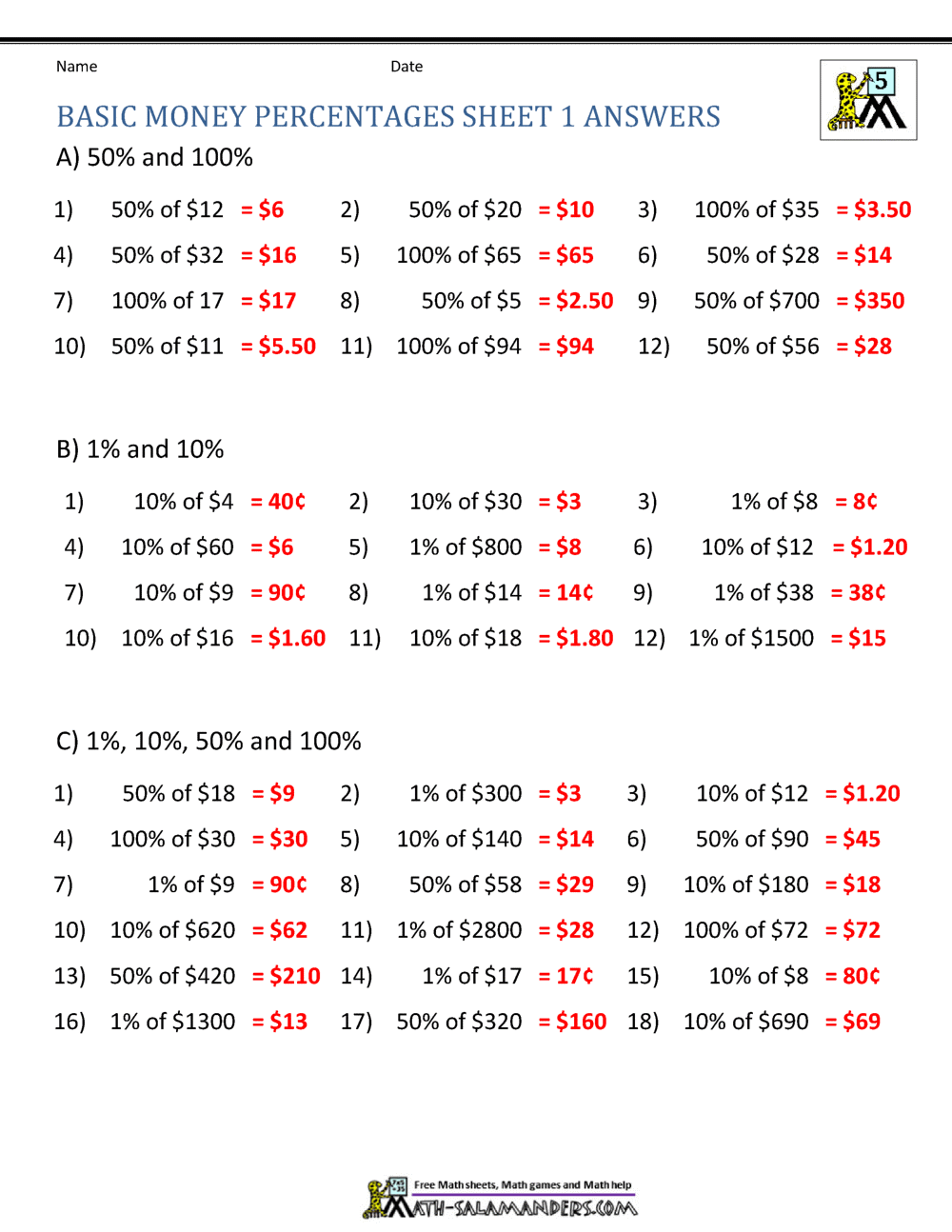
From the moment we interact with money, percentages are subtly, or sometimes overtly, influencing our choices. When you shop, discounts are presented as percentages off the original price, helping you quickly ascertain potential savings. Sales tax, applied at checkout, is a percentage of your purchase total. Calculating a tip at a restaurant involves determining a percentage of your bill. Even understanding the annual percentage rate (APR) on your credit card or a loan requires a grasp of how these percentages translate into actual costs. These daily encounters underscore the immediate and practical relevance of percentages in managing personal finances. They empower consumers to assess value, budget effectively, and ensure they are paying or receiving the correct amounts in various transactions.
Understanding Financial Statements
For businesses and investors, percentages are indispensable for interpreting financial statements. A company’s revenue growth, profit margins, and expense ratios are almost always expressed as percentages. For instance, knowing that a company’s revenue increased by 15% year-over-year provides a much clearer picture of its performance than simply stating the raw dollar change, especially when comparing it to competitors or industry benchmarks. Similarly, gross profit margin (gross profit as a percentage of revenue) and net profit margin (net profit as a percentage of revenue) are critical indicators of a company’s operational efficiency and profitability. These percentages allow stakeholders to quickly gauge financial health, identify trends, and make strategic decisions regarding investments or business operations.
Investment Analysis
In the realm of investments, percentages are the primary metric for evaluating performance and risk. Return on Investment (ROI) is universally expressed as a percentage, indicating the profitability of an investment relative to its cost. Whether you’re tracking the percentage change in a stock’s price, calculating the dividend yield of a share, or assessing the annual returns of a mutual fund, percentages provide the necessary context. They enable investors to compare the performance of different assets, understand the real growth or loss of their capital, and assess how various investments contribute to their overall portfolio. Furthermore, concepts like asset allocation are often framed as percentages, guiding investors on how to distribute their capital across different asset classes to manage risk and pursue specific financial goals.
Budgeting and Debt Management
For effective personal financial planning, percentages are a cornerstone of budgeting and debt management. Many budgeting rules, such as the popular 50/30/20 rule (50% for needs, 30% for wants, 20% for savings and debt repayment), are built around percentage allocations of income. This framework helps individuals ensure their spending aligns with their financial goals and priorities. When managing debt, understanding the interest rate—expressed as a percentage—is crucial. It dictates the cost of borrowing and significantly impacts the total amount repaid over time. Calculating the percentage of your income dedicated to debt payments helps you assess affordability and devise strategies for accelerated repayment. By breaking down income and expenses into percentages, individuals gain clarity on where their money is going and where adjustments can be made to improve their financial standing.
The Basic Formula: How to Calculate a Percentage
At its core, calculating a percentage in money, or any context for that matter, relies on a simple yet powerful formula. This foundational understanding is the key to unlocking its myriad applications across finance.
The Core Formula Explained
The universal formula for calculating a percentage is:
Percentage = (Part / Whole) × 100
Let’s break down each component:
-
Part: This is the specific amount or portion you are interested in. It’s the numerical value that represents a segment of the total.
-
Whole: This is the total amount, the entire quantity, or the base figure against which the “part” is being measured.
-
100: Multiplying by 100 converts the decimal or fractional result into a percentage format, which is easier to understand and compare.
In financial terms, the “part” could be the amount of interest earned, the discount received, a specific expense, or the profit made. The “whole” would typically be the principal amount, the original price, total income, or total investment.
Step-by-Step Calculation Guide
Let’s illustrate with a simple financial example:
Scenario: You earned $50 in interest on a savings account that held an average balance of $1,000 for the year. What percentage return did you earn?
Step 1: Identify the “Part” and the “Whole.”
-
Part (interest earned) = $50
-
Whole (average account balance) = $1,000
Step 2: Divide the “Part” by the “Whole.”
- $50 / $1,000 = 0.05
This result (0.05) is the decimal equivalent of the percentage.
Step 3: Multiply the result by 100 to express it as a percentage.
- 0.05 × 100 = 5%
So, you earned a 5% return on your savings account.
This methodical approach ensures accuracy and clarity, whether you’re calculating a small discount or a significant investment return.
Converting Decimals to Percentages and Vice Versa
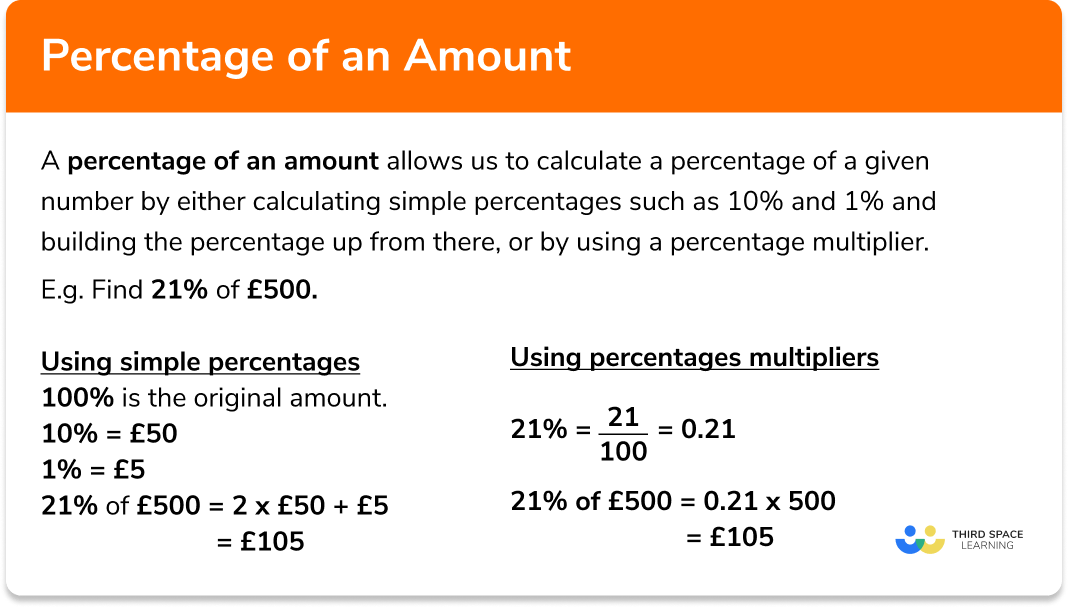
Understanding the relationship between decimals and percentages is crucial for financial calculations. The formula directly shows this connection:
-
Decimal to Percentage: Simply multiply the decimal by 100. (e.g., 0.25 becomes 25%)
-
Percentage to Decimal: Divide the percentage by 100. (e.g., 75% becomes 0.75)
Many financial calculations, especially those involving interest rates over multiple periods or complex formulas, often require you to work with percentages in their decimal form. For instance, when calculating interest, you’ll typically use the interest rate as a decimal (e.g., 5% becomes 0.05) in the formula. Conversely, financial reports and statements almost always present figures as percentages for ease of comprehension. Being able to fluidly convert between these two forms is a fundamental skill for anyone dealing with money.
Practical Applications: Calculating Key Financial Percentages
Beyond the basic formula, percentages come to life when applied to real-world financial scenarios. Mastering these practical applications is what truly elevates one’s financial literacy.
Discounts, Markups, and Sales Tax
These are some of the most common percentage calculations we encounter daily.
-
Calculating a Discount Amount: If an item costs $150 and has a 20% discount, the discount amount is $150 × 0.20 = $30.
-
Finding the Discounted Price: The final price would be $150 – $30 = $120. Alternatively, you can calculate (100% – 20%) of the original price: $150 × 0.80 = $120.
-
Calculating Sales Tax: If an item costs $80 and the sales tax is 7%, the tax amount is $80 × 0.07 = $5.60. The total price is $80 + $5.60 = $85.60.
-
Determining Markup Percentage: A business buys an item for $50 and sells it for $75. The markup amount is $25. The markup percentage (based on cost) is ($25 / $50) × 100 = 50%.
Interest Rates and Loan Payments
Interest is the cost of borrowing money or the reward for lending it, almost always expressed as a percentage.
-
Simple Interest Calculation: If you borrow $1,000 at a 6% simple annual interest rate for 3 years, the total interest is $1,000 × 0.06 × 3 = $180.
-
Understanding Compound Interest: While the calculation itself can be complex, understanding its percentage basis is key. Compound interest means you earn interest on your initial principal AND on the accumulated interest from previous periods. This exponential growth makes percentages incredibly powerful for savings and devastating for debt if not managed.
-
Calculating Interest Portion of a Payment (Simplified): For a single period, if you owe $1,000 at 5% interest per month, the interest due for that month is $1,000 × 0.05 = $50.
Investment Returns (ROI)
Quantifying investment performance relies heavily on percentages.
-
Simple ROI Calculation: You invest $5,000 and sell it for $5,500. Your profit is $500. ROI = ($500 / $5,000) × 100 = 10%.
-
Capital Gains/Losses: If you buy a stock for $100 and it rises to $115, your capital gain is 15%. If it drops to $90, your capital loss is 10%.
-
Annualized Returns: For investments held over multiple periods, financial professionals often annualize returns to compare performance on a yearly basis, even if the holding period was shorter or longer. This involves more complex formulas but stems from the basic percentage change.
Budgeting and Expense Allocation
Percentages bring clarity to how income is managed and spent.
-
Calculating Expense Percentage: If your monthly income is $4,000 and your rent is $1,200, rent constitutes ($1,200 / $4,000) × 100 = 30% of your income.
-
The 50/30/20 Rule: This popular budgeting guideline suggests allocating 50% of your after-tax income to needs, 30% to wants, and 20% to savings and debt repayment. These pre-defined percentages simplify budgeting and provide a clear framework for financial discipline.
Profit Margins for Businesses
For entrepreneurs and business analysts, various profit margins expressed as percentages are vital health indicators.
-
Gross Profit Margin: (Gross Profit / Revenue) × 100. For example, if revenue is $100,000 and Cost of Goods Sold is $60,000, gross profit is $40,000. Gross Profit Margin = ($40,000 / $100,000) × 100 = 40%. This shows the percentage of revenue remaining after accounting for direct production costs.
-
Net Profit Margin: (Net Profit / Revenue) × 100. If net profit is $15,000 from $100,000 revenue, Net Profit Margin = ($15,000 / $100,000) × 100 = 15%. This indicates the percentage of revenue left after all expenses, including taxes and interest. High net profit margins are a sign of efficient management and strong profitability.
Common Pitfalls and Advanced Considerations
While the core percentage formula is straightforward, real-world financial scenarios often introduce nuances that can lead to miscalculations if not carefully considered. Awareness of these subtleties is key to accurate financial analysis.
Understanding the “Base” or “Whole”
One of the most frequent sources of error in percentage calculations is incorrectly identifying the “whole” or the “base” figure. The base is the reference point against which the percentage is calculated, and changing it can drastically alter the outcome.
-
Example: A stock drops from $100 to $80, then recovers from $80 to $100.
-
Drop: ($20 loss / $100 original price) × 100 = 20% loss.
-
Recovery: ($20 gain / $80 new price) × 100 = 25% gain.
-
Notice that a 20% drop requires a 25% gain to recover. This is because the base for the gain ($80) is smaller than the base for the drop ($100). Always be explicit about what your percentage is “of.”
Percentage Points vs. Percentage Change
These two terms are often confused, but their distinction is critical, especially when discussing interest rates or survey results.
-
Percentage Points: Refers to the absolute difference between two percentages. If an interest rate increases from 2% to 3%, it has increased by 1 percentage point.
-
Percentage Change: Refers to the relative change between two percentages. An increase from 2% to 3% is a 50% increase in the interest rate itself (((3% – 2%) / (2%)) * 100 = 50%).
Misinterpreting these can have significant implications when discussing the magnitude of financial shifts or policy changes.
Cumulative Percentages and Compounding Effects
When dealing with multiple percentage changes over time, simply adding or subtracting the percentages can be misleading due to compounding.
-
Example: An investment grows by 10% in year 1 and by another 10% in year 2. It does not grow by 20% overall.
-
Start with $100.
-
Year 1: $100 × (1 + 0.10) = $110.
-
Year 2: $110 × (1 + 0.10) = $121.
-
The total growth is $21, or ($21 / $100) × 100 = 21%.
-
This effect, whether positive (as in compound interest on savings) or negative (as in consecutive percentage decreases in value), is a powerful concept in finance that requires careful calculation rather than simple arithmetic addition of percentages.
Tools and Resources for Calculation
While mental math and basic calculators are sufficient for simple percentages, more complex financial calculations benefit from dedicated tools:
-
Financial Calculators: Many calculators have a dedicated ‘%’ key, but understanding its function (often converts to decimal or calculates a percentage of a number) is important.
-
Spreadsheet Software (e.g., Excel, Google Sheets): These are invaluable for complex financial modeling. They allow you to set up formulas, apply percentages across large datasets, and even handle compounding automatically. Functions like
RATE,PV,FVcan calculate various financial percentages with ease. -
Online Percentage Calculators: Numerous free online tools can quickly compute various percentage scenarios.
-
Financial Software and Apps: Budgeting apps, investment platforms, and accounting software often have built-in percentage calculations for tracking performance, allocating funds, and analyzing data.
Leveraging these tools can save time and reduce errors, especially when dealing with large numbers or intricate financial models, allowing you to focus on the interpretation rather than just the computation.
Conclusion
Mastering how to find percentages in money is an indispensable skill that underpins virtually every aspect of personal and business finance. From decoding sale prices and calculating tip amounts to assessing investment returns and analyzing complex financial statements, percentages provide the clarity and context necessary to make informed decisions. They transform raw figures into meaningful insights, enabling us to compare, evaluate, and plan with greater precision.
By understanding the fundamental formula—(Part / Whole) × 100—and diligently applying it to a diverse range of financial scenarios, you empower yourself to navigate the monetary landscape with confidence. The practical applications explored, from discounts and interest to profit margins and budget allocations, demonstrate the ubiquitous nature of percentages in financial life. Furthermore, recognizing common pitfalls such as misidentifying the base, differentiating between percentage points and percentage change, and accounting for compounding effects will ensure the accuracy and reliability of your calculations.
In an increasingly complex financial world, financial literacy is not merely a desirable trait but a critical necessity. Embracing the power of percentages is a significant step toward achieving that literacy, allowing you to take control of your financial destiny, optimize your resources, and build a more secure and prosperous future.
aViewFromTheCave is a participant in the Amazon Services LLC Associates Program, an affiliate advertising program designed to provide a means for sites to earn advertising fees by advertising and linking to Amazon.com. Amazon, the Amazon logo, AmazonSupply, and the AmazonSupply logo are trademarks of Amazon.com, Inc. or its affiliates. As an Amazon Associate we earn affiliate commissions from qualifying purchases.