
In the dynamic world of finance, understanding change is paramount. Whether you’re tracking your personal investments, evaluating business performance, or simply managing your household budget, the ability to quantify growth and decline is an indispensable skill. Among the most fundamental metrics for this purpose is the “percent of increase.” Far more than just a mathematical formula, mastering the calculation and interpretation of percent of increase empowers individuals and businesses to make informed decisions, identify trends, and strategize for future financial success.
This guide will delve deep into the mechanics of finding the percent of increase, framing it within the context of personal finance, investing, and business finance. We’ll explore why this metric is crucial, how to calculate it accurately, and how to apply it to real-world financial scenarios to unlock greater financial understanding and prosperity.
Understanding the Core Concept: What is Percent of Increase?
At its heart, the percent of increase is a measure of the relative change between two values over a period, specifically when the new value is greater than the original value. It expresses this change as a percentage, providing a standardized way to compare growth across different scales and contexts.
Defining Percentage Change
Percentage change is a broad term that encompasses both percent of increase and percent of decrease. It tells us how much a quantity has changed relative to its initial amount. When we speak of a “percent of increase,” we are specifically referring to situations where a value has grown. For instance, if your investment portfolio grew from $10,000 to $12,000, you experienced a percent of increase. This metric normalizes the change, making it easy to understand the magnitude of growth even if the initial amounts are vastly different. A $2,000 increase on a $10,000 portfolio is significant, but a $2,000 increase on a $1,000,000 portfolio is far less so. The percentage helps clarify this.
Why This Metric Matters in Money Management
For anyone navigating the complexities of finance, the percent of increase isn’t just an academic exercise; it’s a vital tool for insight and action.
Measuring Growth
From the growth of your retirement fund to the expansion of your online income stream, percent of increase provides a clear, quantitative measure of progress. It allows you to see if your financial strategies are yielding positive results and by how much. Without it, you might know your savings went up, but not truly understand the efficiency or impact of that growth relative to your initial capital.
Benchmarking Performance
In investing, comparing the performance of different assets or strategies is impossible without percentage change. Did your stock portfolio outperform the market index? Did your side hustle’s revenue grow faster than the industry average? Percent of increase allows you to benchmark your financial performance against goals, market standards, or competitors, offering critical context for your financial journey.
Forecasting Future Trends
Understanding past growth rates through percent of increase can provide valuable insights for future projections. While past performance is never a guarantee of future results, consistent growth patterns can inform financial planning, investment decisions, and business expansion strategies. It helps in setting realistic goals and anticipating future financial landscapes.
The Essential Formula and Step-by-Step Calculation
Calculating the percent of increase is straightforward once you understand the formula and apply it systematically. This section breaks down the formula and illustrates its application with practical financial examples.
Deconstructing the Percent Increase Formula
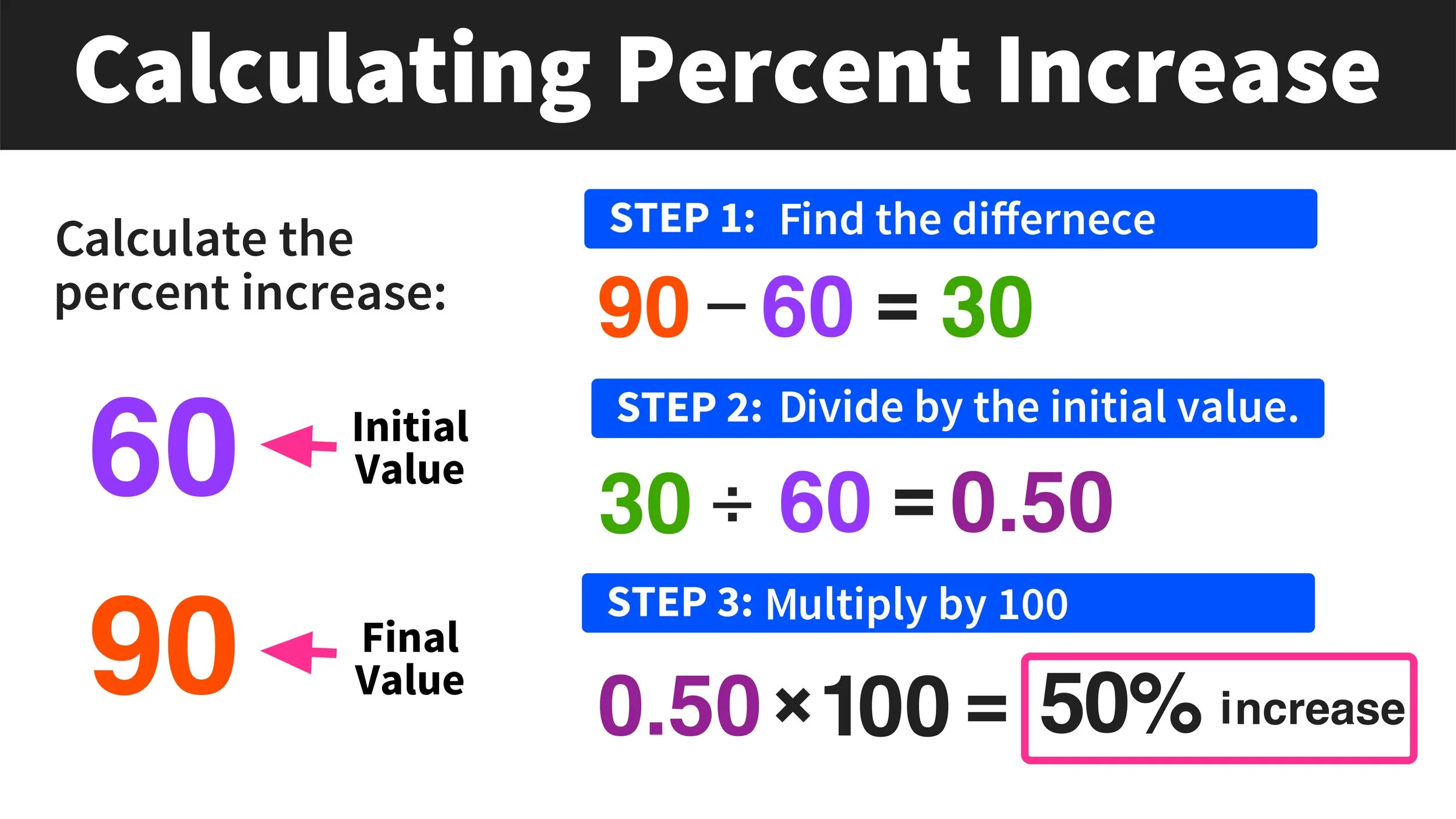
The universal formula for calculating the percent of increase is:
Percent of Increase = ((New Value - Original Value) / Original Value) * 100
Let’s break down each component:
- New Value: The higher, more recent value after the increase.
- Original Value: The initial, lower value before the increase.
- (New Value – Original Value): This calculates the absolute increase or the raw difference between the two values.
- (/ Original Value): Dividing the absolute increase by the original value expresses the change as a decimal proportion relative to the starting point.
- (* 100): Multiplying by 100 converts this decimal proportion into a percentage, making it easier to interpret.
Practical Examples in Personal Finance
Let’s apply this formula to common personal finance scenarios.
Example 1: Investment Portfolio Growth
Imagine your investment portfolio was worth $50,000 at the beginning of the year and grew to $57,500 by year-end.
- Original Value = $50,000
- New Value = $57,500
- Absolute Increase = $57,500 – $50,000 = $7,500
- Decimal Proportion = $7,500 / $50,000 = 0.15
- Percent of Increase = 0.15 * 100 = 15%
Your portfolio experienced a 15% increase.
Example 2: Savings Account Interest
You deposited $1,000 into a high-yield savings account. After one year, due to interest accumulation, the balance is $1,030.
- Original Value = $1,000
- New Value = $1,030
- Absolute Increase = $1,030 – $1,000 = $30
- Decimal Proportion = $30 / $1,000 = 0.03
- Percent of Increase = 0.03 * 100 = 3%
Your savings account earned a 3% interest (percent of increase).
Example 3: Salary Increment Analysis
Your annual salary was $60,000, and after a performance review, it increased to $63,600.
- Original Value = $60,000
- New Value = $63,600
- Absolute Increase = $63,600 – $60,000 = $3,600
- Decimal Proportion = $3,600 / $60,000 = 0.06
- Percent of Increase = 0.06 * 100 = 6%
You received a 6% salary increase.
Practical Examples in Business Finance
The same principles apply to business metrics, offering crucial insights for entrepreneurs and financial analysts.
Example 1: Sales Revenue Growth
A small business generated $200,000 in sales last quarter and $250,000 this quarter.
- Original Value = $200,000
- New Value = $250,000
- Absolute Increase = $250,000 – $200,000 = $50,000
- Decimal Proportion = $50,000 / $200,000 = 0.25
- Percent of Increase = 0.25 * 100 = 25%
The business achieved a 25% increase in sales revenue.
Example 2: Profit Margin Improvement
A company’s profit in Q1 was $50,000, and through strategic cost-cutting and increased sales, it rose to $62,500 in Q2.
- Original Value = $50,000
- New Value = $62,500
- Absolute Increase = $62,500 – $50,000 = $12,500
- Decimal Proportion = $12,500 / $50,000 = 0.25
- Percent of Increase = 0.25 * 100 = 25%
The company improved its profit by 25%.
Example 3: Cost Reduction Efficiency
A manufacturing process initially cost $10,000 per unit to produce. After implementing new efficiencies, the cost dropped to $8,500. While this is a percent decrease, it’s important to recognize how percent changes are used. If we flip the perspective and look at the “saving” as an “increase” in efficiency’s contribution, it highlights how similar calculations inform various aspects of business finance. For a true “percent of increase” example, consider if an investment in R&D increased the value of intellectual property from $1M to $1.2M, resulting in a 20% increase in intangible assets.
Applying Percent of Increase in Real-World Financial Scenarios
The power of the percent of increase truly shines when applied to real-world financial decision-making. It transforms raw numbers into actionable insights, guiding strategies for growth and risk management.
Analyzing Investment Returns and Portfolio Performance
For investors, percent of increase is the language of success. It allows for:
- Comparing different investments: You can objectively compare the 10% return on Stock A to the 12% return on Mutual Fund B, regardless of the initial investment amount.
- Understanding compound growth: Over multiple periods, calculating the cumulative percent increase helps illustrate the magic of compounding, where earnings generate further earnings.
- Evaluating asset classes: Are your equities growing faster than your bonds? This metric provides the data to rebalance your portfolio strategically.
Tracking Business Growth and Profitability
Business leaders rely on percent of increase to monitor the health and trajectory of their enterprises.
- Key Performance Indicators (KPIs): Metrics like year-over-year revenue growth, quarter-over-quarter customer acquisition increase, or month-over-month profit margin expansion are all expressed as percent increases.
- Strategic Decision Making: A significant percent increase in a particular product line’s sales might prompt further investment in that area. Conversely, a plateauing or declining percent increase signals a need for re-evaluation.
- Reporting and Stakeholder Communication: Investors, partners, and employees often look for percentage growth figures as a quick snapshot of a company’s vitality.
Navigating Personal Finance Decisions
Beyond investments, percent of increase informs everyday financial choices.
- Budgeting and Expense Management: Tracking the percent increase in categories like groceries or utilities can highlight areas where costs are spiraling, prompting adjustments.
- Evaluating Debt Reduction Strategies: If you’re paying down debt, observing a percent increase in the principal amount paid off each month can be a powerful motivator and a sign of effective strategy.
- Understanding Inflation’s Impact: While not a direct percent of increase of your money, inflation causes a percent increase in the cost of living. Understanding this helps you evaluate if your income growth (a percent increase) is keeping pace with rising expenses.
Common Pitfalls and Best Practices for Accurate Financial Analysis
While the formula for percent of increase is simple, its application in finance requires careful consideration to avoid misinterpretations and ensure the insights derived are truly valuable.
Avoiding Misinterpretation and Contextual Blind Spots
The raw percentage figure, though powerful, doesn’t tell the whole story.
- The Importance of the Base Value: A 100% increase on $100 (to $200) is far less impactful than a 10% increase on $1,000,000 (to $1,100,000). Always consider the original value from which the increase is derived. Small base values can lead to dramatically high percentages that might be misleading if taken out of context.
- Considering External Factors: A 20% increase in sales during a booming economy might be less impressive than a 5% increase during a recession. Market conditions, industry trends, and unforeseen events all play a role and should be factored into your analysis.
- Beware of “Percent of a Percent”: When dealing with multiple percentage changes, it’s crucial not to simply add or subtract them. For example, an item increasing by 10% and then by another 10% does not mean a 20% total increase on the original price. You must apply each percentage change sequentially.
Leveraging Financial Tools and Software
Manual calculations are fine for simple scenarios, but for complex financial analysis, leveraging technology is a best practice.
- Spreadsheets (Excel, Google Sheets): These are indispensable tools. You can set up formulas once and apply them across vast datasets, making it easy to track hundreds of investments or dozens of business metrics. They also allow for quick scenario planning.
- Online Calculators: Numerous free online tools can instantly calculate percent of increase, useful for quick checks or when you don’t have a spreadsheet handy.
- Financial Planning Software: Many personal finance and business accounting platforms include built-in reporting features that automatically calculate and display percent changes for various accounts and metrics, offering a holistic view of your financial health.
The Power of Consistent Monitoring and Review
Financial landscapes are constantly shifting. What was true last quarter might not be this quarter.
- Regular Review: Consistently monitoring your financial metrics—whether weekly, monthly, or quarterly—allows you to catch trends early, capitalize on opportunities, or course-correct before minor issues become major problems.
- Setting Benchmarks and Goals: Use percent of increase to establish realistic financial goals (e.g., “I want to achieve a 10% increase in my savings balance this year”) and then track your progress against these benchmarks.
- Historical Analysis: Plotting percent increases over time can reveal seasonal patterns, long-term growth trajectories, or periods of stagnation, all critical for strategic financial planning.

Conclusion
The ability to find and interpret the percent of increase is not merely a mathematical exercise; it is a cornerstone of financial literacy and empowerment. From the individual managing a personal budget to the executive steering a multi-million-dollar enterprise, this metric provides clarity, context, and actionable insights into financial performance and growth.
By understanding the underlying formula, applying it diligently to personal and business finance examples, and diligently avoiding common pitfalls, you equip yourself with a powerful analytical tool. Embrace the percent of increase as your compass in the financial world, guiding you towards more informed decisions, greater control over your assets, and ultimately, a more prosperous financial future.
aViewFromTheCave is a participant in the Amazon Services LLC Associates Program, an affiliate advertising program designed to provide a means for sites to earn advertising fees by advertising and linking to Amazon.com. Amazon, the Amazon logo, AmazonSupply, and the AmazonSupply logo are trademarks of Amazon.com, Inc. or its affiliates. As an Amazon Associate we earn affiliate commissions from qualifying purchases.