
In the world of finance, numbers are the language of progress. Whether you are tracking the performance of a stock portfolio, measuring the growth of a small business, or evaluating a salary increase, understanding the relative change between two figures is essential. While raw numbers provide a snapshot, percentages provide the context necessary for strategic decision-making.
Knowing how to find the percent increase between two numbers is more than just a mathematical exercise; it is a fundamental skill for anyone looking to navigate the complexities of personal finance, investing, and business management. This guide explores the mechanics of the percent increase formula and demonstrates its critical application across various financial landscapes.
The Fundamentals of Financial Growth: Understanding the Percent Increase Formula
Before diving into complex financial models, one must master the basic arithmetic of growth. A percent increase represents how much a quantity has grown relative to its starting point, expressed as a fraction of 100. In the “Money” niche, this is the primary metric for determining the velocity of wealth accumulation.
The Basic Mathematical Formula
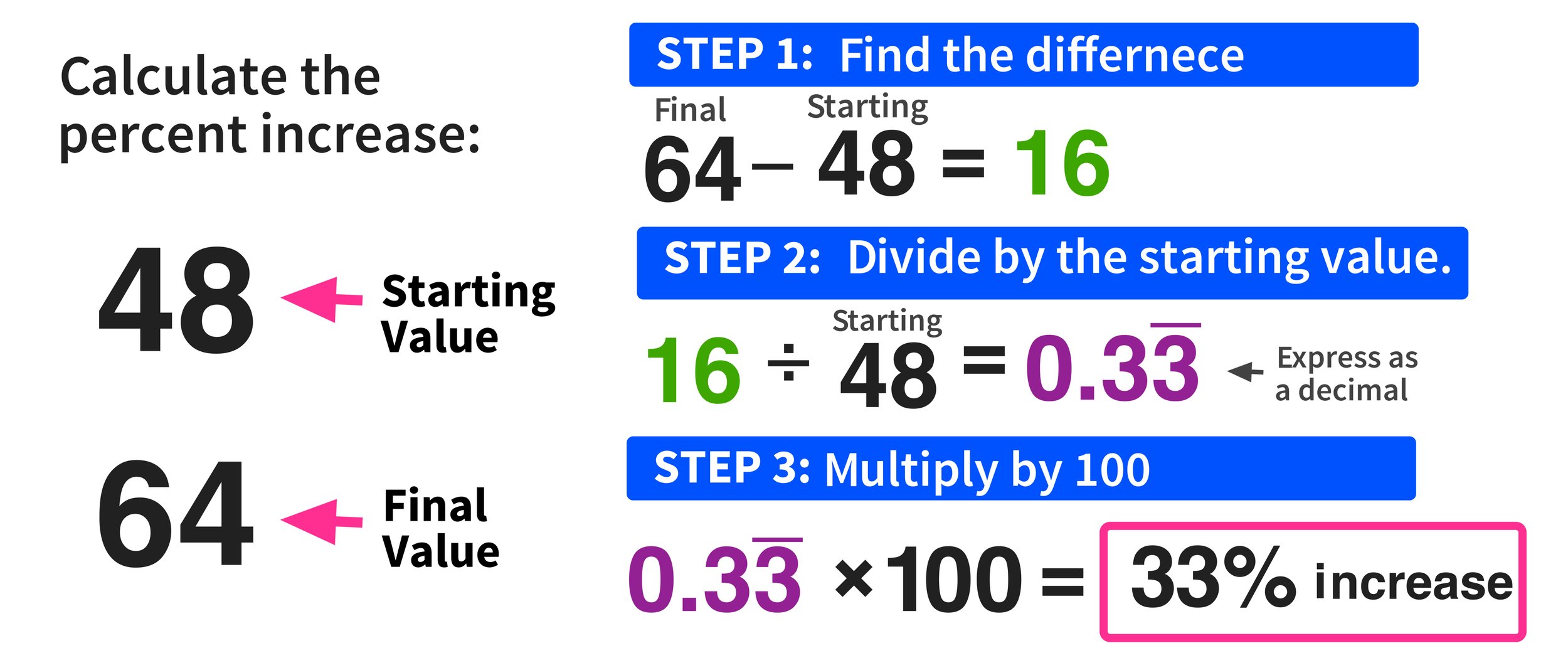
The formula for calculating percent increase is straightforward yet powerful. To find the percentage change between an original value (the “old” number) and a new value, follow these steps:
- Subtract the original value from the new value to find the absolute increase.
- Divide that increase by the original value.
- Multiply the resulting decimal by 100 to convert it into a percentage.
Mathematically, it looks like this:
Percentage Increase = [(New Value – Original Value) / Original Value] * 100
This formula tells you the proportion by which your initial investment or capital has expanded. It is important to always divide by the original value, as this represents the baseline from which growth is measured.
Real-World Example: Tracking Stock Performance
Imagine you invested $5,000 in a diversified index fund at the beginning of the year. By December, your portfolio balance has grown to $5,750. To understand your annual return, you apply the formula:
- Step 1: $5,750 – $5,000 = $750 (Absolute Increase)
- Step 2: $750 / $5,000 = 0.15
- Step 3: 0.15 * 100 = 15%
By calculating the 15% increase, you can compare this performance against benchmarks like the S&P 500 or your own financial goals. Without the percentage, the $750 gain lacks the context of the initial capital required to generate it.
Leveraging Percent Increase for Personal Finance and Budgeting
In personal finance, the ability to calculate percent increase allows for a more nuanced view of your lifestyle and earning potential. It helps individuals move beyond “vibes-based” budgeting and into data-driven financial planning.
Measuring Income Growth and Side Hustle Scalability
For employees, a salary raise is often celebrated in total dollar amounts. However, calculating the percent increase provides a clearer picture of your career trajectory. If you receive a $5,000 raise on a $50,000 salary, that is a 10% increase. If you receive the same $5,000 raise on a $100,000 salary, it is only a 5% increase.
This calculation becomes even more critical when managing a side hustle. If your monthly revenue moves from $1,000 to $1,500, you have achieved a 50% increase. Such a high growth rate might signal that the business model is highly scalable, prompting you to reinvest more capital into that specific venture. By tracking these percentages monthly, you can identify which income streams are yielding the highest growth rates and allocate your time accordingly.
Tracking Inflation’s Impact on Your Purchasing Power
Inflation is essentially a percent increase in the general price level of goods and services. To maintain your standard of living, your personal income should ideally increase at a rate that exceeds the annual inflation rate.
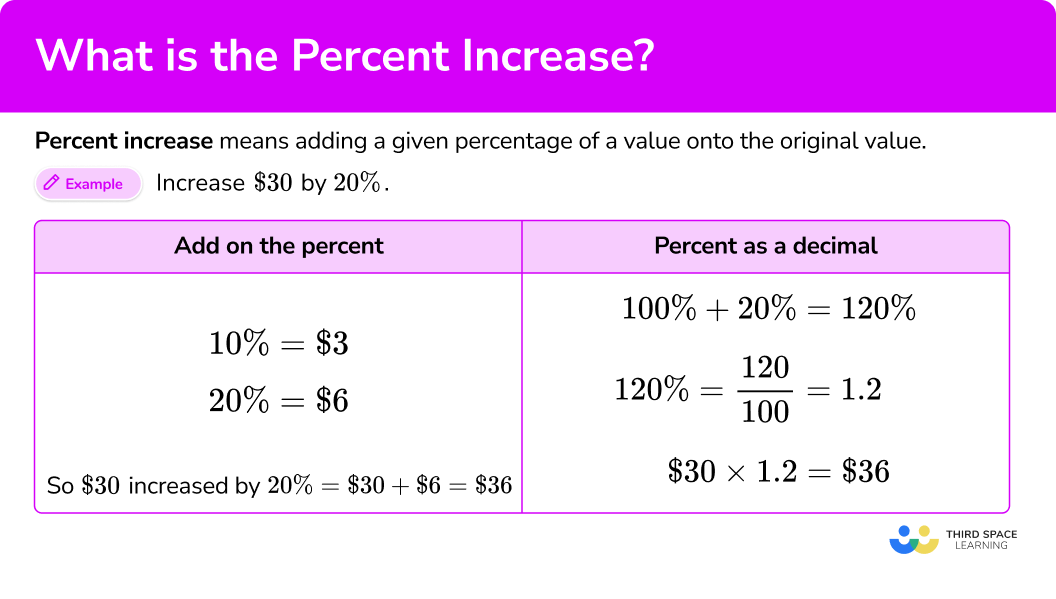
If the Consumer Price Index (CPI) indicates a 4% increase in the cost of living, but your income only increased by 2%, your “real” income has actually decreased. By calculating the percent increase of your core expenses—such as rent, groceries, and utilities—you can adjust your budget before you find yourself in a deficit. This proactive approach is the hallmark of sophisticated financial management.
Business Finance: Using Percent Increase to Analyze Corporate Health
For business owners and corporate analysts, percent increase is a “Key Performance Indicator” (KPI) that dictates strategy. It allows a company to assess its competitive position and operational efficiency over time.
Year-over-Year (YoY) Revenue Analysis
One of the most common applications in business finance is Year-over-Year (YoY) analysis. This compares a company’s financial results for one period with those of the same period the previous year.
For instance, if a retail business generated $200,000 in revenue in Q3 of last year and $250,000 in Q3 of this year, the percent increase is 25%. Investors and stakeholders look for consistent YoY increases as a sign of a healthy, growing business. A decelerating percent increase, even if the raw revenue is still climbing, can be a red flag that market saturation is occurring or that competition is stiffening.
Profit Margin Expansion and Cost Management
Growth isn’t just about top-line revenue; it’s also about the efficiency of operations. Business owners use percent increase to track “Margin Expansion.” If your revenue increases by 10% but your operating costs increase by 15%, your business is actually becoming less efficient.
By calculating the percent increase of specific line items—such as the cost of goods sold (COGS) or customer acquisition costs (CAC)—management can identify areas where expenses are spiraling out of control. If shipping costs have seen a 30% increase while sales only grew by 5%, the business may need to renegotiate carrier contracts or adjust its pricing strategy to protect its bottom line.
Advanced Tools and Techniques for Automating Financial Calculations
While the manual formula is vital for understanding the “why” behind the math, modern financial management relies on tools that automate these calculations to reduce error and save time.
Using Excel and Google Sheets for Dynamic Tracking
Spreadsheets are the backbone of financial analysis. To calculate percent increase in Excel or Google Sheets, you can use a simple cell reference formula.
Suppose your “Original Value” is in cell A2 and your “New Value” is in cell B2. The formula in cell C2 would be:
=(B2-A2)/A2
After entering this, you simply click the “Percent Style” button in the toolbar to format the decimal as a percentage. The power of this tool lies in its scalability; you can drag this formula down across hundreds of rows to track the growth of different stock tickers or monthly expense categories simultaneously. Furthermore, using “Conditional Formatting” can automatically highlight any percent increase above or below a certain threshold, providing instant visual feedback on financial performance.
Online Financial Calculators and Investment Apps
For those who prefer a more mobile-friendly approach, various financial tools and apps integrate percent increase calculations into their dashboards. Most brokerage apps (like Vanguard, Fidelity, or Robinhood) automatically display the “Total Return” or “Day Gain” as a percentage.
However, it is beneficial to use dedicated “CAGR” (Compound Annual Growth Rate) calculators for long-term investments. Unlike a simple percent increase, CAGR accounts for the effect of compounding over several years. While a simple percent increase tells you how much you grew from point A to point B, CAGR tells you the smoothed annual rate of growth required to get there. Utilizing these specialized financial tools allows for a more sophisticated interpretation of wealth accumulation over time.
Conclusion: Making Data-Driven Financial Decisions
In the realm of money, the ability to calculate the percent increase between two numbers serves as a bridge between raw data and actionable insight. It strips away the obfuscation of large numbers and reveals the true rate of progress, whether you are looking at your personal savings or a multinational corporation’s earnings report.
By consistently applying this calculation, you gain the clarity needed to:
- Identify high-performing assets in your portfolio.
- Negotiate better salary increases by benchmarking against inflation.
- Optimize business operations by spotting disproportionate cost hikes.
Financial literacy is built on a foundation of these fundamental skills. As you move forward in your financial journey, let the percent increase be your primary metric for success. In the pursuit of wealth, it is not just about how much you have, but about the rate at which you are growing. Master this simple calculation, and you master the ability to measure—and improve—your financial future.
aViewFromTheCave is a participant in the Amazon Services LLC Associates Program, an affiliate advertising program designed to provide a means for sites to earn advertising fees by advertising and linking to Amazon.com. Amazon, the Amazon logo, AmazonSupply, and the AmazonSupply logo are trademarks of Amazon.com, Inc. or its affiliates. As an Amazon Associate we earn affiliate commissions from qualifying purchases.