
Understanding how to find a monthly payment is one of the most vital skills in personal finance. Whether you are eyeing a new home, considering a car upgrade, or looking to consolidate high-interest debt, the monthly payment is the heartbeat of your budget. It determines your cash flow, your ability to save, and your overall financial flexibility.
Many consumers make the mistake of looking only at the “sticker price” of a purchase. However, in the world of credit and lending, the sticker price is often less important than the structural components of the loan: the interest rate, the term length, and the principal balance. This guide provides a deep dive into the mechanics of calculating monthly payments, the tools available to you, and the strategic implications these numbers have on your long-term wealth.
The Mechanics of Monthly Payments: Why the Calculation Matters
Before diving into the formulas, it is essential to understand why calculating a monthly payment accurately is more than just a mathematical exercise. It is a risk management tool. When you commit to a monthly payment, you are essentially “buying” a piece of your future income.
Debt-to-Income Ratio and Affordability
Lenders use a metric called the Debt-to-Income (DTI) ratio to determine how much you can afford to borrow. Usually, lenders prefer a DTI where your total monthly debt payments—including your potential new loan—do not exceed 36% to 43% of your gross monthly income. By learning how to find your monthly payment before you even talk to a loan officer, you can determine your own “comfort zone.” This prevents you from becoming “house poor” or “car poor,” a state where your fixed obligations are so high that you have no room for savings or discretionary spending.
The Psychology of Monthly Budgeting vs. Total Cost
There is a psychological trap in focusing solely on the monthly payment. Shrewd salespeople often ask, “What monthly payment are you looking for?” If you provide a number, they can manipulate the loan term to meet that payment, often by extending the loan to six or seven years. While the monthly payment remains low, the total interest paid over the life of the loan skyrockets. Knowing how to calculate these figures yourself allows you to see the “hidden” costs of a low monthly payment.
Decoding the Math: Formulas and Variables
To find a monthly payment, you must navigate the relationship between three primary variables: the Principal ($P$), the Interest Rate ($i$), and the Term ($n$).
The Standard Amortization Formula
The most common way to find a monthly payment for a fixed-rate loan (like a standard mortgage or auto loan) is through the amortization formula. The formula is expressed as:
$M = P [ i(1 + i)^n ] / [ (1 + i)^n – 1 ]$
Where:
- M is the total monthly payment.
- P is the principal loan amount.
- i is the monthly interest rate (annual rate divided by 12).
- n is the number of months (term length).
While this looks daunting, it reveals a fundamental truth: as the interest rate or the principal increases, the payment rises. Conversely, as the term length ($n$) increases, the monthly payment drops, though the total interest paid over time increases.
Understanding Principal vs. Interest
Every monthly payment in an amortized loan consists of two parts: the principal repayment and the interest charge. In the early stages of a loan, a larger portion of your monthly payment goes toward interest. As the balance decreases, the interest portion shrinks, and more of your money goes toward paying off the principal. This is why “finding the payment” is only the first step; understanding the amortization schedule shows you how much equity you are actually building each month.
The Impact of Loan Terms (15 vs. 30 Years)
Choosing a term is a balancing act. A 15-year mortgage will have a significantly higher monthly payment than a 30-year mortgage, but the interest rate is typically lower, and the total interest paid over the life of the loan is drastically reduced. By calculating both scenarios, a borrower can decide if their monthly cash flow can handle the higher payment in exchange for the long-term savings of a shorter term.
Calculating Payments for Specific Loan Types

Not all monthly payments are created equal. Depending on what you are financing, the calculation might include additional variables that change the final number.
Mortgages: PITI and Escrow
When finding a monthly mortgage payment, calculating the Principal and Interest (P&I) is only half the battle. Most homeowners pay a “PITI” payment, which stands for:
- Principal: The money that reduces your loan balance.
- Interest: The cost of borrowing.
- Taxes: Property taxes levied by your local government.
- Insurance: Homeowners insurance and, if applicable, Private Mortgage Insurance (PMI).
To find the true monthly payment, you must estimate your annual taxes and insurance, divide them by 12, and add them to your P&I calculation. Failing to account for these can lead to a payment that is 20-30% higher than originally anticipated.
Auto Loans: Simple Interest and Depreciation
Auto loans are generally simpler but come with their own risks. Unlike homes, cars are depreciating assets. When calculating an auto payment, it is crucial to consider the “gap.” If you find a monthly payment that is low because the term is 84 months, you may find yourself “underwater”—owing more on the car than it is worth—within a year or two.
Personal Loans and Credit Cards
Personal loans are typically fixed-rate and fixed-term, making them the easiest to calculate using the standard formula. Credit cards, however, use a “minimum monthly payment” calculation, which is usually a small percentage (2-3%) of the total balance. To find the payment that will actually clear the debt, you should treat it as a fixed-term loan and calculate the payment required to reach a zero balance within 12 to 24 months.
Digital Tools and Resources for Instant Accuracy
In the modern financial landscape, you don’t need to do long-form algebra on a napkin to find your monthly payment. Various digital tools provide precision and speed.
Using Online Financial Calculators
The most accessible way to find a monthly payment is through specialized online calculators. Many financial websites offer “What-If” scenarios, allowing you to slide a bar to see how a 1% drop in interest rates or a $5,000 increase in down payment affects your monthly obligation. These tools are excellent for the “discovery” phase of financial planning.
Spreadsheet Mastery: Excel and Google Sheets
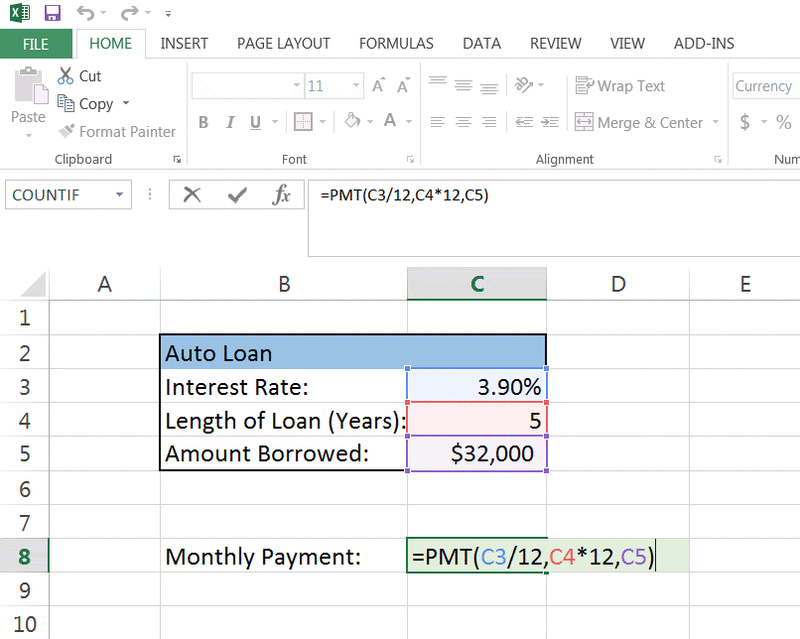
For those who want more control, spreadsheet software is the gold standard. The PMT function is a built-in tool designed specifically for this purpose.
The syntax is: =PMT(rate/12, nper, pv)
- Rate/12: Your annual interest rate divided by 12.
- Nper: The total number of monthly payments.
- Pv: The Present Value (the loan amount).
Using a spreadsheet allows you to build your own amortization table, which gives you a month-by-month breakdown of how much of your payment is going toward interest versus principal.
Strategic Ways to Lower Your Monthly Obligation
Once you know how to find your monthly payment, the next step is learning how to manipulate the variables to your advantage. Financial health isn’t just about knowing the number; it’s about optimizing it.
Refinancing and Interest Rate Negotiation
The interest rate is the most significant lever in the monthly payment equation. A difference of 1% on a $300,000 mortgage can change the monthly payment by hundreds of dollars. If market rates drop or your credit score improves significantly, “re-finding” your monthly payment through a refinance can free up substantial monthly cash flow.
The Power of Down Payments
The simplest way to reduce a monthly payment is to reduce the principal. Every dollar you put down upfront is a dollar you don’t have to pay interest on for years to come. In the context of mortgages, a 20% down payment also eliminates the need for Private Mortgage Insurance (PMI), which can shave an extra $100 to $300 off your monthly bill.

Credit Score Optimization
Your credit score is the primary determinant of the interest rate offered by lenders. Before applying for a loan and locking in a monthly payment, it is often wise to spend six months improving your credit score. By moving from a “Fair” to “Excellent” credit tier, you can lower your monthly payment more effectively than almost any other strategy, simply by qualifying for the lowest possible interest rate.
In conclusion, knowing how to find a monthly payment is a fundamental pillar of financial literacy. It allows you to move beyond the marketing “teasers” and see the reality of a financial commitment. By mastering the formulas, utilizing digital tools, and understanding the impact of taxes and interest, you empower yourself to make decisions that protect your budget today and build your wealth for tomorrow.
aViewFromTheCave is a participant in the Amazon Services LLC Associates Program, an affiliate advertising program designed to provide a means for sites to earn advertising fees by advertising and linking to Amazon.com. Amazon, the Amazon logo, AmazonSupply, and the AmazonSupply logo are trademarks of Amazon.com, Inc. or its affiliates. As an Amazon Associate we earn affiliate commissions from qualifying purchases.