
In the realm of personal finance and macroeconomics, few metrics hold as much weight as the inflation rate. It is the invisible force that determines the true value of your savings, the purchasing power of your paycheck, and the ultimate success of your investment portfolio. For the sophisticated investor or the diligent household budgeter, understanding how to calculate this rate isn’t just an academic exercise—it is a fundamental necessity for maintaining financial health.
The primary tool used by economists and financial analysts to track this phenomenon is the Consumer Price Index (CPI). By learning how to find the inflation rate using CPI, you gain the ability to look past “nominal” numbers and see the “real” economic landscape. This guide provides a comprehensive breakdown of the methodology, application, and strategic implications of CPI-based inflation tracking.

Decoding the Consumer Price Index (CPI)
Before performing the calculation, one must understand what the Consumer Price Index actually represents. At its core, the CPI is a measure of the average change over time in the prices paid by urban consumers for a market basket of consumer goods and services.
What is the “Market Basket”?
The Bureau of Labor Statistics (BLS) identifies thousands of items that an average household consumes. This “market basket” includes everything from necessities like bread, milk, and gasoline to discretionary spending like apparel, electronics, and recreational services. These items are weighted based on their importance in the average consumer’s budget. For instance, housing costs carry a much heavier weight in the index than the cost of apparel, reflecting how most families actually spend their money.
The Role of the Bureau of Labor Statistics (BLS)
In the United States, the BLS serves as the primary data collector. Every month, they release the CPI report, which provides the raw data points needed to calculate the inflation rate. These index numbers represent a price level relative to a “base period.” If the index for a specific month is 300, it essentially means that the basket of goods that cost $100 in the base period (usually 1982-1984) now costs $300.
The Mathematical Blueprint: Calculating the Inflation Rate
Once you have access to the CPI data, calculating the inflation rate is a straightforward mathematical process. This calculation allows you to determine how much prices have risen (or fallen) over a specific timeframe, typically a month or a year.
The Standard Inflation Formula
To find the percentage change in prices between two periods, you use the following formula:
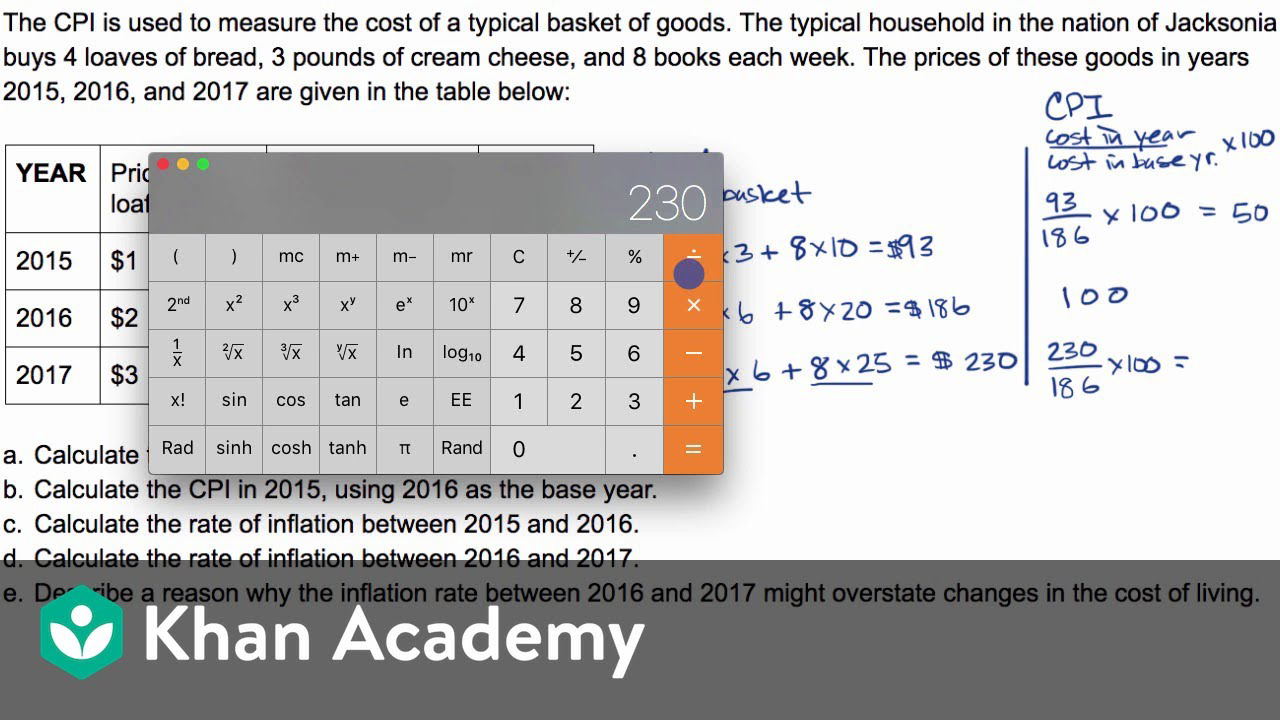
Inflation Rate = [(CPI in Year 2 – CPI in Year 1) / CPI in Year 1] x 100
In this equation, “CPI in Year 1” is the index value at the beginning of the period you are measuring, and “CPI in Year 2” is the index value at the end. By subtracting the initial value from the current value, you find the total change in price points. Dividing that change by the original value gives you the decimal representation of the growth, which is then multiplied by 100 to convert it into a percentage.
A Practical Walkthrough: 2023 vs. 2024
Let’s look at a hypothetical example. Suppose the CPI for January 2023 was 290, and by January 2024, it had risen to 300.
- Subtract: 300 – 290 = 10. (Prices rose by 10 index points).
- Divide: 10 / 290 = 0.03448.
- Multiply: 0.03448 x 100 = 3.45%.
In this scenario, the annual inflation rate for that period was 3.45%. This means that, on average, a consumer needed 3.45% more money in 2024 to buy the exact same goods they purchased in 2023.

Strategic Financial Planning in the Face of Inflation
Understanding the rate of inflation is only the first step. For those focused on personal finance and wealth management, the goal is to apply this percentage to real-world decision-making.
Adjusting Your Household Budget
If you find that the inflation rate is 5% but your income has remained stagnant, your “real” income has effectively decreased. To maintain your lifestyle, you must either find 5% more income or reduce your expenditures by 5%. Monitoring the CPI allows you to anticipate these shifts. If the “Food and Beverage” component of the CPI is rising faster than the general index, a savvy budgeter might shift their spending habits toward wholesale purchasing or alternative brands before the impact hits their bank account.
Salary Negotiations and Cost-of-Living Adjustments (COLA)
The CPI is the most powerful tool in your arsenal during a performance review. Many employees accept a 3% raise as a “win,” but if the annual inflation rate calculated via CPI is 4%, that employee has actually taken a 1% pay cut in terms of purchasing power. By citing the CPI, you can argue for a Cost-of-Living Adjustment (COLA) that ensures your standard of living does not erode over time. Businesses also use this data to adjust contracts and lease agreements to ensure they remain profitable as their own costs of operation rise.
Investment Implications: Using CPI to Protect Your Portfolio
In the world of investing, inflation is often referred to as “the silent killer.” It erodes the value of fixed-income assets and can distort the perceived success of an investment strategy.
Real vs. Nominal Returns
When reviewing your investment performance, you must distinguish between nominal and real returns. The nominal return is the percentage gain you see on your brokerage statement. The real return is the nominal return minus the inflation rate.
- Example: If your stock portfolio returned 8% last year, but inflation was 6%, your real return was only 2%.
By calculating the inflation rate using CPI, you can determine if your current investment strategy is actually building wealth or simply treading water against the rising tide of prices.
Inflation-Hedged Assets: TIPS and Real Estate
Investors who monitor CPI closely often shift their asset allocation when they notice an upward trend in inflation. Treasury Inflation-Protected Securities (TIPS) are a prime example of a financial tool directly linked to the CPI. The principal of a TIPS bond increases with inflation and decreases with deflation, as measured by the CPI. Additionally, real estate often serves as a natural hedge, as property values and rental income tend to correlate with rising consumer prices.
Beyond the Headline: Understanding Core CPI and Personal Inflation
While the “Headline CPI” (the number usually reported in the news) provides a broad overview, a deeper look at the data reveals more nuanced insights that can refine your financial strategy.
Headline vs. Core CPI
Economists often point to “Core CPI,” which excludes the volatile categories of food and energy. For a long-term financial plan, Core CPI can be more useful because it filters out short-term price “noise” caused by geopolitical events or seasonal weather changes. If Headline CPI is high but Core CPI is low, it suggests that inflation might be temporary (transitory), and you might not need to make drastic changes to your long-term investment strategy.
Tracking Your Personal Inflation Rate
The CPI is an average, but no one is an “average” consumer. If you own your home outright, you are not affected by rising rents—a major component of the CPI. If you do not drive, the price of gasoline is irrelevant to you.
To achieve true financial mastery, you should use the CPI categories to calculate your personal inflation rate. By looking at the specific CPI sub-indices for the goods you actually consume, you can create a far more accurate financial forecast. This allows for precision in retirement planning, as you can estimate future costs based on your specific lifestyle rather than a generalized national average.
Conclusion: Data-Driven Financial Resilience
Finding the inflation rate using CPI is more than a simple calculation; it is a gateway to informed economic participation. In a world where the value of currency is constantly in flux, those who understand the math behind the numbers are better equipped to protect their savings, negotiate their earnings, and allocate their capital effectively.
By mastering the CPI formula and understanding its implications on both a personal and macroeconomic level, you transition from a passive observer of the economy to an active participant. Whether you are adjusting your monthly budget or rebalancing a multi-million dollar portfolio, the ability to quantify the erosion of purchasing power is the first step toward long-term financial resilience and prosperity.
aViewFromTheCave is a participant in the Amazon Services LLC Associates Program, an affiliate advertising program designed to provide a means for sites to earn advertising fees by advertising and linking to Amazon.com. Amazon, the Amazon logo, AmazonSupply, and the AmazonSupply logo are trademarks of Amazon.com, Inc. or its affiliates. As an Amazon Associate we earn affiliate commissions from qualifying purchases.