
Understanding how to calculate an increase percentage is a foundational skill in personal finance, investing, and business management. It’s not merely a mathematical exercise; it’s a critical tool for gauging growth, assessing performance, making informed decisions, and setting realistic financial goals. Whether you’re tracking your investment portfolio, analyzing business revenue, evaluating salary increases, or monitoring your household budget, mastering this calculation provides invaluable insight into the dynamics of your financial landscape.
The Indispensable Role of Percentage Increase in Financial Analysis
In the realm of money, raw numbers alone often fail to tell the complete story. Knowing that your investment portfolio grew by $10,000 is useful, but understanding that it increased by 15% offers a much clearer perspective on its performance relative to the initial capital or market benchmarks. Percentage increases normalize growth, allowing for meaningful comparisons across different periods, investment sizes, or business operations. This normalization is crucial for several reasons:
Firstly, it provides context. A $100 increase might be negligible for an expense of $10,000 but substantial for an expense of $500. Expressing this as a percentage immediately highlights the proportional change. Secondly, it facilitates performance evaluation. Investors consistently use percentage returns to compare different assets, funds, or strategies, irrespective of the amount invested. A fund that delivers a 10% return is objectively better than one that yields 5%, even if the absolute dollar gain was lower due to a smaller initial investment. Lastly, it aids in forecasting and budgeting. By understanding historical percentage increases in income, expenses, or market trends, individuals and businesses can project future financial states more accurately, leading to more robust financial planning.
Mastering the Universal Formula: A Financial Lens
The formula for calculating an increase percentage is elegantly simple yet profoundly powerful in its financial applications. It quantifies the proportional change between an older value and a newer, larger value.
The core formula is:
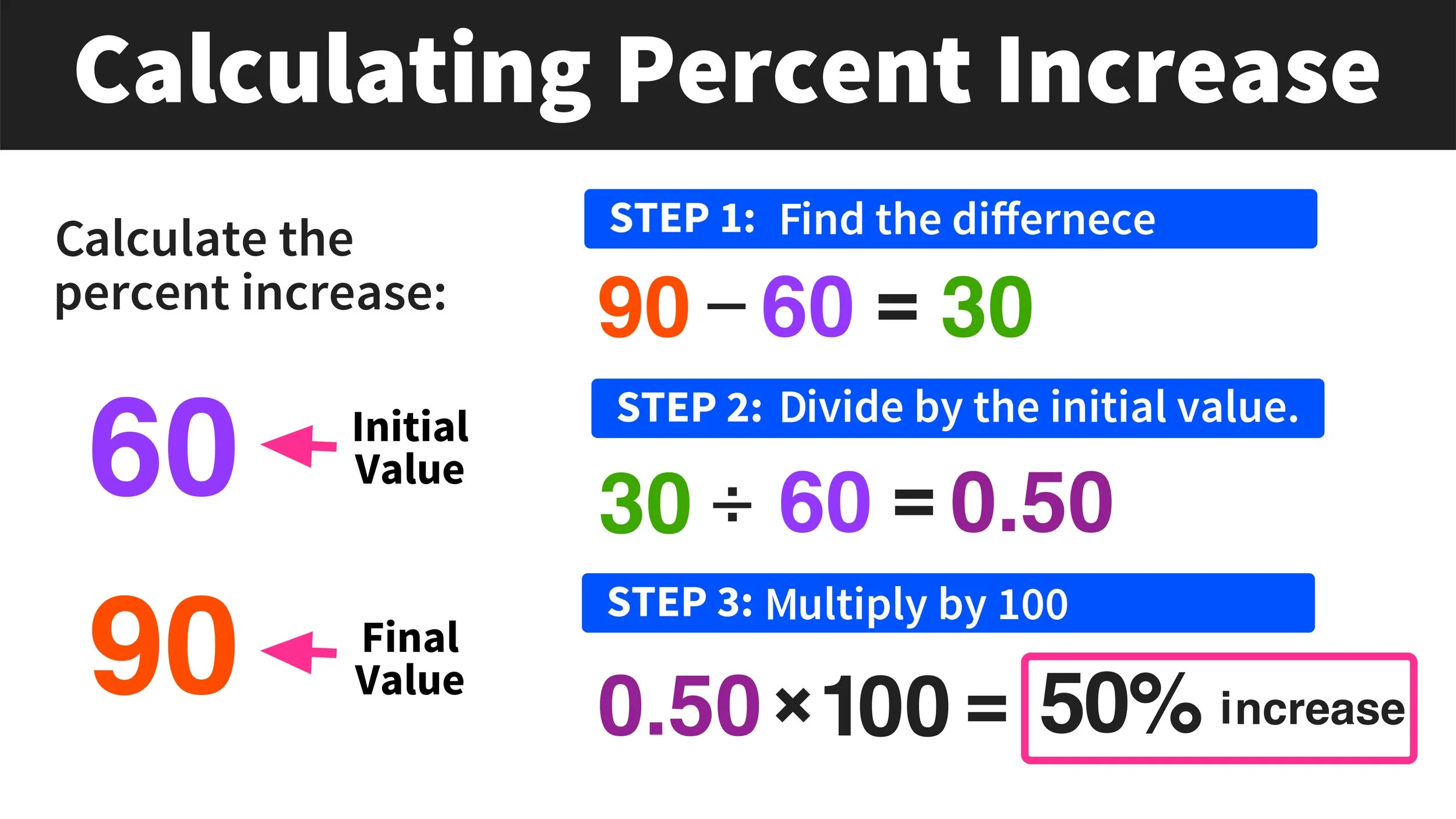
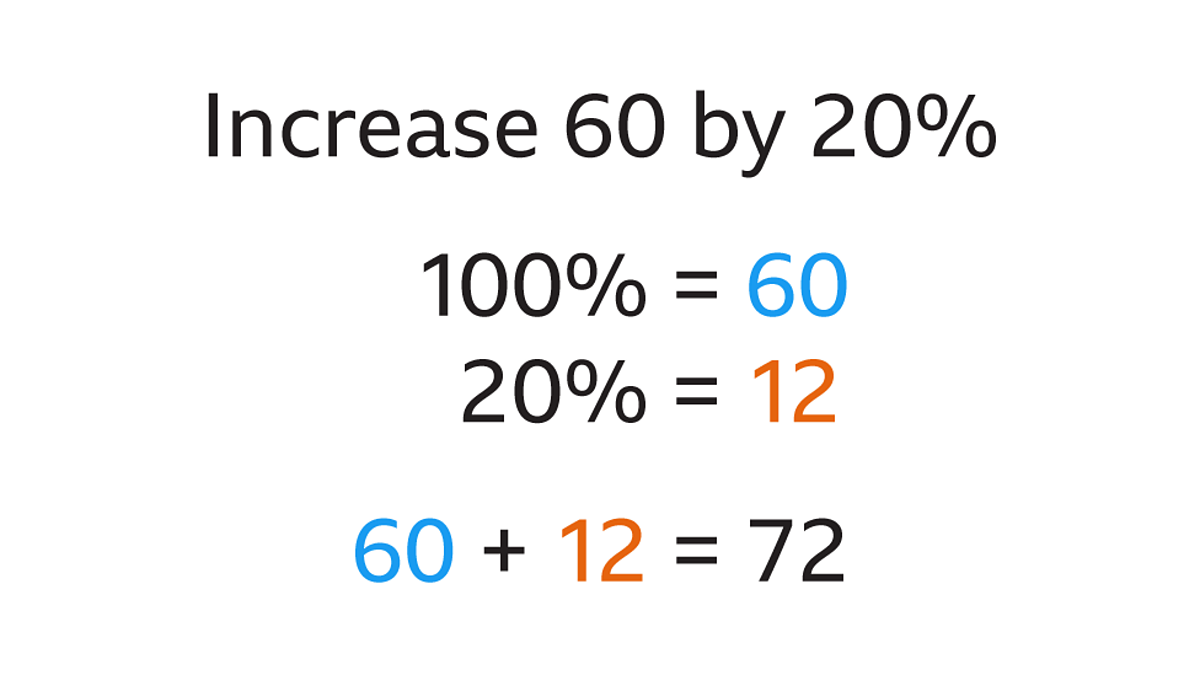
Percentage Increase = ((New Value - Old Value) / Old Value) * 100%
Let’s break down each component from a financial perspective:
- New Value (or Current Value): This represents the most recent or ending financial figure. In finance, this could be your current investment portfolio balance, the latest quarter’s revenue, your new salary after a raise, or the current month’s utility bill.
- Old Value (or Original Value): This is the starting or baseline financial figure from which the increase is measured. Financially, this might be your initial investment amount, the previous quarter’s revenue, your salary before a raise, or the previous month’s utility bill.
- Difference (New Value – Old Value): This calculation yields the absolute dollar amount of the increase. It tells you exactly how much more money you have, earned, or spent. While useful, it lacks the proportional context.
- Division by Old Value: This is the critical step that transforms the absolute increase into a relative proportion. By dividing the dollar increase by the original amount, you determine what fraction of the original value the increase represents. This normalizes the growth.
- Multiplication by 100%: The final step converts this decimal proportion into a readily understandable percentage, making it easy to communicate and compare.
Consider an example: You started with an initial investment of $10,000 (Old Value), and it has grown to $12,500 (New Value) over a year.
- Find the difference: $12,500 – $10,000 = $2,500
- Divide by the old value: $2,500 / $10,000 = 0.25
- Multiply by 100%: 0.25 * 100% = 25%
Your investment saw a 25% increase. This single number offers far more analytical power than just knowing it grew by $2,500.
Practical Applications Across Diverse Financial Scenarios
The ability to calculate an increase percentage transcends theoretical understanding, finding practical utility across virtually every aspect of personal and business finance.
Investment Growth Tracking
For investors, calculating percentage increase is fundamental to evaluating portfolio performance.
- Stock Appreciation: If you bought a stock at $50 per share and it’s now trading at $65, the increase percentage is
(($65 - $50) / $50) * 100% = 30%. This metric allows you to compare its performance against other stocks, indices, or your overall portfolio. - Portfolio Returns: To understand the growth of your entire investment portfolio, you would take your current portfolio value and subtract your initial investment (including any additional contributions, adjusted for withdrawals). For instance, if you started with $50,000 and it grew to $60,000, your return is
(($60,000 - $50,000) / $50,000) * 100% = 20%. This is your overall return on investment (ROI).
Budgeting and Expense Management
Tracking percentage increases in expenses is crucial for maintaining a healthy budget and identifying areas for potential savings.
- Rising Utility Bills: If your electricity bill went from $120 last month to $150 this month, the increase is
(($150 - $120) / $120) * 100% = 25%. A significant percentage increase flags an issue worth investigating, such as increased usage or a rate change. - Grocery Costs: If your average weekly grocery spending increased from $150 to $170 over a quarter, that’s a
(($170 - $150) / $150) * 100% = 13.33%increase, indicating a need to reassess shopping habits or account for rising food prices.
Business Revenue and Profit Analysis
For business owners and financial analysts, percentage increases are vital for assessing growth, setting targets, and evaluating operational efficiency.
- Revenue Growth: A company’s revenue increasing from $1,000,000 in Q1 to $1,200,000 in Q2 represents a
(($1,200,000 - $1,000,000) / $1,000,000) * 100% = 20%growth. This metric is closely watched by investors and management to gauge market penetration and business expansion. - Profit Margin Improvement: If a business’s net profit margin (profit as a percentage of revenue) improved from 10% to 12%, this is not a 2% increase, but a
((12% - 10%) / 10%) * 100% = 20%increase in the profit margin itself. This distinction is critical and often misunderstood.
Salary and Income Progression
Understanding the percentage increase in your salary helps you evaluate the real growth of your earning power and compare it against inflation.
- Pay Raise Impact: A salary increase from $60,000 to $63,000 per year translates to a
(($63,000 - $60,000) / $60,000) * 100% = 5%raise. This percentage allows you to quickly assess if the raise keeps pace with the cost of living or industry benchmarks.
Avoiding Common Pitfalls and Misinterpretations
While straightforward, misapplying the percentage increase formula can lead to significant financial misjudgments. Awareness of common pitfalls is key to accurate analysis.
The “Base Value” Trap
Always remember to divide by the original or old value. A common mistake is to divide by the new value or an average, which will yield an incorrect percentage.
Consider an asset that drops from $100 to $50, then later recovers from $50 back to $100.
- Drop:
(($50 - $100) / $100) * 100% = -50%(a 50% decrease). - Recovery:
(($100 - $50) / $50) * 100% = +100%(a 100% increase).
The percentage increase required to recover from a loss is often much larger than the initial percentage loss, because the base value for the increase is smaller. Misunderstanding this can lead to unrealistic expectations about investment recovery.
Distinguishing Between Percentage Increase and Percentage Point Increase
This distinction is particularly important when dealing with rates, such as interest rates, tax rates, or market share.
- Example: If an interest rate goes from 5% to 6%, it’s a 1 percentage point increase. However, the percentage increase in the rate itself is
((6% - 5%) / 5%) * 100% = 20%. The rate increased by one percentage point, but the value of the rate increased by 20%. Confusing these two can lead to significant miscalculations in financial models or contract understanding.
Considering Inflation and Real Returns
A nominal increase in your income or investments might not translate to a real increase in purchasing power if inflation is high.
- If your salary increases by 3%, but inflation (the general increase in prices) for the same period is 4%, your real purchasing power has actually decreased by approximately 1%. Financial analysis often requires adjusting nominal returns by inflation to determine the true increase in wealth.
Leveraging Financial Tools for Efficiency
While the formula is simple enough for manual calculation, modern financial planning benefits immensely from leveraging technology to automate and visualize these calculations.
Spreadsheets (Excel, Google Sheets)
Spreadsheets are indispensable for financial analysis. You can set up columns for “Old Value,” “New Value,” and a formula for “Percentage Increase” =(B2-A2)/A2 (where A2 is old value, B2 is new value), then format the result as a percentage. This allows for quick calculations across numerous data points, facilitating budget tracking, investment portfolio analysis, and business performance metrics over time.

Online Calculators and Financial Software
Numerous online percentage calculators provide instant results. More sophisticated financial software and investment platforms often have built-in functions to automatically track and display percentage changes for your investments, income, and expenses. Tools like Quicken, Mint, or even broker-specific platforms offer dashboards that visualize these increases, helping you monitor your financial health without manual calculation.
In conclusion, understanding and correctly applying the percentage increase formula is more than just arithmetic; it is a fundamental pillar of financial literacy. It empowers individuals and businesses to make sense of financial data, evaluate performance accurately, anticipate future trends, and ultimately make smarter, more profitable decisions in an ever-evolving economic landscape.
aViewFromTheCave is a participant in the Amazon Services LLC Associates Program, an affiliate advertising program designed to provide a means for sites to earn advertising fees by advertising and linking to Amazon.com. Amazon, the Amazon logo, AmazonSupply, and the AmazonSupply logo are trademarks of Amazon.com, Inc. or its affiliates. As an Amazon Associate we earn affiliate commissions from qualifying purchases.