
Calculating percentages is more than just a basic mathematical exercise; it is a fundamental pillar of financial literacy. Whether you are calculating a discount at a retail store, determining how much to set aside for taxes, or structuring a corporate budget, the ability to find 30 percent of a number quickly and accurately is indispensable. In the world of personal and business finance, the “30 percent” figure appears frequently—from the 50/30/20 budgeting rule to credit utilization ratios and tax withholding.
Mastering this calculation allows you to make informed decisions in real-time, ensuring you remain in control of your capital. This guide explores the most efficient methods for calculating 30 percent and examines why this specific figure is so pivotal in various financial contexts.
The Mathematics of 30 Percent: Reliable Calculation Methods
Before diving into the strategic financial applications, it is vital to master the mechanics. There are three primary ways to find 30 percent of any given number. Each method offers its own advantages depending on whether you are using a calculator, a spreadsheet, or performing mental math during a meeting.
The Decimal Method
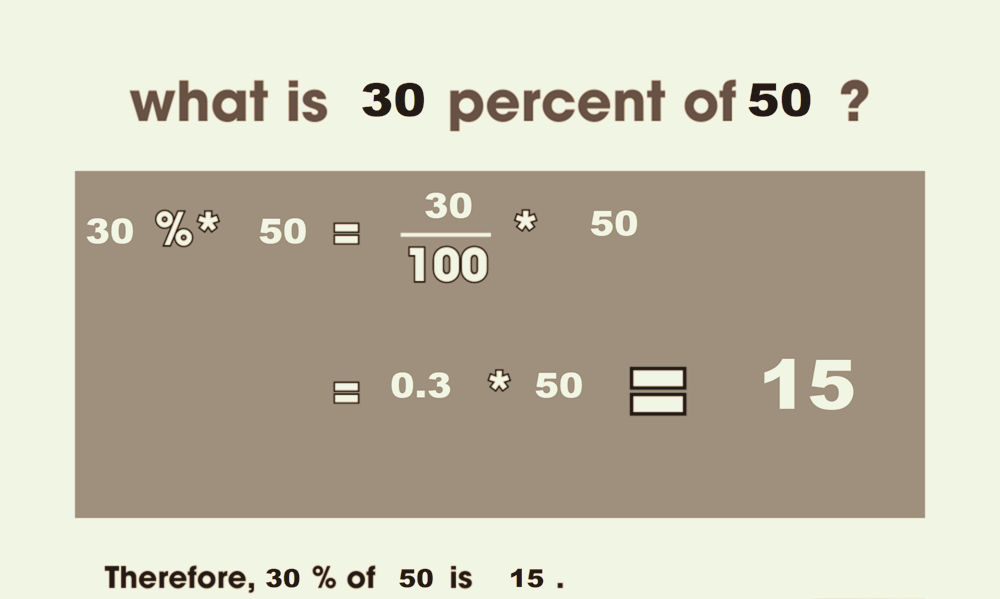
The most straightforward way to calculate a percentage is to convert the percentage into a decimal. In mathematics, “percent” literally means “per one hundred.” Therefore, 30 percent is the same as 30/100, which simplifies to 0.30.
To find 30 percent of a number using this method, simply multiply the number by 0.3. For example, if you need to find 30 percent of $4,500:
$4,500 × 0.30 = $1,350
This method is the standard for digital calculations, whether you are typing a formula into a handheld calculator or a sophisticated financial modeling tool.
The 10% Shortcut (Mental Math)
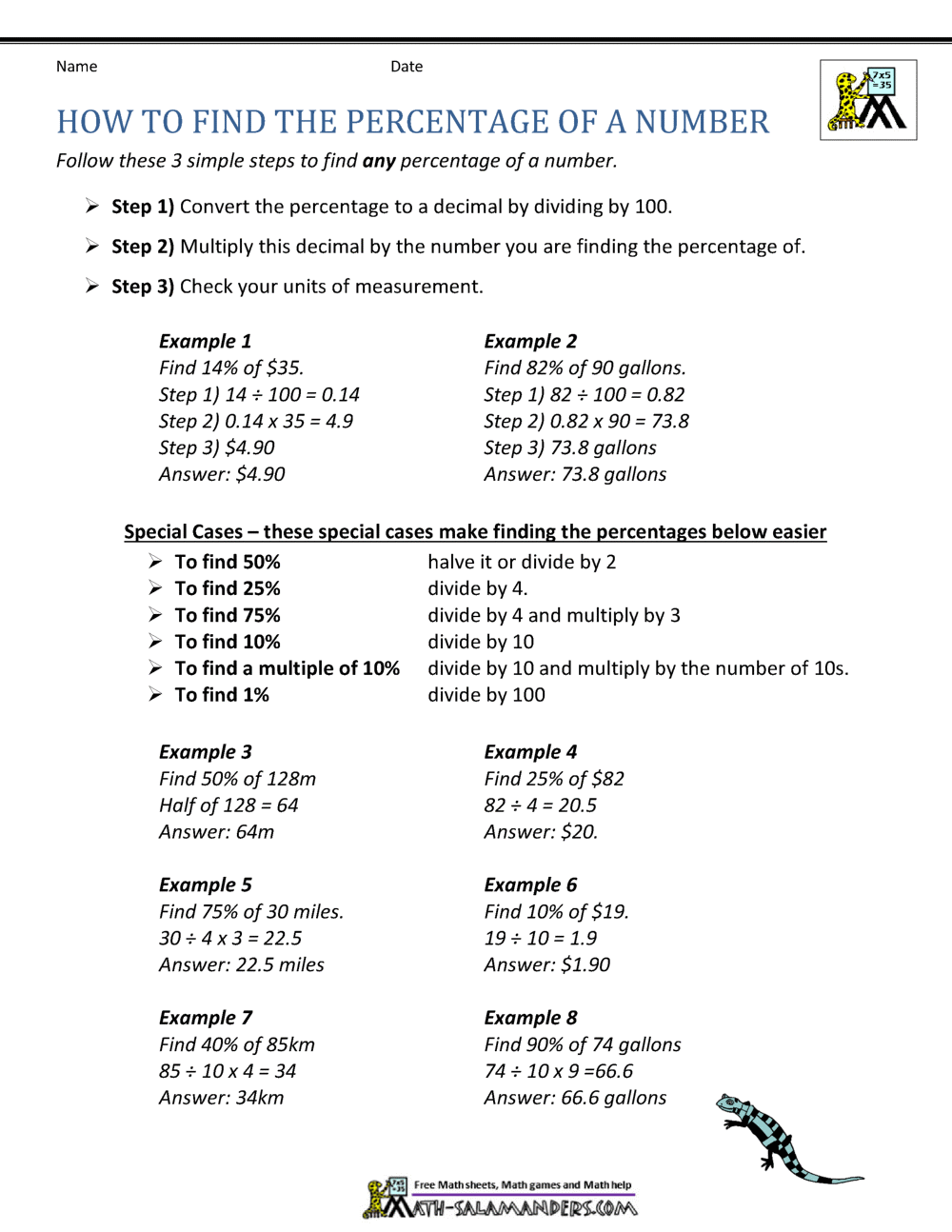
In professional settings where speed is an asset, the “10% shortcut” is the most effective mental math strategy. Finding 10 percent of any number is as simple as moving the decimal point one place to the left. Once you have 10 percent, you simply multiply that result by three to reach 30 percent.
Consider a business dinner bill of $210.
- Find 10%: Move the decimal left to get $21.00.
- Multiply by 3: $21 × 3 = $63.
The 30 percent value is $63.
This method allows for rapid estimation during negotiations or when evaluating quick-fire investment opportunities without the need for a device.
The Fraction Method
For those who prefer working with fractions, 30 percent can be expressed as 3/10. To find 30 percent of a number, you divide the number by 10 and then multiply by 3. This is essentially a formalization of the mental math shortcut.
For instance, to find 30 percent of 1,200:
- Divide by 10: 1,200 / 10 = 120.
- Multiply by 3: 120 × 3 = 360.
30 Percent in Personal Finance and Budgeting
In the realm of personal finance, 30 percent is a recurring benchmark used to measure health and stability. Understanding how to calculate this figure is the first step toward implementing some of the most effective wealth-building strategies available to the modern consumer.
The 50/30/20 Budgeting Rule
One of the most popular personal finance frameworks is the 50/30/20 rule, popularized by Senator Elizabeth Warren. This rule suggests that 50% of your after-tax income should go to “Needs” (housing, utilities, groceries), 20% should go to “Savings and Debt Repayment,” and the remaining 30% should be allocated to “Wants.”
Knowing how to find 30 percent of your monthly take-home pay is essential for maintaining this balance. If your monthly income is $6,000, calculating 30 percent ($1,800) tells you exactly how much lifestyle flexibility you have for dining out, hobbies, and travel without compromising your financial future.
The 30% Housing Rule
A long-standing guideline in financial planning is that an individual should spend no more than 30 percent of their gross monthly income on housing costs. This includes rent or mortgage payments, property taxes, and insurance.
Lenders often use this 30 percent threshold to determine a borrower’s debt-to-income ratio (DTI). If you earn $8,000 a month, finding 30 percent ($2,400) gives you a ceiling for your housing search. Staying under this 30 percent mark ensures that you are not “house poor,” a state where so much of your income goes to your residence that you cannot afford other life necessities or investments.
Credit Utilization and Credit Scores
In the world of credit scoring, specifically the FICO model, your “amounts owed” accounts for 30 percent of your total score. Within this category, “credit utilization”—the ratio of your outstanding balances to your total available credit—is a critical metric.
Financial experts generally recommend keeping your credit utilization below 30 percent to maintain a high credit score. If you have a total credit limit of $10,000 across all cards, you must be able to quickly calculate 30 percent ($3,000) to know your spending limit. Exceeding this 30 percent threshold can signal to lenders that you are overextended, leading to a decrease in your creditworthiness and higher interest rates on future loans.
Business Finance: Margins, Taxes, and Benchmarks
For entrepreneurs and business owners, calculating 30 percent is a daily necessity. It serves as a benchmark for profitability, a safeguard for tax compliance, and a tool for performance evaluation.
Setting Aside Money for Taxes
For the self-employed, freelancers, and small business owners, tax withholding is not automated by an employer. A common rule of thumb is to set aside 30 percent of every check received to cover federal and state income taxes, as well as self-employment taxes (Social Security and Medicare).
If a freelancer lands a contract worth $15,000, they must immediately calculate 30 percent ($4,500) and move that capital into a high-yield savings account or an escrow-style business account. Failing to accurately calculate this 30 percent can lead to significant liquidity crises during quarterly tax deadlines.
Gross Profit Margin Targets
In many industries, such as retail and food service, a 30 percent gross profit margin is often considered the minimum threshold for long-term viability. Gross profit margin is calculated as (Revenue – Cost of Goods Sold) / Revenue.
If a product costs $70 to manufacture, a business owner needs to understand that to achieve a 30 percent margin, the selling price cannot simply be $70 plus 30 percent. They must use the calculation to ensure the final price allows for a 30 percent “slice” of the total revenue to remain after production costs. This nuanced understanding of percentages separates successful enterprises from those that struggle with cash flow.
Marketing and Customer Acquisition
In corporate finance, 30 percent is often used as a limit for Customer Acquisition Cost (CAC) relative to the Lifetime Value (LTV) of a customer. Many SaaS (Software as a Service) companies aim for a CAC that is no more than 30 percent of the total revenue expected from that customer over their lifetime. Monitoring this 30 percent ratio ensures that the company is growing sustainably rather than burning through venture capital at an inefficient rate.
Investing and Risk Management
Investors use the 30 percent calculation to manage risk and identify opportunities in the market. Whether you are looking at stock market corrections or portfolio diversification, this number is a vital indicator.
Market Corrections and Volatility
In the stock market, a “correction” is typically defined as a 10 percent drop from recent highs, while a “bear market” is a drop of 20 percent or more. A 30 percent decline is often viewed as a major buying opportunity for long-term value investors.
By calculating what a 30 percent drop looks like for a specific index (like the S&P 500) or a specific stock, investors can set “limit orders” or “buy triggers.” For example, if a blue-chip stock is trading at $200, an investor might decide to enter a position if it drops 30 percent to $140.
Portfolio Rebalancing
Professional portfolio managers often use “rebalancing triggers” to maintain a target asset allocation. If an investor wants a portfolio of 70 percent stocks and 30 percent bonds, they must regularly calculate 30 percent of the total portfolio value.
If the stock market performs exceptionally well, the bond portion of the portfolio might shrink to 20 percent of the total value. The investor must then calculate the 30 percent target of the new, larger total and sell stocks to buy more bonds, effectively “selling high” and “buying low” to return to their original risk profile.
Leveraging Digital Tools for Percentage Calculations
While mental math is valuable, the scale and complexity of modern finance often require the precision of digital tools. Understanding how to find 30 percent using software allows for automation and error reduction.
Spreadsheet Formulas
In Microsoft Excel or Google Sheets, finding 30 percent of a cell is a core function of financial modeling. If your data is in cell A1, the formula to find 30 percent is:
=A1*0.3
For more complex financial analysis, such as calculating a 30 percent increase (compounding), the formula would be:
=A1*1.3
These formulas allow business owners to create dynamic budgets where changing one number automatically updates the 30 percent tax or savings allocations across the entire document.
Financial Calculators and Apps
Most modern financial calculators have a dedicated “%” key. However, for specialized tasks—such as calculating the impact of a 30 percent down payment on a mortgage—using dedicated mortgage calculators is more effective. These tools take the 30 percent figure and apply it against interest rates, loan terms, and amortization schedules to provide a comprehensive view of the financial commitment.
Conclusion
The ability to find 30 percent of a number is a versatile tool that bridges the gap between basic arithmetic and sophisticated financial strategy. In personal finance, it acts as a guardrail for spending and a benchmark for credit health. In business, it serves as a critical margin for profitability and tax readiness. In investing, it provides a metric for risk and a signal for opportunity.
By mastering the decimal, shortcut, and fractional methods of calculation, you empower yourself to navigate the financial world with greater confidence. Whether you are managing a household budget or a corporate balance sheet, the “30 percent rule” is often the difference between financial stability and fiscal uncertainty.
aViewFromTheCave is a participant in the Amazon Services LLC Associates Program, an affiliate advertising program designed to provide a means for sites to earn advertising fees by advertising and linking to Amazon.com. Amazon, the Amazon logo, AmazonSupply, and the AmazonSupply logo are trademarks of Amazon.com, Inc. or its affiliates. As an Amazon Associate we earn affiliate commissions from qualifying purchases.