
Retirement marks a significant life transition, offering the promise of freedom and the pursuit of passions unfettered by daily work. However, this dream often hinges on a crucial question: “How much money will I have, and will it be enough?” Figuring out your retirement income is not merely a mathematical exercise; it’s a strategic process that involves foresight, planning, and a deep understanding of your financial landscape. This comprehensive guide will walk you through the essential steps, considerations, and strategies to confidently calculate and secure your financial future in retirement.
The Foundation: Understanding Your Retirement Income Needs
Before you can figure out where your retirement income will come from, you must first determine how much income you’ll actually need. This critical initial step sets the benchmark for all subsequent planning.
Estimating Future Expenses
Your current spending habits provide a good starting point, but retirement expenses can differ significantly from your working years. Some costs might decrease (like commuting, work clothes, or saving for retirement itself), while others might increase (such as healthcare, travel, or hobbies).
Start by listing all your current monthly expenses. Categorize them into essential (housing, food, utilities, insurance, transportation) and discretionary (entertainment, dining out, travel, hobbies). Then, project how these categories might change in retirement. For instance, if your mortgage will be paid off, your housing costs will drop significantly. If you plan to travel extensively, your discretionary spending will likely rise. Don’t forget to account for larger, infrequent expenses like vehicle replacement or home repairs.
A common rule of thumb suggests you’ll need 70-80% of your pre-retirement income to maintain your lifestyle. However, this is a broad generalization. A more personalized approach, meticulously detailing your expected outlays, will yield a far more accurate figure.
Defining Your Desired Retirement Lifestyle
The quality of your retirement life is directly tied to the income it supports. Do you envision a quiet life at home, pursuing local interests? Or do you dream of world travel, luxurious experiences, and constant engagement with new adventures? Your desired lifestyle is a primary driver of your income needs.
Consider factors like:
-
Housing: Will you stay in your current home, downsize, relocate, or live abroad?
-
Travel: How frequently and how far do you plan to travel?
-
Hobbies and Activities: Will you invest in new hobbies, join clubs, or take classes?
-
Family Support: Do you plan to financially assist children or grandchildren?
-
Legacy Planning: Are you interested in charitable giving or leaving an inheritance?
Each of these choices has a financial implication. A clear vision for your retirement lifestyle provides the context for your expense estimations, transforming abstract numbers into concrete goals.
Accounting for Inflation and Healthcare Costs
Two significant factors often underestimated in retirement planning are inflation and healthcare costs.
Inflation: The purchasing power of money erodes over time due to inflation. A dollar today will buy less in 20 or 30 years. When calculating your future income needs, it’s crucial to factor in a realistic inflation rate (e.g., 2-3% annually) to ensure your money maintains its value. This means that if you need $50,000 in today’s dollars, you’ll need significantly more in future dollars to maintain the same purchasing power.
Healthcare: Healthcare expenses are notoriously high for retirees and often increase with age. Medicare covers a portion, but deductibles, co-pays, prescription drugs, and services not covered by Medicare (like dental, vision, and long-term care) can add up quickly. Fidelity Investments, for example, estimated that a couple retiring at age 65 in 2023 would need approximately $315,000 saved just for healthcare expenses throughout retirement. Incorporating these potential costs into your retirement budget is non-negotiable for a secure future.
Identifying Your Retirement Income Streams
Once you have a clear picture of your income needs, the next step is to identify and quantify the various sources from which your retirement income will flow. A diversified approach to income streams provides greater security and flexibility.
Social Security Benefits
For most Americans, Social Security will form a foundational layer of retirement income. The amount you receive depends on your earnings history and the age at which you claim benefits.
-
Full Retirement Age (FRA): This is the age at which you are entitled to 100% of your Primary Insurance Amount (PIA). It varies based on your birth year (e.g., 66 for those born between 1943 and 1954, gradually increasing to 67 for those born in 1960 or later).
-
Early Claiming: You can start receiving benefits as early as age 62, but your monthly payments will be permanently reduced.
-
Delayed Claiming: For each year you delay claiming past your FRA, up to age 70, your benefits increase by 8% per year (known as Delayed Retirement Credits). This can result in significantly higher monthly payments.
You can get an estimate of your future Social Security benefits by creating an account on the Social Security Administration’s website (ssa.gov). Strategizing when to claim Social Security is a crucial decision, often best made in consultation with a financial advisor, especially for couples.
Pensions and Employer-Sponsored Plans
If you worked for an employer that offered a traditional defined benefit pension plan, this could provide a predictable stream of income in retirement. Understand the payout options (e.g., single life annuity, joint and survivor annuity) and their implications.
Beyond pensions, employer-sponsored defined contribution plans like 401(k)s, 403(b)s, and 457 plans are common retirement savings vehicles. These plans grow tax-deferred (or tax-free in the case of Roth versions), and withdrawals in retirement are a primary source of income. The amount of income you can derive from these plans depends on your accumulated balance and your withdrawal strategy.
Personal Savings and Investment Portfolios
Individual Retirement Accounts (IRAs – Traditional and Roth), taxable brokerage accounts, and other personal savings form another critical component of your retirement income. These self-directed investments give you control over asset allocation and withdrawal timing.
-
Traditional IRAs/401(k)s: Contributions are often tax-deductible, and growth is tax-deferred. Withdrawals in retirement are taxed as ordinary income.
-
Roth IRAs/401(k)s: Contributions are made with after-tax dollars, and qualified withdrawals in retirement are tax-free.
-
Taxable Brokerage Accounts: These offer flexibility as there are no age restrictions on withdrawals, but capital gains and dividends are taxed annually or upon sale.
The growth of these portfolios over decades is vital. The asset allocation (mix of stocks, bonds, cash) should be chosen to align with your risk tolerance and time horizon, aiming to maximize returns while managing risk.
Other Potential Income Sources
Some retirees supplement their primary income streams with other creative solutions:
-
Rental Property Income: If you own investment properties, the rental income can provide a steady cash flow.
-
Part-Time Work or Consulting: Many retirees choose to work part-time, either for enjoyment, social interaction, or to supplement income and delay drawing from their investment portfolios.
-
Reverse Mortgages: For homeowners, a reverse mortgage can convert a portion of home equity into tax-free income or a line of credit, without needing to sell the home. This option comes with complexities and fees, requiring careful consideration.
-
Annuities: These financial products, purchased from insurance companies, can provide a guaranteed income stream for a set period or for life. They offer predictability but come with trade-offs regarding liquidity and potential for lower overall returns compared to diversified portfolios.
Calculating Your Retirement Income Gap (or Surplus)
With your estimated needs and identified income sources, the next step is to perform the actual calculation to see if you have an income gap (you need more) or a surplus (you have more than enough).

The 4% Rule and Other Withdrawal Strategies
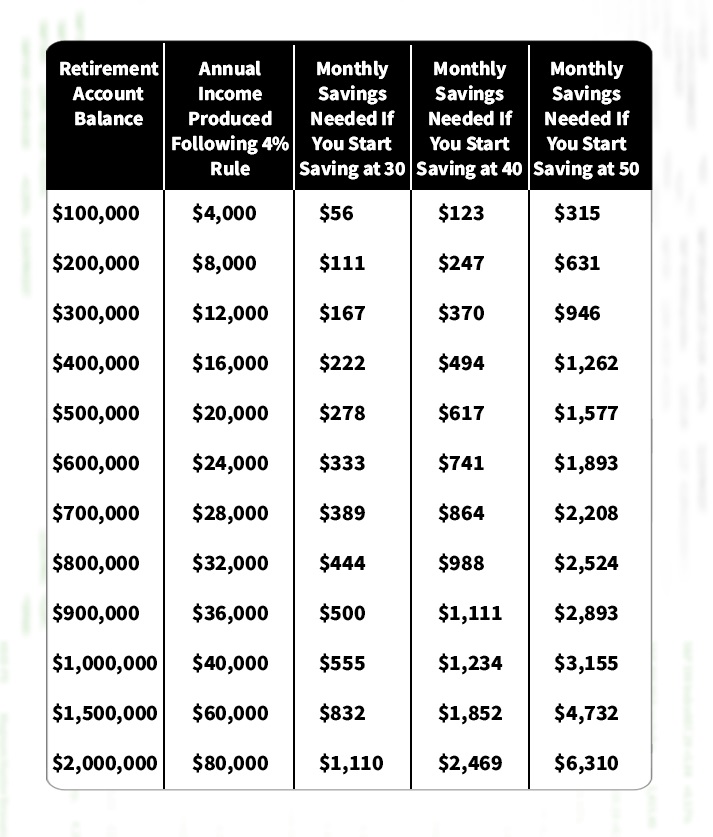
A widely discussed guideline for sustainable portfolio withdrawals is the “4% Rule.” This rule suggests that you can safely withdraw 4% of your initial retirement portfolio value in your first year of retirement, and then adjust that amount for inflation in subsequent years, with a high probability of your money lasting for 30 years. For example, a $1,000,000 portfolio would allow for an initial withdrawal of $40,000.
While a popular starting point, the 4% rule is a guideline, not a guarantee. Factors like market performance, your portfolio’s asset allocation, and the actual length of your retirement can impact its efficacy. Other withdrawal strategies include:
-
Dynamic Withdrawal Strategies: Adjusting withdrawals based on market performance (e.g., taking less in down markets, more in up markets).
-
Bucketing Strategy: Dividing your portfolio into different “buckets” for short-term (cash), mid-term (bonds), and long-term (stocks) needs, with withdrawals taken from the appropriate bucket.
-
Fixed Percentage Withdrawal: Taking a consistent percentage of your current portfolio value each year, meaning your dollar amount fluctuates.
The “right” withdrawal rate depends on your personal circumstances, risk tolerance, and the flexibility of your retirement budget.
Projecting Investment Growth
To calculate how much income your portfolio can generate, you need to project its future growth. This is where online retirement calculators or financial planning software become invaluable. These tools allow you to input your current savings, contributions, anticipated returns, and withdrawal rates to simulate various scenarios.
-
Rate of Return: Be realistic with your assumed annual rate of return. Historically, diversified portfolios have averaged 7-10% annually before inflation, but future returns are never guaranteed. Many planners use a more conservative 5-7% for projections.
-
Monte Carlo Simulations: Advanced planning tools often use Monte Carlo simulations, which run thousands of different market scenarios to provide a probability of success for your retirement plan. This helps in understanding the risks involved.
The Role of Annuities and Guaranteed Income
For those seeking more certainty, annuities can convert a lump sum into a guaranteed stream of income, often for life. There are various types:
-
Immediate Annuities (SPIAs): Purchased with a single premium, income payments begin almost immediately.
-
Deferred Annuities: Payments begin at a future date (e.g., retirement).
-
Fixed Annuities: Offer a guaranteed interest rate and predictable income.
-
Variable Annuities: Investment returns and income payments fluctuate based on the performance of underlying investments, often with riders to guarantee minimum income.
-
Indexed Annuities: Returns are linked to a market index, offering some upside potential with downside protection.
Annuities can act as a “personal pension,” providing a floor of guaranteed income to cover essential expenses, reducing reliance on a volatile investment portfolio for those critical needs. However, they typically come with less liquidity and may offer lower overall returns than a diversified investment portfolio.
Strategies for Bridging the Gap and Maximizing Income
If your calculations reveal an income gap, don’t despair. There are numerous strategies you can employ to bridge it and enhance your retirement income.
Optimizing Your Savings Rate
The most direct way to increase your retirement income is to save more during your working years.
-
Increase Contributions: Max out your 401(k)s, IRAs, and other retirement accounts, especially if your employer offers a matching contribution (which is essentially free money).
-
Automate Savings: Set up automatic transfers from your checking to your savings and investment accounts.
-
“Pay Yourself First”: Treat your retirement savings as a non-negotiable expense, just like rent or utilities.
-
Windfalls: Direct bonuses, tax refunds, or inheritances directly into your retirement accounts.
Investment Portfolio Diversification
A well-diversified portfolio is crucial for long-term growth and risk management.
-
Asset Allocation: Ensure your portfolio has a suitable mix of stocks (for growth), bonds (for stability and income), and cash (for liquidity). Rebalance periodically to maintain your target allocation.
-
Global Diversification: Invest across different geographies and market capitalizations.
-
Consider Risk vs. Return: As you approach and enter retirement, you may gradually shift towards a more conservative portfolio to protect capital, but some growth-oriented investments are still necessary to combat inflation.
Considering Later Retirement or Part-Time Work
Delaying retirement by even a few years can have a profound impact:
-
More Savings: You have more time to contribute to your retirement accounts.
-
Compounding: Your existing investments have more time to grow.
-
Delayed Withdrawals: You delay drawing down your portfolio, allowing it to grow further.
-
Higher Social Security: You can potentially earn higher Social Security benefits by delaying claiming.
Working part-time in retirement can provide a similar boost, covering discretionary expenses and allowing your portfolio to remain untouched for longer.
Tax-Efficient Withdrawal Strategies
How you withdraw your money in retirement can significantly impact its longevity.
-
Sequence of Withdrawals: A common strategy is to withdraw from taxable accounts first, then tax-deferred accounts (like Traditional IRAs/401(k)s), and finally from tax-free accounts (like Roth IRAs/401(k)s). This can help manage your taxable income and potentially keep you in a lower tax bracket.
-
Roth Conversions: Consider converting portions of your Traditional IRA/401(k) to a Roth during lower-income years (e.g., between leaving work and claiming Social Security) to create future tax-free income.
-
Required Minimum Distributions (RMDs): Be aware of RMDs from tax-deferred accounts, which typically start at age 73 (or 75 for those born in 1960 or later). These distributions are mandatory and taxable, and must be factored into your income plan.
Leveraging Financial Tools and Professional Guidance
Navigating the complexities of retirement income planning can be daunting. Fortunately, numerous resources are available to help.
Online Retirement Calculators and Planners
The internet offers a wealth of free and subscription-based retirement calculators and planning tools. These tools allow you to input your specific financial details, project different scenarios, and visualize the potential outcomes of various savings and spending decisions. Examples include tools from financial institutions (Fidelity, Vanguard), government sites, and independent financial planning platforms. While useful for initial estimates, they often lack the personalized insight of a human advisor.
The Value of a Financial Advisor
For complex situations or if you simply prefer expert guidance, a qualified financial advisor can be invaluable. A good advisor can help you:
-
Create a Personalized Plan: Tailor a retirement income strategy specific to your goals, risk tolerance, and timeline.
-
Optimize Investments: Help you select appropriate investments and manage your portfolio.
-
Tax Planning: Develop tax-efficient withdrawal and legacy strategies.
-
Navigate Complex Decisions: Assist with Social Security claiming strategies, pension payout choices, and long-term care planning.
-
Provide Objectivity: Offer an unbiased perspective and help you stay on track, especially during market volatility.
Look for a fee-only fiduciary advisor, who is legally bound to act in your best interest.
Regular Review and Adjustment
Retirement income planning is not a one-time event; it’s an ongoing process. Your financial situation, market conditions, and personal goals will evolve.
-
Annual Review: Conduct an annual review of your retirement plan. Reassess your expenses, income sources, and investment performance.
-
Life Events: Major life events (marriage, divorce, new children, illness, inheritance) necessitate a review and potential adjustment of your plan.
-
Market Changes: Periods of significant market downturns or upturns may require re-evaluation of your withdrawal strategy or portfolio allocation.
By regularly reviewing and adjusting your plan, you can ensure it remains aligned with your evolving needs and provides the financial security you desire throughout your retirement years.

Conclusion
Figuring out your retirement income is a journey of introspection and proactive planning. It requires a realistic assessment of your future needs, a thorough understanding of your potential income sources, and a strategic approach to managing your assets. While the numbers can seem overwhelming, breaking the process down into manageable steps and leveraging available tools and expertise can demystify the process. By taking control of your financial future today, you can pave the way for a retirement that is not only financially secure but also filled with purpose, comfort, and the freedom to truly live your dreams.
aViewFromTheCave is a participant in the Amazon Services LLC Associates Program, an affiliate advertising program designed to provide a means for sites to earn advertising fees by advertising and linking to Amazon.com. Amazon, the Amazon logo, AmazonSupply, and the AmazonSupply logo are trademarks of Amazon.com, Inc. or its affiliates. As an Amazon Associate we earn affiliate commissions from qualifying purchases.