
In the complex tapestry of personal finance, business operations, and investment strategies, one fundamental mathematical concept stands out for its pervasive utility: the percentage. Far from being a mere academic exercise, understanding how to figure percentages is an indispensable skill that empowers individuals and businesses to make informed decisions, optimize financial outcomes, and navigate the economic landscape with confidence. From calculating a discount on a new purchase to deciphering interest rates on a loan, assessing investment returns, or analyzing business growth, percentages provide a standardized and easily comparable way to express proportions, changes, and relationships. This guide delves into the essence of percentages, their critical role in financial management, and practical methods for calculating them accurately.
The Ubiquity of Percentages in Financial Life
Percentages are the universal language of finance, permeating every aspect of our monetary interactions. Their ability to contextualize numbers relative to a whole makes them incredibly powerful for comparison and analysis, often more so than raw figures alone. Recognizing where percentages appear is the first step toward mastering their application.
Daily Financial Transactions
Every day, we encounter percentages in scenarios that directly impact our wallets. When shopping, discounts are almost always advertised as percentages off the original price, requiring a quick calculation to determine the final cost. Sales tax is applied as a percentage of the purchase price, and gratuities (tips) are typically calculated as a percentage of the bill. Understanding these simple percentage applications ensures you pay the correct amount, take full advantage of savings, and tip appropriately. Moreover, managing personal debt involves understanding interest rates on credit cards, car loans, and mortgages, all of which are expressed as percentages. A small difference in an annual percentage rate (APR) can translate into thousands of dollars over the lifetime of a loan, underscoring the importance of percentage literacy.
Understanding Investment Performance
For investors, percentages are the bedrock of performance evaluation. Returns on stocks, bonds, mutual funds, and other assets are invariably quoted as percentage gains or losses. This allows for straightforward comparison between different investment vehicles, even if their initial capital investments were vastly different. A 10% return on a $1,000 investment can be easily compared to a 10% return on a $100,000 investment, highlighting the efficiency of the growth rather than just the absolute dollar amount. Risk, diversification, and portfolio allocation are also discussed in percentage terms, enabling investors to construct balanced portfolios that align with their financial goals and risk tolerance. From yield percentages on dividends to expense ratios on funds, percentages are vital for assessing an investment’s potential and cost.
Business Metrics and Growth Analysis
In the business world, percentages are foundational to strategic planning, operational analysis, and financial reporting. Profit margins (gross, operating, net) are calculated as percentages of revenue, providing critical insights into a company’s profitability and efficiency. Growth rates for sales, market share, and customer acquisition are expressed as percentages, allowing stakeholders to track progress and identify trends. Financial statements are replete with percentage analyses, such as year-over-year revenue growth, percentage of debt to equity, and return on assets. These metrics empower business owners, managers, and investors to benchmark performance, identify areas for improvement, and make data-driven decisions that foster sustainable growth and profitability.
Essential Methods for Calculating Percentages
While the applications of percentages are diverse, the core methods for calculating them are relatively straightforward. Mastering these fundamental techniques will equip you to handle almost any percentage-related financial challenge.
Basic Percentage Calculation: Part-to-Whole
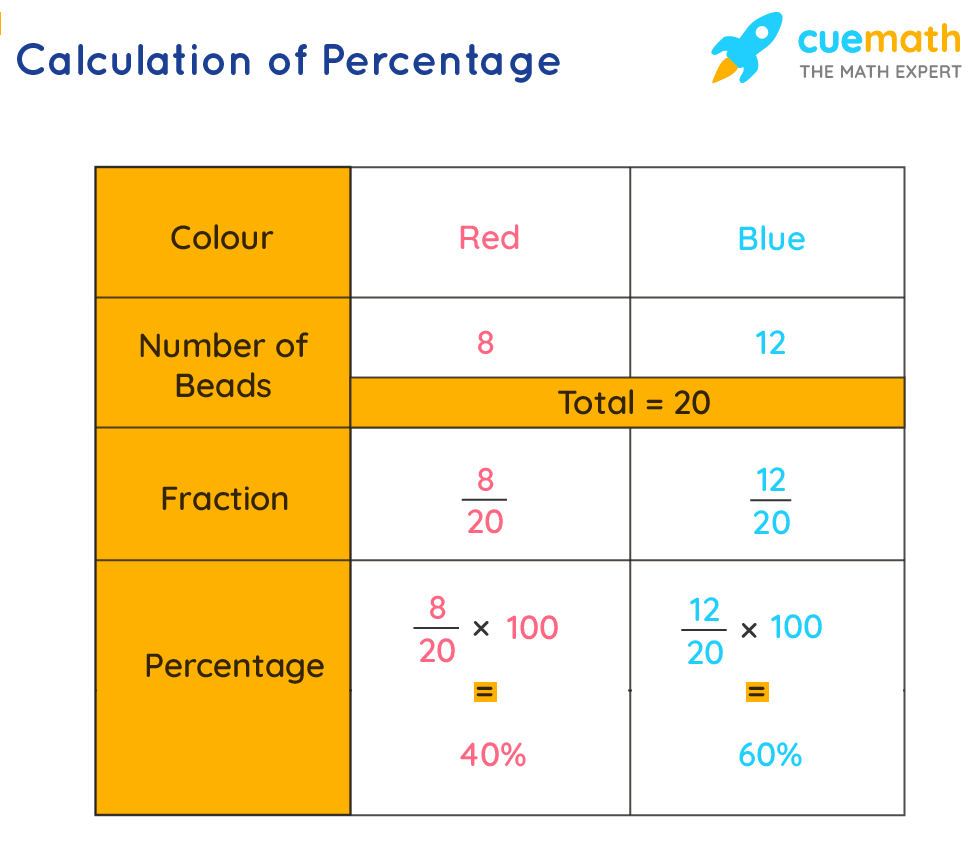
The most common application of percentages involves expressing a part of a whole as a proportion of 100. The formula is simple and highly versatile:
Percentage = (Part / Whole) × 100
- Example: If you spent $300 on groceries from a total monthly budget of $2,000, your grocery spending represents: ($300 / $2,000) × 100 = 15% of your budget.
- Example: A company sold 150 units of a product out of a total production run of 500 units. The percentage of units sold is: (150 / 500) × 100 = 30%.
Conversely, if you know the percentage and the whole, you can find the part:
Part = (Percentage / 100) × Whole
- Example: If you want to leave a 15% tip on a $60 restaurant bill: (15 / 100) × $60 = 0.15 × $60 = $9.
Calculating Percentage Increase or Decrease
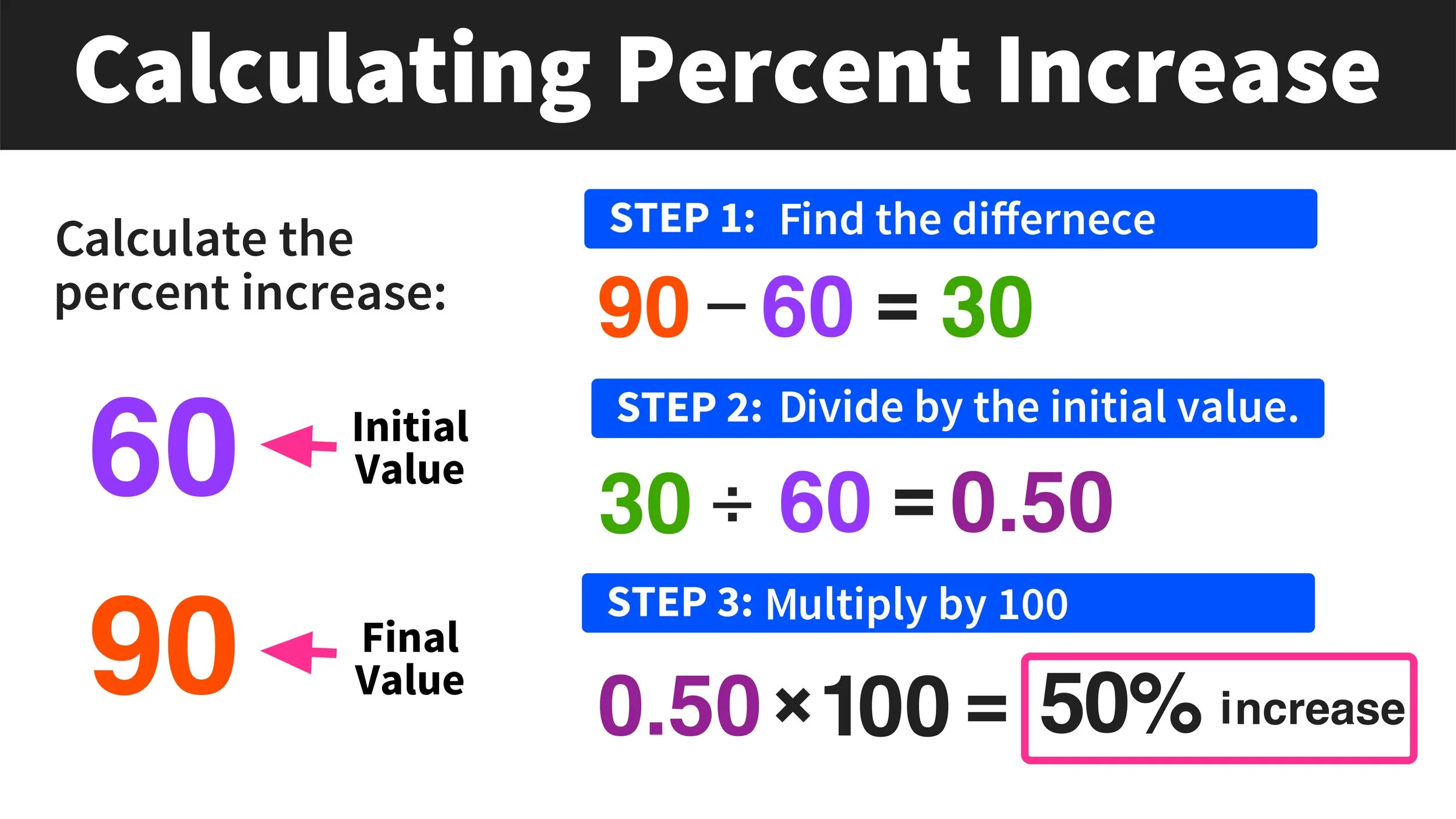
Understanding how to calculate percentage change is crucial for tracking growth, evaluating performance, and comparing data over time. Whether it’s the growth in your investment portfolio, the inflation rate, or a change in your income, this calculation provides vital context.
Percentage Increase = ((New Value – Old Value) / Old Value) × 100
Percentage Decrease = ((Old Value – New Value) / Old Value) × 100
Alternatively, you can use a single formula and interpret the sign:
Percentage Change = ((New Value – Old Value) / Old Value) × 100
-
A positive result indicates an increase.
-
A negative result indicates a decrease.
-
Example (Increase): Your stock investment grew from $5,000 to $6,000. The percentage increase is: (($6,000 – $5,000) / $5,000) × 100 = ($1,000 / $5,000) × 100 = 0.20 × 100 = 20%.
-
Example (Decrease): The value of a cryptocurrency dropped from $1,000 to $750. The percentage decrease is: (($1,000 – $750) / $1,000) × 100 = ($250 / $1,000) × 100 = 0.25 × 100 = 25%.
Finding the Original Value After a Percentage Change
Sometimes, you’re given a final value and the percentage change that led to it, and you need to work backward to find the original value. This is common when dealing with sales (discounted prices) or inflated costs.

-
For a Percentage Increase:
Original Value = New Value / (1 + (Percentage Increase / 100))- Example: A product is now $120 after a 20% price increase. The original price was: $120 / (1 + (20 / 100)) = $120 / (1 + 0.20) = $120 / 1.20 = $100.
-
For a Percentage Decrease (Discount):
Original Value = New Value / (1 – (Percentage Decrease / 100))- Example: You bought an item for $75, which was 25% off the original price. The original price was: $75 / (1 – (25 / 100)) = $75 / (1 – 0.25) = $75 / 0.75 = $100.
Practical Applications: Putting Percentages to Work
Beyond the mechanics of calculation, the true power of percentages lies in their practical application to enhance financial literacy and decision-making.
Budgeting and Saving
Effective budgeting hinges on understanding where your money goes. By categorizing expenses and calculating each category as a percentage of your total income, you gain a clear picture of your spending habits. For instance, if housing takes up 40% of your income and savings only 5%, you might identify an opportunity to reduce housing costs or increase your savings rate to meet financial goals, such as retirement or a down payment. The popular “50/30/20 rule” (50% for needs, 30% for wants, 20% for savings and debt repayment) is a prime example of using percentages to structure a balanced budget.
Evaluating Loans and Interest
Interest rates, expressed as percentages, are the cost of borrowing money. Comparing the APRs of different loans (mortgages, personal loans, credit cards) is crucial. Even a seemingly small difference in percentage points can significantly impact the total amount repaid over the loan’s term. Understanding compound interest – where interest is calculated on the initial principal and also on the accumulated interest from previous periods – is particularly vital for long-term debt like mortgages or for growing savings. A 5% annual interest rate compounded daily will yield a slightly higher effective rate than one compounded annually.
Deciphering Discounts and Sales
Sales events often feature multiple percentage-based discounts. A “20% off plus an additional 10% at checkout” isn’t simply 30% off. You’d first apply the 20% discount, then apply the additional 10% to the already discounted price. For a $100 item:
- $100 – (20% of $100) = $100 – $20 = $80
- $80 – (10% of $80) = $80 – $8 = $72
The actual total discount is $28, or 28%. Knowing how to calculate successive discounts ensures you accurately determine the final price and truly understand the savings.
Analyzing Investment Returns and Risks
When comparing investments, percentage returns allow for an apples-to-apples comparison. A stock that gains 15% is performing better than one that gains 10%, regardless of the initial investment amount. However, it’s also important to consider the risk involved. A high percentage return might come with higher volatility. Furthermore, when diversifying a portfolio, investors allocate percentages of their total capital to different asset classes (e.g., 60% stocks, 30% bonds, 10% cash) to manage risk and optimize potential returns according to their individual financial plans.
Leveraging Tools for Precision and Efficiency
While manual calculation is fundamental, modern financial life benefits immensely from tools that simplify and accelerate percentage calculations, reducing the risk of error.
The Power of Calculators and Spreadsheets
For quick, accurate calculations, a basic calculator is indispensable. Most modern calculators have a dedicated percentage key (%) that can simplify computations like adding or subtracting a percentage. For more complex or recurring financial analysis, spreadsheets like Microsoft Excel or Google Sheets are invaluable. They allow you to set up formulas once and apply them to vast datasets, instantly updating calculations as numbers change. Functions like =PERCENTAGE() or simply = (Part/Whole) formatted as a percentage can automate your financial analysis, from budgeting templates to investment performance trackers.
Financial Apps and Online Tools
The digital age offers a plethora of financial apps and online tools designed to assist with percentage-related calculations. Budgeting apps automatically categorize expenses and display them as percentages of your income. Investment platforms show percentage gains or losses on your portfolio in real-time. Online calculators are readily available for specific tasks, such as mortgage payment calculations (which incorporate interest rate percentages), retirement planning (which factors in percentage-based returns), or compound interest calculations. These tools provide not only accuracy but also convenience, making sophisticated financial analysis accessible to everyone.
Common Pitfalls and How to Avoid Them
Even with a solid understanding of percentage mechanics, certain nuances can lead to misinterpretation or errors. Awareness of these common pitfalls is key to accurate financial analysis.
Misinterpreting Percentage Points vs. Percent Change
A critical distinction in finance is between “percentage points” and “percent change.” If an interest rate increases from 5% to 7%, this is an increase of 2 percentage points. It is not a 2% increase. To calculate the percent change, we use our formula: ((7 – 5) / 5) × 100 = (2 / 5) × 100 = 40%. This is a 40% increase in the interest rate, a much more significant figure than a mere 2%. Confusing these two concepts can lead to serious misjudgments in financial planning and investment decisions.
The Impact of Compounding
Compounding, especially with interest, can dramatically alter outcomes over time. When dealing with investments, compound interest allows your earnings to generate further earnings, leading to exponential growth. With debt, however, it means your interest accrues on previous interest, potentially spiraling out of control if not managed. Understanding whether a percentage rate is simple (applied only to the principal) or compound (applied to principal plus accumulated interest) is crucial for projecting future values accurately and making sound financial choices.
Double-Checking Your Calculations
Despite the simplicity of basic percentage formulas, errors can occur, especially with complex scenarios or when dealing with large numbers. Always double-check your calculations, particularly when significant financial implications are involved. Use different methods or tools (e.g., a calculator and a spreadsheet) to verify results. For critical financial decisions, seeking professional advice can provide an additional layer of scrutiny and expertise.
In conclusion, “how to figure percent” is not just a mathematical inquiry but a gateway to greater financial literacy and empowerment. By understanding the omnipresence of percentages in our financial lives, mastering the core calculation methods, and leveraging available tools, individuals and businesses can confidently navigate the complexities of budgeting, investing, debt management, and growth analysis. This foundational skill translates directly into better financial decisions, enhanced economic well-being, and a clearer pathway to achieving your monetary goals.
aViewFromTheCave is a participant in the Amazon Services LLC Associates Program, an affiliate advertising program designed to provide a means for sites to earn advertising fees by advertising and linking to Amazon.com. Amazon, the Amazon logo, AmazonSupply, and the AmazonSupply logo are trademarks of Amazon.com, Inc. or its affiliates. As an Amazon Associate we earn affiliate commissions from qualifying purchases.