
In the dynamic world of personal finance, where every dollar counts, the ability to quickly and accurately calculate percentage discounts is an indispensable skill. From spotting a genuine bargain during a sales event to understanding the true cost implications of a promotional offer, mastering this fundamental mathematical concept empowers individuals to make more informed purchasing decisions, manage budgets effectively, and ultimately, enhance their financial well-being. This article delves into the core mechanics of figuring out a percentage off a price, providing a clear, step-by-step guide and practical insights to transform you into a more astute consumer and a smarter money manager.

The Foundation of Discounts: Understanding Percentages in Personal Finance
At its heart, a percentage represents a fraction of a whole, specifically one part in every hundred. When we talk about “percentage off a price,” we’re referring to a reduction in the original cost, expressed as a proportion of that original value. This concept is omnipresent in our financial lives, from retail markdowns to interest rate adjustments. Grasping the basic premise of percentages is the first step toward unlocking significant savings and greater financial control.
What is a Percentage? A Quick Refresher
A percentage is denoted by the “%” symbol and signifies “per hundred.” For example, 25% means 25 out of 100, or 25/100. In the context of discounts, if an item is 25% off, it means that for every $100 of its original price, you save $25. This simple representation makes comparing different discount offers straightforward, even when the original prices vary wildly. Understanding this fractional relationship is crucial for converting percentages into usable figures for calculations.
Why Discounts Matter in Personal Finance
The allure of a discount goes beyond immediate savings; it plays a critical role in strategic financial planning. For individuals working with a fixed budget, every percentage point off a necessary purchase translates into more money available for other expenses, savings, or investment opportunities. Discounts enable consumers to acquire goods and services at a lower effective cost, stretching their purchasing power further. Over time, consistently applying smart discount calculation can lead to substantial aggregate savings, contributing significantly to long-term financial goals, such as debt reduction, building an emergency fund, or saving for a major purchase. It’s not just about spending less; it’s about making your money work harder for you.
Common Scenarios for Percentage Off Calculations
The need to calculate a percentage off a price arises in numerous everyday financial situations:
- Retail Shopping: This is perhaps the most obvious application, from holiday sales to clearance events where items are marked down by a certain percentage.
- Coupon Usage: Many coupons offer a percentage discount on a single item or an entire purchase.
- Service Reductions: Subscriptions, memberships, or service contracts often offer introductory discounts or loyalty percentage reductions.
- Bills and Fees: Sometimes, financial institutions or service providers offer a percentage reduction on late fees or specific charges.
- Wholesale or Bulk Purchases: Businesses often receive percentage discounts for large orders, which impacts their cost of goods sold and profit margins.
- Investment Fees: Understanding percentage-based fees (e.g., expense ratios for mutual funds) helps in evaluating the true cost of an investment.
In each of these scenarios, the ability to quickly determine the exact savings empowers individuals and businesses to make financially sound decisions.
Step-by-Step Guide to Calculating Discounts
Calculating a percentage off a price can be approached in a couple of ways, both yielding the same correct result. Familiarizing yourself with both methods ensures you have the flexibility to choose the one that feels most intuitive for any given situation.
Method 1: Calculating the Discount Amount First
This method breaks the calculation into two clear steps: first finding out how much money you save, and then subtracting that from the original price.
Step 1: Convert Percentage to Decimal
To use a percentage in a mathematical calculation, you must first convert it into its decimal equivalent. This is done by dividing the percentage by 100.
- Example: A 20% discount becomes 20 / 100 = 0.20
- Example: A 35% discount becomes 35 / 100 = 0.35
- Example: A 5% discount becomes 5 / 100 = 0.05
Step 2: Multiply by Original Price
Once you have the decimal form of the percentage, multiply it by the original price of the item. This calculation will give you the exact monetary amount of the discount.
- Formula: Discount Amount = Original Price × (Percentage Discount / 100)
- Example: If an item costs $80 and is 20% off: Discount Amount = $80 × 0.20 = $16
Step 3: Subtract Discount from Original Price
The final step is to subtract the calculated discount amount from the original price. This will give you the final price you will pay.
- Formula: Final Price = Original Price – Discount Amount
- Example: Using the previous example, Final Price = $80 – $16 = $64
Method 2: Calculating the Final Price Directly
This method is often quicker, as it allows you to arrive at the final discounted price in a single multiplication step, bypassing the need to calculate the discount amount separately.
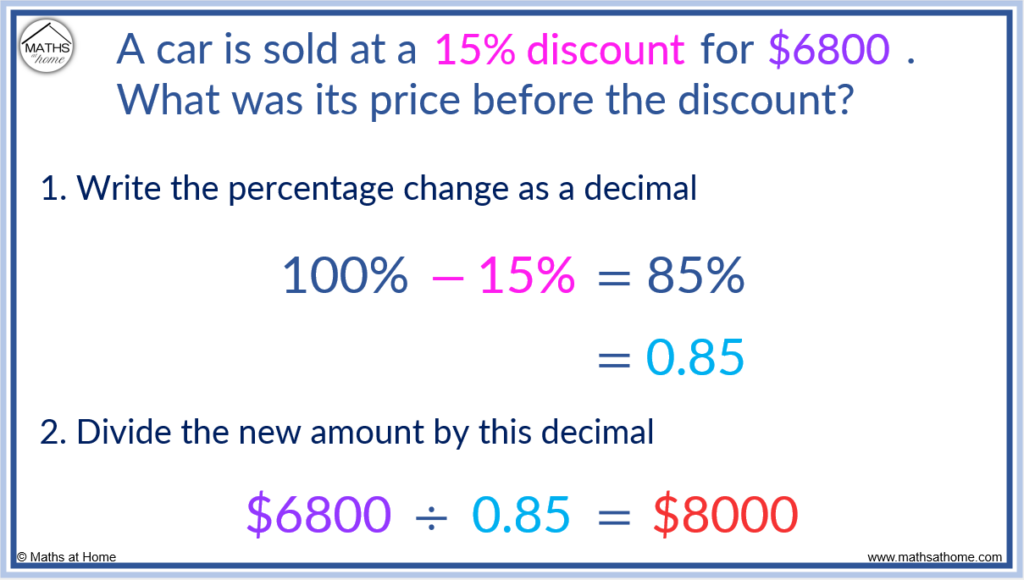
Step 1: Subtract Percentage from 100%
Think of the original price as 100% of its value. If you’re getting a discount, you’re paying a smaller percentage of that original price. Subtract the discount percentage from 100%.
- Example: For a 20% discount, you will pay 100% – 20% = 80% of the original price.
- Example: For a 35% discount, you will pay 100% – 35% = 65% of the original price.
Step 2: Convert Resulting Percentage to Decimal
Just like in Method 1, convert this new percentage (the percentage you will pay) into its decimal form by dividing by 100.
- Example: 80% becomes 80 / 100 = 0.80
- Example: 65% becomes 65 / 100 = 0.65
Step 3: Multiply by Original Price
Finally, multiply this decimal by the original price. The result is the final price after the discount.
- Formula: Final Price = Original Price × ((100 – Percentage Discount) / 100)
- Example: If an item costs $80 and is 20% off: Final Price = $80 × 0.80 = $64
Illustrative Examples for Clarity
Let’s apply these methods to a common scenario:
Scenario: You want to buy a new jacket originally priced at $150, and it’s on sale for 30% off.
Using Method 1 (Calculate Discount Amount First):
- Convert 30% to decimal: 30 / 100 = 0.30
- Calculate discount amount: $150 × 0.30 = $45
- Subtract discount from original price: $150 – $45 = $105
- You will pay $105 for the jacket.
Using Method 2 (Calculate Final Price Directly):
- Subtract discount percentage from 100%: 100% – 30% = 70%
- Convert 70% to decimal: 70 / 100 = 0.70
- Multiply by original price: $150 × 0.70 = $105
- You will pay $105 for the jacket.
Both methods confirm that the final price is $105, demonstrating their reliability and the power of understanding both approaches for mental flexibility in financial calculations.

Practical Applications and Real-World Scenarios
The ability to calculate percentage discounts extends far beyond simply shopping; it’s a core component of financial literacy that impacts budgeting, savings, and investment decisions. Integrating this skill into your daily routine can yield substantial financial benefits.
Shopping Smart: Sales, Coupons, and Promotions
Navigating the retail landscape requires a keen eye for value. Whether it’s a “Buy One, Get One 50% Off” deal, a “25% off all electronics” promotion, or a coupon for “15% off your entire purchase,” accurately calculating the percentage off allows you to:
- Compare Deals: Determine which store or promotion offers the best actual discount when faced with different percentage markdowns or different original prices.
- Avoid Overspending: Understand the true savings and avoid the psychological trap of feeling compelled to buy something just because it’s “on sale” if the discount isn’t significant or the item isn’t truly needed.
- Stack Discounts: Some retailers allow combining percentage-off coupons with existing sale prices. Knowing how to calculate these layered discounts is key to maximizing savings, though it’s important to understand if discounts are applied to the original or already discounted price.
Beyond Retail: Understanding Financial Rate Reductions
The concept of percentage off isn’t exclusive to physical goods. In the realm of personal finance, it applies to:
- Interest Rate Reductions: If a loan’s interest rate is reduced by a certain percentage point (e.g., from 5% to 4%), or if a promotional offer reduces your effective rate by a percentage (e.g., 10% off your interest payment this month), understanding the impact on your payments is vital.
- Service Fee Waivers/Reductions: Financial service providers might offer percentage reductions on monthly account fees or transaction charges, which directly impacts your overall cost of banking.
- Insurance Premiums: Discounts for bundling policies or for good driving records are often expressed as a percentage off your premium. Calculating these helps you compare different insurance providers more effectively.
Budgeting with Discounts in Mind
Integrating discount calculations into your budgeting process can significantly enhance its effectiveness. By accurately predicting the final cost of items, you can allocate funds more precisely and identify opportunities to save.
- Pre-emptive Savings: When planning for future purchases, factor in anticipated sales or discounts to set more realistic savings goals.
- Category Management: If you have specific budget categories (e.g., clothing, entertainment), using discounts to stay within or even under budget for these categories frees up funds for other priorities or emergency savings.
- Maximizing Value: Discounts allow you to purchase higher-quality goods or services that might otherwise be out of budget, improving the overall value derived from your spending.
Tools and Techniques for Quick Calculations
While understanding the manual steps is crucial, in today’s fast-paced world, leveraging available tools and mental shortcuts can make calculating percentage discounts even more efficient.
Leveraging Your Smartphone Calculator
Your smartphone’s built-in calculator is an incredibly powerful financial tool. Most modern calculators allow you to directly input percentages. For example, to find 20% off $80, you might type: 80 - 20% (some calculators automatically convert this to 80 – (80 * 0.20)). Others might require 80 * 0.80 for the direct approach. Practice with your specific calculator to find the most efficient sequence. For more complex calculations involving multiple discounts, the calculator becomes indispensable.
Online Discount Calculators and Apps
The internet abounds with free online discount calculators and dedicated mobile apps designed specifically for this purpose. These tools are particularly useful for:
- Multiple Item Purchases: Some apps allow you to input several items with different discounts and then calculate the total final price.
- “Stacking” Discounts: Certain calculators can handle scenarios where one discount is applied after another (e.g., “30% off, then an additional 10% off the discounted price”).
- Visual Confirmation: They provide instant results, which can be helpful for quick verification, especially when dealing with large purchases or complex promotions.
While these digital financial tools streamline the process, a foundational understanding of the math prevents over-reliance and allows for quick estimations even without technology.
Mental Math Shortcuts for Common Percentages
Developing mental math shortcuts can save time and foster greater confidence in your financial decisions, even without a calculator.
- 10% Rule: To find 10% of any number, simply move the decimal point one place to the left. For example, 10% of $150 is $15. This is a great starting point.
- Easy Multiples:
- 20% off: Calculate 10% (move decimal), then double it. (e.g., 20% of $150 = 10% of $150 * 2 = $15 * 2 = $30).
- 5% off: Calculate 10% (move decimal), then halve it. (e.g., 5% of $150 = 10% of $150 / 2 = $15 / 2 = $7.50).
- 25% off: This is simply dividing by 4 (or halving twice). (e.g., 25% of $160 = $160 / 4 = $40).
- 50% off: This is simply halving the original price.
- Combining for Other Percentages: For 35% off, you could calculate 30% (three times 10%) and add 5% (half of 10%).
Practicing these mental shortcuts strengthens your number sense and empowers you to quickly estimate savings on the fly, a valuable asset for any savvy spender.
Avoiding Common Pitfalls and Maximizing Savings
While discounts offer clear financial benefits, understanding the nuances of how they are presented and applied is crucial to ensure you’re truly getting a good deal. Not all discounts are created equal, and some tactics can mislead consumers.
Watch Out for “Up To” Discounts
Phrases like “Up to 50% off!” can be deceptive. This often means that some items might be 50% off, but the majority could be discounted by a much smaller percentage, or not at all. Always verify the actual discount on the specific item you’re interested in, rather than being swayed by the highest advertised figure. A general “up to X% off” promotion should prompt careful individual item price checking.
The Importance of Unit Price Comparison
When comparing discounted items, especially groceries or household goods, always look beyond the percentage off and consider the unit price. A larger package with a smaller percentage discount might still be a better deal per ounce or per item than a smaller package with a higher percentage off. This practice ensures you’re maximizing value for your money rather than simply chasing the biggest percentage reduction.
When a Discount Isn’t a Good Deal (Needs vs. Wants)
Perhaps the most critical financial pitfall related to discounts is succumbing to impulse purchases for items you don’t truly need, simply because they are on sale. A 50% discount on an item you weren’t going to buy anyway still means you’re spending 50% of its price unnecessarily. Before making any purchase, especially a discretionary one, ask yourself:
- Do I truly need this item?
- Would I buy this item at its original price?
- Does this purchase align with my financial goals and budget?
If the answer to these questions is no, even the steepest discount doesn’t make it a “good deal” for your personal finances. Smart spending prioritizes needs and planned purchases, leveraging discounts to save on those items, rather than being driven by the discounts themselves.
Conclusion
Mastering the art of figuring out percentage off a price is more than just a mathematical exercise; it’s a vital component of personal financial literacy. By understanding the underlying principles, practicing the calculation methods, and applying this knowledge strategically in real-world scenarios, you empower yourself to make smarter spending decisions, manage your budget more effectively, and accumulate savings. Whether you’re comparing sale items, assessing financial service fees, or simply budgeting for household expenses, the ability to confidently calculate discounts ensures that you are always in control of your money, transforming every shopping trip and financial transaction into an opportunity for intelligent saving. Embrace this essential skill, and watch your financial acumen grow, paving the way for a more secure and prosperous financial future.
aViewFromTheCave is a participant in the Amazon Services LLC Associates Program, an affiliate advertising program designed to provide a means for sites to earn advertising fees by advertising and linking to Amazon.com. Amazon, the Amazon logo, AmazonSupply, and the AmazonSupply logo are trademarks of Amazon.com, Inc. or its affiliates. As an Amazon Associate we earn affiliate commissions from qualifying purchases.