
In the realm of finance, percentages are more than just mathematical symbols; they are the fundamental language of value, growth, and risk. Whether you are tracking the performance of a stock portfolio, calculating the interest on a high-yield savings account, or determining the gross profit margin of a small business, understanding how to figure out a percentage is an essential skill for financial literacy.
Percentages allow us to standardize information, making it possible to compare a small local business to a multinational corporation or to weigh the benefits of a 2% cash-back credit card against a 5% interest rate on a personal loan. This guide provides a deep dive into the mechanics of percentage calculations specifically through the lens of money management, ensuring you can navigate your financial life with precision and confidence.
The Mathematical Foundation: Calculating Percentages in a Financial Context
At its core, a percentage represents a “part of a hundred.” In finance, this translates to how much of your total capital is being moved, earned, or lost. Before diving into complex investment strategies, one must master the basic formulas that underpin every financial statement.
The Standard Percentage Formula
To find the percentage of a specific amount—such as calculating a 15% down payment on a $400,000 home—the formula is straightforward:
(Total Amount × Percentage) / 100 = Part.
In a professional financial context, it is often more efficient to work with decimals. To convert a percentage to a decimal, simply move the decimal point two places to the left (15% becomes 0.15). Multiplying $400,000 by 0.15 gives you $60,000. This basic calculation is the cornerstone of determining sales tax, tip amounts, and initial investment outlays.
Calculating Percentage Increase and Decrease
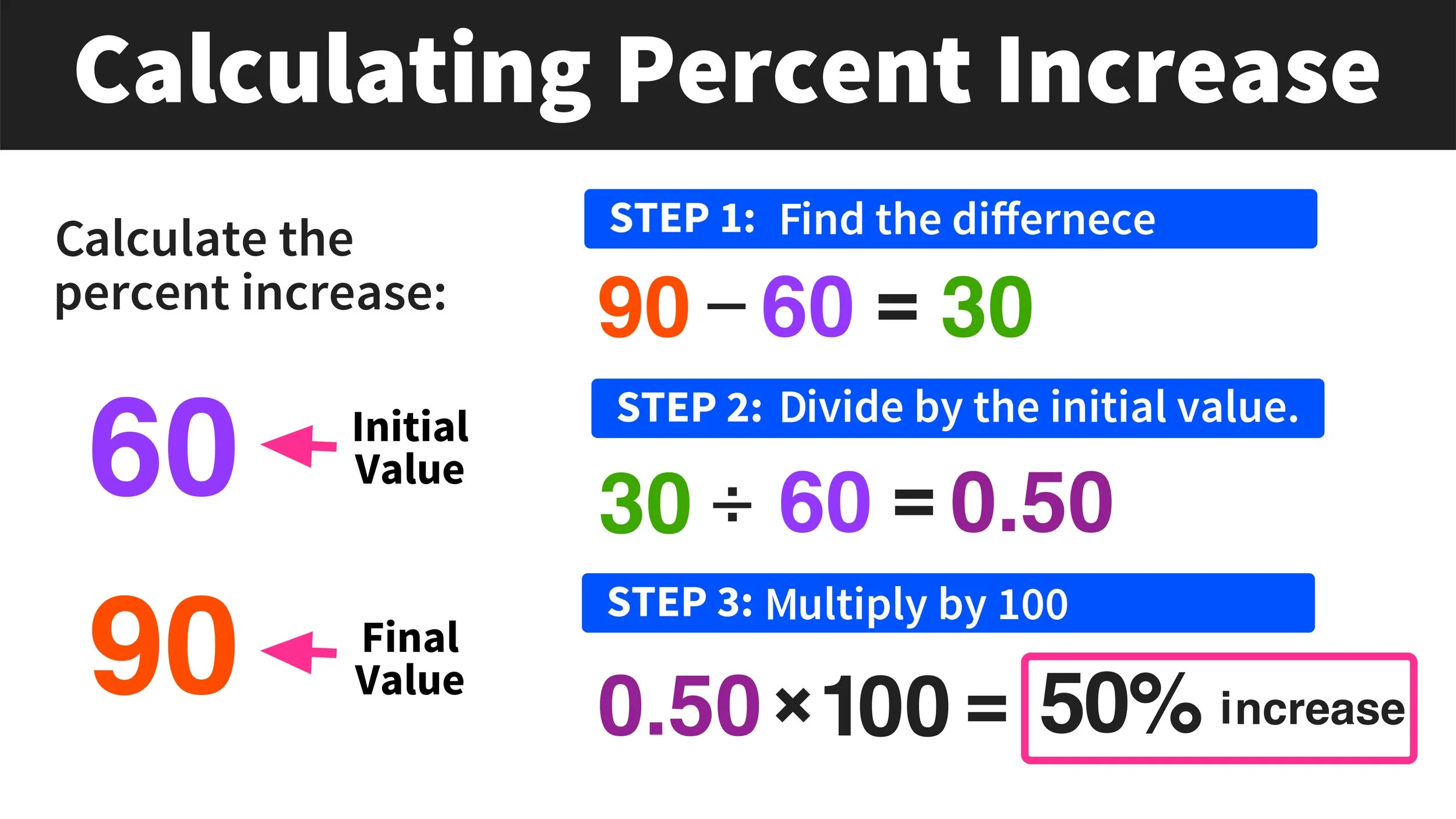
In the world of money, values are rarely static. Understanding the percentage change is vital for tracking inflation, salary raises, or stock market volatility. The formula for percentage change is:
[(New Value – Old Value) / Old Value] × 100.
For example, if your monthly grocery bill rose from $500 to $575, the calculation would be ($75 / $500) × 100, resulting in a 15% increase. Conversely, if a stock price drops from $100 to $80, it represents a 20% decrease. Mastering this allows you to see past raw numbers to the actual rate of growth or decay in your purchasing power.
Reverse Percentage: Finding the Original Value
Sometimes, you are presented with the “after” figure and need to find the “before.” For instance, if you bought a laptop for $1,080 including an 8% sales tax, how do you find the base price? You divide the total by (1 + the tax rate in decimal form). In this case, $1,080 / 1.08 equals $1,000. This is a critical skill for business owners who need to back-calculate net prices from gross receipts.
Navigating Personal Finance: From Budgeting to Debt Management
Percentages are the primary tool used to organize personal wealth. They provide a framework for stability that raw dollar amounts cannot, because percentages scale as your income grows.
The 50/30/20 Rule of Budgeting
One of the most popular financial frameworks is the 50/30/20 rule. This strategy suggests allocating your after-tax income into three percentage-based categories:
- 50% for Needs: Housing, utilities, groceries, and insurance.
- 30% for Wants: Dining out, hobbies, and travel.
- 20% for Financial Goals: Debt repayment, emergency funds, and retirement contributions.
By viewing your budget through percentages rather than fixed dollar amounts, you maintain a balanced lifestyle regardless of whether you earn $40,000 or $400,000 a year. If your “Needs” exceed 50%, the percentage calculation alerts you that you are “house poor” or over-leveraged, prompting a strategic adjustment.
Understanding Interest Rates: APR and APY
When borrowing or saving money, percentages represent the “cost” or “reward” of capital. However, not all percentage rates are created equal.
- Annual Percentage Rate (APR): This represents the annual cost of a loan, including interest and fees. If you have a credit card with an 18% APR, understanding that percentage helps you calculate the daily periodic rate (0.18 / 365), showing you exactly how much interest you accrue every 24 hours.
- Annual Percentage Yield (APY): This is used for savings accounts and accounts for compound interest. Because APY reflects the effect of interest earning interest, it is always slightly higher than the nominal rate. Figuring out this percentage is the key to choosing the right vehicle for your emergency fund.

Debt-to-Income Ratio (DTI)
Lenders use percentages to determine your creditworthiness. Your DTI is calculated by dividing your total monthly debt payments by your gross monthly income. For example, if you pay $1,500 in rent and $500 in car loans on a $6,000 monthly salary, your DTI is 33.3%. Most mortgage lenders look for a DTI below 36% to 43%. Knowing how to calculate this percentage allows you to “see” your finances through the eyes of a bank before you apply for a loan.
Investment Strategies: Quantifying Growth and Portfolio Risk
For the savvy investor, percentages are the yardstick of success. They allow for the comparison of disparate assets, such as real estate, cryptocurrencies, and index funds.
Calculating Return on Investment (ROI)
ROI is the most common metric for evaluating the efficiency of an investment. The formula is:
(Net Profit / Cost of Investment) × 100.
If you invest $10,000 in a mutual fund and sell it a year later for $11,200, your net profit is $1,200. Dividing $1,200 by $10,000 gives you an ROI of 12%. This percentage is vital because it allows you to compare that 12% return against the 7% average inflation rate or a 4% yield on a government bond, helping you determine if the risk was worth the reward.
Asset Allocation and Diversification
Portfolio management is entirely a game of percentages. A “Moderate” portfolio might be defined as 60% equities and 40% fixed income. As the market fluctuates, these percentages shift. If stocks perform exceptionally well, your portfolio might drift to 70% equities. Figuring out these percentages tells you when to “rebalance”—selling high-performing assets to return to your target percentage. This disciplined approach prevents emotional decision-making and enforces the “buy low, sell high” mantra.
The Power of Compound Interest
The most profound use of percentages in money is compound interest. The formula A = P(1 + r/n)^nt might look daunting, but it essentially describes a percentage being applied to a balance that is constantly growing. If you earn a 7% annual return, your money doesn’t just grow by a fixed amount; it grows by 7% of an ever-larger “whole.” Understanding how this percentage works over a 30-year horizon is often the difference between a modest retirement and a wealthy one.
Professional and Business Finance: Profit Margins and Strategic Pricing
For entrepreneurs and business professionals, calculating percentages is a daily necessity. Miscalculating a margin by even 1% or 2% can mean the difference between a thriving enterprise and bankruptcy.
Gross Profit Margin vs. Markup
These two terms are often confused, but they represent different ways of looking at a percentage.
- Markup: This is the percentage added to the cost of a product to arrive at a selling price. If a product costs $100 and you sell it for $150, the markup is 50%.
- Gross Profit Margin: This is the percentage of the selling price that is profit. Using the same $150 sale, your profit is $50. ($50 / $150) = 33.3% margin.
Business owners must understand that a 50% markup does not equal a 50% margin. Figuring out these percentages correctly ensures that the business remains profitable after accounting for overhead expenses like rent and payroll.
Break-Even Analysis
A break-even analysis uses percentages to determine when a business will become profitable. By calculating fixed costs against the “contribution margin” (the percentage of each sale that covers fixed costs), a manager can determine exactly how much revenue is needed to stop losing money. For instance, if a restaurant has a 70% variable cost (food and labor), its contribution margin is 30%. If monthly rent is $3,000, they must generate $10,000 in sales ($3,000 / 0.30) to break even.
Tax Obligations and Withholdings
In business finance, percentages dictate your relationship with the government. Whether it is calculating the 7.65% FICA tax for employees or estimating a 25% corporate tax bracket, accuracy is non-negotiable. Knowing how to figure out these percentages allows for better cash flow management, ensuring that the “tax man” is paid without disrupting the company’s daily operations.
Conclusion: The Strategic Value of Financial Numeracy
Mastering the art of figuring out a percentage is not merely a mathematical exercise; it is a fundamental requirement for anyone serious about building and maintaining wealth. From the simplicity of a retail discount to the complexity of compound annual growth rates, percentages provide the clarity needed to make informed financial decisions.
By applying these formulas to your personal budget, your investment portfolio, and your business operations, you move from a position of guesswork to one of strategic mastery. In the world of money, those who understand percentages are the ones who control the narrative of their financial future. Whether you are aiming for debt freedom, early retirement, or business expansion, let the percentage be the compass that guides your capital toward its highest and best use.
aViewFromTheCave is a participant in the Amazon Services LLC Associates Program, an affiliate advertising program designed to provide a means for sites to earn advertising fees by advertising and linking to Amazon.com. Amazon, the Amazon logo, AmazonSupply, and the AmazonSupply logo are trademarks of Amazon.com, Inc. or its affiliates. As an Amazon Associate we earn affiliate commissions from qualifying purchases.