
In a world brimming with sales, promotions, and special offers, the phrase “20% off” is a ubiquitous beacon for shoppers and consumers alike. Whether you’re browsing for a new gadget, updating your wardrobe, or stocking up on groceries, understanding how to quickly and accurately calculate a 20 percent discount is an indispensable skill. It’s not just about saving money; it’s about smart financial literacy, empowering you to make informed purchasing decisions, compare deals effectively, and ultimately stretch your hard-earned cash further. This article delves into the various straightforward methods for figuring out 20 percent off, equipping you with the confidence to navigate any sale with financial savvy and precision.

The Fundamental Methods: Core Calculations Explained
At its heart, calculating 20 percent off involves basic arithmetic, but several approaches offer different levels of speed and mental agility. Understanding these core methods provides a robust foundation for all your discount deciphering.
Method 1: The Subtraction Approach (Calculate Discount, then Subtract)
This is perhaps the most intuitive method for many, breaking the calculation into two logical steps. First, you determine the exact monetary value of the 20 percent discount, and then you subtract that amount from the original price.
To execute this, you convert the percentage into a decimal (20% becomes 0.20) and multiply it by the original price. The result is the dollar amount of the discount. Subtract this from the original price, and you have your final cost.
Example:
Imagine a jacket priced at $150.
-
Calculate 20% of $150:
$150 * 0.20 = $30.00
-
Subtract the discount from the original price:
$150 – $30.00 = $120.00
So, the jacket costs $120 after a 20% discount. This method is clear and methodical, reducing the chances of error, especially with more complex numbers. It’s particularly useful when you want to know not just the final price, but also how much you are actually saving.
Method 2: The Direct Multiplication Approach (Calculate Remaining Percentage)
For those who prefer a more streamlined calculation, the direct multiplication approach is highly efficient. Instead of focusing on the discount, this method centers on the percentage of the original price you will be paying. If an item is 20% off, it means you are paying 80% of its original price (100% – 20% = 80%).
To apply this, convert the remaining percentage (80%) into a decimal (0.80) and multiply it directly by the original price. This single step yields the final discounted price.
Example:
Using the same jacket priced at $150.
-
Determine the percentage you pay:
100% – 20% = 80%
-
Convert 80% to a decimal and multiply by the original price:
$150 * 0.80 = $120.00
This method is often quicker, especially for mental calculations or when using a calculator, as it bypasses the intermediate step of calculating the discount amount separately. It’s ideal when your primary concern is the final price tag.
Method 3: Breaking Down 20%: The “Rule of Ten” Trick
This mental math shortcut is incredibly useful for on-the-spot calculations, especially when a calculator isn’t immediately available. The trick relies on the fact that 20% is simply double 10%.
To use this method, first find 10% of the original price by simply moving the decimal point one place to the left. Then, double that amount to find 20%. Finally, subtract this doubled amount from the original price.
Example:
Consider a pair of shoes priced at $75.
-
Find 10% of $75:
Move the decimal one place left: $7.50
-
Double 10% to get 20%:
$7.50 * 2 = $15.00
-
Subtract 20% from the original price:
$75 – $15.00 = $60.00
The shoes cost $60 after the 20% discount. This “Rule of Ten” method is fantastic for quick estimations and for impressing your friends with your numerical prowess while shopping. It’s particularly effective with prices that end in zero or are easily divisible by ten.
Practical Applications and Real-World Scenarios
Understanding how to calculate 20% off extends far beyond the realm of theoretical math problems. It’s a vital tool for everyday financial management and strategic consumer behavior.
Shopping Smart: From Apparel to Electronics
In retail environments, 20% off is a very common promotional figure. Knowing how to calculate it instantly empowers you to:
-
Compare deals: Quickly ascertain which store or offer provides the better value, especially when discounts are applied to different original prices.
-
Budget on the fly: Determine if a discounted item truly fits within your spending limits without needing to wait in line or pull out a complex app.
-
Avoid overspending: Distinguish between a genuinely good deal and a perceived bargain that might still be outside your financial comfort zone. For instance, a $500 laptop at 20% off (now $400) might be a great deal, but if your budget was $350, it’s still an overspend.
This knowledge also helps in understanding the real value of loyalty programs or credit card rewards that sometimes offer percentage-based discounts.
Budgeting and Financial Planning
Integrating discount calculations into your personal finance strategy can lead to significant long-term savings.
-
Forecasting expenses: If you know certain regular purchases often go on sale for 20% off, you can factor those potential savings into your monthly or annual budget.
-
Optimizing savings: When planning larger purchases, like furniture or appliances, anticipating potential 20% off sales can inform the timing of your purchase, allowing you to save hundreds of dollars.
-
Impact of small savings: Regularly saving 20% on various items throughout the year can accumulate into substantial amounts, which can then be allocated to investments, debt repayment, or a dedicated savings goal. This reinforces the principle that every dollar saved is a dollar earned.
Beyond 20%: Scaling the Knowledge
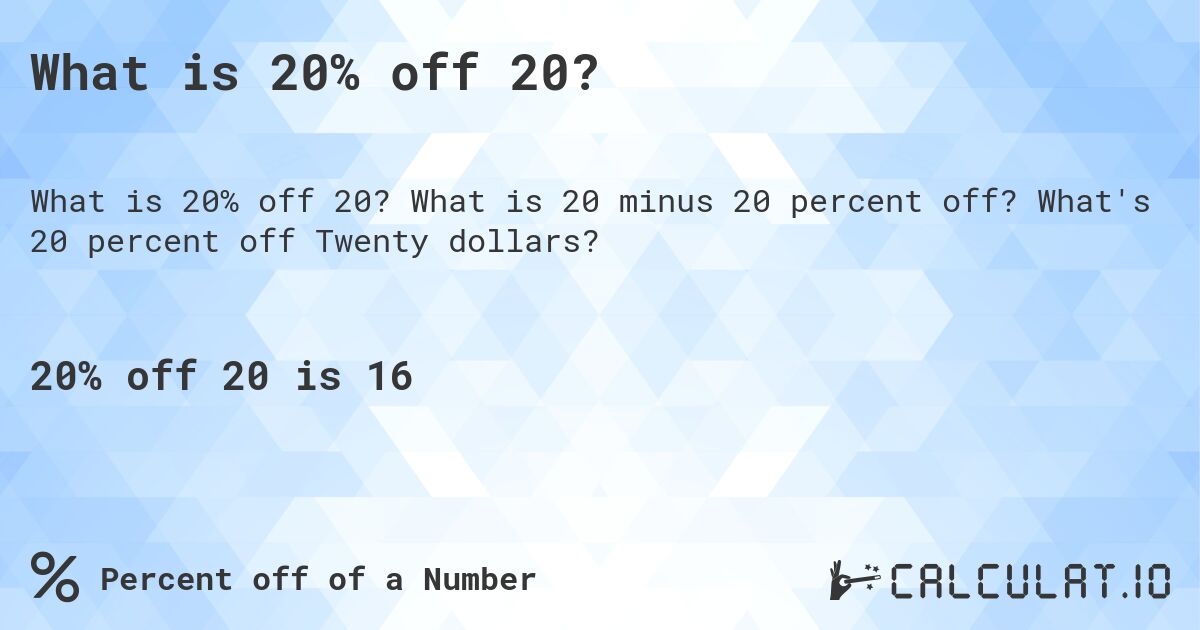
The beauty of mastering 20% off calculations is that the underlying principles are highly adaptable to any percentage discount.
-
For 10%, 50%, or 25%: These are often simpler. 50% is half the price. 25% is half of 50%, or a quarter of the price. 10% is simply moving the decimal.
-
For odd percentages (e.g., 15%, 35%): You can use the direct multiplication method (e.g., multiply by 0.85 for 15% off, or 0.65 for 35% off). Alternatively, you can combine mental math tricks: for 15% off, find 10% and then add half of that (which is 5%), then subtract the total.
The goal isn’t just to memorize how to do 20% off, but to understand the percentage-to-decimal conversion and the logical steps, enabling you to confidently tackle any discount offered.
Tools and Technologies to Aid Your Calculations
While mental math skills are invaluable, modern technology offers powerful and convenient tools to ensure accuracy and speed, especially for complex transactions or when time is of the essence.
The Ubiquitous Smartphone Calculator
Your smartphone’s built-in calculator is arguably the most accessible and frequently used tool for discount calculations.
-
Direct input: Simply type in the original price, multiply by the decimal equivalent of the remaining percentage (e.g.,
150 * 0.80), or use the two-step subtraction method (150 - (150 * 0.20)). -
Efficiency: It’s always in your pocket, eliminating the need for pen and paper, and reduces the likelihood of mental arithmetic errors, particularly with larger or less round numbers.
-
Accessibility: Most modern smartphones also offer a percentage button (%) that can simplify the process even further, depending on the calculator app’s specific functionality.
Dedicated Discount Calculator Apps and Websites
For serious shoppers or those dealing with multiple discounts, taxes, and tips, specialized apps and websites provide a more robust solution.
-
Multi-discount handling: Some items might have a “20% off sale price” followed by an “additional 10% off at checkout.” These apps can correctly apply sequential discounts.
-
Tax and tip inclusion: Many apps allow you to input sales tax rates and even tip percentages, giving you the true final cost of an item or service.
-
Comparison features: Some tools let you compare different discount scenarios side-by-side, helping you decide which deal offers the best value. Websites like online percentage calculators serve a similar purpose for quick calculations without needing to download an app.
Spreadsheets for Large-Scale Analysis
For budgeting, inventory management, or tracking significant purchases over time, spreadsheet programs like Microsoft Excel or Google Sheets are incredibly powerful.
-
Automated calculations: Set up simple formulas in columns to automatically calculate discounted prices, savings amounts, and even average discounts across multiple items.
-
Financial tracking: Integrate discount calculations into a personal budget spreadsheet, allowing you to project spending and savings more accurately.
-
Scenario planning: Experiment with different discount percentages on a list of desired items to see the potential savings and impact on your overall budget.
By leveraging these tools, you can move beyond manual calculations and manage your discounted purchases with greater precision and efficiency.
Common Mistakes and How to Avoid Them
Even with straightforward calculations, common pitfalls can lead to misinterpretations and unexpected costs. Being aware of these can save you money and frustration.
Misinterpreting “Up To” Discounts
A classic marketing tactic is the “up to 20% off” sign. This crucial phrase means that some items in the sale might be 20% off, but many others will be discounted by a smaller percentage, or perhaps not at all.
-
Always verify: Do not assume every item qualifies for the maximum discount. Check price tags or ask sales associates for the specific discount on the item you’re interested in.
-
Read the fine print: Sales terms often specify which items or categories are included or excluded from the highest discount tier.
Forgetting Sales Tax or Other Fees
The advertised discount almost universally applies to the item’s base price before sales tax is added.
-
Final price calculation: After calculating the 20% off, remember to add your local sales tax to the discounted price for the true out-of-pocket cost.
-
Hidden fees: Be mindful of other potential charges such as shipping costs for online orders, processing fees, or environmental levies, which are typically applied after any discounts.
Double-Checking Complex Discounts
Some promotions involve multiple layers of discounts, which can be tricky to calculate correctly. Examples include “take an additional 20% off sale items” or “buy one, get one 20% off.”
-
Order of operations: Always apply discounts sequentially. For “additional 20% off sale items,” first apply the initial sale discount to get the sale price, and then apply the additional 20% off to that new, lower price. Do not add the percentages together (e.g., 30% off + 20% off is not 50% off).
-
Item-specific application: In “buy one, get one 20% off” scenarios, the 20% discount usually applies to the cheaper of the two items, not necessarily the most expensive one. Understand the store’s policy.
The Financial Psychology of Discounts
Understanding the mechanics of calculating discounts is one thing, but being aware of the psychological impact of sales and promotions is equally important for maintaining sound financial health.
The Power of Perceived Value
Discounts play a significant role in consumer psychology, often creating a sense of urgency or an irresistible opportunity.
-
The “deal” effect: A discounted price can make an item appear more valuable or desirable than its full price, even if the absolute price is still high.
-
Fear of missing out (FOMO): Limited-time sales and significant percentage drops can trigger impulse purchases, driven by the fear of missing a good deal.
-
Mindful consumption: Being aware of these psychological triggers allows you to pause and evaluate whether the purchase is truly necessary or if you’re just being swayed by the discount.
Smart Saving vs. Overspending
A discount is only a true saving if you were planning to buy the item anyway, or if it genuinely fulfills a need within your budget.
-
“Saving money by spending money”: This common fallacy leads consumers to buy things they don’t need simply because they’re on sale. If you spend $80 on a shirt that was originally $100 (20% off), you saved $20, but you spent $80 you might not have intended to.
-
Budget adherence: The most financially savvy approach is to set a budget, identify actual needs, and then seek out discounts on those specific items. A 20% discount on an item you weren’t going to buy is an expense, not a saving.
-
Long-term perspective: Prioritize your long-term financial goals over immediate gratification from a sale. Sometimes, the best saving is not buying anything at all.

Conclusion
Mastering how to figure out 20 percent off is more than just a mathematical exercise; it’s a cornerstone of personal financial literacy. By understanding the straightforward methods—whether it’s the two-step subtraction, the direct multiplication of the remaining percentage, or the quick “Rule of Ten” mental trick—you gain immediate control over your purchasing power. These skills empower you to shop smarter, budget more effectively, and confidently navigate the landscape of consumer promotions.
Leveraging technological tools, being vigilant about common discount pitfalls, and understanding the psychological influences of sales further enhance your ability to make financially sound decisions. In a marketplace constantly vying for your attention with enticing offers, the ability to quickly and accurately calculate a 20 percent discount transforms you from a passive consumer into an empowered, strategic saver. Embrace these calculations, and watch your financial acumen—and your savings—grow.
aViewFromTheCave is a participant in the Amazon Services LLC Associates Program, an affiliate advertising program designed to provide a means for sites to earn advertising fees by advertising and linking to Amazon.com. Amazon, the Amazon logo, AmazonSupply, and the AmazonSupply logo are trademarks of Amazon.com, Inc. or its affiliates. As an Amazon Associate we earn affiliate commissions from qualifying purchases.