
Compound interest, often hailed as the “eighth wonder of the world” by Albert Einstein, is a fundamental concept in finance that empowers individuals to grow their wealth exponentially over time. It’s a principle so powerful that understanding and harnessing it can be the single most impactful factor in achieving your long-term financial goals. Unlike simple interest, which is calculated only on the principal amount, compound interest is calculated on the initial principal and also on all the accumulated interest from previous periods. This seemingly small distinction creates a snowball effect, where your money starts working harder for you, generating returns on its own returns.
Many people are familiar with the term but don’t fully grasp its mechanics or its profound implications for savings, investments, and even debt. This article will demystify compound interest, breaking down its calculation, illustrating its real-world impact, and providing actionable strategies to leverage it for your financial benefit. Whether you’re planning for retirement, saving for a down payment, or simply aiming to build a more secure financial future, understanding how to figure compound interest is not just an advantage—it’s a necessity.
The Unrivaled Power of Compounding: More Than Just Interest
At its core, compound interest is about earning “interest on interest.” It’s a concept that transforms linear growth into exponential growth, making time an invaluable asset in your financial journey. To truly appreciate its power, one must first understand what it is and how it differs from its simpler counterpart.
What is Compound Interest? A Fundamental Definition
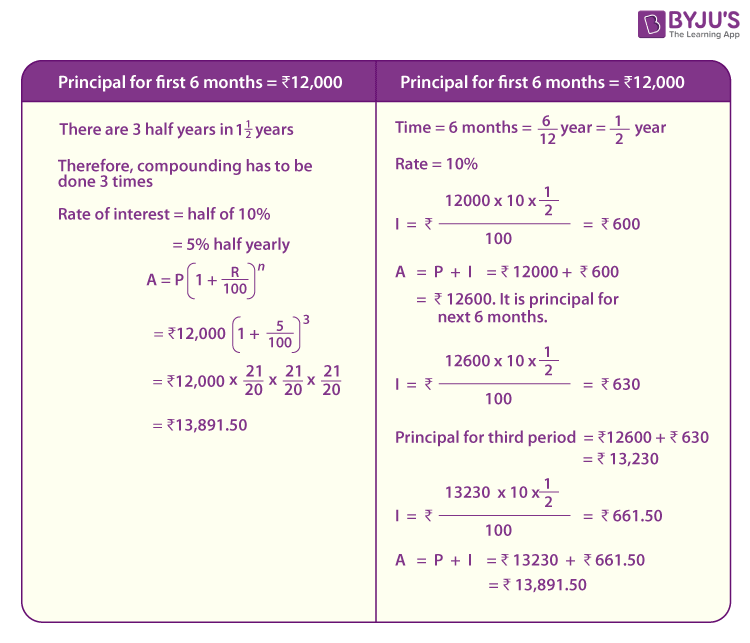
Compound interest is the interest earned on an initial principal amount, as well as on any accumulated interest from prior periods. Imagine you invest $1,000 at a 10% annual interest rate. With simple interest, you would earn $100 each year, and after two years, you’d have $1,200. With compound interest, after the first year, you earn $100, bringing your total to $1,100. In the second year, you earn 10% on the new principal of $1,100, which is $110. Your total after two years would be $1,210. That extra $10 might seem small, but over decades and with larger sums, these differences escalate dramatically.
The magic lies in this reinvestment of earnings. Each time interest is compounded, it becomes part of the principal for the next compounding period. This continuous cycle means your money grows not just arithmetically, but geometrically. It’s like a snowball rolling down a hill; it picks up more snow, getting bigger and faster with every turn.
The Core Principle: Earning Interest on Interest
This core principle is what separates compound interest from simple interest. Simple interest is straightforward: Principal × Rate × Time. It’s fixed. Compound interest, however, is dynamic. The interest earned itself starts earning interest. This iterative process accelerates wealth accumulation, which is why it’s so crucial for long-term financial planning.
Think about a savings account. If it compounds monthly, every month the interest earned from the previous month is added to your balance, and the next month’s interest is calculated on this slightly larger balance. Over years, this frequent compounding can lead to significantly higher returns than annual compounding, even with the same nominal interest rate.
Why Time is Your Greatest Ally
The single most important variable in the compound interest equation, beyond the interest rate itself, is time. The longer your money has to compound, the more significant the returns. This is often referred to as the “power of starting early.” Even small, consistent contributions made over a long period can outperform larger, later contributions due to the extended compounding runway.
Consider two individuals: Person A invests $5,000 per year for 10 years (total $50,000) and then stops, letting the money grow for another 30 years. Person B starts 10 years later, investing $5,000 per year for 30 years (total $150,000). Assuming an 8% annual return, Person A, despite investing less overall, will likely have a much larger nest egg due to the initial 10 years of compounding that Person B missed. This illustrates that early action, even with modest amounts, provides an unparalleled advantage through the magic of compounding.
Demystifying the Formula: How to Calculate Compound Interest
While online calculators can do the heavy lifting, understanding the underlying formula for compound interest is empowering. It allows you to grasp the mechanics and manipulate variables to better plan your financial future.
The Compound Interest Formula Explained
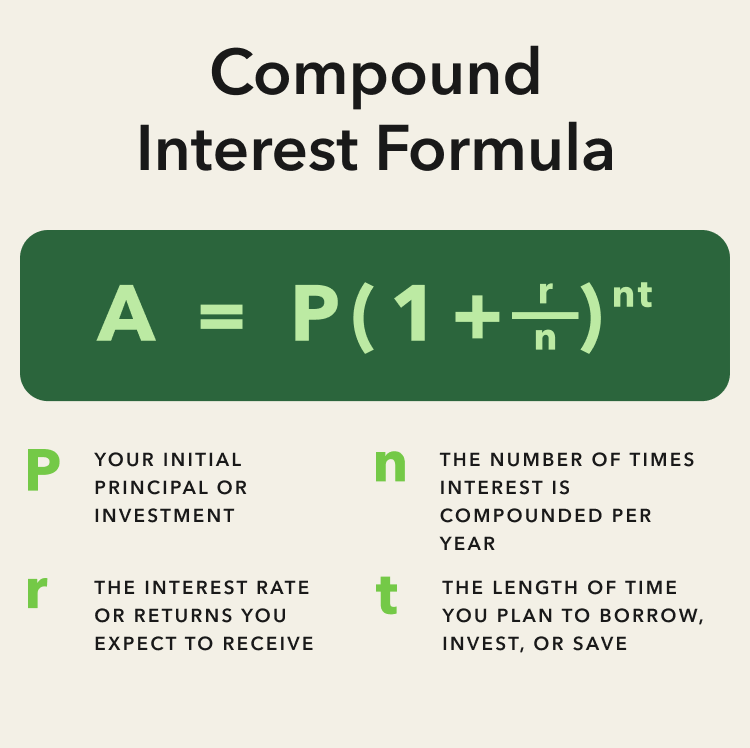
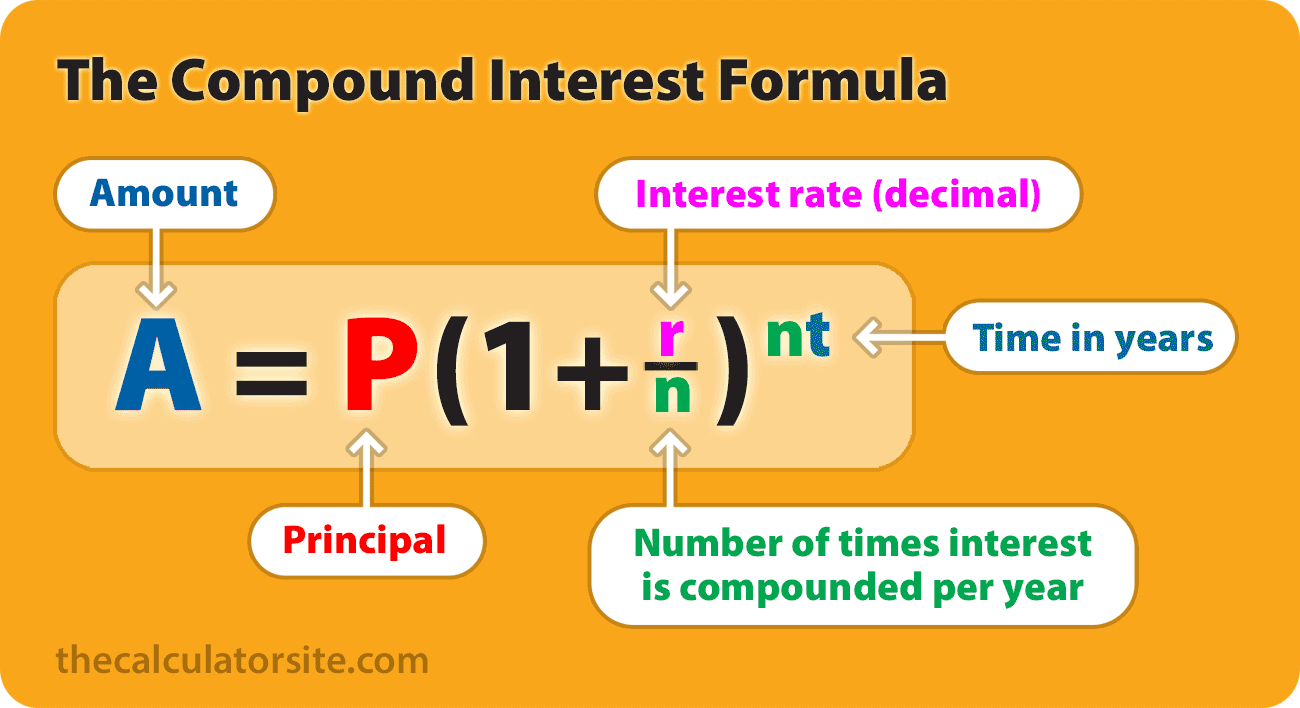
The standard formula for calculating compound interest is:
A = P (1 + r/n)^(nt)
Where:
- A = The future value of the investment/loan, including interest
- P = The principal investment amount (the initial deposit or loan amount)
- r = The annual interest rate (as a decimal)
- n = The number of times that interest is compounded per year
- t = The number of years the money is invested or borrowed for
This formula looks intimidating at first glance, but breaking it down makes it much clearer. It calculates the final amount you’ll have after your principal has compounded over a certain period, at a given rate and frequency.
Deconstructing Each Variable
Let’s look at each component individually:
- P (Principal): This is your starting point. The initial amount of money you invest or borrow. The higher the principal, the greater the base for compounding.
- r (Annual Interest Rate): This is the percentage return you expect to earn or pay each year. It must be expressed as a decimal in the formula (e.g., 5% becomes 0.05).
- n (Number of Compounding Periods Per Year): This is crucial. It determines how often your interest is calculated and added back to your principal. Common compounding frequencies include:
- Annually (n=1)
- Semi-annually (n=2)
- Quarterly (n=4)
- Monthly (n=12)
- Weekly (n=52)
- Daily (n=365)
The higher the ‘n’, the more frequently your money compounds, and generally, the higher your final balance will be, assuming all other factors are equal.
- t (Time in Years): This is the duration over which your investment or loan will compound. As discussed, longer timeframes dramatically amplify the effects of compounding.
Step-by-Step Calculation Examples
Let’s illustrate with a practical example:
Scenario: You invest $10,000 at an annual interest rate of 5%, compounded monthly, for 10 years.
-
Identify your variables:
- P = $10,000
- r = 5% = 0.05
- n = 12 (compounded monthly)
- t = 10 years
-
Plug into the formula:
- A = 10,000 (1 + 0.05/12)^(12*10)
- A = 10,000 (1 + 0.00416667)^(120)
- A = 10,000 (1.00416667)^(120)
-
Calculate the exponent first:
- (1.00416667)^120 ≈ 1.647009
-
Multiply by the principal:
- A = 10,000 * 1.647009
- A ≈ $16,470.09
So, after 10 years, your $10,000 investment would grow to approximately $16,470.09. The interest earned would be $6,470.09. If this were simple interest (10,000 * 0.05 * 10 = $5,000), you would have only $15,000. This example vividly shows the power of compounding.
Real-World Applications and Investment Scenarios
Compound interest isn’t just a theoretical concept; it’s the engine behind most long-term wealth creation strategies. Understanding its application across various financial products can help you make informed decisions.
Savings Accounts and Certificates of Deposit (CDs)
These are some of the simplest examples of compound interest in action. When you deposit money into a savings account, the bank pays you interest. This interest is then added to your principal, and the next interest calculation includes that newly added amount. CDs typically offer slightly higher interest rates than standard savings accounts in exchange for locking up your money for a fixed term, and they also benefit from compounding. While their returns might seem modest compared to other investments, they provide a foundational understanding of compounding.
Retirement Accounts (401(k)s, IRAs)
This is where compound interest truly shines for the average individual. Retirement accounts like 401(k)s and IRAs are specifically designed for long-term growth, making them ideal vehicles for compounding. Contributions made to these accounts are invested in various assets (stocks, bonds, mutual funds), which generate returns. These returns, especially if reinvested, compound over decades, often leading to millions of dollars by retirement age, even from relatively small annual contributions. The tax advantages of these accounts further amplify the power of compounding by allowing your money to grow tax-deferred or tax-free.
Stock Market Investments and ETFs
Investing in the stock market offers the potential for higher returns, which significantly boosts the effect of compounding. When you invest in individual stocks, mutual funds, or Exchange Traded Funds (ETFs), your investment grows through capital appreciation (the value of the asset increasing) and often through dividends. If these dividends are reinvested, they buy more shares, which then earn more dividends and potentially more capital appreciation. This dividend reinvestment plan (DRIP) is a classic example of compounding at work, supercharging your investment growth. The longer you stay invested in a diversified portfolio, the greater the likelihood of harnessing significant compound returns.
The Pitfalls: Compound Interest and Debt (Credit Cards, Loans)
While compound interest is a boon for investors, it can be a significant burden when applied to debt. High-interest credit card debt, for instance, compounds frequently (often daily or monthly), leading to balances that can quickly spiral out of control if only minimum payments are made. Personal loans, mortgages, and student loans also accrue compound interest, meaning you’re paying interest on the principal and on the previously accrued interest. Understanding this negative side of compounding is vital; it underscores the importance of paying off high-interest debt aggressively to prevent it from eroding your financial well-being.
Strategies to Maximize Your Compound Returns
To truly leverage the power of compound interest, a proactive approach is necessary. Here are key strategies to maximize your returns.
Start Early, Invest Consistently
This cannot be stressed enough. Time is the most potent factor in the compound interest formula. The earlier you begin investing, even with small amounts, the more time your money has to grow exponentially. Consistent contributions, whether monthly or annually, ensure that you are continuously adding to your principal, giving compounding more fuel to work with. Automating your investments is an excellent way to ensure consistency and avoid procrastination.
Understand the Impact of Interest Rate and Compounding Frequency
While time is paramount, the interest rate (r) and compounding frequency (n) also play critical roles. Naturally, a higher interest rate will lead to greater returns. However, also pay attention to how often interest is compounded. More frequent compounding (e.g., daily vs. annually) will result in slightly higher returns because your interest starts earning interest sooner. When comparing savings accounts or investment products, always look for the Annual Percentage Yield (APY), which already accounts for the compounding frequency, giving you a truer picture of the annual return.
Reinvesting Dividends and Earnings
For investments that generate income, such as stocks that pay dividends or bonds that pay interest, always consider reinvesting those earnings. Instead of taking the cash payout, use it to purchase more shares or increase your principal. This immediately boosts your principal for the next compounding period, accelerating your wealth accumulation without requiring new out-of-pocket contributions. Many brokerage accounts offer automatic dividend reinvestment plans.
Minimizing Fees and Taxes
Fees, no matter how small, can chip away at your returns and significantly impede the compounding process over time. High expense ratios in mutual funds, trading fees, or advisory fees can cumulatively subtract a substantial amount from your potential gains. Similarly, taxes on investment gains or interest income can reduce the amount available for reinvestment. Utilizing tax-advantaged accounts like 401(k)s and IRAs, which allow investments to grow tax-deferred or tax-free, is an excellent strategy to keep more money working for you and maximize the effect of compounding.
Tools and Resources for Easier Calculation and Planning
While understanding the formula is important, modern financial tools can make the process of figuring out compound interest much simpler and allow for sophisticated planning.
Online Compound Interest Calculators
The internet is replete with free compound interest calculators. These tools allow you to input your principal, interest rate, compounding frequency, and time horizon, instantly providing you with the future value of your investment. Many calculators also let you input additional monthly or annual contributions, offering a more realistic projection for ongoing savings and investment plans. They are excellent for quick “what-if” scenarios and for visualizing the long-term impact of your decisions.
Spreadsheet Software (Excel, Google Sheets)
For those who prefer a hands-on approach or need more customized calculations, spreadsheet software like Microsoft Excel or Google Sheets is invaluable. You can easily set up your own compound interest formulas, create tables to track growth year-over-year, and even build scenarios to compare different investment strategies. This allows for a deeper dive into the numbers and a more personalized financial model.
Financial Planning Software and Advisors
For comprehensive financial planning, dedicated software (e.g., Personal Capital, Quicken) or the guidance of a qualified financial advisor can be highly beneficial. These resources can integrate various aspects of your financial life, including income, expenses, investments, and retirement goals, to create a holistic plan that fully accounts for compound interest across all your assets. A financial advisor can provide personalized strategies, help you navigate complex investment choices, and ensure you are maximizing compounding opportunities while minimizing risks.
Understanding how to figure compound interest is more than just a mathematical exercise; it’s a foundational pillar of financial literacy. It highlights the immense potential of patient, disciplined investing and exposes the corrosive power of high-interest debt. By grasping its mechanics and applying strategic principles—starting early, investing consistently, optimizing rates and frequencies, and minimizing drag from fees and taxes—you can effectively harness this powerful force to build substantial wealth over your lifetime. Embrace compound interest, and watch your financial future grow.
aViewFromTheCave is a participant in the Amazon Services LLC Associates Program, an affiliate advertising program designed to provide a means for sites to earn advertising fees by advertising and linking to Amazon.com. Amazon, the Amazon logo, AmazonSupply, and the AmazonSupply logo are trademarks of Amazon.com, Inc. or its affiliates. As an Amazon Associate we earn affiliate commissions from qualifying purchases.