
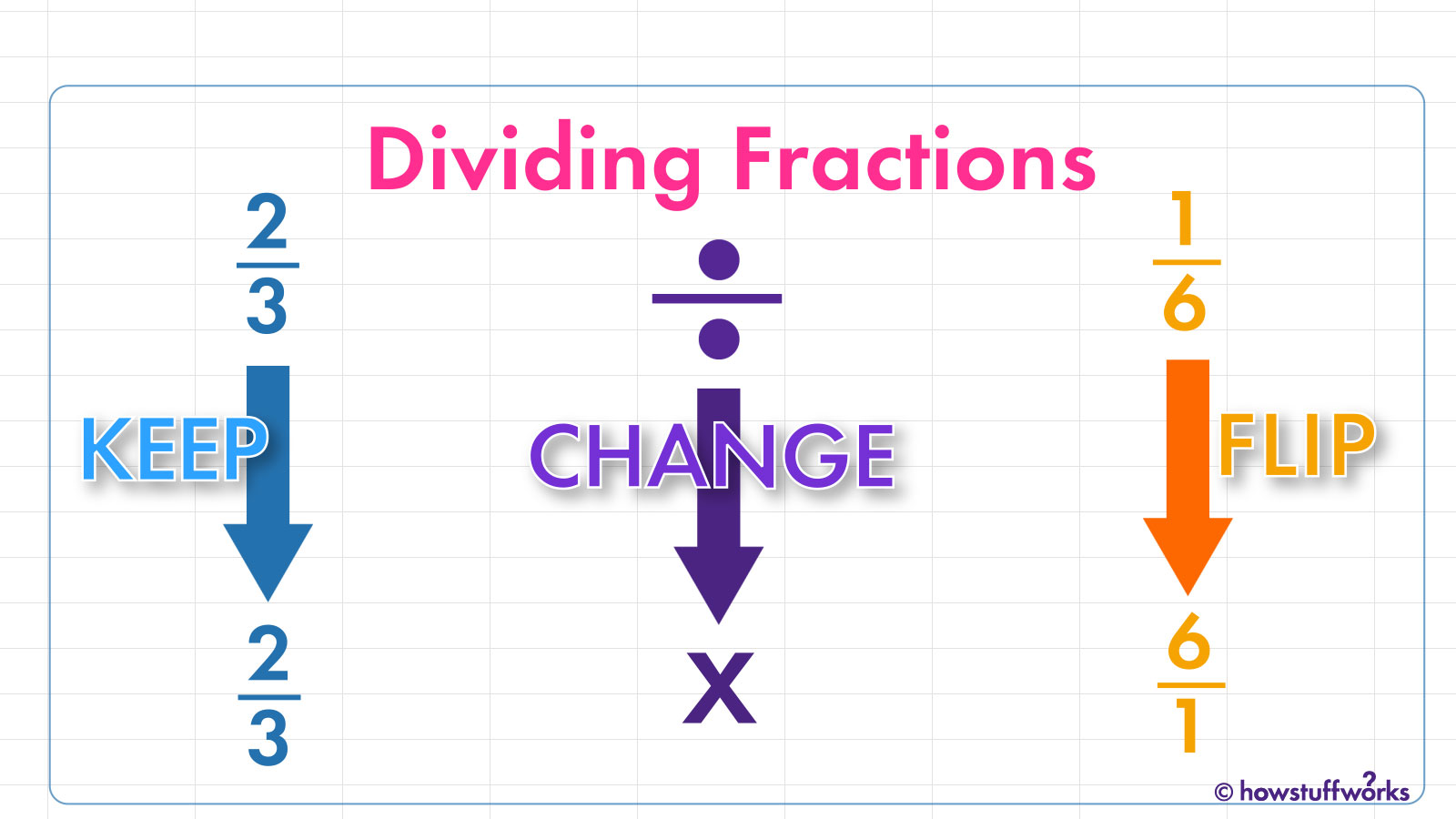
In the realm of mathematics, dividing a fraction is often taught through the simple mnemonic “Keep, Change, Flip.” However, when this concept is translated into the world of technology—specifically within software development, data engineering, and algorithmic design—the process becomes significantly more complex. Ensuring precision, managing memory allocation, and avoiding the pitfalls of floating-point arithmetic are essential skills for any technologist. This guide explores the technical implementation of fractional division across various stacks, ensuring that your applications maintain high-fidelity results.
The Algorithmic Logic of Fractional Division
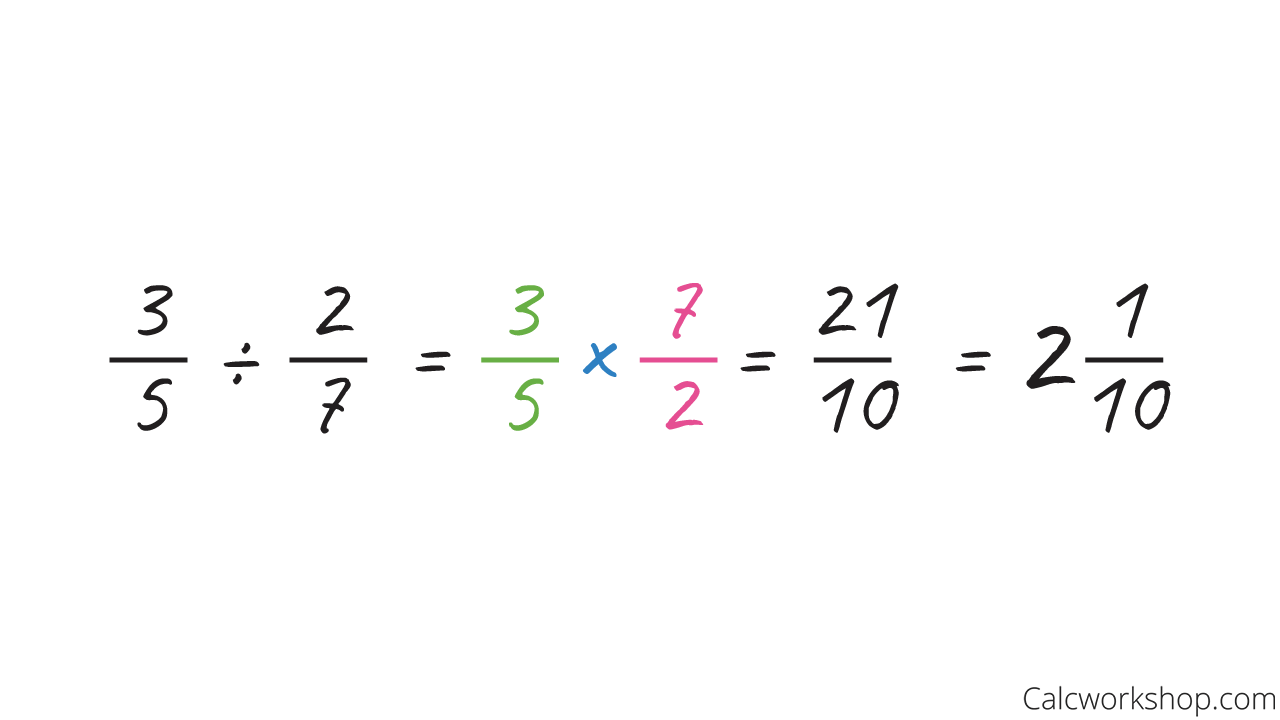
At its core, dividing one fraction by another is an operation of multiplication by a reciprocal. If we represent a fraction as $a/b$ and the divisor as $c/d$, the operation $(a/b) div (c/d)$ is equivalent to $(a/b) times (d/c)$. From a technical standpoint, this is the most efficient way to process the operation, but it requires careful handling of data types.
Understanding Floating-Point Arithmetic vs. Exact Rational Types
In computer science, numbers are typically represented as integers or floating-point numbers. The challenge with dividing fractions using standard floats (like float64 in Go or double in C++) is that many fractions cannot be represented exactly in binary. For instance, the fraction 1/3 results in a repeating decimal that a computer must eventually truncate, leading to “rounding errors.”
To solve this, advanced software systems use “Rational” data types or “BigInt” structures to store the numerator and denominator separately as integers. This ensures that the division remains an exact representation until the final output is required. By keeping the fraction in its symbolic form ($a/b$), developers avoid the precision loss that plagues financial and scientific software.
Implementing the Reciprocal Method in Code
When building an algorithm for fractional division, the logic must include a step to simplify the resulting fraction. After multiplying the first numerator by the second denominator, the resulting fraction ($ad/bc$) often needs to be reduced to its lowest terms. This is achieved using the Greatest Common Divisor (GCD) algorithm, typically implemented via the Euclidean algorithm. This ensures that your software doesn’t just provide the correct numerical answer, but the most optimized version of that data.
Handling Fractions in Popular Programming Languages
Different programming environments offer various tools to handle fractional division. Choosing the right tool depends on whether your priority is execution speed or mathematical precision.
Python’s fractions Module: Precision Without Decimals
Python is widely used in data science and AI because of its robust standard library. The fractions module is the gold standard for dividing fractions without losing a single bit of information.
from fractions import Fraction

# Dividing 3/4 by 1/2
result = Fraction(3, 4) / Fraction(1, 2)
print(result)  # Output: 3/2
In this tech implementation, Python handles the “Keep, Change, Flip” logic internally. It also automatically applies the GCD to simplify the result. This is particularly useful in FinTech applications where dividing shares of an asset must be exact to prevent “dust” (tiny fractions of currency left over from rounding).
JavaScript and the Pitfalls of IEEE 754
JavaScript does not have a native rational type. It treats all numbers as 64-bit floats. This can be disastrous when dividing fractions in a web-based accounting tool or a precision-based game engine. For example, (1/10) / (1/5) might not yield exactly 0.5 in every environment due to the way binary approximations work.
To handle fractional division in a JavaScript environment, developers often turn to libraries like Fraction.js or Big.js. These libraries treat fractions as objects with two properties—the numerator and the denominator—allowing the software to perform the reciprocal multiplication manually before converting the final result back to a decimal for display.

C++ and Custom Rational Classes
In high-performance computing, such as graphics rendering or high-frequency trading systems, developers often write custom classes to handle fractional division. By overloading the / operator, a developer can define exactly how the system should handle the division of two fraction objects. This allows for manual memory management and ensures that the CPU can process these operations at maximum speed without the overhead of a heavy interpreted library.
Fractions in Data Analysis and Spreadsheet Automation
Beyond traditional coding, the need to divide fractions frequently arises in data engineering and automated reporting systems. Whether you are managing a SQL database or a complex Excel-based financial model, the “tech” of the fraction remains vital.
Advanced Division Formulas in Excel and Google Sheets
While most users simply use the / operator in spreadsheets, professional data analysts often use the PRODUCT and RECIPROCAL logic to maintain clarity in complex models. When dealing with fractions in Excel, formatting is key. If you enter 3/4 into a cell, Excel may interpret it as a date.
The technical workaround is to use the custom number format # ?/?. When performing division across thousands of rows in a CSV or an XLSX file, using the MROUND function or the QUOTIENT function allows engineers to control the granularity of the division, ensuring that the “remainder” is handled according to business logic (e.g., rounding up for inventory but rounding down for tax liability).
SQL Query Optimization for Ratio Calculations
In database management, dividing fractions is often part of calculating ratios (e.g., conversion rates or churn). A common technical pitfall in SQL is “integer division.” If you divide two integers, such as 3 / 4, many SQL engines (like PostgreSQL or SQL Server) will return 0 because they discard the remainder.
To correctly divide fractions in a database context, developers must “cast” the integers as floats or decimals:
SELECT CAST(numerator AS float) / CAST(denominator AS float) as ratio
FROM analytics_table;
Furthermore, when dividing one ratio by another (a fraction of a fraction), the query must be structured with subqueries or Common Table Expressions (CTEs) to ensure the order of operations follows the mathematical reciprocal logic.
AI and Machine Learning: Why Fractional Precision Matters
In the current landscape of Artificial Intelligence, fractional division is a constant, albeit hidden, operation. Neural networks rely on weight adjustments and normalization, which are essentially high-speed fractional calculations.
Normalization and Feature Scaling Logic
When preparing data for a Machine Learning model, engineers use “Min-Max Scaling.” This involves dividing a value by the range of the dataset. This fractional division scales all data points to a value between 0 and 1. If the division isn’t handled with high precision, the model may suffer from “gradient vanishing,” where the numbers become so small that the AI stops learning.
The technical solution is “Batch Normalization,” where fractions are divided across a mean to stabilize the learning process. This requires hardware-level optimization, often utilizing the FP16 (Half-precision) or BF16 (Bfloat16) formats on modern GPUs (Graphics Processing Units) to balance the need for fractional accuracy with the need for speed.
Training Models with Fractional Weight Adjustments
During the backpropagation phase of training an AI, the “learning rate” acts as a fractional multiplier. If you divide your gradient by a factor that is too large, the model will never reach accuracy. Conversely, if the division results in too small a fraction, the model becomes computationally expensive.
Modern AI frameworks like PyTorch and TensorFlow have built-in “schedulers” that handle this fractional division automatically. They use adaptive algorithms (like Adam or SGD) that essentially “divide” the updates based on historical momentum. Understanding the underlying math of how to divide these fractions allows AI engineers to tune models for better performance and lower energy consumption.
Conclusion: The Precision of Tech-Driven Mathematics
While the primary school method of “flipping and multiplying” suffices for paper-and-pencil math, the digital age demands a much more rigorous approach. Whether you are avoiding rounding errors in a Python script, managing integer division in a SQL database, or scaling weights in a massive neural network, the “how” of dividing a fraction is a cornerstone of technical excellence. By leveraging the right data types, libraries, and hardware optimizations, developers can ensure that their fractional logic is not just accurate, but robust enough to power the next generation of software tools.
aViewFromTheCave is a participant in the Amazon Services LLC Associates Program, an affiliate advertising program designed to provide a means for sites to earn advertising fees by advertising and linking to Amazon.com. Amazon, the Amazon logo, AmazonSupply, and the AmazonSupply logo are trademarks of Amazon.com, Inc. or its affiliates. As an Amazon Associate we earn affiliate commissions from qualifying purchases.