
In the ecosystem of modern computing, numerical precision is the bedrock upon which reliable software is built. While most users interact with decimals daily—checking a bank balance or viewing a discount on an e-commerce site—the underlying architecture of high-performance computing often requires a more precise representation of numbers. Converting a decimal to a fraction is not merely a middle-school math exercise; it is a fundamental process in data science, financial technology, and software engineering. Understanding how to execute this conversion programmatically and conceptually ensures that digital systems remain accurate, efficient, and user-friendly.
The Digital Architecture of Decimals and Fractions
To understand why we convert decimals to fractions in a tech-driven world, we must first look at how computers handle numbers. Most modern software uses floating-point arithmetic. While convenient, floating-point numbers often suffer from precision errors because binary systems cannot perfectly represent certain base-10 decimals. For example, the decimal 0.1 becomes a repeating sequence in binary, leading to minute rounding errors that can compound in large-scale simulations or financial ledgers.
Floating-Point vs. Symbolic Representation
In software development, decimals are typically stored as “floats” or “doubles.” These are approximations. In contrast, representing a number as a fraction—storing the numerator and denominator as distinct integers—is a form of symbolic representation. This method preserves absolute precision. When building calculators, CAD software, or cryptographic algorithms, the ability to switch from a lossy decimal to an exact fraction is essential for maintaining integrity across complex calculations.
The Need for Ratios in Data Science
Data scientists often work with probabilities and ratios. While 0.333 is a common decimal representation, using the fraction 1/3 provides a higher level of mathematical “truth.” In machine learning, particularly in algorithms involving Bayesian probability, maintaining the fractional form until the final output can prevent the “drift” that occurs when successive decimal approximations are multiplied or divided.
Algorithmic Approaches to Decimal-to-Fraction Conversion
For a developer, the process of converting a decimal to a fraction involves more than just “putting it over 10.” It requires an algorithmic approach that can handle terminating decimals, repeating decimals, and irrational approximations.
The Terminating Decimal Algorithm
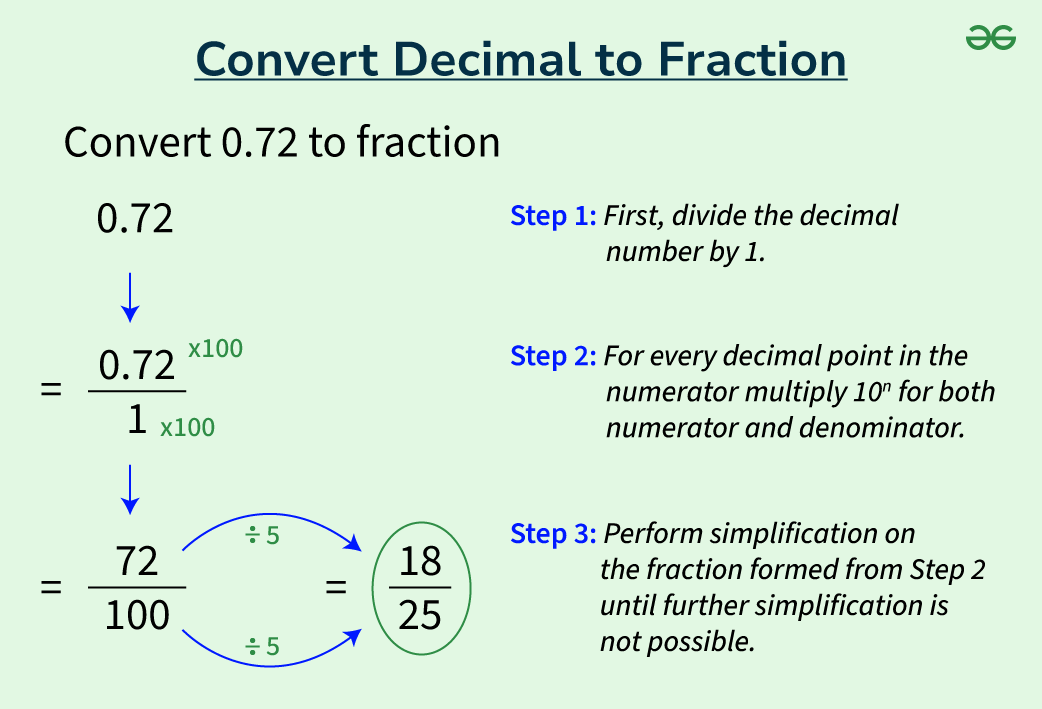
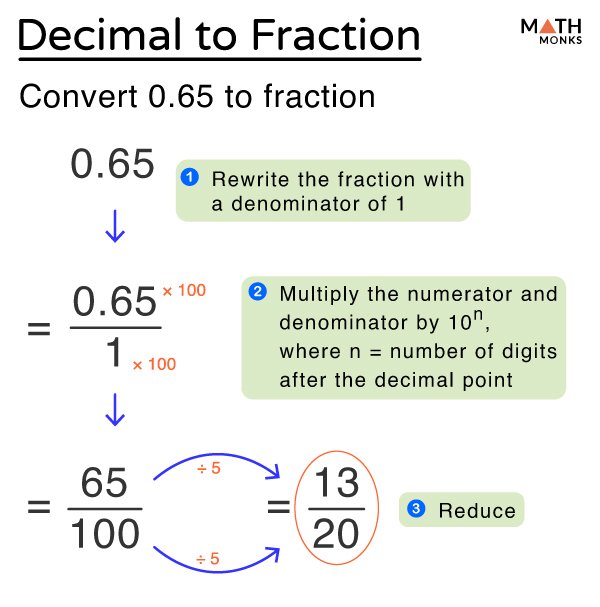
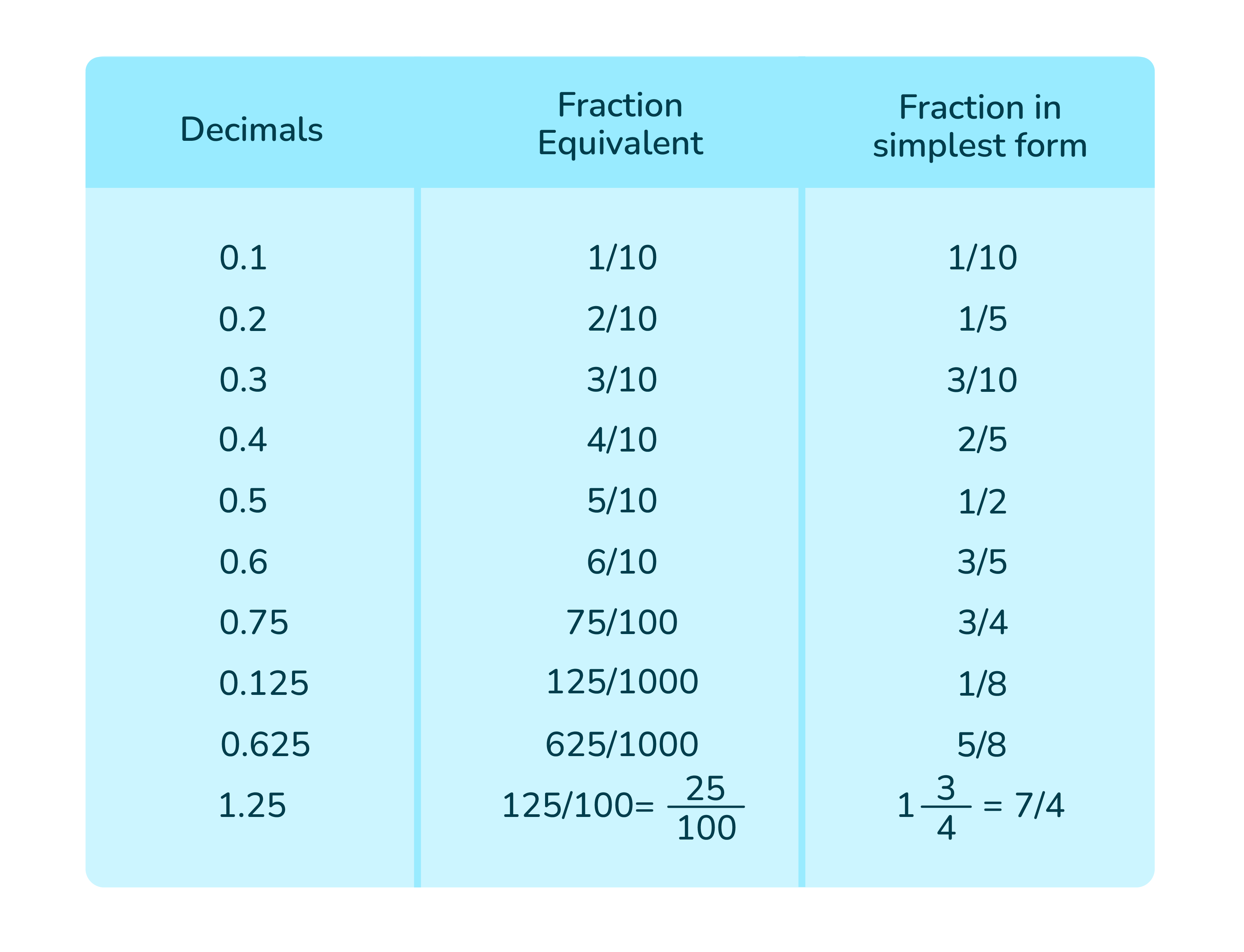
The most straightforward conversion involves terminating decimals. If a program encounters a value like 0.75, the logic follows a predictable path:
-
Identify the number of decimal places (in this case, two).
-
Create a denominator that is a power of 10 based on those places (10^2 = 100).
-
Place the decimal digits over that denominator (75/100).
-
Simplify the fraction using the Greatest Common Divisor (GCD).
In a programmatic context, the GCD is found using the Euclidean Algorithm. This is an efficient recursive process where the larger number is replaced by the remainder of the larger divided by the smaller, continuing until the remainder is zero. For 75/100, the GCD is 25, resulting in the simplified fraction 3/4.
Handling Repeating Decimals Programmatically
Repeating decimals, such as 0.666…, present a unique challenge for digital systems. These are often the result of divisions like 2/3. To convert these back into fractions, developers use algebraic logic. If x = 0.666…, then 10x = 6.666…. Subtracting the first equation from the second yields 9x = 6, or x = 6/9, which simplifies to 2/3. Implementing this in code requires pattern recognition strings or specialized libraries capable of identifying cyclic patterns in a floating-point sequence.
Continued Fractions and Best Rational Approximations
For irrational numbers or decimals with extremely long tails (like Pi or Euler’s number), computer scientists use “Continued Fractions.” This algorithm provides the “best rational approximation.” It allows a system to find a fraction with a relatively small denominator that is remarkably close to the complex decimal. This is vital in graphics programming where pixel coordinates must be integers but are derived from complex decimal-based trigonometry.
Implementing Conversion in Modern Programming Languages
Different programming environments offer various levels of native support for decimal-to-fraction conversion. Choosing the right tool depends on the required precision and the specific needs of the application.
Python’s fractions Module
Python is often the language of choice for data heavy-lifting due to its robust standard library. The fractions module allows for seamless conversion. By calling Fraction('0.25'), Python automatically handles the GCD simplification and returns 1/4. This module is particularly powerful because it allows for arithmetic operations between fractions, ensuring that the result remains an exact ratio rather than reverting to a float.
JavaScript and Web-Based Implementation
In web development, JavaScript does not have a native fraction type. Developers building financial tools or educational apps usually rely on libraries like Fraction.js or Math.js. These libraries provide the logic to handle decimal precision issues that are notorious in JavaScript (such as the 0.1 + 0.2 = 0.30000000000000004 problem). By converting decimals to fraction objects, web applications can display “1/3” to a user instead of a long string of threes.
C++ and High-Performance Systems
In systems where memory management and speed are critical, such as game engines or high-frequency trading platforms, developers often write custom fraction classes. These classes store two 64-bit integers and overload operators (+, -, *, /) to perform fractional math. This avoids the overhead of decimal-to-binary conversion and keeps the data “clean” for as long as possible within the processing pipeline.
AI and Machine Learning in Numerical Logic
As AI tools become more integrated into the development workflow, the way we handle mathematical conversions is evolving. Large Language Models (LLMs) and symbolic AI are now being used to bridge the gap between human-readable math and machine-executable code.
Large Language Models for Mathematical Reasoning
While LLMs are primarily text-based, advanced models have been trained on vast mathematical datasets. When a user asks an AI to “convert 0.123456 to a fraction,” the AI doesn’t just perform a rote calculation; it explains the logic, identifies if the number looks like a common ratio, and provides the simplified result. For developers, AI acts as a pair programmer, helping to write the regex patterns needed to identify repeating decimals or suggesting the most efficient GCD algorithm for a specific codebase.
Symbolic AI and Computational Engines
Tools like Wolfram Alpha or the SymPy library in Python represent a different branch of AI known as “Symbolic AI.” Unlike neural networks that predict the next token, these systems understand the rules of mathematics. They treat decimals and fractions as objects with properties. When converting a decimal, they can determine if that decimal is a representation of a square root, a constant, or a simple ratio, providing a level of insight that goes beyond basic division.
Precision, UX, and the Future of Digital Calculations
The shift toward fractions in tech isn’t just about the “back-end” logic; it significantly impacts User Experience (UX). How data is presented to a user can change their perception of accuracy and professional quality.
Enhancing User Interfaces with Rational Numbers
In fintech apps, displaying a stock’s movement as “1/8” (a legacy of fractional pricing) or a recipe app showing “1/3 cup” instead of “0.3333 cups” is crucial for usability. Developers use conversion algorithms to take raw decimal data from databases and transform it into “human-friendly” fractions on the fly. This requires a balance between mathematical precision and the UI’s design constraints.
The Role of LaTeX and Digital Rendering
For technical documentation and educational software, simply converting the number isn’t enough; it must be rendered correctly. Using LaTeX—a high-quality typesetting system—developers can take the output of a decimal-to-fraction algorithm and display it as a vertically stacked fraction. This is essential for STEM education platforms where visual clarity directly impacts learning outcomes.
Final Thoughts on Technical Accuracy
As we move into an era dominated by Big Data and complex AI simulations, the humble conversion from decimal to fraction remains a vital skill for the tech professional. It is the bridge between the approximate world of human measurement and the exact world of digital logic. Whether you are optimizing a Python script for better precision, building a responsive web app for financial tracking, or leveraging AI to solve complex equations, mastering this conversion ensures that your data remains as accurate as the logic behind it. In the digital realm, precision is not just a preference; it is a requirement for innovation.
aViewFromTheCave is a participant in the Amazon Services LLC Associates Program, an affiliate advertising program designed to provide a means for sites to earn advertising fees by advertising and linking to Amazon.com. Amazon, the Amazon logo, AmazonSupply, and the AmazonSupply logo are trademarks of Amazon.com, Inc. or its affiliates. As an Amazon Associate we earn affiliate commissions from qualifying purchases.