
Understanding how loan payments are calculated is more than just a numerical exercise; it’s a cornerstone of sound personal and business finance. Whether you’re considering a mortgage, an auto loan, a personal loan, or even managing business debt, grasping the mechanics behind your monthly obligation empowers you to make informed decisions, budget effectively, and ultimately achieve financial peace of mind. Without this fundamental knowledge, borrowers can find themselves overwhelmed, paying more than necessary, or making choices that don’t align with their long-term financial goals. This guide will demystify the process, walking you through the core components of loan calculation, manual methods, the power of financial tools, and strategies for managing your debt efficiently.

The Fundamentals of Loan Calculation
At its heart, a loan payment calculation balances the repayment of the borrowed principal with the interest charged by the lender over a specified period. To truly understand your payment, you must first grasp its fundamental building blocks.
Key Components of a Loan
Every loan, regardless of its purpose, is defined by a few critical variables that collectively determine your payment:
- Principal (P): This is the initial amount of money you borrow. It’s the core sum that you are obligated to repay.
- Interest Rate (r): Expressed as an annual percentage rate (APR), the interest rate is the cost of borrowing money. It represents the fee charged by the lender for the use of their funds. For calculation purposes, this annual rate is typically converted into a periodic rate (e.g., monthly) based on your payment frequency.
- Loan Term (n): This is the duration over which you agree to repay the loan, usually expressed in years or months. A longer term generally results in lower monthly payments but accrues more interest over the life of the loan.
- Payment Frequency: Most common loans require monthly payments, but some might be bi-weekly, quarterly, or annually. The frequency influences how the interest rate is applied and the total number of payments.
Simple vs. Compound Interest
Before delving into the payment formula, it’s crucial to distinguish between simple and compound interest. While simple interest is calculated only on the principal amount, compound interest is calculated on the initial principal and also on the accumulated interest from previous periods. Most consumer loans, especially mortgages, auto loans, and personal loans, use compound interest. This means that as interest accrues, it can itself earn interest, which is why understanding the amortization schedule becomes so vital. The amortization process gradually shifts the payment allocation from primarily interest to primarily principal over the life of the loan.
Amortization Basics
Amortization is the process of paying off debt over time through a series of regular payments. Each payment consists of both principal and interest. In the initial stages of an amortizing loan, a larger portion of your payment goes towards interest, while a smaller portion reduces the principal. As the loan matures, this allocation shifts, with more of each payment going towards reducing the principal. An amortization schedule is a table detailing each payment, showing how much is allocated to interest, how much to principal, and the remaining loan balance. This schedule provides a transparent view of how your debt diminishes over time.
Manual Calculation Methods
While financial calculators and software have simplified the process, understanding the underlying formula for calculating loan payments is invaluable. It provides a deeper insight into the mechanics of your debt and helps you verify automated calculations.
The Amortization Formula Explained
The standard formula for calculating a fixed monthly loan payment (M) for an amortizing loan is as follows:
$$ M = P frac{r(1+r)^n}{(1+r)^n – 1} $$
Where:
- M = Your monthly loan payment
- P = The principal loan amount (the initial amount borrowed)
- r = Your monthly interest rate (the annual interest rate divided by 12)
- n = Total number of payments (the loan term in years multiplied by 12)
Let’s break down the components and how they interact:
- The
r(1+r)^npart of the numerator accounts for the accumulation of interest over the loan term. - The
(1+r)^n - 1part of the denominator represents the future value of a series of payments. - Together, these components determine the fixed payment required to fully pay off the principal and all accrued interest over the specified term.
Step-by-Step Example
Let’s apply this formula to a hypothetical loan:
- Principal (P): $200,000 (e.g., a mortgage)
- Annual Interest Rate: 5%
- Loan Term: 30 years
Step 1: Convert Annual Rate to Monthly Rate (r)
Annual Rate = 5% = 0.05
Monthly Rate (r) = 0.05 / 12 = 0.00416667
Step 2: Calculate Total Number of Payments (n)
Loan Term = 30 years
Total Payments (n) = 30 years * 12 months/year = 360 payments
Step 3: Plug Values into the Formula
$$ M = 200,000 frac{0.00416667(1+0.00416667)^{360}}{(1+0.00416667)^{360} – 1} $$
First, calculate (1+r)^n:
1.00416667^360 ≈ 4.4735
Now, substitute this back into the formula:
$$ M = 200,000 frac{0.00416667 * 4.4735}{4.4735 – 1} $$
$$ M = 200,000 frac{0.018640}{3.4735} $$
$$ M = 200,000 * 0.00536647 $$
$$ M ≈ $1,073.69 $$
So, your estimated monthly payment would be approximately $1,073.69.
To understand the first month’s breakdown:
- Interest for Month 1: Principal * Monthly Rate = $200,000 * 0.00416667 = $833.33
- Principal Paid for Month 1: Monthly Payment – Interest = $1,073.69 – $833.33 = $240.36
- New Principal Balance: $200,000 – $240.36 = $199,759.64
This manual calculation clearly illustrates how much of your initial payment goes towards interest, demonstrating the power of compound interest working against you in the early stages of a loan.
Leveraging Financial Tools for Accuracy
While understanding the manual calculation is empowering, in practice, most people rely on modern financial tools for speed and precision. These tools eliminate human error and can provide detailed amortization schedules instantly.
Spreadsheet Software (Excel/Google Sheets)
Spreadsheets are incredibly powerful for loan calculations. Both Microsoft Excel and Google Sheets offer a built-in function specifically for calculating payments: the PMT function.
The PMT function syntax is typically:
PMT(rate, nper, pv, [fv], [type])
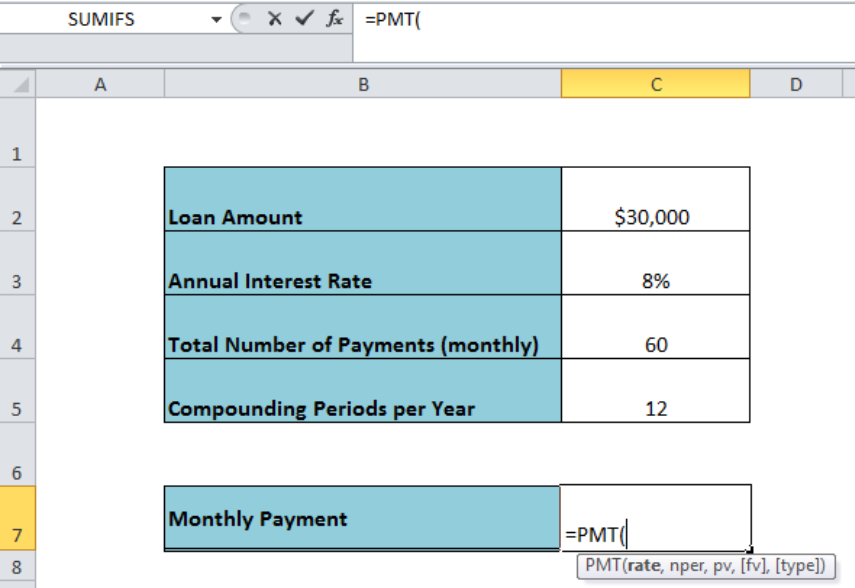
Where:
- rate: The interest rate per period (e.g., annual rate / 12).
- nper: The total number of payments for the loan (e.g., loan term in years * 12).
- pv: The present value, or the total value of all loan payments now (i.e., the principal amount). This is usually entered as a negative number if representing money you’re paying out.
- [fv]: (Optional) The future value, or a cash balance you want to attain after the last payment is made. If omitted, it defaults to 0.
- [type]: (Optional) Specifies when payments are due (0 for end of period, 1 for beginning of period). Defaults to 0.
Using our previous example ($200,000 loan, 5% annual interest, 30 years):
=PMT(0.05/12, 30*12, 200000)
This will return approximately ($1,073.64). The negative sign indicates an outgoing payment.
Spreadsheets can also be used to create full amortization schedules, detailing every single payment’s interest, principal, and remaining balance for the entire loan term, offering a clear visual roadmap of your debt repayment.
Online Loan Calculators
The internet is replete with free online loan calculators for various loan types (mortgage, auto, personal, student). These tools are user-friendly and require only a few inputs: principal, interest rate, and loan term.
Benefits of online calculators:
- Instant Results: Get your monthly payment in seconds.
- Scenario Planning: Easily adjust inputs to see how different interest rates, down payments, or loan terms impact your payment.
- Visualizations: Many provide charts and graphs to show interest vs. principal over time.
- Amortization Schedules: Often generate a full, printable amortization schedule.
When using online calculators, ensure they come from reputable financial institutions or well-known financial planning websites to guarantee accuracy. Be wary of calculators that ask for excessive personal information upfront.
Financial Planning Apps and Software
Beyond simple calculators, sophisticated financial planning apps (like Mint, YNAB, Personal Capital) and software often include robust loan management features. These tools can:
- Track multiple loans simultaneously.
- Integrate loan payments into your overall budget.
- Project future debt-free dates.
- Suggest strategies for accelerated repayment.
- Even link directly to your loan accounts for real-time updates.
These comprehensive solutions are particularly useful for individuals or businesses managing multiple debt obligations, providing a holistic view of their financial health.
Beyond the Monthly Payment: Understanding the Full Picture
While the monthly payment is a crucial figure, a truly informed borrower looks beyond it to understand the total cost and implications of their loan.
Total Cost of the Loan
The most significant figure beyond the monthly payment is the total amount you will pay over the entire life of the loan. This includes the original principal plus the total interest accumulated. Using our $200,000 example with a $1,073.69 monthly payment over 360 months:
- Total Payments = $1,073.69/month * 360 months = $386,528.40
- Total Interest Paid = Total Payments – Principal = $386,528.40 – $200,000 = $186,528.40
This illustrates that while you borrowed $200,000, you will effectively pay nearly an additional $186,528.40 in interest alone over 30 years. This perspective highlights the long-term financial commitment and the true cost of borrowing. It also underscores the significant savings achievable through early repayments or securing lower interest rates.
The Impact of Interest Rate and Loan Term
Understanding how changes in interest rate and loan term affect your total cost is vital for strategic borrowing:
- Interest Rate: Even a seemingly small difference in the interest rate can have a profound impact. A 0.5% or 1% lower rate could save you tens of thousands of dollars over a long loan term. This is why shopping for the best rate and improving your credit score is always recommended.
- Loan Term: A shorter loan term means fewer payments, resulting in significantly less interest paid overall, though your individual monthly payments will be higher. Conversely, a longer loan term reduces your monthly payment, making it more affordable in the short term, but dramatically increases the total interest paid over the loan’s life. Borrowers must weigh their monthly budget against their long-term financial goals when choosing a loan term.
Additional Loan-Related Costs
Beyond principal and interest, loans can come with various other fees that contribute to their overall cost:
- Origination Fees: Charged by the lender for processing the loan.
- Closing Costs: For mortgages, these include appraisal fees, title insurance, legal fees, etc.
- Prepayment Penalties: Some loans might charge a fee if you pay off the loan early.
- Insurance: Mandatory mortgage insurance (PMI) or credit life insurance.
- Late Payment Fees: Penalties for missing payment deadlines.
Always inquire about all associated fees before finalizing a loan agreement to have a complete picture of your financial commitment.
Strategies for Managing and Optimizing Loan Payments
Armed with the knowledge of how loan payments are calculated, you can proactively manage and even optimize your loan repayment strategy.
Refinancing Options
Refinancing involves taking out a new loan to pay off an existing one, typically to secure a better interest rate, lower monthly payments, or change the loan term. It’s an excellent strategy when:
- Interest rates have dropped significantly since you took out your original loan.
- Your credit score has improved, qualifying you for better terms.
- You want to convert a variable-rate loan to a fixed-rate loan for stability.
- You need to change the loan term (e.g., shorten it to pay less interest, or lengthen it to reduce monthly payments).
Always compare the total savings from refinancing against any new closing costs or fees associated with the new loan.
Accelerating Loan Repayment
Paying off your loan faster can save you a substantial amount in interest. Here are common strategies:
- Extra Principal Payments: Even small, regular extra payments directed specifically towards the principal can significantly shorten your loan term and reduce total interest.
- Bi-weekly Payments: Instead of 12 monthly payments, you make 26 half-payments per year, effectively making one extra full monthly payment each year. This accelerates the principal reduction.
- Round Up Payments: If your payment is $1,073.69, consider paying $1,100 or $1,200. The extra goes directly to principal.
- Windfalls: Apply bonuses, tax refunds, or other unexpected income directly to your loan principal.
Ensure your lender applies extra payments directly to the principal and not just to pre-pay upcoming interest.
Debt Consolidation
If you have multiple high-interest debts (e.g., credit cards, personal loans), debt consolidation can simplify your finances and potentially save money. This involves taking out a new, larger loan (often at a lower interest rate) to pay off several smaller debts. The goal is to:
- Reduce your overall monthly payment.
- Lower your average interest rate.
- Simplify your payments to a single bill.
Common consolidation methods include personal loans, balance transfer credit cards, or even home equity loans. While effective, it’s crucial to address the root causes of debt to avoid accumulating more debt after consolidation.

Conclusion
Understanding “how to count loan payments” is more than just crunching numbers; it’s about gaining control over a significant aspect of your financial life. From deciphering the amortization formula to leveraging sophisticated software, and from strategically shortening your loan term to optimizing repayments, an informed approach empowers you to manage your debt rather than being managed by it. By consistently applying these insights, you can navigate the world of loans with confidence, minimize your financial burden, and pave the way for a more secure and prosperous future. Take the time to understand your commitments, explore your options, and make your money work smarter for you.
aViewFromTheCave is a participant in the Amazon Services LLC Associates Program, an affiliate advertising program designed to provide a means for sites to earn advertising fees by advertising and linking to Amazon.com. Amazon, the Amazon logo, AmazonSupply, and the AmazonSupply logo are trademarks of Amazon.com, Inc. or its affiliates. As an Amazon Associate we earn affiliate commissions from qualifying purchases.