
Understanding the “Consumer Price Index,” or CPI, is fundamental to mastering personal finance and business strategy. While the term is frequently mentioned in news cycles and economic reports, many individuals find the actual mechanics of how to count or calculate CPI to be elusive. At its core, CPI is the most widely used measure of inflation and, by extension, the most reliable indicator of how the value of your money changes over time.
In this guide, we will break down the complex world of economic indexing into actionable knowledge. Whether you are an investor looking to protect your portfolio from inflation, a business owner setting prices, or a curious individual aiming to understand why your grocery bill is rising, mastering the calculation and application of CPI is a vital financial skill.

Understanding the Foundation of CPI
Before we dive into the mathematics of counting CPI, we must understand what the index actually represents. The Consumer Price Index is not a measure of the price of a single item, but rather a weighted average of prices for a “market basket” of goods and services.
What Exactly is the Consumer Price Index?
The CPI tracks the change in prices paid by urban consumers for a representative basket of goods and services. Think of it as a giant, metaphorical shopping cart that contains everything the average household consumes. By tracking the total cost of this cart over months and years, economists can determine whether the purchasing power of the dollar is strengthening or weakening.
In the context of money management, CPI serves as a benchmark. If your investment returns are 5% but the CPI has risen by 6%, you have technically lost purchasing power. Therefore, “counting” CPI is the first step in calculating “real” versus “nominal” financial gains.
The Market Basket: What’s Inside?
To count CPI accurately, one must understand what goes into the basket. The Bureau of Labor Statistics (BLS) and similar global entities categorize thousands of items into several major groups:
- Housing: Rent, owners’ equivalent rent, fuel oil, and bedroom furniture.
- Food and Beverages: Breakfast cereal, milk, coffee, chicken, and dining out.
- Transportation: New vehicles, airline fares, gasoline, and motor vehicle insurance.
- Medical Care: Prescription drugs, medical supplies, and hospital services.
- Education and Communication: College tuition, postage, telephone services, and computer software.
Each category is “weighted” based on its importance in the average consumer’s budget. For instance, housing typically carries a much higher weight than apparel because people spend a larger portion of their income on shelter.
The Step-by-Step Process of Calculating CPI
Counting CPI requires a systematic approach. It is a relative measurement, meaning it compares the price of the basket today to the price of the same basket in a predetermined “base period.”
Selecting the Base Year
To measure change, you need a starting point. In economic terms, this is the “Base Year.” The value of the CPI in the base year is always set to 100. This provides a clean reference point. For example, if the CPI today is 125, it tells us immediately that prices have risen by 25% since the base period. When you are performing your own business finance calculations, you might set a base year relative to your company’s inception to track internal inflation.
The Core Formula: Current Price vs. Base Price
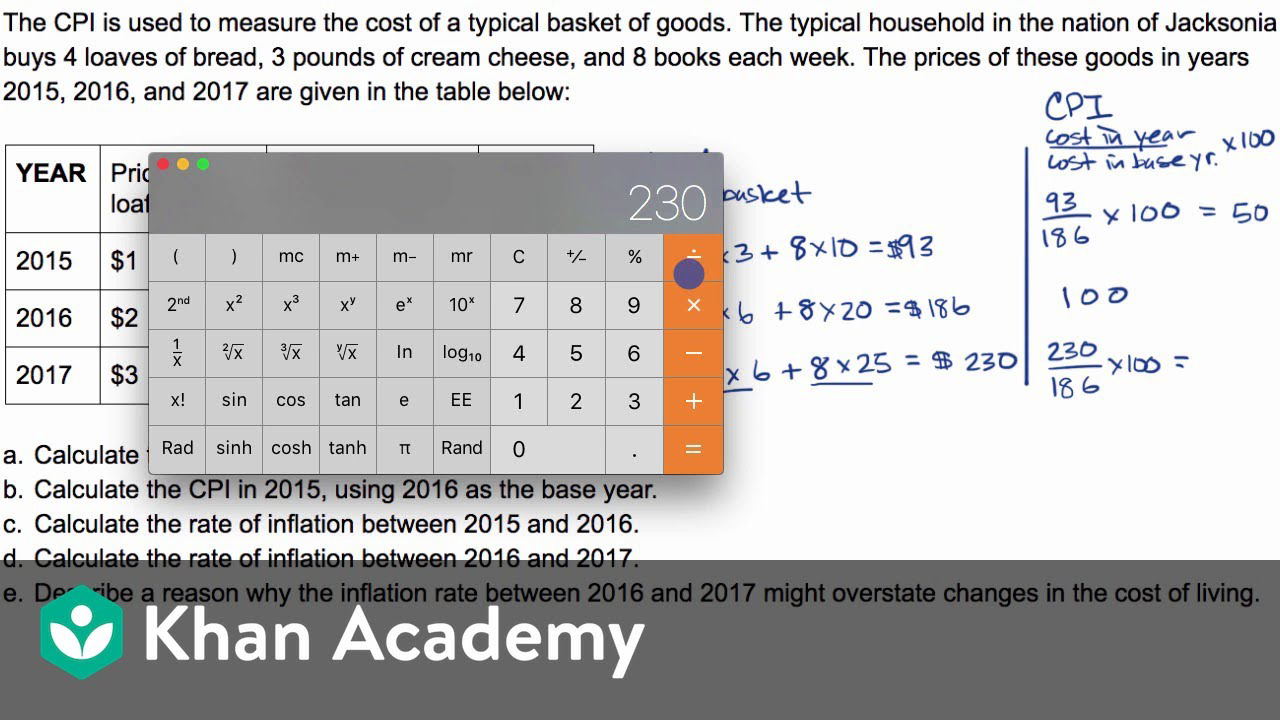
The actual calculation of CPI follows a straightforward formula. To find the index for a specific period, you follow this equation:
CPI = (Cost of Market Basket in Current Year / Cost of Market Basket in Base Year) × 100
Let’s look at a simplified example for clarity:
- Define the Basket: Suppose our basket contains 10 loaves of bread and 5 gallons of milk.
- Base Year Cost: In 2020 (the base year), bread was $2 and milk was $3. Total cost = (10 x 2) + (5 x 3) = $35.
- Current Year Cost: In 2024, bread is $3 and milk is $4. Total cost = (10 x 3) + (5 x 4) = $50.
- The Calculation: ($50 / $35) × 100 = 142.8.
The CPI for 2024 is 142.8, signifying a 42.8% increase in price levels over four years.

Calculating the Percentage Change (Inflation Rate)
While the CPI index itself is useful, most people are interested in the inflation rate—the percentage change in CPI from one period to the next. This is how you “count” the annual inflation that impacts your savings accounts and salary negotiations.
The formula for the inflation rate is:
[(CPI New – CPI Old) / CPI Old] × 100
Using our previous index of 142.8, if the previous year’s index was 138.0, the annual inflation rate would be:
[(142.8 – 138.0) / 138.0] × 100 = 3.47%.
Why Accuracy Matters in Financial Planning
Understanding how to count CPI is not just an academic exercise; it is a prerequisite for sophisticated financial planning. Inflation is the “silent tax” on cash, and failing to account for it can derail long-term wealth building.
Impact on Real Interest Rates
For investors and savers, the relationship between interest rates and CPI is paramount. The “nominal” interest rate is what the bank tells you you’re earning (e.g., a 4% yield on a CD). However, the “real” interest rate is the nominal rate minus the CPI inflation rate.
If you are earning 4% interest but CPI is growing at 5%, your “real” return is -1%. By knowing how to count and track CPI, you can pivot your money into assets that historically hedge against inflation, such as real estate, commodities, or Treasury Inflation-Protected Securities (TIPS).
Adjusting for Cost of Living (COLA)
In the corporate world and government sectors, CPI is used to calculate Cost of Living Adjustments (COLA). Many labor contracts and social security systems are indexed to the CPI. If you are a business owner, understanding the trajectory of CPI allows you to make fair and data-driven decisions regarding employee raises. If you do not adjust wages in line with CPI, you are effectively giving your employees a pay cut in terms of purchasing power, which can lead to talent attrition.
Limitations and Variations of the Index
While the CPI is a powerful tool, it is not a one-size-fits-all metric. To truly master the “money” aspect of this index, one must recognize that different versions of CPI exist for different financial purposes.
Headline vs. Core CPI
When you see CPI reports in the media, they often distinguish between “Headline CPI” and “Core CPI.”
- Headline CPI includes everything in the basket, including volatile categories like food and energy.
- Core CPI excludes food and energy.
For long-term financial forecasting, many economists prefer Core CPI because it removes the “noise” of temporary price spikes in oil or seasonal agricultural shifts. When counting CPI for your personal long-term investment strategy, Core CPI often provides a clearer picture of the underlying economic trend.
The Substitution Bias and Quality Changes
A common critique of how we count CPI is “substitution bias.” If the price of beef rises significantly, consumers might buy more chicken instead. Traditional CPI models sometimes struggle to account for these shifts in consumer behavior immediately.
Furthermore, “quality change” adjustments are necessary. If a smartphone costs $1,000 today—the same as it did five years ago—but is ten times more powerful, the “cost per unit of utility” has actually gone down. Economists use “hedonic adjustment” to account for this. As a financial strategist, it is important to realize that while the CPI might say inflation is 3%, your personal “lifestyle inflation” might be higher or lower depending on your specific spending habits.
Summary: Mastering the Metric of Money
Learning how to count CPI is an essential transition from being a passive consumer to becoming an active participant in your financial future. By understanding the basket of goods, mastering the base-year formula, and recognizing the difference between nominal and real returns, you gain a massive advantage in wealth preservation.
Inflation is a constant force in the global economy. By tracking the Consumer Price Index, you aren’t just looking at numbers on a spreadsheet; you are measuring the very heartbeat of your purchasing power. Use this knowledge to negotiate better salaries, choose more resilient investments, and build a financial life that isn’t just growing in numbers, but growing in actual, tangible value.
aViewFromTheCave is a participant in the Amazon Services LLC Associates Program, an affiliate advertising program designed to provide a means for sites to earn advertising fees by advertising and linking to Amazon.com. Amazon, the Amazon logo, AmazonSupply, and the AmazonSupply logo are trademarks of Amazon.com, Inc. or its affiliates. As an Amazon Associate we earn affiliate commissions from qualifying purchases.