
In an increasingly data-driven world, where precision underpins everything from software development to financial modeling, a foundational understanding of numerical concepts remains paramount. Among these, the ability to deftly manipulate fractions—and specifically, to convert mixed numbers into improper fractions—is a surprisingly vital skill, not just for students, but for anyone interacting with digital tools that process numerical data. This conversion is more than a mere arithmetic exercise; it’s a gateway to understanding how software interprets and handles non-integer values, how spreadsheets calculate proportions, and how accurate representations are maintained across various technological platforms.
This guide will demystify the process of converting mixed numbers into fractions, grounding the manual steps in the logical principles that digital tools replicate, and exploring how modern technology assists, interprets, and applies this fundamental mathematical transformation. Whether you’re a budding programmer, a data analyst, or simply someone looking to enhance their digital literacy, mastering this conversion offers a clearer lens through which to view the numerical backbone of our technological landscape.
The Digital Imperative: Understanding Fractions in the Tech Landscape
In an age defined by algorithms and data, the foundational elements of mathematics often take on new significance. The simple act of converting a mixed number into an improper fraction, while seemingly basic, underpins numerous processes in computing, data analysis, and software functionality. Without a clear understanding of how these values are represented and manipulated, errors can creep into calculations, data visualizations can become misleading, and the very logic of applications can falter.
Bridging Abstract Math with Practical Applications
Consider a scenario in software development where an interface needs to display a ratio or a proportion that naturally results in a mixed number, such as 3 ½ units. For internal computational purposes, this mixed number must be converted into a format that the computer can easily process, typically an improper fraction (7/2) or a decimal (3.5). The conversion from 3 ½ to 7/2 allows for consistent arithmetic operations. For instance, if you need to double that quantity, calculating 2 * (7/2) is straightforward, yielding 7. Directly multiplying 2 * (3 ½) requires an extra step of distributing the multiplication to both the whole number and the fraction, which adds complexity to the underlying software logic. This foundational conversion simplifies the computational burden and ensures accuracy across different programming languages and data types.
The Role of Precision in Data and Software
Precision is the bedrock of reliable technology. In fields like scientific computing, engineering simulations, or even financial applications where stock prices might be quoted with fractional components, representing values precisely is critical. While floating-point decimals are commonly used, they often introduce minute rounding errors due to their binary representation. Fractions, on the other hand, offer an exact representation of rational numbers. Converting a mixed number into an improper fraction maintains this exactness, which can be crucial when algorithms demand absolute precision. For example, in graphic rendering, where every pixel position or color component might involve fractional coordinates, maintaining fractional precision through internal conversions helps prevent cumulative errors that could lead to visual anomalies or inaccuracies in complex models. Understanding the conversion process helps users and developers alike appreciate the subtle nuances of numerical representation in digital environments.
Mastering the Manual Conversion: A Foundation for Digital Tools
Before delving into technological aids, a firm grasp of the manual conversion process is essential. This not only builds a deeper conceptual understanding but also illuminates the logic that powers the digital tools designed to perform these very tasks. The steps are straightforward, yet profoundly logical, reflecting the inherent structure of numerical values.
Step-by-Step Guide to Improper Fractions
Let’s take a mixed number, for instance, 3 ⅔. Here, ‘3’ is the whole number, and ‘⅔’ is the fractional part. The goal is to express this entire quantity as a single fraction where the numerator is greater than or equal to the denominator—an improper fraction.
- Identify the Whole Number, Numerator, and Denominator: In 3 ⅔, the whole number is 3, the numerator of the fraction is 2, and the denominator is 3.
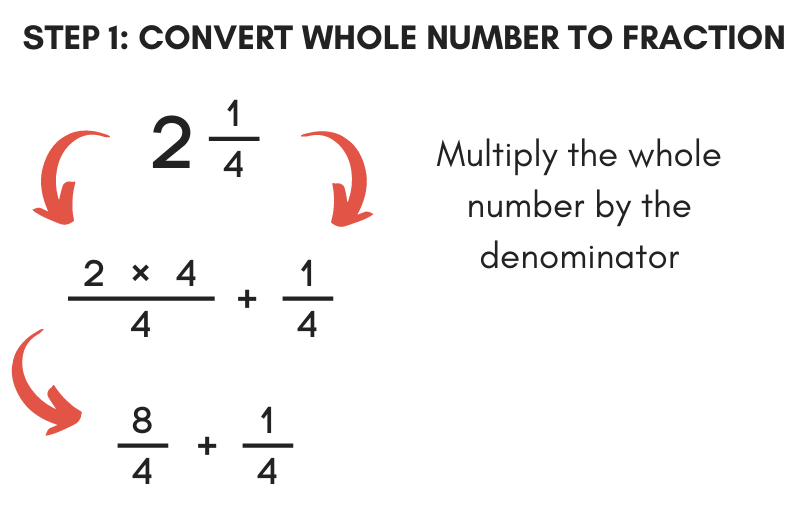
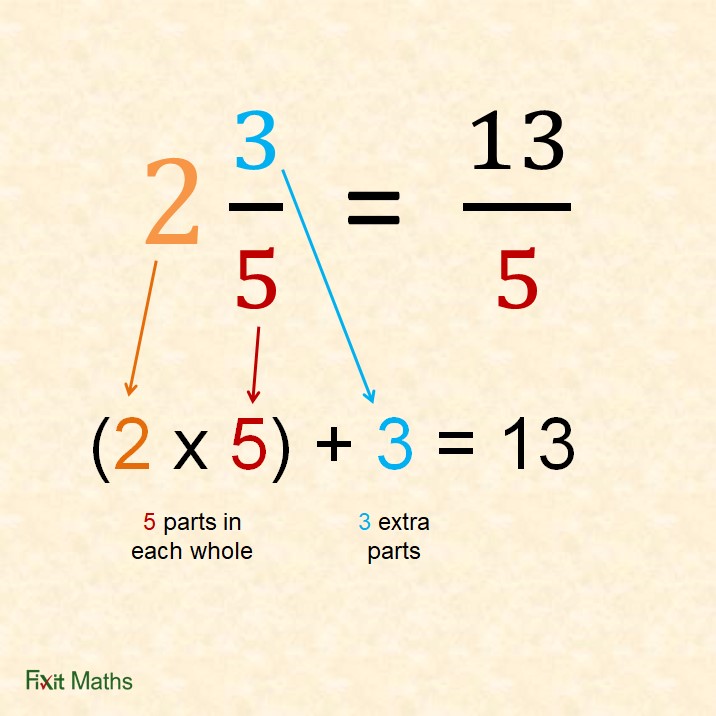
- Multiply the Whole Number by the Denominator: This step converts the whole number part into an equivalent fraction with the same denominator as the fractional part. So, 3 (whole number) * 3 (denominator) = 9. This means that the ‘3’ whole units can be expressed as ‘9/3’.
- Add the Result to the Original Numerator: Now, combine this new numerator (from the whole number conversion) with the original numerator of the fractional part. So, 9 (from step 2) + 2 (original numerator) = 11.
- Place the New Numerator Over the Original Denominator: The new combined numerator (11) is placed over the original denominator (3). The result is the improper fraction 11/3.
Thus, 3 ⅔ is converted to 11/3. This method ensures that the value remains consistent, simply changing its representation from a mixed number to an improper fraction.
The Logic Behind Numerator and Denominator
The elegance of this conversion lies in its underlying logic. A mixed number essentially represents a sum: a whole number plus a proper fraction. When we multiply the whole number by the denominator, we are effectively asking, “How many ‘parts’ (as defined by the denominator) make up this whole number?” For 3 ⅔, each ‘whole’ is made of 3 ‘thirds’. So, three wholes are made of 3 * 3 = 9 thirds. Adding the existing 2 thirds from the fractional part gives us a total of 11 thirds. This conceptualization is crucial for understanding why computers and software follow this precise sequence of operations. It’s not just a rule; it’s an intuitive breakdown of the quantity into its smallest common parts, making it universally digestible for arithmetic operations, whether performed by hand or by processor.
Leveraging Technology for Fraction Conversion
While understanding the manual process is foundational, modern technology provides powerful tools that streamline and automate fraction conversion, enhancing efficiency and reducing the likelihood of human error. These tools range from ubiquitous digital calculators to sophisticated spreadsheet software and specialized educational applications.
Utilizing Scientific and Online Calculators
The most accessible technological aid for fraction conversion is often the scientific calculator, whether a physical device or a virtual one embedded in an operating system or available online. Many scientific calculators feature a dedicated button for handling fractions, often labeled ‘a b/c’ or similar. To convert a mixed number like 4 ¼:
- Input the Whole Number: Type ‘4’.
- Press the Fraction Button: This signals that the next input is the numerator of the fractional part.
- Input the Numerator: Type ‘1’.
- Press the Fraction Button Again (or a dedicated ‘denominator’ button): This prepares for the denominator input.
- Input the Denominator: Type ‘4’.
- Press the ‘Equals’ or ‘Fraction Conversion’ Button: The calculator will then display the improper fraction, which in this case would be 17/4.
Online calculators, freely available on numerous educational and utility websites, often provide a more visual interface. Users input the whole number, numerator, and denominator into separate fields, and the calculator instantly displays the improper fraction, often alongside a step-by-step explanation, reinforcing the manual process. These tools are invaluable for quick checks and for verifying calculations, especially when dealing with complex numbers.
Spreadsheet Solutions for Fractional Data
Spreadsheets like Microsoft Excel, Google Sheets, or LibreOffice Calc are indispensable tools for data management and numerical analysis in various professional contexts. While they primarily work with decimals, they offer formatting options and functions that can handle and display fractions. If you input a mixed number into a cell (e.g., “4 1/4”), Excel might automatically convert it to a date or a decimal. To treat it as a fraction:
- Format the Cell: Right-click the cell(s), select “Format Cells,” and choose “Fraction” from the “Number” tab. You can then select how many digits of the denominator you want to display (e.g., “Up to two digits”).
- Input the Mixed Number Correctly: Type the whole number, a space, and then the fraction (e.g.,
4 1/4). Excel will then correctly interpret and display it as a mixed number. - Converting to Improper Fraction (Conceptually): While Excel doesn’t have a direct “mixed to improper fraction” function, once a mixed number is entered, you can perform calculations that yield its decimal equivalent (e.g.,
4 + (1/4)will give4.25). If you then need the improper fraction, you would conceptually perform the manual conversion using the decimal value or directly use the formula:=(Whole_Number * Denominator + Numerator) / Denominator. For example, if ‘4’ is in A1, ‘1’ in B1, ‘4’ in C1:=(A1*C1+B1)/C1. This provides the decimal, which you can then (if needed) manually convert back to an improper fraction’s numerator and denominator, or just use for further calculations.
For programmatic conversion within spreadsheets (VBA for Excel, Google Apps Script for Google Sheets), one could write custom functions to directly convert a text-based mixed number into its improper fraction string representation or two separate cells for numerator and denominator.
Educational Apps and Interactive Tools
The rise of educational technology has brought forth a plethora of apps and interactive platforms designed to make learning mathematics more engaging and accessible. Many of these tools specifically target fraction mastery. Apps like Khan Academy, Photomath, or dedicated fraction calculators not only perform conversions instantly but also often provide visual representations, step-by-step breakdowns, and practice exercises. These applications transform the learning experience from rote memorization into an interactive exploration, allowing users to experiment with different mixed numbers and immediately see their improper fraction equivalents, reinforcing the understanding of the underlying mathematical principles. For tech-savvy learners, these apps demonstrate how complex interfaces can simplify powerful mathematical operations.
Beyond Basic Conversion: Fractions in Advanced Tech Contexts
The utility of understanding fraction conversion extends beyond basic arithmetic, touching upon more complex areas of computing and data handling. In advanced technological contexts, fractions are not just numerical values but fundamental concepts influencing data representation, algorithm design, and even user experience.
Understanding Fractional Representation in Computing
At its core, a computer processes numbers in binary. Representing fractional values precisely in binary is a nuanced challenge. While floating-point numbers (like those adhering to the IEEE 754 standard) are widely used for decimals, they are approximations. When exact rational numbers are required, some programming paradigms or specialized libraries opt for “rational number” data types that store the numerator and denominator separately. In such systems, converting a mixed number (which implicitly has a whole number and a fraction) into a single improper fraction (numerator/denominator) is the essential first step to represent it as a true rational number data type. This ensures that operations like addition, subtraction, multiplication, and division on these “exact fractions” yield precise results, avoiding the minute inaccuracies that can accumulate with floating-point arithmetic in sensitive applications (e.g., cryptography, scientific research, high-precision engineering).
Data Visualization and Proportionality
In data analytics and visualization, fractions and proportions are central to conveying insights. Whether it’s a pie chart showing market share, a bar graph representing survey responses as parts of a whole, or a progress bar indicating completion, the underlying data often needs to be understood in fractional terms. While visualizations typically display percentages or decimals, the initial data might originate from measurements or inputs that are naturally mixed numbers. For instance, if a project is reported as “3 ¼ complete,” converting this to an improper fraction (13/4) and then understanding its decimal equivalent (3.25) allows for easy calculation of the percentage completion (e.g., 3.25/Total_Units * 100%). This mental or algorithmic conversion ensures that the visual representation accurately reflects the underlying data’s true proportion. This is crucial for dashboards and reporting tools where clarity and precision are paramount for decision-making.

Conclusion: Empowering Your Digital Fluency
The conversion of mixed numbers into improper fractions, seemingly a humble mathematical operation, serves as a crucial building block in our interaction with technology. It underscores the precision demanded by software, informs the design of digital tools, and enhances our ability to interpret and manipulate data effectively. From the simple logic of a scientific calculator to the complex algorithms managing rational number types in advanced computing, the principles of this conversion are omnipresent.
By mastering the manual process, we gain insight into the computational logic that digital systems employ. By leveraging technological tools, we streamline our work and ensure accuracy. Ultimately, a strong grasp of how mixed numbers transform into improper fractions is more than just a math skill; it’s a foundational element of digital fluency, empowering individuals to navigate and contribute to the numerically driven world of technology with greater confidence and precision. As technology continues to evolve, the demand for such fundamental numerical literacy will only grow, cementing the relevance of even the most basic mathematical concepts in our increasingly digital lives.
aViewFromTheCave is a participant in the Amazon Services LLC Associates Program, an affiliate advertising program designed to provide a means for sites to earn advertising fees by advertising and linking to Amazon.com. Amazon, the Amazon logo, AmazonSupply, and the AmazonSupply logo are trademarks of Amazon.com, Inc. or its affiliates. As an Amazon Associate we earn affiliate commissions from qualifying purchases.