
Navigating the complex landscape of mortgage deals can feel overwhelming, but making an informed decision is one of the most significant financial steps you’ll take in your lifetime. A mortgage is likely the largest debt many people will ever incur, and even a slight difference in interest rates or fees can translate into tens of thousands of dollars over the loan’s lifespan. This comprehensive guide will dissect the essential elements of mortgage deals, equip you with the knowledge to identify hidden costs, and outline a strategic process for comparing offers effectively, all aimed at securing the best financial outcome for your homeownership journey.

Understanding the Core Components of a Mortgage Deal
Before you can effectively compare mortgage offers, it’s crucial to understand the fundamental building blocks that constitute a loan agreement. Each component plays a vital role in determining your monthly payments, total costs, and long-term financial flexibility.
Interest Rates: Fixed vs. Variable
The interest rate is arguably the most publicized and understood aspect of a mortgage deal. It represents the cost of borrowing the principal amount and directly impacts your monthly payment.
-
Fixed-Rate Mortgages: With a fixed-rate mortgage, your interest rate remains constant for the entire duration of the loan. This provides stability and predictability, as your principal and interest payment will never change. It’s an excellent option for those who prefer consistent budgeting and are concerned about potential interest rate increases in the future. The trade-off might be a slightly higher initial rate compared to variable options when rates are low, or missing out on lower rates if the market declines significantly.
-
Adjustable-Rate Mortgages (ARMs): ARMs feature an interest rate that is fixed for an initial period (e.g., 3, 5, 7, or 10 years) and then adjusts periodically based on a chosen financial index (like SOFR or a Treasury Index) plus a margin set by the lender. While ARMs often start with lower interest rates than fixed-rate mortgages, they introduce an element of risk. Your payments could increase significantly if interest rates rise after the fixed period, though they could also decrease. ARMs are typically suited for borrowers who plan to sell or refinance before the fixed period ends, or those comfortable with market volatility. Understanding the cap structures (how much the rate can increase in a period or over the life of the loan) is paramount when considering an ARM.
Loan Terms and Repayment Periods
The loan term, or repayment period, dictates how long you have to pay back the mortgage. Common terms are 15, 20, and 30 years, though other durations exist.
-
Impact on Monthly Payments and Total Interest: A shorter loan term (e.g., 15 years) typically comes with a lower interest rate and results in significantly less interest paid over the life of the loan. However, your monthly payments will be higher because you’re paying off the principal more quickly. Conversely, a longer loan term (e.g., 30 years) offers lower monthly payments, making homeownership more affordable on a month-to-month basis, but you’ll pay substantially more in total interest over the life of the loan.
-
Financial Goals: Your choice of loan term should align with your financial goals and risk tolerance. If maximizing monthly cash flow is a priority, a longer term might be preferable. If minimizing total interest paid and building equity quickly is your aim, a shorter term is often better, provided you can comfortably manage the higher payments.
Mortgage Types: Conforming, FHA, VA, and Jumbo
Different mortgage types cater to various borrower profiles and financial situations.
-
Conforming Loans: These are the most common type of mortgage, adhering to guidelines set by Fannie Mae and Freddie Mac, including loan limits. They generally offer competitive interest rates and require good credit.
-
FHA Loans: Backed by the Federal Housing Administration, FHA loans are designed to make homeownership more accessible, especially for first-time buyers or those with lower credit scores or smaller down payments (as low as 3.5%). They require mortgage insurance premiums (MIP) for the life of the loan, which adds to the overall cost.
-
VA Loans: Guaranteed by the U.S. Department of Veterans Affairs, VA loans are a tremendous benefit for eligible service members, veterans, and surviving spouses. They often require no down payment and no private mortgage insurance (PMI), though they do have a VA funding fee.
-
Jumbo Loans: For properties that exceed the conforming loan limits set by Fannie Mae and Freddie Mac, jumbo loans are necessary. These loans typically require higher credit scores, larger down payments, and more stringent underwriting criteria due to the increased risk for lenders.
Beyond the Interest Rate: Hidden Costs and Fees
Focusing solely on the interest rate can be a costly mistake. Mortgage deals come with a myriad of fees and charges that can significantly increase the total cost of your loan. Understanding these “hidden” costs is crucial for an accurate comparison.
Closing Costs Explained
Closing costs are the expenses incurred during the home buying process, paid at the loan closing. These can range from 2% to 5% of the loan amount and include various fees from different parties involved in the transaction.
-
Origination Fees: Charged by the lender for processing your loan application, underwriting, and funding the loan.
-
Appraisal Fees: Paid to a professional appraiser to determine the fair market value of the property.
-
Title Insurance: Protects both the lender and the homeowner against claims against the property’s title.
-
Attorney Fees: If you live in a state where an attorney is required for real estate closings, you’ll pay their fees.
-
Recording Fees: Paid to the local government to record the sale and mortgage documents.
-
Prepaid Expenses: These can include property taxes and homeowner’s insurance premiums for a certain period, which are often collected at closing to establish an escrow account.
It’s essential to scrutinize the Loan Estimate document (provided by lenders) to get a detailed breakdown of all closing costs.
Lender Fees and Points
Beyond the basic origination fee, lenders might impose other charges or offer options that influence your interest rate.
-
Discount Points: These are upfront fees paid to the lender at closing in exchange for a lower interest rate over the life of the loan. One “point” typically equals 1% of the loan amount. For example, on a $300,000 loan, one point would cost $3,000. Deciding whether to pay points involves calculating the “break-even point” – how long it will take for the interest savings to offset the upfront cost.
-
Administrative Fees: Some lenders might charge application fees, underwriting fees, or processing fees that are separate from the origination fee. These should all be clearly itemized on your Loan Estimate.
Escrow Accounts and Ongoing Costs
While not strictly closing costs, understanding escrow and ongoing obligations is vital for a complete financial picture.
-
Property Taxes and Homeowner’s Insurance: Lenders often require an escrow account, where a portion of your monthly mortgage payment is set aside to cover future property tax bills and homeowner’s insurance premiums. This ensures these crucial expenses are paid on time, protecting the lender’s interest in the property.
-
Mortgage Insurance (PMI/MIP): If your down payment is less than 20% on a conventional loan, you’ll likely need to pay Private Mortgage Insurance (PMI). FHA loans require Mortgage Insurance Premiums (MIP) regardless of down payment size, often for the life of the loan. VA loans typically don’t require mortgage insurance but have a funding fee. Mortgage insurance adds to your monthly payment and protects the lender in case you default.
The Comparison Process: Step-by-Step
Comparing mortgage deals effectively requires a systematic approach, ensuring you gather all necessary information and evaluate offers comprehensively.
Get Your Financial House in Order
Before you even start shopping for a mortgage, preparing your finances will put you in a stronger negotiating position and help you understand what you can realistically afford.
-
Credit Score Importance: Your credit score is a major factor in determining the interest rate you’ll be offered. A higher score signifies lower risk to lenders, leading to better rates. Work on improving your credit score by paying bills on time, reducing debt, and checking for errors on your credit report.
-
Debt-to-Income Ratio (DTI): Lenders evaluate your DTI ratio to assess your ability to manage monthly payments. This is calculated by dividing your total monthly debt payments by your gross monthly income. A lower DTI typically indicates you’re a less risky borrower.
-
Down Payment Savings: The size of your down payment directly impacts your loan amount, monthly payments, and whether you’ll need to pay PMI. The larger your down payment, the better your loan terms often become.
Shop Around: Multiple Lenders and Loan Officers
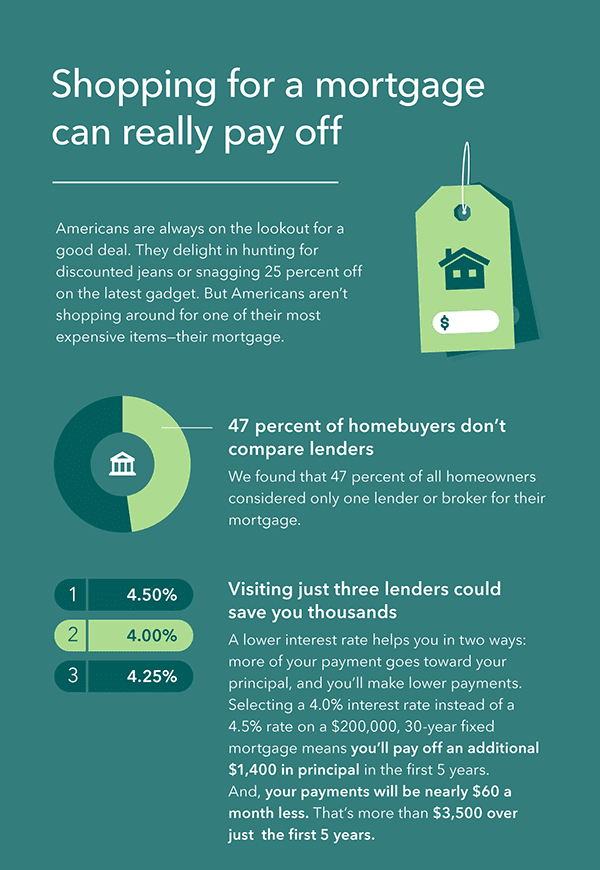
Never settle for the first offer you receive. Comparing offers from multiple sources is the single most effective way to save money on a mortgage.
-
Sources of Loans: Explore different types of lenders: traditional banks, credit unions (often have competitive rates for members), online lenders (known for efficiency and sometimes lower overhead costs), and mortgage brokers (who work with multiple lenders to find you the best deal).
-
Getting Loan Estimates: Apply for a mortgage with at least three to five different lenders. Each lender is required to provide you with a “Loan Estimate” document within three business days of your application. This standardized three-page form clearly outlines the interest rate, monthly payment, and estimated closing costs, making side-by-side comparison straightforward. Pay close attention to the Annual Percentage Rate (APR), which reflects the total cost of the loan over its term, including interest and most fees, giving a more accurate picture than the interest rate alone.
Analyze the Total Cost of the Loan
While the interest rate and monthly payment are important, you must look at the overall financial commitment.
-
APR vs. Interest Rate: As mentioned, the APR is a better metric for comparison as it incorporates most of the fees into the annual cost. A loan with a lower interest rate but higher fees could potentially have a higher APR than a loan with a slightly higher interest rate but fewer fees.
-
Calculating Total Interest Paid: Use an online mortgage calculator to estimate the total interest you’ll pay over the life of different loans. This can reveal significant differences between seemingly similar offers, especially when comparing different loan terms.
-
Potential Future Costs: If considering an ARM, understand the potential maximum payments if rates increase. Factor in the cost of mortgage insurance and any potential property tax or insurance increases over time.
Key Considerations and Strategic Tips
Beyond the mechanics of comparison, several strategic considerations can further optimize your mortgage decision.
Pre-Approval vs. Pre-Qualification
These terms are often used interchangeably, but there’s a crucial difference.
-
Pre-Qualification: This is a preliminary assessment based on information you provide, giving you an estimate of how much you might be able to borrow. It’s a good starting point but not a commitment from a lender.
-
Pre-Approval: This is a more thorough process where the lender verifies your financial information (credit report, income, assets) and commits to lending you a specific amount up to a certain price point. A pre-approval makes your offer more attractive to sellers and provides a clearer budget for your home search. Always aim for pre-approval before seriously looking at homes.
Refinancing Opportunities and Market Changes
Your initial mortgage decision isn’t necessarily permanent. Keep an eye on market conditions.
-
When to Refinance: If interest rates drop significantly, your credit score improves, or your financial situation changes (e.g., you can afford higher payments for a shorter term), refinancing could be a viable option to lower your interest rate, reduce your loan term, or tap into home equity.
-
Economic Trends: Understanding general economic trends and the Federal Reserve’s actions regarding interest rates can help you anticipate potential rate movements and inform your decision-making, both for initial purchase and future refinancing.
Don’t Be Afraid to Negotiate
Even in a competitive market, there’s often room for negotiation.
-
Leveraging Competing Offers: Once you have multiple Loan Estimates, use them to negotiate. Show one lender a better offer from another and ask if they can match or beat it, particularly regarding interest rates or specific fees.
-
Asking for Fee Waivers or Reductions: Some lenders may be willing to waive or reduce certain fees, especially if you have an excellent credit score or a substantial down payment. It never hurts to ask!

Conclusion
Comparing mortgage deals is a critical financial exercise that demands thoroughness, patience, and a keen eye for detail. By deeply understanding interest rates, loan terms, mortgage types, and especially the often-overlooked closing costs and fees, you can move beyond surface-level comparisons. Shopping around for multiple Loan Estimates, meticulously analyzing the total cost of the loan (APR), and strategically leveraging pre-approval and negotiation tactics will empower you to make an informed decision that aligns with your long-term financial health. Remember, a mortgage is a decades-long commitment; the diligence you put in upfront will pay dividends for years to come, securing not just a house, but a financially sound home. If in doubt, consulting with a trusted financial advisor or a reputable mortgage professional can provide invaluable personalized guidance.
aViewFromTheCave is a participant in the Amazon Services LLC Associates Program, an affiliate advertising program designed to provide a means for sites to earn advertising fees by advertising and linking to Amazon.com. Amazon, the Amazon logo, AmazonSupply, and the AmazonSupply logo are trademarks of Amazon.com, Inc. or its affiliates. As an Amazon Associate we earn affiliate commissions from qualifying purchases.