
In the dynamic world of finance, understanding growth and change is paramount. Whether you’re tracking investment returns, analyzing salary increases, or monitoring business revenue, the ability to accurately calculate a percentage increase is an indispensable skill. It allows us to move beyond mere absolute differences and grasp the relative magnitude of change, providing a more insightful perspective on financial performance and trends. This guide will demystify the process, offering a clear, step-by-step approach to calculating percentage increases and illustrating its widespread applications in both personal and business finance.
Understanding the Essence of Percentage Increase in Finance
At its core, a percentage increase quantifies the relative change between an initial value and a final, larger value, expressed as a fraction of the initial value, multiplied by 100. It’s not just about how much something has grown, but how significant that growth is in proportion to where it started. This distinction is crucial in finance, where context often dictates the true meaning of a numerical change.
Why Percentage Increase Matters for Your Money
Imagine your investment portfolio grew by $1,000. Is that good? It depends. If your initial investment was $10,000, a $1,000 gain represents a 10% increase. However, if your initial investment was $100,000, a $1,000 gain is only a 1% increase. The absolute dollar amount is the same, but the percentage increase reveals the true efficiency and impact of that growth. For investors, this metric helps evaluate the performance of different assets, compare returns against benchmarks, and make informed decisions about future allocations. For individuals, it helps assess the real growth of their income, the impact of inflation on their purchasing power, or the rate at which they are paying down debt. For businesses, it’s vital for understanding market share growth, revenue expansion, or even cost inflation. Without percentage increase, financial analysis would be a series of disconnected absolute figures, lacking the comparative context needed for meaningful interpretation.
Differentiating Absolute Change from Relative Change
Before diving into the formula, it’s important to distinguish between absolute change and relative change.
-
Absolute Change is simply the raw difference between the final value and the initial value. If an asset started at $50 and ended at $60, the absolute change is $10 ($60 – $50). While straightforward, it doesn’t convey the scale of the change.
-
Relative Change, expressed as a percentage, puts that absolute change into perspective relative to the starting point. Using the same example, a $10 increase from $50 is a 20% increase ($10/$50 * 100%). A $10 increase from $1,000, however, would only be a 1% increase. The percentage increase provides this crucial relative context, making it a far more powerful tool for financial comparisons and performance evaluation. It normalizes the change, allowing for apples-to-apples comparisons regardless of the base values.
The Fundamental Formula: Demystified
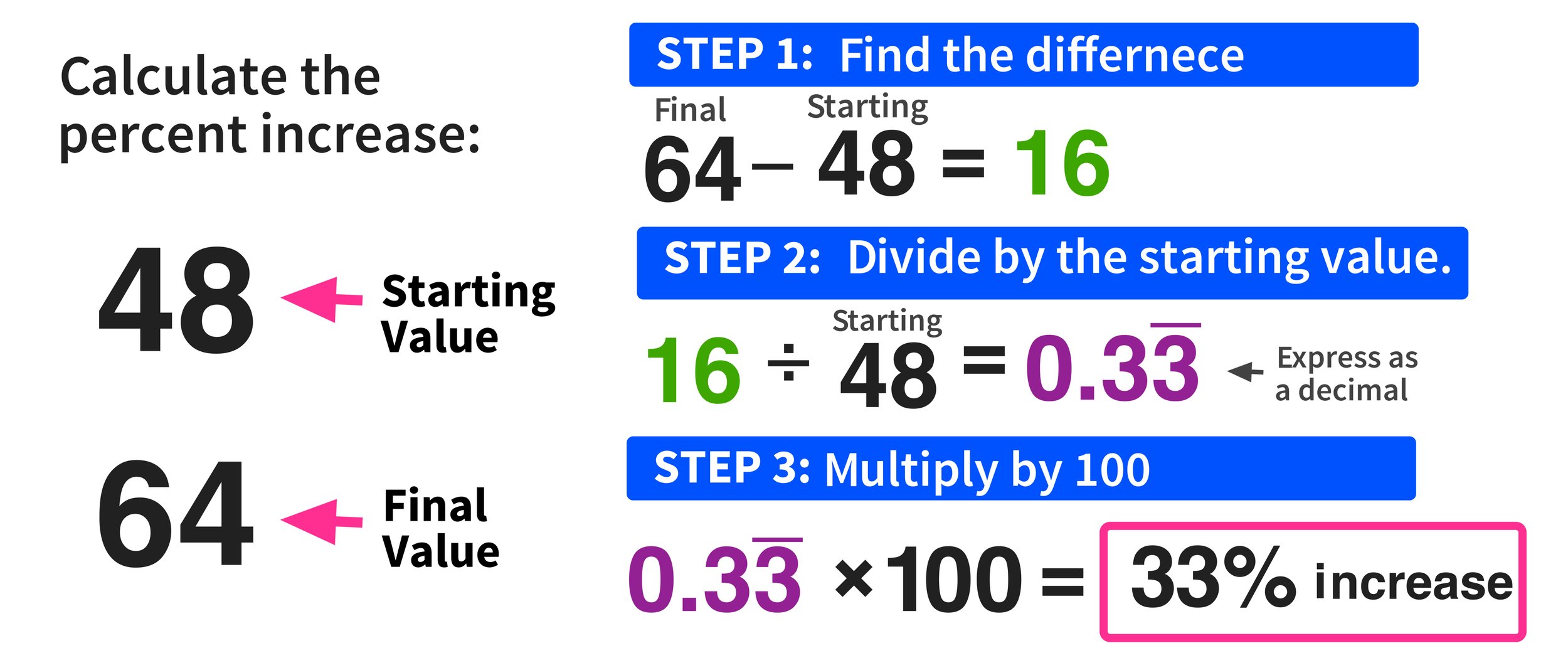
Calculating the percentage increase is a straightforward process once you understand the simple formula. It involves three key steps: finding the absolute difference, dividing it by the original number, and then multiplying by 100 to convert the decimal into a percentage.
Step-by-Step Calculation Guide
Here’s the universally accepted formula and how to apply it:
Formula:
Percentage Increase = ((Final Value - Initial Value) / Initial Value) * 100
Let’s break it down:
-
Find the Difference (Absolute Change): Subtract the initial value from the final value. This tells you how much the number has increased in absolute terms.
Difference = Final Value - Initial Value -
Divide by the Initial Value: Divide the difference you calculated in step 1 by the initial value. This gives you a decimal representing the proportionate increase.
Proportionate Increase = Difference / Initial Value -
Multiply by 100: To express this proportion as a percentage, multiply the result from step 2 by 100.
Percentage Increase = Proportionate Increase * 100
Example: If your savings account balance grew from $2,000 to $2,500.
-
Difference = $2,500 – $2,000 = $500
-
Proportionate Increase = $500 / $2,000 = 0.25
-
Percentage Increase = 0.25 * 100 = 25%
Your savings increased by 25%.
Practical Example: Investment Growth
Let’s apply this to a common financial scenario: tracking an investment.
Suppose you invested in a stock, and its price changed over time:
-
Initial Stock Price (Beginning of Year): $75.00
-
Final Stock Price (End of Year): $82.50
Here’s how to calculate the percentage increase in the stock’s value:
-
Calculate the Difference: $82.50 (Final Value) – $75.00 (Initial Value) = $7.50
-
Divide by the Initial Value: $7.50 / $75.00 = 0.10
-
Multiply by 100: 0.10 * 100 = 10%
The stock’s value increased by 10% over the year. This 10% figure is much more useful than just knowing it went up by $7.50, especially if you want to compare its performance to other investments or market indices.
Common Pitfalls and How to Avoid Them
While the formula is simple, a few common errors can lead to incorrect results:
-
Using the Final Value as the Divisor: A frequent mistake is dividing the difference by the final value instead of the initial value. Always remember that the percentage increase is calculated relative to the starting point.
-
Forgetting to Multiply by 100: The calculation
(Final - Initial) / Initialyields a decimal. To express it as a percentage, you must multiply by 100. -
Misidentifying Initial and Final Values: Ensure you correctly identify which number is the starting point (initial value) and which is the ending point (final value). If the final value is smaller than the initial value, you’re calculating a percentage decrease, which will result in a negative percentage using this formula.
Real-World Applications in Personal Finance
The ability to calculate percentage increase isn’t just an academic exercise; it’s a vital tool for managing and understanding your personal finances more effectively.
Tracking Your Investments and Savings
Monitoring the growth of your investments and savings is perhaps the most direct application. Whether it’s a retirement fund, a brokerage account, or a high-yield savings account, knowing the percentage increase helps you:
-
Evaluate Performance: Compare the growth of different investment vehicles or funds over specific periods. Did your mutual fund perform better than your individual stocks?
-
Assess Progress Towards Goals: Understand how quickly your savings are growing relative to your financial targets (e.g., down payment for a house, retirement nest egg).
-
Make Informed Decisions: If one investment consistently delivers a higher percentage increase than another with similar risk, it might influence your future investment choices.
Analyzing Income Growth and Salary Raises
Your income is one of your most significant financial assets. Tracking its percentage increase over time can reveal important trends:
-
Salary Negotiation: When discussing a raise, knowing the percentage increase you’ve received in previous years (or how much your industry peers have seen) can be a powerful negotiation tool. A 5% raise might sound good, but if inflation is 3% and your industry average is 7%, you’re still lagging.
-
Career Progression: Over the long term, monitoring your percentage income growth helps you assess your career trajectory and financial advancement.
-
Budgeting Adjustments: As your income increases, you can adjust your budget and savings goals proportionately.
Understanding Inflation’s Impact
Inflation, the general increase in prices and fall in the purchasing value of money, is often expressed as a percentage. Understanding how to calculate it (or interpret reported inflation rates) is crucial:
-
Real vs. Nominal Growth: If your salary increased by 3% but inflation was 4%, your “real” purchasing power actually decreased. Percentage increase calculations help you discern true growth after accounting for inflation.
-
Cost of Living: Track how the cost of essential goods and services (e.g., groceries, housing, healthcare) is increasing as a percentage, helping you anticipate future expenses and adjust your financial planning.
Evaluating Debt Reduction Progress
While primarily focused on “increase,” the same principles apply to understanding the rate of decrease or progress in debt reduction. By tracking how much your debt has decreased as a percentage of its original amount, you can:
-
Motivate Yourself: Seeing a significant percentage reduction in your credit card balance or mortgage principal can be highly motivating.
-
Assess Strategies: Evaluate the effectiveness of different debt reduction strategies (e.g., snowball vs. avalanche) by comparing their percentage impact over time.
Business Finance and Strategic Insights
For businesses, percentage increase is not just a metric; it’s a critical indicator of health, growth, and competitive standing. It informs strategic decisions, operational adjustments, and investor relations.
Measuring Revenue and Profit Growth
The most fundamental application in business finance is tracking revenue and profit growth.
-
Quarterly/Annual Reports: Companies regularly report percentage increases (or decreases) in revenue, gross profit, operating profit, and net profit. Investors and analysts scrutinize these figures to gauge performance.
-
Sales Performance: Sales teams use percentage increase to measure their success against targets and previous periods.
-
Product Line Performance: Management uses it to compare the growth of different product lines or services, informing resource allocation and marketing strategies. A 15% increase in a new product’s revenue is a strong signal for continued investment.
Assessing Cost Escalation
Just as important as revenue growth is monitoring cost increases.
-
Operating Expenses: Tracking the percentage increase in costs like raw materials, labor, and overhead helps businesses identify areas of efficiency or concern. A sudden 20% increase in a specific cost category might trigger an investigation into supply chain issues or market price volatility.
-
Budgeting and Forecasting: Understanding historical cost increases as percentages allows for more accurate future budgeting and forecasting, ensuring the business allocates sufficient funds to cover rising expenses.
Benchmarking Performance Against Competitors
Percentage increase is a powerful tool for competitive analysis.
-
Industry Standards: Businesses constantly compare their percentage revenue growth, profit margin increases, or market share gains against industry averages or direct competitors.
-
Identifying Strengths and Weaknesses: If a competitor announces a 25% increase in their customer base while your business only saw a 5% increase, it highlights an area for strategic review and improvement. Conversely, outperforming competitors can signal market leadership and effective strategies.
Leveraging Tools for Easier Calculations
While manual calculation is fundamental, in today’s digital age, various tools can automate and simplify the process, especially when dealing with large datasets or complex financial models.
Spreadsheet Software (Excel, Google Sheets)
Spreadsheets are the go-to tool for financial calculations for both individuals and businesses. They make it incredibly easy to calculate percentage increases.
-
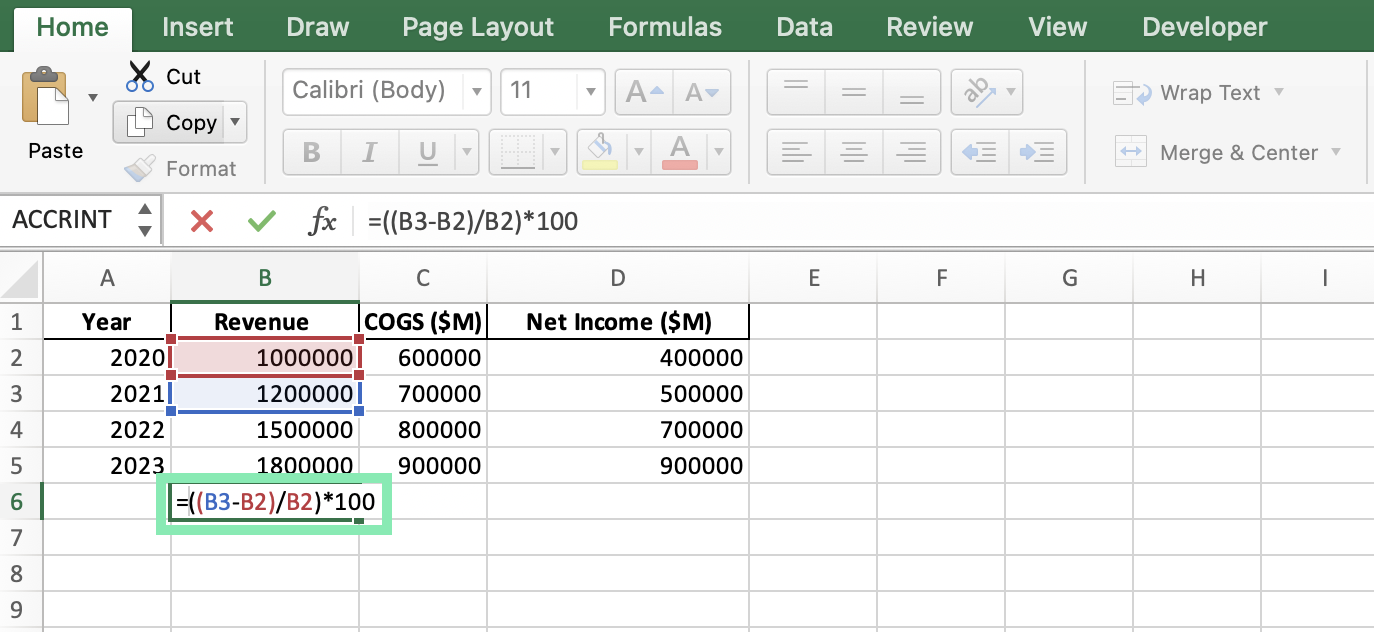
Formula Application: You can directly input the formula into a cell. For example, if your initial value is in cell A1 and your final value is in cell B1, the formula would be
=(B1-A1)/A1. To display it as a percentage, simply format the cell as a percentage. -
Data Analysis: Spreadsheets allow you to quickly apply this calculation across columns of data, tracking percentage increases for multiple investments, income streams, or expense categories over various periods.
-
Visualizations: Once calculated, these percentages can be easily used to create charts and graphs, providing clear visual representations of financial trends.
Online Calculators and Financial Apps
Numerous online percentage increase calculators and financial apps can perform this calculation instantly.
-
Quick Checks: For one-off calculations or quick verifications, these tools are highly convenient.
-
Integrated Finance Apps: Many personal finance apps (e.g., budgeting apps, investment trackers) have built-in functionalities that automatically calculate percentage changes for your assets, liabilities, and income, often presenting them in user-friendly dashboards.
-
Accessibility: They are readily available on smartphones and web browsers, offering on-the-go calculation capabilities.

Conclusion: Mastering the Metric for Financial Empowerment
The ability to calculate the percentage increase between two numbers is far more than a simple mathematical trick; it’s a cornerstone of financial literacy and a critical skill for anyone looking to navigate the complexities of personal wealth management and business operations. From evaluating investment returns and understanding the impact of inflation on your purchasing power, to analyzing business growth and benchmarking performance, percentage increase provides the essential relative context that absolute numbers often lack.
By mastering this fundamental calculation, you gain a powerful lens through which to view your financial world. It empowers you to make more informed decisions, identify meaningful trends, and ultimately, achieve greater financial insight and control. Whether you’re crunching numbers manually, utilizing a spreadsheet, or relying on automated financial tools, the core understanding of how and why to calculate percentage increase remains an invaluable asset in your financial toolkit. Embrace this metric, and unlock a deeper understanding of your financial journey.
aViewFromTheCave is a participant in the Amazon Services LLC Associates Program, an affiliate advertising program designed to provide a means for sites to earn advertising fees by advertising and linking to Amazon.com. Amazon, the Amazon logo, AmazonSupply, and the AmazonSupply logo are trademarks of Amazon.com, Inc. or its affiliates. As an Amazon Associate we earn affiliate commissions from qualifying purchases.