
For many retirees, Social Security forms the bedrock of their financial security. However, a common misconception among pre-retirees is that these benefits are entirely tax-free. While that was true until 1983, the current tax code mandates that a portion of Social Security benefits may be subject to federal income tax if your total income exceeds specific thresholds. Understanding how to calculate this taxable portion is essential for effective retirement planning and avoiding an unexpected bill from the IRS.
The process of determining how much of your benefit is taxable involves a unique metric known as “combined income” or “provisional income.” By mastering this calculation, you can better project your cash flow and implement strategies to minimize your tax liability throughout your golden years.
The Foundation: Understanding Combined Income
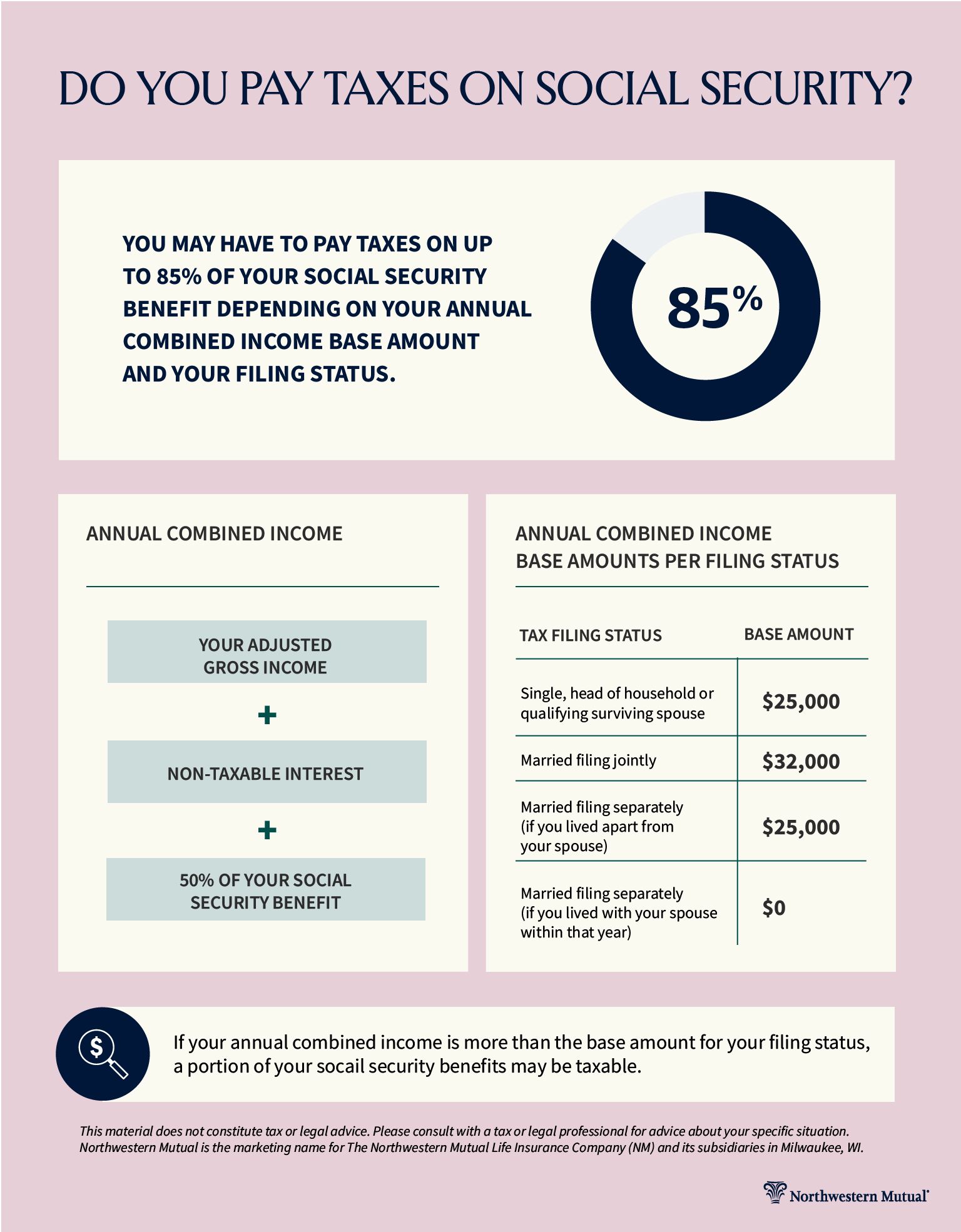
The IRS does not look solely at your Social Security check to determine taxability. Instead, they use a specific formula to calculate your combined income. This figure serves as the gatekeeper; if your combined income falls below the base amount for your filing status, none of your benefits are taxed. If it exceeds that amount, up to 50% or 85% of your benefits may be included in your taxable income.
The Calculation Formula
To find your combined income, you must aggregate three specific components:
-
Adjusted Gross Income (AGI): This includes your wages (if you are still working), taxable pensions, capital gains, interest, dividends, and distributions from traditional IRAs or 401(k)s.
-
Nontaxable Interest: Even if interest from municipal bonds is exempt from federal income tax, the IRS requires you to add it back in when calculating your Social Security taxability.
-
One-Half of Your Social Security Benefits: You only include 50% of the total Social Security benefits you received during the year.
Why Half of Social Security?
The decision to include only 50% of your benefits in the combined income calculation is a structural choice by the IRS to recognize that you paid into the system with after-tax dollars via FICA taxes during your working years. By adding only half of your benefits to your other income sources, the formula creates a “buffer” that protects lower-income retirees from being taxed on their benefits at all.
The Impact of Other Income Sources
It is important to note that distributions from Roth IRAs or Roth 401(k)s are generally not included in your AGI, and therefore do not count toward your combined income. This is one of the primary reasons financial advisors often recommend Roth accounts as a tool for managing taxes in retirement. Conversely, large required minimum distributions (RMDs) from traditional retirement accounts can significantly inflate your combined income, potentially pushing you into a higher tier of Social Security taxation.
IRS Thresholds and the Tiered Tax System
Once you have calculated your combined income, you must compare it against the IRS thresholds. These thresholds have remained stagnant for decades, meaning that as inflation rises and nominal incomes grow, more retirees find themselves crossing these lines.
Thresholds for Individual Filers
If you file your federal tax return as an individual (Single, Head of Household, or Qualifying Surviving Spouse), the tiers are as follows:
-
Below $25,000: Your Social Security benefits are generally not taxable.
-
Between $25,000 and $34,000: You may have to pay income tax on up to 50% of your benefits.
-
More than $34,000: Up to 85% of your benefits may be taxable.
Thresholds for Married Couples Filing Jointly
For couples filing a joint return, the thresholds are slightly higher, though they do not double the individual limits:
-
Below $32,000: Benefits are generally not taxable.
-
Between $32,000 and $44,000: You may have to pay income tax on up to 50% of your benefits.
-
More than $44,000: Up to 85% of your benefits may be taxable.
The Married Filing Separately Exception
The IRS treats married couples who live together but file separate returns very strictly. In most cases, if you lived with your spouse at any time during the year and file separately, the threshold is $0. This means that from the very first dollar of income, 85% of your Social Security benefits will likely be subject to tax. This is a critical consideration for couples weighing the benefits of separate filing.
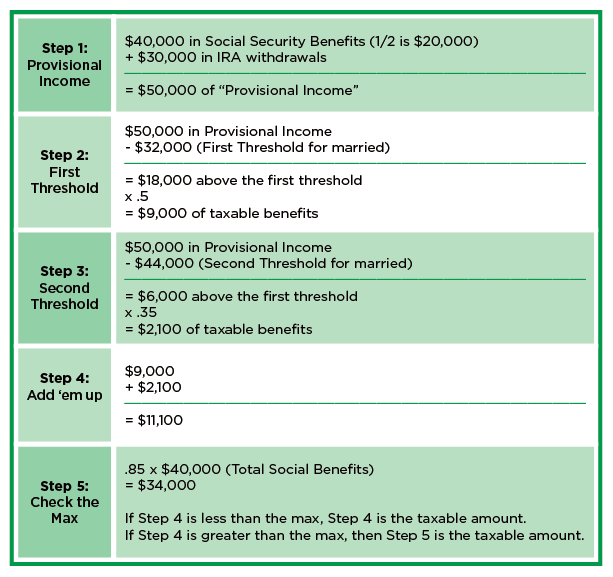
A Step-by-Step Calculation Example
To visualize how this works, let’s look at a hypothetical scenario. Consider a married couple, Susan and Robert, who file jointly.
-
They receive $30,000 in total Social Security benefits.
-
They have $35,000 in taxable income from a pension and part-time work.
-
They earned $1,000 in tax-exempt municipal bond interest.

Step 1: Determine Combined Income
First, we take their AGI ($35,000), add their tax-exempt interest ($1,000), and add half of their Social Security benefits ($15,000).
$35,000 + $1,000 + $15,000 = $51,000.
Step 2: Compare to Thresholds
Since their combined income of $51,000 is greater than $44,000, they fall into the highest tier, where up to 85% of their benefits could be taxable.
Step 3: The Multi-Step Math
The actual calculation of the taxable amount is a bit more complex than simply multiplying $30,000 by 85%. The IRS uses a worksheet to determine the lesser of several calculations. For this couple, the taxable amount would be the lesser of:
-
85% of their Social Security benefits ($25,500).
-
The sum of 85% of the amount over $44,000 plus the smaller of $6,000 or 50% of the benefits.
In most cases where income is significantly above the $44,000 mark, retirees will find that exactly 85% of their benefits are added to their taxable income. It is vital to remember that “85% taxable” does not mean the government takes 85% of your check. It means that 85% of the benefit is treated as ordinary income and taxed at your marginal tax rate (e.g., 10%, 12%, or 22%).
Strategies to Manage and Minimize Liability
If you find that your Social Security benefits are being taxed at the 85% level, there are several financial tools and strategies you can use to lower your combined income and keep more of your money.
Roth Conversions
By converting traditional IRA funds into a Roth IRA before you begin taking Social Security, you pay the taxes upfront. Once you enter retirement, withdrawals from the Roth IRA do not count toward your AGI. This can keep your combined income below the $25,000 or $32,000 thresholds, potentially rendering your Social Security benefits completely tax-free.
Qualified Charitable Distributions (QCDs)
For those over age 70½, a QCD allows you to transfer up to $105,000 per year directly from your traditional IRA to a qualified charity. This distribution satisfies your RMD requirement but is excluded from your AGI. Because it isn’t part of your AGI, it doesn’t count toward the combined income formula, which can be a powerful way to stay under the Social Security tax thresholds.
Managing Capital Gains and Losses
If you need to sell assets in a taxable brokerage account, be mindful of the timing. Realizing a large capital gain in a single year can spike your AGI and trigger the 85% taxability tier for your Social Security. Conversely, using tax-loss harvesting to offset gains can lower your AGI and help protect your benefits from taxation.
Strategic Withdrawal Sequencing
The order in which you tap your accounts matters. Using taxable accounts first, followed by tax-deferred accounts, and saving tax-free Roth accounts for later in retirement can help you control your AGI. By managing the “income faucet,” you can ensure that your combined income stays within a range that minimizes the percentage of Social Security benefits subject to tax.
Reporting and Compliance
When tax season arrives, you will receive Form SSA-1099 from the Social Security Administration. This form shows the total amount of benefits you received in the previous year. You will use this form, along with the Social Security Benefits Worksheet in the instructions for Form 1040, to report the taxable portion on your tax return.
State-Level Taxation
While this guide focuses on federal taxes, it is important to remember that state laws vary significantly. As of the current tax year, the majority of states do not tax Social Security benefits. However, about a dozen states still impose some form of tax on benefits, though many offer exemptions based on age or income level. Always check the specific regulations in your state of residence to ensure full compliance and accurate budgeting.
Voluntary Withholding
If you know your benefits will be taxable, you can avoid a large year-end tax bill by requesting voluntary federal income tax withholding from your monthly Social Security checks. You can do this by filing Form W-4V with the Social Security Administration. You can choose to have 7%, 10%, 12%, or 22% of your total benefit amount withheld for federal taxes. This is a “set it and forget it” way to manage your tax liability and ensure that you aren’t caught off guard by the IRS.
By understanding the mechanics of the combined income formula and the tiered threshold system, you can move from a reactive stance to a proactive one. Retirement planning is not just about how much you save, but how much you keep after the IRS takes its share. Proper calculation and strategic management of your taxable Social Security benefits are essential steps toward a more secure and predictable financial future.
aViewFromTheCave is a participant in the Amazon Services LLC Associates Program, an affiliate advertising program designed to provide a means for sites to earn advertising fees by advertising and linking to Amazon.com. Amazon, the Amazon logo, AmazonSupply, and the AmazonSupply logo are trademarks of Amazon.com, Inc. or its affiliates. As an Amazon Associate we earn affiliate commissions from qualifying purchases.