
Understanding how Social Security benefits are taxed is a critical component of retirement financial planning. For many retirees, their Social Security income forms a significant part of their financial foundation, and knowing how it interacts with other income sources can significantly impact their overall tax liability. Unlike common misconceptions, Social Security benefits are not universally tax-free; a portion of them can become taxable if your total income exceeds certain thresholds. This guide delves into the specifics of these calculations, empowering you to navigate the complexities of Social Security taxation.
Understanding Social Security Taxation Basics
When the Social Security Act was initially passed, benefits were entirely tax-free. However, this changed in 1983 when amendments introduced taxation for higher-income beneficiaries. Further legislation in 1993 expanded the scope, leading to the current system where up to 85% of benefits can be subject to federal income tax.
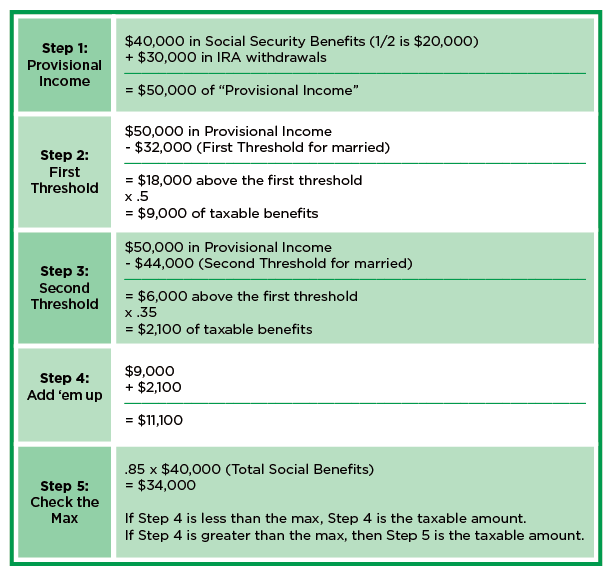
The key to understanding Social Security taxation lies in recognizing that it’s not the Social Security benefit itself that is directly taxed. Instead, it’s a portion of your benefits that gets added to your other taxable income, potentially increasing your adjusted gross income (AGI) and overall tax bill. The amount subject to tax is determined by a figure the IRS calls “provisional income.”
Who is Affected?
Generally, individuals with low to moderate income who rely primarily on Social Security for their living expenses will not pay federal income tax on their benefits. The taxation thresholds are designed to impact those with other substantial sources of income during retirement, such as pensions, withdrawals from traditional IRAs or 401(k)s, interest, dividends, and wages. If your only income is Social Security, it’s highly unlikely your benefits will be taxed.
The determination of whether your benefits are taxable, and to what extent, hinges entirely on your “provisional income” and your tax filing status. This makes calculating provisional income the first and most crucial step in understanding your Social Security tax liability.
The Provisional Income Calculation
The concept of “provisional income” is central to determining how much of your Social Security benefits will be subject to federal income tax. It’s a specific calculation used by the IRS solely for this purpose and differs from your standard Adjusted Gross Income (AGI).
What is Provisional Income?
Provisional income is the sum of your:
-
Adjusted Gross Income (AGI) excluding your Social Security benefits, certain passive activity losses, foreign earned income exclusion, and other minor exclusions.
-
Tax-exempt interest income (e.g., interest from municipal bonds).
-
One-half (50%) of your Social Security benefits.
Let’s break down each component in more detail to ensure clarity:
Components of Provisional Income
-
Adjusted Gross Income (AGI): This is your gross income minus certain above-the-line deductions. For the purpose of calculating provisional income, you’ll start with your AGI before considering Social Security benefits. This includes income from wages, salaries, self-employment, interest, dividends, capital gains, pensions, annuities, and distributions from traditional IRAs or 401(k)s. Deductions that reduce AGI include contributions to traditional IRAs, student loan interest, and self-employment tax deductions, among others.
- Example: If your AGI from pensions, interest, and dividends is $20,000, that’s your starting point.
-
Tax-Exempt Interest Income: This refers to interest earned from certain investments that are not subject to federal income tax, most commonly municipal bonds (state and local bonds). While this income isn’t taxed directly, the IRS includes it in your provisional income calculation to prevent higher-income individuals from sheltering significant portions of their earnings while still receiving tax-free Social Security benefits.
- Example: If you earned $2,000 in tax-exempt interest from municipal bonds, this amount is added to your provisional income calculation.
-
One-Half (50%) of Your Social Security Benefits: This is a specific provision for the provisional income calculation. You only include half of your total annual Social Security benefits received. It’s important to note that this does not mean only 50% of your benefits will be taxed; it’s simply a step in the calculation to determine the threshold for taxation.
- Example: If you received $18,000 in Social Security benefits for the year, you would include $9,000 (50% of $18,000) in your provisional income calculation.
Putting It Together: A Provisional Income Example
Let’s assume you are a single filer with the following income for the year:
-
Pension income: $15,000
-
Taxable interest and dividends: $3,000
-
Tax-exempt municipal bond interest: $2,000
-
Annual Social Security benefits: $18,000
Your provisional income would be calculated as follows:
-
AGI (from pension, interest/dividends): $15,000 + $3,000 = $18,000
-
Add tax-exempt interest: $18,000 + $2,000 = $20,000
-
Add one-half of Social Security benefits: $20,000 + ($18,000 * 0.50) = $20,000 + $9,000 = $29,000
Your provisional income for the year is $29,000. This is the figure that will be used to determine how much, if any, of your Social Security benefits are taxable.
Taxation Tiers: How Much is Taxed?
Once you have calculated your provisional income, the next step is to apply it to the IRS’s two-tiered system for Social Security taxation. The percentage of your benefits that become taxable depends on your filing status and whether your provisional income exceeds specific thresholds.
It’s crucial to understand that “up to 50%” or “up to 85%” does not mean that percentage of your total benefits is automatically taxed. Instead, it refers to the maximum portion of your benefits that could be included in your taxable income. The actual taxable amount is the lesser of a specific calculated figure or the percentage threshold.
For Single, Head of Household, or Qualifying Widow(er) Filers:
-
Tier 1: Provisional income between $25,000 and $34,000
-
If your provisional income falls within this range, up to 50% of your Social Security benefits may be taxable. The taxable amount is the lesser of:
-
50% of your Social Security benefits, OR
-
50% of the amount by which your provisional income exceeds $25,000.
-
-
Example: Single filer with $29,000 provisional income and $18,000 in annual Social Security benefits (from previous example).
-
Provisional income exceeds $25,000 by: $29,000 – $25,000 = $4,000
-
50% of this excess: $4,000 * 0.50 = $2,000
-
50% of total Social Security benefits: $18,000 * 0.50 = $9,000
-
The taxable portion of Social Security is the lesser of $2,000 and $9,000. Therefore, $2,000 of your Social Security benefits will be added to your taxable income.
-
-
-
Tier 2: Provisional income above $34,000
-
If your provisional income exceeds $34,000, up to 85% of your Social Security benefits may be taxable. The taxable amount is the lesser of:
-
85% of your Social Security benefits, OR
-
The sum of $4,500 (which is 50% of the $9,000 difference between $25,000 and $34,000) PLUS 85% of the amount by which your provisional income exceeds $34,000.
-
-

*   *Example:* Single filer with $38,000 provisional income and $18,000 in annual Social Security benefits.


    *   First part of the calculation: $4,500


    *   Provisional income exceeds $34,000 by: $38,000 - $34,000 = $4,000


    *   85% of this excess: $4,000 * 0.85 = $3,400


    *   Total calculated amount: $4,500 + $3,400 = $7,900


    *   85% of total Social Security benefits: $18,000 * 0.85 = $15,300


    *   The taxable portion of Social Security is the lesser of $7,900 and $15,300. Therefore, $7,900 of your Social Security benefits will be added to your taxable income.
For Married Filing Jointly:
-
Tier 1: Provisional income between $32,000 and $44,000
-
If your provisional income falls within this range, up to 50% of your Social Security benefits may be taxable. The taxable amount is the lesser of:
-
50% of your combined Social Security benefits, OR
-
50% of the amount by which your provisional income exceeds $32,000.
-
-
Example: Married couple with $38,000 provisional income and $30,000 in combined annual Social Security benefits.
-
Provisional income exceeds $32,000 by: $38,000 – $32,000 = $6,000
-
50% of this excess: $6,000 * 0.50 = $3,000
-
50% of total Social Security benefits: $30,000 * 0.50 = $15,000
-
The taxable portion is the lesser of $3,000 and $15,000. Therefore, $3,000 of your Social Security benefits will be added to your taxable income.
-
-
-
Tier 2: Provisional income above $44,000
-
If your provisional income exceeds $44,000, up to 85% of your Social Security benefits may be taxable. The taxable amount is the lesser of:
-
85% of your combined Social Security benefits, OR
-
The sum of $6,000 (which is 50% of the $12,000 difference between $32,000 and $44,000) PLUS 85% of the amount by which your provisional income exceeds $44,000.
-
-
Example: Married couple with $50,000 provisional income and $30,000 in combined annual Social Security benefits.
-
First part of the calculation: $6,000
-
Provisional income exceeds $44,000 by: $50,000 – $44,000 = $6,000
-
85% of this excess: $6,000 * 0.85 = $5,100
-
Total calculated amount: $6,000 + $5,100 = $11,100
-
85% of total Social Security benefits: $30,000 * 0.85 = $25,500
-
The taxable portion is the lesser of $11,100 and $25,500. Therefore, $11,100 of your Social Security benefits will be added to your taxable income.
-
-
Married Filing Separately: If you are married filing separately and lived with your spouse at any time during the year, 85% of your Social Security benefits are generally taxable, regardless of your income. If you lived apart from your spouse for the entire year, you use the single filer thresholds.
Strategies to Potentially Reduce Social Security Taxation
While you cannot avoid Social Security taxes if your income exceeds the thresholds, strategic financial planning can often help manage your provisional income and potentially reduce the amount of your benefits subject to tax. The core idea is to lower your Adjusted Gross Income (AGI) or manage the timing of income.
Managing AGI Through Retirement Account Withdrawals
Since AGI is a major component of provisional income, strategies that control or reduce your AGI can be highly effective.
-
Qualified Charitable Distributions (QCDs): If you are age 70½ or older and have a Traditional IRA, you can make a QCD directly from your IRA to an eligible charity. These distributions count towards your Required Minimum Distributions (RMDs) but are excluded from your AGI. This means they satisfy your RMD without increasing your provisional income, a significant benefit for managing Social Security taxation.
-
Strategic Roth Conversions: This strategy requires careful planning, often years before Social Security benefits begin. By converting a Traditional IRA or 401(k) to a Roth IRA, you pay taxes on the converted amount in the year of conversion. While this increases your AGI in the conversion year, future withdrawals from the Roth IRA (after meeting certain conditions) are tax-free and do not count towards provisional income. This “pays the tax now” approach can result in lower provisional income and less taxable Social Security benefits later in retirement.
-
Phased Withdrawals: Diversify your retirement savings across different account types: taxable brokerage accounts, tax-deferred accounts (Traditional IRA/401k), and tax-free accounts (Roth IRA/401k). By strategically withdrawing from these accounts, you can manage your AGI. For instance, in years where you might otherwise hit a higher Social Security tax threshold, you could prioritize withdrawals from your Roth accounts, as these are tax-free and do not affect your AGI or provisional income.
Investment Choices
-
Tax-Advantaged Investments: While municipal bond interest is included in provisional income, it remains federally tax-exempt. For some, this can still be a beneficial investment, especially in higher tax brackets.
-
Roth Accounts for Growth: Contributions to a Roth IRA or 401(k) are made with after-tax dollars, allowing qualified withdrawals in retirement to be tax-free. As mentioned, these tax-free withdrawals do not increase your AGI or provisional income, making Roth accounts excellent tools for managing future Social Security taxation.
Timing of Income
-
Delaying Social Security Benefits: While delaying benefits primarily aims to increase your monthly payout, it can also play a role in tax planning. If you continue working or have substantial income from other sources in your early retirement years, delaying Social Security can keep your provisional income lower in those years. However, this is a complex decision that should be weighed against your overall financial needs.
-
Harvesting Capital Gains/Losses: Strategically realizing capital gains in years when your provisional income is otherwise low can prevent pushing more Social Security benefits into taxation in other years. Conversely, realizing capital losses can offset other taxable income, reducing your AGI.
Navigating these strategies effectively often requires a holistic view of your financial situation. Consulting with a qualified financial advisor or tax professional is highly recommended to tailor a plan that aligns with your specific retirement goals and income sources. They can provide personalized advice on how these strategies might impact your particular tax situation and overall financial well-being.
Reporting Social Security Income on Your Tax Return
Calculating the taxable portion of your Social Security benefits is one thing; accurately reporting it on your federal income tax return is another. Fortunately, the process is streamlined thanks to the Social Security Administration (SSA) and modern tax software.
Form SSA-1099
Each January, the SSA sends out Form SSA-1099, “Social Security Benefit Statement,” to all beneficiaries. This crucial document details the total amount of Social Security benefits you received in the prior year.
-
Box 3 of Form SSA-1099 shows the “Net Benefits” for the year, which is the amount you will use to calculate your provisional income and subsequently, the taxable portion of your benefits.
-
The form also shows any amounts you may have repaid to Social Security (Box 4) and any federal income tax you elected to have withheld (Box 5).
Keep this form with your other important tax documents, such as W-2s and 1099-Rs.
Reporting on IRS Form 1040
When you prepare your federal income tax return, the information from your SSA-1099 is entered on IRS Form 1040.
-
Lines related to Social Security benefits are typically found towards the bottom of the first page of Form 1040.
-
You will enter your total Social Security benefits received (from Box 3 of SSA-1099).
-
Then, after calculating the taxable portion using the provisional income method, you will enter that taxable amount.
-
The difference between the total benefits received and the taxable amount is the portion that remains tax-free.
Most tax software programs will guide you through this process automatically. You simply enter the figures from your SSA-1099, and the software performs the provisional income calculation and determines the taxable portion of your benefits for you. If you work with a tax professional, they will handle this calculation and reporting.
Withholding Federal Income Tax
You have the option to have federal income tax withheld from your Social Security benefits. This can be a useful strategy to avoid a large tax bill at the end of the year, especially if you anticipate your benefits will be taxable. To request this, you would file Form W-4V, Voluntary Withholding Request, with the Social Security Administration. On this form, you can elect to have 7%, 10%, 12%, or 22% of your monthly benefit withheld for federal taxes. This is an excellent way to manage cash flow and prevent underpayment penalties.
Understanding how to calculate and report tax on your Social Security benefits is an essential part of effective retirement financial management. By proactively planning and staying informed, you can make educated decisions that help optimize your tax situation and secure your financial future.
aViewFromTheCave is a participant in the Amazon Services LLC Associates Program, an affiliate advertising program designed to provide a means for sites to earn advertising fees by advertising and linking to Amazon.com. Amazon, the Amazon logo, AmazonSupply, and the AmazonSupply logo are trademarks of Amazon.com, Inc. or its affiliates. As an Amazon Associate we earn affiliate commissions from qualifying purchases.